⚡ In short
Around the world, undersea kelp forests are being devoured by sea urchins and turning into bare 'urchin barrens'. Northern California lost about 95% of its bull kelp in five years, and Japan's seaweed beds shrank by roughly 30% in two decades. This article explains the mechanism, the causes, and restoration efforts such as urchin ranching.
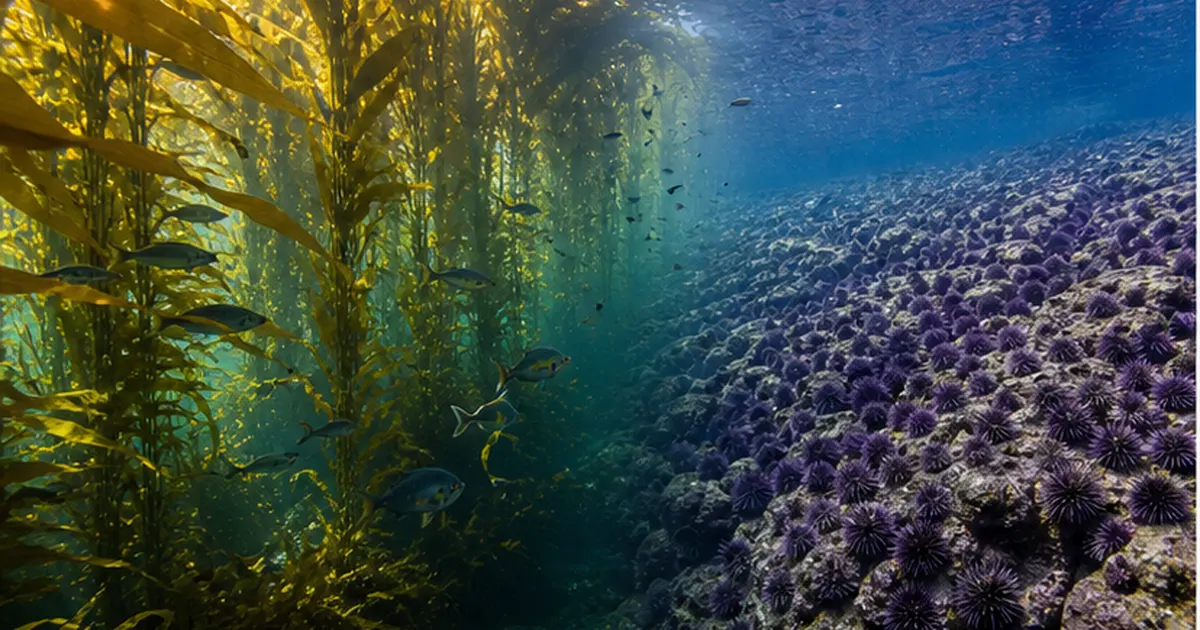
There are forests in the sea. Giant seaweeds tens of meters tall grow in dense stands, sheltering fish, abalone and even sea otters - these are kelp forests. Yet today, across the globe, these underwater forests are being devoured by sea urchins and reduced to "urchin barrens": bare rock crowded with nothing but urchins.
Off northern California, about 95% of the bull kelp forest vanished in just five years from 2014. In Tasmania, Australia, roughly 95% of the giant kelp beds have been lost. In Japan the same phenomenon is called "isoyake", and the decline of kombu and arame beds continues to batter coastal fisheries.
Why do ocean forests collapse so suddenly? Why can urchins stay put even after eating everything? This article walks through the science of urchin barrens, the situation around the world and in Japan, and the frontline of restoration - the movement to "catch, ranch and eat" the urchins to bring the forests back - based on primary sources.
What you will learn in this article
- What kelp forests are and why they are called 'rainforests of the sea'
- How urchin barrens (isoyake) form, and why starving urchins refuse to die
- Real-world collapses in California, Tasmania and Norway
- The state of isoyake in Japan and countermeasures under the Fisheries Agency guideline
- How 'urchin ranching' turns worthless empty urchins into premium seafood
- Seaweed-bed restoration, blue carbon, and what consumers can do
What Is a Kelp Forest? The 'Rainforest of the Sea'
Kelp is the collective name for large brown algae of the order Laminariales. Anchored to cold, nutrient-rich rocky seabeds by root-like holdfasts, kelps extend their stipes and blades toward the surface, building three-dimensional 'underwater forests'. The kombu, arame and kajime so familiar in Japan all belong to this group.
Kelp forests fringe cold-temperate and subpolar coasts worldwide: the Pacific coast of North America, Chile and other South American shores, southern Australia and Tasmania, Norway and northern Europe, and northern Japan. While tropical coral reefs are called the 'rainforests of the sea', kelp forests are the centers of biodiversity in cold waters - the temperate and polar counterpart of those rainforests.
Along Japan's coasts stretch kombu beds in Hokkaido and Tohoku, arame and kajime beds from Honshu to Kyushu, and garamo beds of sargassum - a rich mosaic of seaweed forests. The kombu that underpins dashi culture, and the wakame and hijiki on every table, are all gifts of these forests. Few peoples have lived as closely with seaweed forests as the Japanese - which is why isoyake is also a crisis for Japan's food culture.
The World's Largest Seaweed Grows 50 cm a Day
One star of the kelp forest, giant kelp (Macrocystis pyrifera), reaches more than 50 m in length - the largest seaweed on Earth. Gas-filled floats at the base of each blade lift it straight from the seabed to the surface. Its growth is astonishing: under good conditions it is said to grow around 50 cm in a single day, faster than any land plant, raising a canopied forest in the sea.
A kelp's body consists of a holdfast gripping the rock, a stem-like stipe and leaf-like blades. Unlike land plants it does not draw nutrients through roots: it absorbs dissolved nutrients across its entire surface. That is why kelp can grow explosively where upwelling delivers cold, nutrient-rich water - and why it withers quickly when waters warm and nutrients thin out.
The canopy spreading at the surface, the mid-water grove of stipes, the understory of juveniles and low-growing algae - a kelp forest is layered just like a forest on land, and each layer hosts different creatures. Fish cruise between the stipes, abalone and urchins wait on the bottom for drifting fragments of kelp, and sea otters doze wrapped in the canopy. A single seaweed forms the foundation of an entire ecosystem.
An Ecosystem Worth Some $500 Billion a Year
An international study published in Nature Communications in 2023 (Eger et al.) produced the first comprehensive estimate of the value generated by the world's kelp forests. Counting just three ecosystem services - supporting fisheries, absorbing nitrogen pollution and fixing carbon - their value comes to $465-562 billion per year (about $500 billion on average), equivalent to as much as $111,000 per hectare per year.
- A cradle for seafood - spawning grounds and nurseries for fish, and habitat for abalone, sea urchins and lobsters
- Water purification - absorbing nitrogen and other nutrients flowing from land, buffering eutrophication
- Carbon uptake - fixing CO2 through photosynthesis, part of which is exported and stored in the deep sea (blue carbon)
- Wave attenuation - dense fronds sap wave energy and protect shorelines
- Tourism and culture - diving, seaweed cuisine and local economies
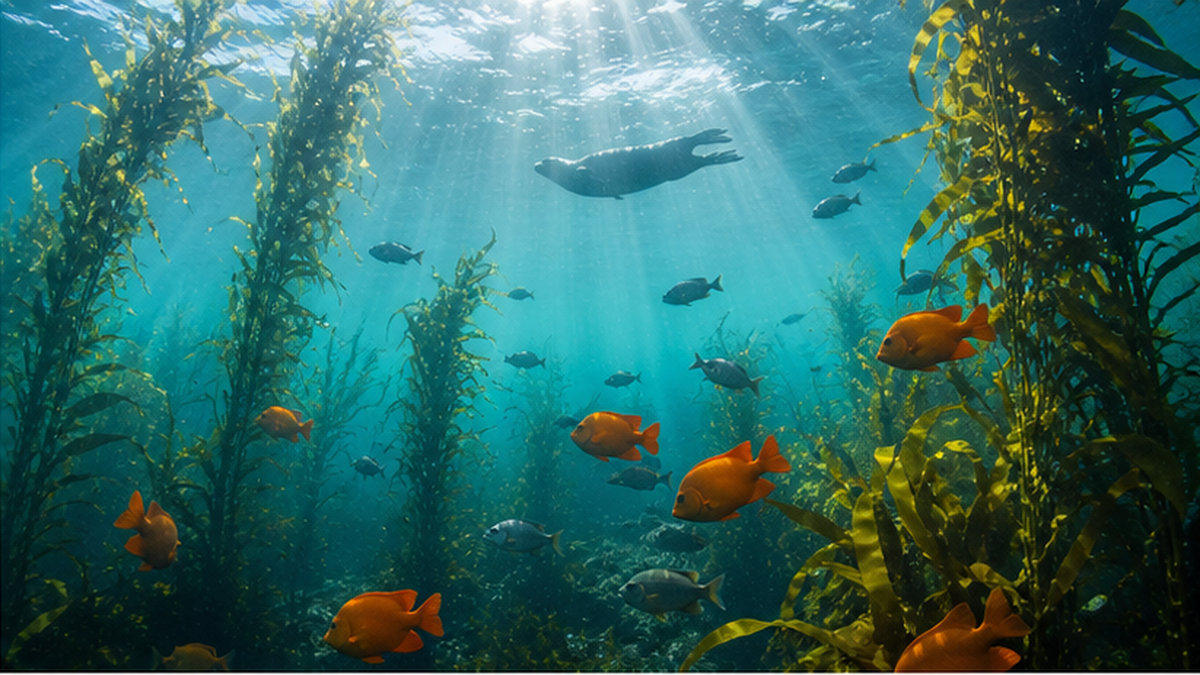
Kelp Forest Basics
- Kelp = large brown algae of the order Laminariales; Japan's kombu, arame and kajime are members
- Giant kelp exceeds 50 m in length and can grow about 50 cm per day - the world's largest seaweed
- Fisheries, nitrogen removal and carbon fixation are valued at about $500 billion per year globally
What Is an Urchin Barren? How a Forest Becomes a Desert
An urchin barren is a stretch of bare seabed where exploding urchin populations have devoured the seaweed, leaving nothing but rock and urchins. In Japan the phenomenon is called 'isoyake', and the urchin-driven form is also known as 'uni-yake'. The Fisheries Agency's Isoyake Countermeasure Guideline defines it as follows.
A phenomenon in which seaweed communities (seaweed beds) on shallow rocky and boulder seabeds decline or disappear markedly, beyond seasonal fluctuation and ordinary year-to-year variation, leaving an impoverished vegetation state
― Fisheries Agency of Japan, 'Isoyake Countermeasure Guideline'
When seaweed beds vanish, the fish and shellfish that fed and sheltered there disappear, and the coastal fisheries that depend on them founder. Isoyake is not a mere change of scenery: it is 'desertification of the sea' that uproots coastal ecosystems and local economies alike.
'Isoyake' Has Been Known Since the Meiji Era
Isoyake is by no means new. The word itself is said to appear in Meiji-era records describing the loss of seaweed stands off the Izu Peninsula. What has changed is scale and persistence: barrens that were once local and temporary now spread widely, last longer and lock in without recovering, in oceans around the world. Because global-scale ocean change lies behind this shift, isoyake is drawing renewed attention as a modern marine environmental problem.
Why Only the Urchins Survive: Astonishing Starvation Tolerance
The puzzle is that urchins do not die even after eating their food source to nothing. Urchins are extremely tolerant of starvation: they slow their metabolism and survive long periods with almost no food. A starved urchin's gonads - the part we eat - shrivel away, making it worthless to fisheries, yet the animal itself lives on. And every time a new seaweed sprout appears, the waiting urchins mow it down. The seeds of recovery are clipped again and again.
Once Broken, Hard to Mend: Two Stable States
Research from the University of California, Santa Cruz and others shows that when kelp is abundant, urchins hide in crevices and passively feed on drifting kelp fragments. When that drift supply dwindles, they emerge and roam, actively grazing living kelp. This behavioral switch is one trigger of the abrupt flip from forest to barren.
Ecologists regard kelp forest and urchin barren as two alternative stable states of the same reef. While the forest stands, it can tolerate a fair number of urchins; but once a threshold is crossed and the reef tips into a barren, it will not return unless urchin numbers are cut drastically. The path back demands different conditions than the path in - this 'hysteresis' is the core reason isoyake is so hard to reverse.
The practical lesson: protecting a forest before it collapses is far cheaper than repairing it afterward. On reefs already turned to barrens, the key is to slash urchin density while mother plants - the seed source - still survive nearby. The longer one waits, the thinner the seed supply, and the higher the hurdle to recovery.
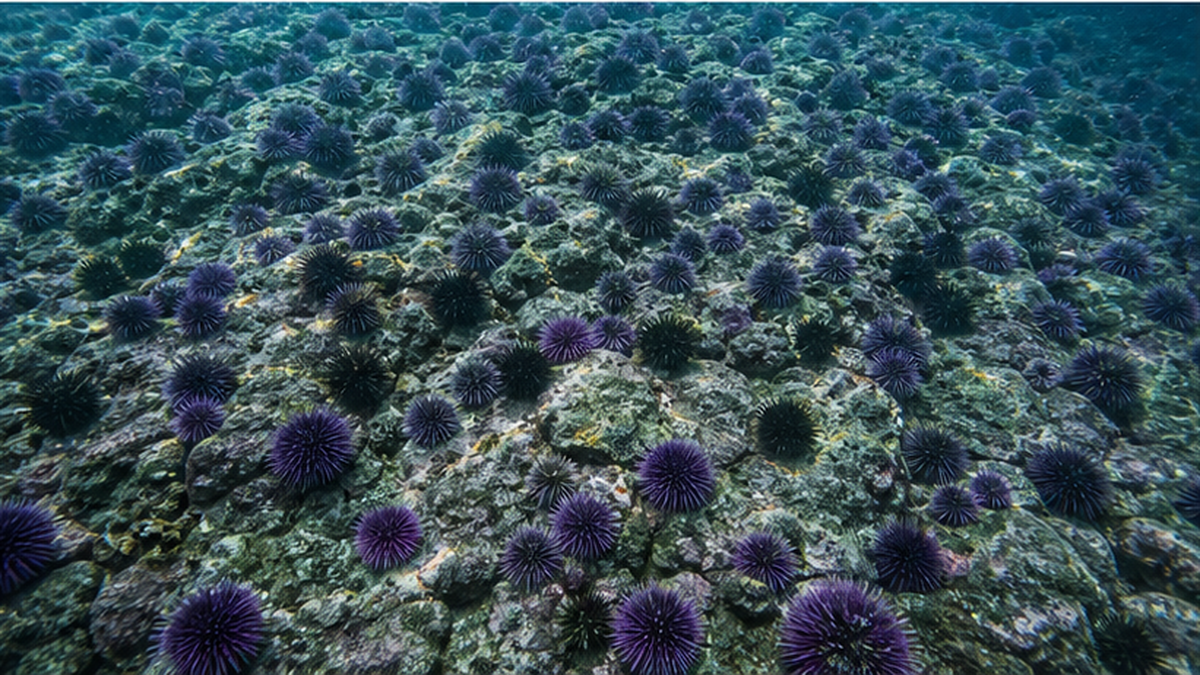
The Three Faces of Isoyake
- Urchin grazing - overgrown urchin populations; the main driver in northern Japan, North America and Australia
- Fish grazing - herbivorous fish such as rabbitfish; worsening in southern Japan with warming
- Environmental change - high temperatures, nutrient scarcity and turbidity weakening the seaweed itself
The Triggers: Lost Predators and a Warming Ocean
In a healthy sea, predators keep urchin numbers in check and seaweed beds coexist with urchins. Behind the rise of urchin barrens lie two great changes: the loss of those regulators (predators) and rising sea temperatures.
The Forest's Guardians Have Vanished
In the North Pacific, sea otters long protected kelp beds as the urchin's nemesis. Where otters were wiped out by the fur trade, urchins exploded and kelp forests disappeared (see our article on why the sea otter is a 'keystone of the sea'). Sunflower sea stars, large fish such as cod, and spiny and clawed lobsters are likewise key urchin predators, and seas that lost predators to disease or overfishing are where barrens spread most readily - a pattern confirmed worldwide.
Marine Heatwaves Deliver the Final Blow
Warming corners seaweed beds in two ways. High temperatures and nutrient scarcity directly stunt and kill cold-water kelps such as kombu. At the same time, warmer water makes urchins and herbivorous fish more active and hungrier. The result is the worst possible combination: a weakened forest set upon by grazers with sharpened appetites. In recent years, marine heatwaves - abnormal warm spells lasting weeks to months - have struck oceans everywhere, triggering forest collapse.
In Japan, Grazing Fish Add to the Damage
In southern Japan, beyond urchins, herbivorous fishes - rabbitfish (aigo), sea chubs (isuzumi) and parrotfish - inflict serious damage. As winters fail to cool, these fish now graze actively year-round and are expanding northward. The Fisheries Agency guideline devotes as much attention to the biology and removal of herbivorous fish as it does to urchins.
Not a Lone Culprit but a Conspiracy
Crucially, isoyake has no single cause. In each sea area, urchins, fish, temperature, nutrients, turbidity and predators combine differently. That is why the guideline puts 'diagnose the cause in your own waters first' at the top of the workflow. Sow seaweed seed where urchins rule and it will simply be eaten; cull urchins where heat is the killer and the forest still will not return. Diagnosis is the starting point of every countermeasure.
An often-overlooked factor is changing nutrient supply. Seaweeds grow on dissolved nitrogen and phosphorus, so when warm nutrient-poor currents strengthen or stratification cuts off deep-water nutrients, kelp starves even without a single urchin. Heat, nutrient scarcity and grazing intertwine, and which dominates differs from coast to coast.
- Loss of predators - fewer sea otters, sea stars, large fish and lobsters lets urchins multiply
- Marine heatwaves and warming - weakening kelp while sharpening grazers' appetites
- Chains of overfishing - depleting the very species that kept urchins in check
- Coastal change - declining nutrients and increasing turbidity hindering seaweed growth
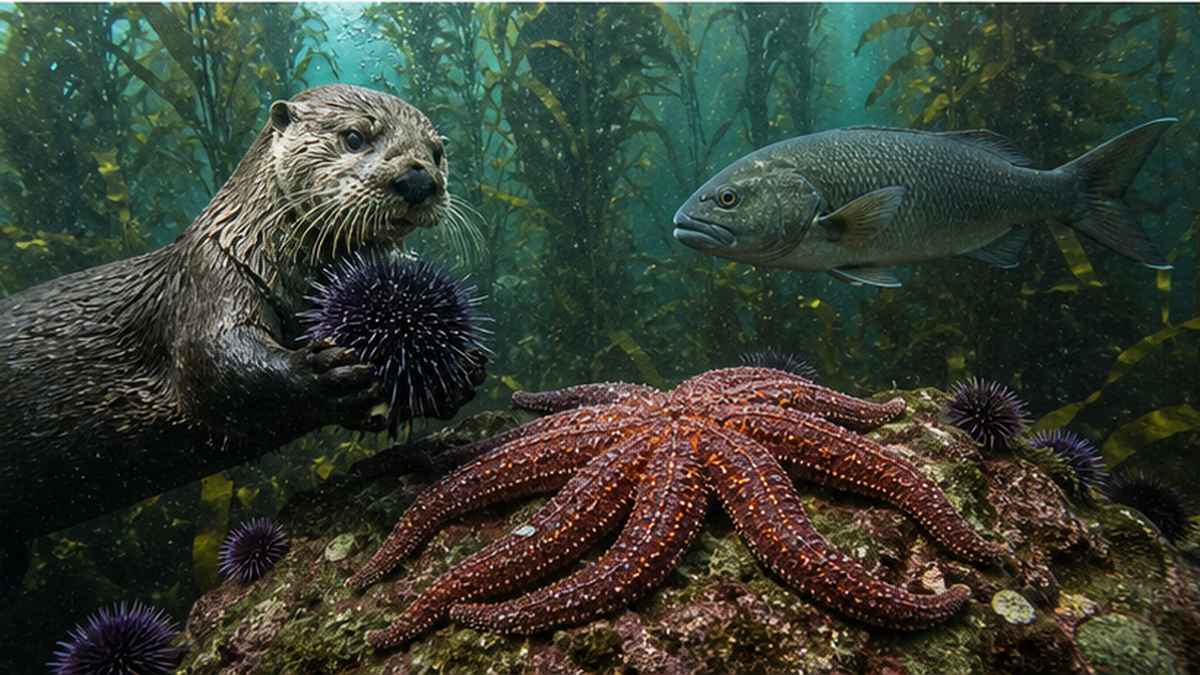
California's Tragedy: 95% of the Forest Gone in Five Years
What alerted the world to the menace of urchin barrens was the great collapse off northern California. According to a study published in Scientific Reports in 2019, about 95% of northern California's bull kelp forest disappeared between 2014 and 2019, with kelp canopy reduced by more than 90% along over 350 km of coastline.
A Chain of Ruin That Began with a Sick Sea Star
It started with the epidemic of sea star wasting syndrome that broke out in 2013. The urchin's greatest enemy, the sunflower sea star - one of the world's largest sea stars with more than 20 arms - crashed by over 97% from historic numbers along the Pacific coast, and in 2020 it was listed as Critically Endangered on the IUCN Red List.
Right after the predator vanished, in 2014-2016, a record marine heatwave nicknamed 'the Blob' and an El Niño struck the northeast Pacific. Purple sea urchins, freed of their enemy, surged into the heat-weakened kelp beds - their numbers along the north coast are reported to have grown more than 10,000% (a hundred-fold) since 2014.
The Blow to Fisheries: Abalone Season Closed
The forest's loss struck fisheries head-on. Kelp-eating abalone died en masse in 2017 (roughly 80% mortality), and in 2018 the recreational abalone fishery of northern California - estimated at $44 million - was closed. The commercial red urchin fishery collapsed too, as starving urchins held no roe. Urchins multiplied, and yet the urchin fishery died - a bitter irony.
What shocked researchers most was the speed. The forest did not fade over decades; two triggers - a sea star plague and a marine heatwave - coincided, and 350 km of coastal forest vanished within a few years. Ecosystem collapse comes not gradually but as an avalanche once a threshold is crossed; California is now shared among marine scientists as the textbook case.
| Year | Event |
|---|---|
| 2013 | Sea star wasting syndrome breaks out; sunflower sea stars crash by over 97% |
| 2014-2016 | The marine heatwave 'Blob' and an El Niño bring record warm water |
| 2014 onward | Purple sea urchins increase ~100-fold and carpet the seabed |
| 2014-2019 | About 95% of northern California's bull kelp forest disappears |
| 2017 | Starved abalone die en masse (about 80%) |
| 2018 | Recreational abalone fishery closed; commercial red urchin fishery collapses |
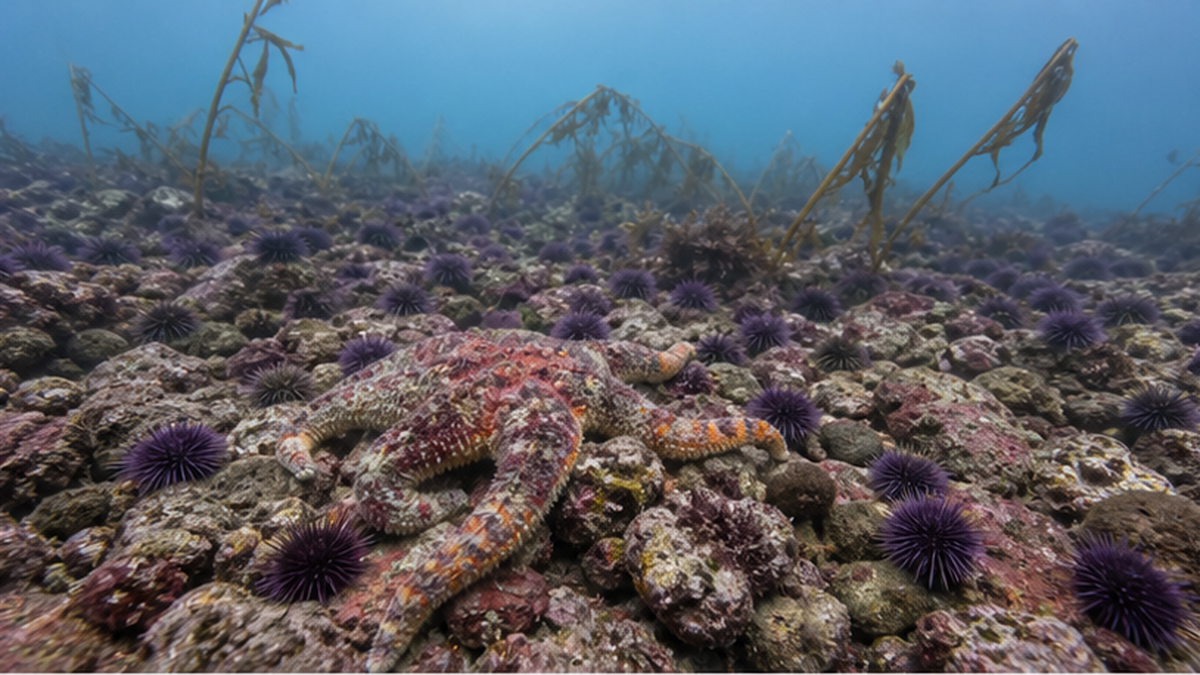
Urchin Barrens Worldwide: Tasmania and Norway, Darkness and Light
Urchin barrens are not a Californian peculiarity. From Australia in the south to Norway in the north, the same pattern of collapse is under way along the world's cold-temperate coasts. Yet the outcomes diverge by region - and in that divergence lie hints for countermeasures.
Tasmania: A Spiny Invader Carried by the Current
Around Tasmania, the once-vast giant kelp forests have shrunk by about 95% over recent decades, and in 2012 they became Australia's first marine community listed as endangered. A chief culprit is the long-spined sea urchin (Centrostephanus rodgersii), carried south by the strengthening East Australian Current as the ocean warms. First recorded in Tasmania in 1978, it has since multiplied explosively, turning reef after reef into barrens. Overfishing of its predator, the southern rock lobster, is thought to have accelerated the outbreak.
Norway: 8,400 km² of Barren - and an Unexpected Recovery
In Norway, from the early 1970s, outbreaks of the green sea urchin (a close relative of Japan's kita-murasaki urchin) laid bare an estimated 8,400 km² of kombu-like kelp beds - about four times the area of Tokyo - and the barrens persisted for decades. Recently, however, warming waters in mid-Norway have hampered urchin larval development; recruitment is failing, and kelp is reported to be returning. Warming ignites barrens in one sea and extinguishes them in another - emblematic proof that the balance between urchin and kelp hangs on temperature.
Norwegian experiments also confirmed that kelp regrows quickly in plots where urchin density is slashed, and businesses that harvest urchins efficiently for food have begun to emerge. Even barrens locked in for decades can revert to forest once conditions change - a fact that gives hope to isoyake programs worldwide.
A Pattern Common to the World
The lead urchin and the trigger differ by region, but the plot is strikingly the same: (1) predators decline through disease or overfishing, (2) warming and heatwaves weaken the kelp, (3) urchins explode and strip the forest, (4) starving urchins squat and block recovery. Syntheses of long-term change in the world's kelp forests likewise report an overall declining trend despite great regional variation. The urchin barren is no local fisheries problem, but part of planetary-scale ecosystem change.
| Region | Main urchin | Main trigger | Status |
|---|---|---|---|
| Northern California | Purple sea urchin | Sea star plague + marine heatwave | About 95% of bull kelp lost; recovery limited |
| Tasmania | Long-spined sea urchin | Strengthened current + lobster overfishing | Giant kelp down ~95%; listed as endangered community |
| Norway | Green sea urchin | Predator decline (from the 1970s) | ~8,400 km² denuded; mid-Norway recovering as warming curbs urchins |
| Japan | Kita-murasaki urchin, gangaze and others + herbivorous fish | Warming, reduced predation, nutrient change (compound) | Seaweed beds down ~30% in 20 years; nationwide countermeasures under way |
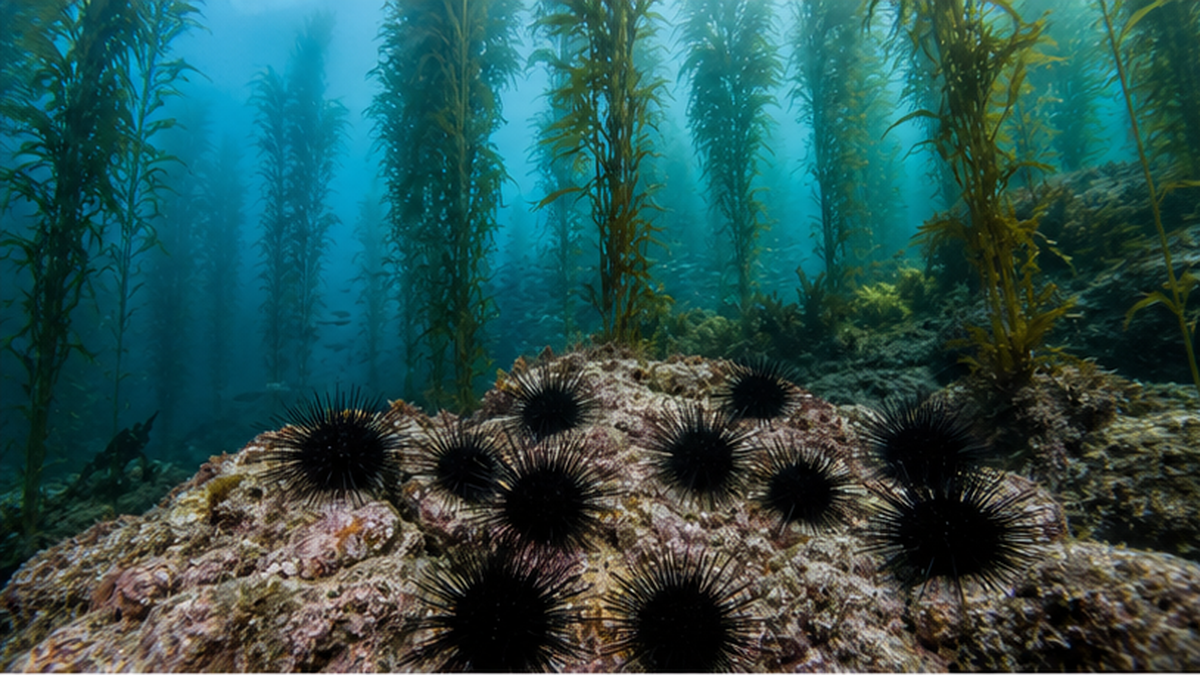
Isoyake in Japan: 30% of Seaweed Beds Lost in 20 Years
Japan is one of the world's great seaweed nations, and isoyake damage has long been known here. According to the Ministry of the Environment's National Survey on the Natural Environment, Japan's seaweed beds shrank from about 208,000 ha in 1978 to about 142,000 ha by the late 1990s - a loss of roughly 30% (about 65,000 ha) in two decades. Declines have continued to be reported since.
| Type of bed | Main seaweeds | Main distribution | Main isoyake threats |
|---|---|---|---|
| Kombu beds | Ma-kombu, Rishiri kombu and others | Hokkaido, Tohoku | Kita-murasaki urchin grazing, high temperatures |
| Arame/kajime beds | Arame, kajime, kurome | Pacific coasts of Honshu to Kyushu | Herbivorous fish and gangaze grazing, high temperatures |
| Garamo beds | Sargassum species | Nationwide | Grazing, changing nutrients |
| Amamo (eelgrass) beds | Eelgrass (a seagrass) | Sandy-muddy bays | Reclamation and water quality (largely distinct from isoyake) |
The North: Kombu Beds versus the Kita-Murasaki Urchin
Along Hokkaido's Sea of Japan coast, isoyake of the kombu beds has been a decades-long struggle. The protagonist is the kita-murasaki sea urchin. Where urchins swarm, kombu cannot grow - so the kombu fishery suffers, and because urchins without food carry no roe, the urchin fishery fails too: a double loss. Fishers and municipalities continue removal, relocation and mother-plant installation.
The South: Arame and Kajime Beds versus Gangaze and Fish
From Kyushu and Shikoku along southern Honshu, grazing by long-spined gangaze urchins is compounded by herbivorous fish such as rabbitfish, made more active by warming. Add direct heat-kill of the seaweed itself, and arame, kajime and hijiki beds are retreating everywhere. These beds double as fishing grounds for spiny lobster and shellfish, so their loss strikes local fishing businesses directly.
Gangaze wield needle-sharp spines over 10 cm long whose sting is intensely painful, making removal laborious and dangerous. Favoring warm water, they are thought to be spreading north with climate change. Fishery cooperatives and divers persist in crushing them underwater with hammers and shears, and in some areas juvenile arame and kajime have begun returning after culls.
What Happens to the Kombu Heartland
Japan's kombu production, wild and cultured, centers on Hokkaido, underpinning dashi and processed foods. Losing kombu beds to isoyake means more than losing one seaweed: the food web built on kombu, household fishing economies, and even the raw-material base of washoku cuisine are shaken. Warming is meanwhile pushing kombu's suitable habitat northward, and some studies project future range contraction. Urchin control and climate action are the two wheels of the cart for kombu's future.
The National Response: The Isoyake Countermeasure Guideline
The Fisheries Agency issued its Isoyake Countermeasure Guideline in February 2007 and revised it in 2015 with accumulated knowledge. The guideline lays out a procedure for diagnosing the cause and a menu of remedies by cause - removal of urchins and herbivorous fish, installation of mother plants, outplanting of seedlings - and backs recovery activities led by the fishers themselves. Nationwide conservation work is supported by programs such as the multifunctional fisheries scheme, and a supplementary manual now addresses rising sea temperatures.
The hands doing the work are local groups of fishers, divers, researchers and municipalities. They set cull frequencies and plots, install mother plants and monitor results - an unglamorous accumulation of adaptive management that is winning seaweed beds back, patch by patch. Aging memberships and funding remain shared challenges, which is precisely why schemes that 'sell the urchins to fund the work', described next, are drawing attention.
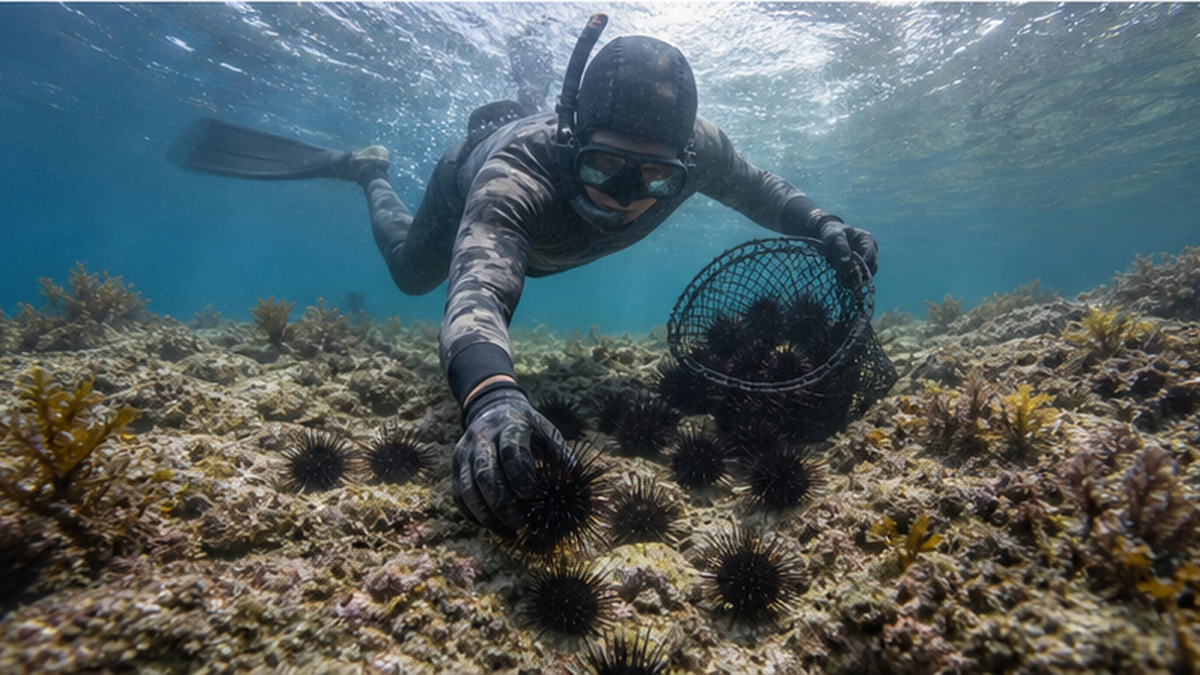
What Isoyake Takes Away
- Harvests of the seaweeds themselves - kombu, wakame, hijiki
- Reef resources dependent on the beds - abalone, turban shells, urchins
- Spawning and nursery functions for fish (impacts on total catches)
- The blue-carbon function of CO2-absorbing ecosystems
The Road Back: Catch, Ranch and Eat the Urchins to Restore the Forest
The most direct route out of an urchin barren is to cut urchin density. Trials across Japan and in Norway confirm that seaweed returns where urchins are removed thoroughly. But culled urchins are empty and unsellable, so removal tended to be a money-losing chore. What is changing that arithmetic is the idea of turning the urchins themselves into a resource.
'Urchin Ranching' Turns a Pest into a Prize
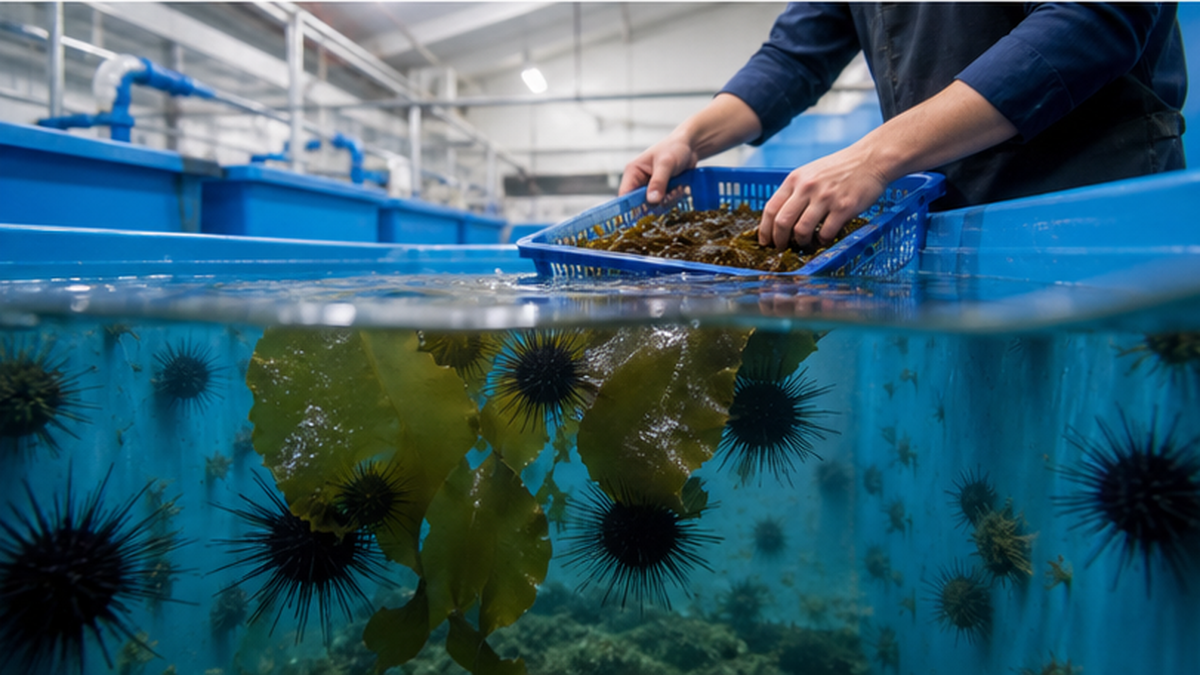
Even an emaciated urchin, once collected and fed in a land-based tank, recovers marketable roe within months - a practice called ranching (chikuyō). Urchin culls for isoyake control thereby become raw-material procurement for premium uni, converting the cost of removal into revenue - a circular model.
The pioneer of this field is Urchinomics, founded in 2017. The company buys emaciated urchins from barren grounds and ranches them in land-based facilities, operating across Japan from Hokkaido to Oita and abroad in the United States, Canada, Norway, Australia and beyond. Fishers earn income from the urchins they remove; the sea gets lower urchin density and a chance for kelp to return. The Fisheries Agency's national isoyake council has showcased it as a countermeasure that enriches fishers and regions alike.
Visit this companyUrchinomics | Sea urchin ranching that turns barrens back into kelpUrchinomics buys emaciated urchins removed from barren grounds, feeds them in land-based facilities, and ships them as premium uni - aligning kelp recovery with fishers' income, in Japan and overseas.🔗 uninomics.co.jpIn Kunisaki, Oita Prefecture, Oita Uni Farm, using Urchinomics' methods, began what is described as the world's first commercial-scale land-based urchin ranching in spring 2021. Fed a proprietary diet based on offcuts of food-grade kombu, the urchins' roe content improves four- to five-fold, and since August 2021 they have shipped under the brand 'Bungo no Isomori' ('Guardians of the Bungo Shore'). The model, pairing isoyake control with a new local specialty, is featured among Japan's climate-adaptation case studies.
See this initiativeOita Uni Farm | The world's first commercial-scale land-based urchin ranchingIn Kunisaki, Oita Prefecture, emaciated urchins from barren grounds are fattened on land and shipped as the local specialty 'Bungo no Isomori'. Learn why urchins are raised on land.🔗 oita-uni-farm.co.jpThe beauty of urchin ranching is that it flips the cause of isoyake into a local specialty. Once a buyer exists for culled urchins, fishers gain a standing economic motive to keep culling, and the work shifts from subsidy-dependent to self-sustaining. And for consumers, savoring ranched uni is itself participation in reef restoration - an environmental action whose entry fee is a delicious meal.
The 'Eat Them to Beat Them' Movement Abroad
In California, divers and fishers are culling purple urchins, and ventures to ranch the culls for food have begun. Norway and Tasmania, too, run projects pairing urchin harvest and marketing with kelp recovery. In Tasmania and California, researchers are further attempting kelp reforestation - nursery-raising seedlings from surviving stands and outplanting them - and selecting strains that tolerate warmer water. In Tasmania, a restoration project growing seedlings from rare heat-tolerant survivors of giant kelp is reported to be showing results.
The Isoyake Toolbox
- Removing urchins and herbivorous fish - diver culls and netting to cut grazing pressure and protect sprouts
- Urchin ranching - fattening empty urchins on land for market, monetizing the cull
- Supplying mother plants and seed - spore bags and nursery-raised transplants to jump-start regrowth
- Restoring predators - protecting and managing sea stars, lobsters and sea otters
- Grazing-resistant beds - deploying heat- and grazing-tolerant seaweeds and improving conditions
Ocean Forests for the Future: Blue Carbon and What We Can Do
Kelp forests and seaweed beds do more than raise fish: they draw attention as blue-carbon ecosystems that absorb and store CO2. In Japan, a scheme that trades the CO2 uptake of restored beds as credits (J Blue Credit) is up and running, giving isoyake control a second value as climate action. For restoration methods in detail, see our article on bringing back the fish-cradle seaweed beds.
Once blue-carbon value is quantified, corporate money can flow into protecting the beds. Companies buying restoration credits toward decarbonization targets are increasing, and society's frame is shifting from 'isoyake control = a cost for fisheries' to 'isoyake control = an investment in carbon and biodiversity'. Making the forest's value visible is how you rally the strength to defend it.
Eating to Protect, Knowing to Protect
- Choose isoyake-fighting uni and seaweed products - buying ranched urchins and seafood from bed-conserving regions funds removal and restoration
- Keep the seaweed food culture alive - consuming kombu, wakame and hijiki sustains the economic base of the beds
- Learn and take part - follow and support local conservation groups, diver culls and blue-carbon projects
- Push climate action forward - curbing ocean warming, the root driver, is the greatest bed conservation of all
Deforestation on land shows up in satellite photos for all to see; the loss of ocean forests advances silently below the surface. Yet the fact that one sea star disease or one shifted current can erase hundreds of kilometers of forest teaches us how delicate the ocean's balance is. Catch the urchins, ranch them, eat them, and keep the seaweed culture alive - reweaving human activity into the ocean's cycles is the surest path from barren back to forest.
In Japan's traditional satoyama landscapes, moderate wood-cutting and leaf-gathering by people kept the forests rich. The sea works the same way: people harvesting urchins and using seaweed helped keep the beds healthy. The spread of isoyake is also a warning bell for an age in which people and the sea have drifted apart. Now that you know the story of the ocean's forests, a single choice at the table can help plant a forest in a distant sea.
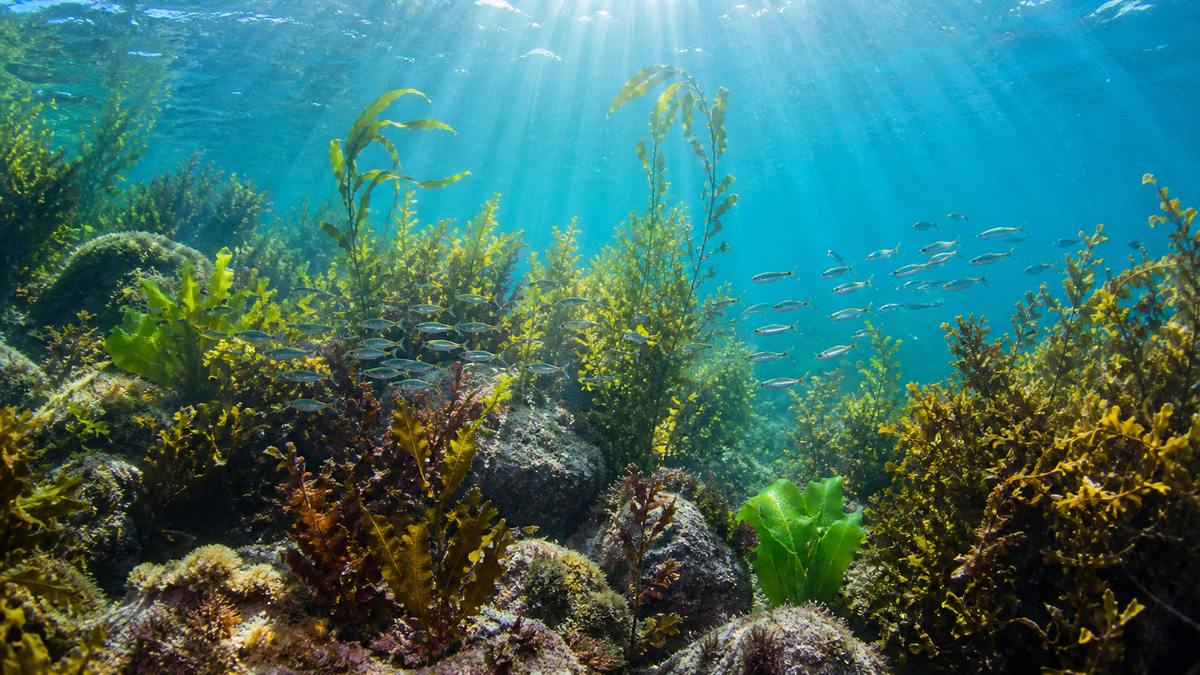
Article Summary
- Kelp forests are underwater woodlands of large Laminariales algae, generating an estimated $500 billion a year - 'rainforests of the sea'
- An urchin barren (isoyake) is 'ocean desertification': urchins unleashed by lost predators and warming strip the seaweed bare
- Northern California lost ~95% of its bull kelp in five years; Tasmania has lost ~95% of its giant kelp
- Japan's seaweed beds fell ~30% in about 20 years; fisher-led countermeasures proceed under the national guideline
- Models that monetize the cull - such as ranching emaciated urchins - are spreading worldwide
References and Sources
- Fisheries Agency of Japan – Conservation of seaweed beds and isoyake countermeasures (Isoyake Countermeasure Guideline)
- Biodiversity Center of Japan, Ministry of the Environment – National Survey on the Natural Environment: seaweed bed surveys
- Eger et al. (2023) Nature Communications – The value of ecosystem services in global marine kelp forests
- Rogers-Bennett & Catton (2019) Scientific Reports – Marine heat wave and multiple stressors tip bull kelp forest to sea urchin barrens
- University of California, Santa Cruz – Destruction and recovery of kelp forests driven by changes in sea urchin behavior
- CSIRO (Australia's national science agency) – An ocean forest in danger (Tasmania's kelp forests)
- NIVA (Norwegian Institute for Water Research) – Restoring Norway's underwater forests
- Fisheries Agency of Japan, National Isoyake Council – Urchinomics: isoyake countermeasures through urchin ranching
- Climate Change Adaptation Information Platform (A-PLAT) – Re-raising the urchins that cause isoyake to restore seaweed beds (Oita)
* Ordered by reliability: government and academic institutions > peer-reviewed papers > specialized organizations > trusted media