⚡ The answer in 30 seconds
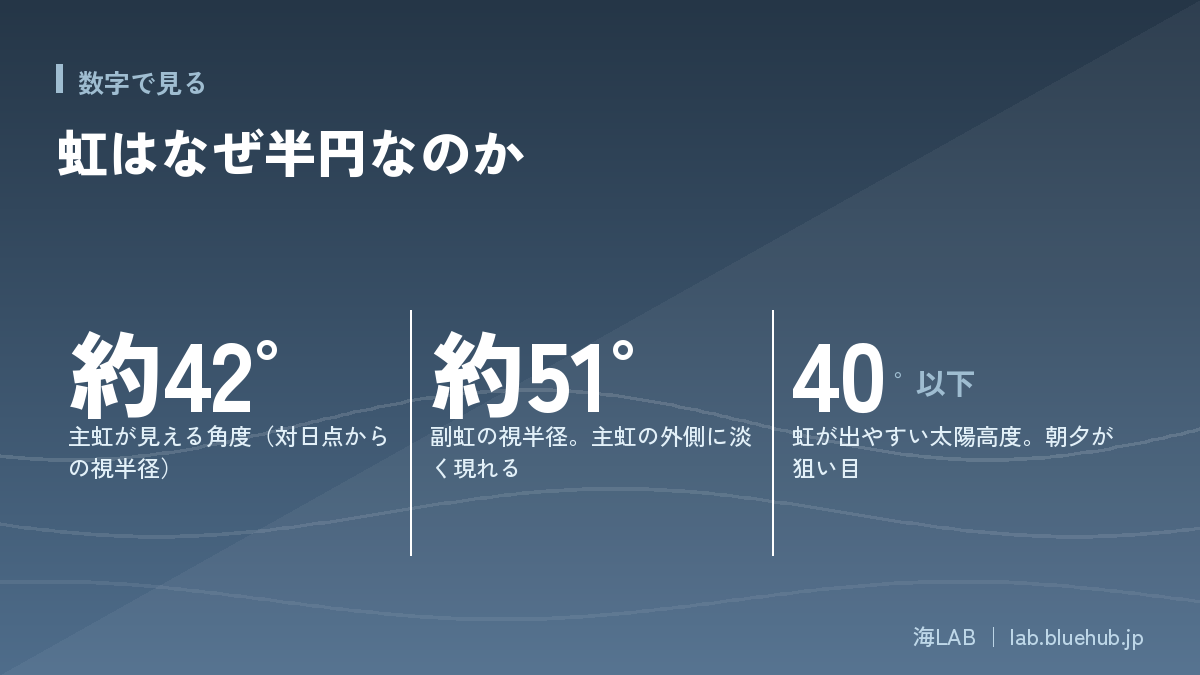
- A rainbow is really a circle. Light returns as a ring of about 42 degrees angular radius centred on the antisolar point, directly opposite the sun; the lower half looks missing because there are few raindrops below the horizon.
- 42 degrees is the angle where light piles up most densely after entering a droplet, reflecting once inside and refracting out again. Red emerges near 42 degrees and violet near 40, which splits the band into colours.
- The secondary bow comes from light reflected twice inside the droplet, at an angular radius of about 51 degrees. The extra reflection makes it dimmer, and its colour order is reversed relative to the primary.
- To find one, turn your back to the sun and look toward the head of your own shadow. The best chance comes when the sun is below about 40 degrees — morning and evening, just as rain is clearing.
When a rainbow arches over the sky after rain, even adults stop walking. Yet ask why a rainbow is a semicircle and the answer is surprisingly hard to give. In fact a rainbow is not a semicircle at all but a full ring — we simply cannot see the lower half, which the ground hides. And the size of that ring is fixed at about 42 degrees. For something that seems so capricious, a rainbow is remarkably disciplined.
This article starts inside a single raindrop and works outward: the primary and secondary bows, the dark band lying between them, why a rainbow need not be seven colours, and how raindrop size changes its appearance. No difficult equations — just numbers and diagrams you can follow.
The second half is practical. The solar elevation below 40 degrees rule, why morning and evening are the windows to aim for, why coastlines and waterfalls are prime rainbow territory, and the mistakes people make when photographing one. By the end you will know exactly where to look in a clearing sky.
What you'll learn in this article
- Why a rainbow looks like a semicircle: it is really a circle whose lower half is hidden by the ground
- How the 42-degree angle follows inevitably from refraction and reflection inside a single raindrop
- Why the colours reverse in the secondary bow, and what Alexander's dark band between the two really is
- Why a rainbow does not have to be seven colours — the count is set by language and culture, not physics
- How raindrop size changes a rainbow's character, producing supernumerary bows, fogbows and moonbows
- A practical routine for finding rainbows — face away from the sun and look toward your shadow's head — plus photography tips
A Rainbow Is a Circle, Not a Semicircle — the Half You Never See
To start with the conclusion: a rainbow is a full ring. It looks like a semicircle because the part of the ring that would fall below the horizon is blocked by ground or sea, where almost no raindrops exist to send sunlight back to you. What we see in everyday life is always the upper half of a circle.
The centre is the antisolar point — the head of your own shadow
The centre of the rainbow's circle lies exactly opposite the sun. This point is called the antisolar point. The name sounds technical, but finding it is easy. Stand with your back to the sun and look at where the tip of your shadow's head points on the ground — that is the antisolar point. The rainbow appears all around it at a constant angle.
So a rainbow's position is never accidental. Once the sun's position and your own are fixed, the direction of the bow follows automatically. That is why you never need to scan the whole sky: just check which way your shadow's head points.
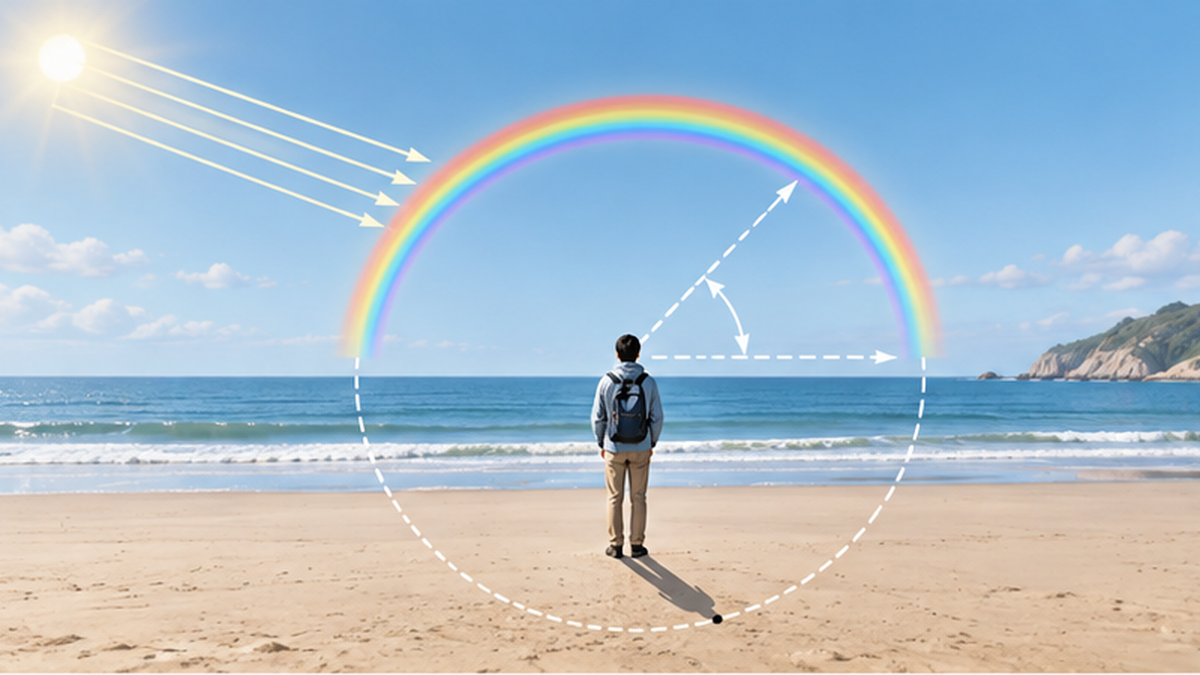
Places where a circular rainbow is visible
Remove the obstruction and the rainbow shows its true shape — a complete ring. Full 360-degree rainbows are reported under conditions like these.
- From an aircraft window — when cloud or rain lies below and you are seated on the side away from the sun. A ring centred on the aircraft's shadow may appear, sometimes overlapping with a glory
- From a mountain summit — when the valley below is filled with fog or rain and a low sun sits behind you
- Beside a fountain or garden hose — spray water down to ground level and you can create a ring that continues to your feet. Easily reproduced in a back garden
You cannot walk up to a rainbow
- A rainbow is not an object in a particular place; it is the relationship of light returning from a certain angle
- Move, and a different set of raindrops takes over the job — the rainbow moves with you by exactly the same amount
- That is why you can never reach the foot of a rainbow or pass under one. Even two people standing side by side are strictly seeing different rainbows built by different drops
What 42 Degrees Really Means: Inside a Single Water Droplet
So why 42 degrees? The answer lies inside a single raindrop. The small water drops suspended in the sky are flattened slightly by air resistance as they fall, but they are essentially spheres. When sunlight enters such a sphere, it behaves in a strictly determined way.
Three steps: refract, reflect, refract
- Refraction (entering) — moving from air into denser water, the light slows down and bends
- Reflection (bouncing inside) — at the far surface of the droplet, part of the light reflects back inside. Only part: the rest passes out
- Refraction (leaving) — as the reflected light passes from water back into air it bends once more, heading back toward the side it came from
The US National Oceanic and Atmospheric Administration (NOAA) describes the same sequence: light enters a droplet, slows and bends, reflects inside where it separates into its component wavelengths, and makes a rainbow as it exits. The key point is that the light returns toward the direction it came from. That is precisely why rainbows appear only opposite the sun.
Why light concentrates at 42 degrees
Some rays strike the droplet through its centre, others graze its edge. Since the bending depends on where a ray hits, the return angles ought to be scattered — but here something interesting happens. The return angle has a limiting value, and near that limit the light becomes extraordinarily concentrated.
This 'cannot bend any further' angle is the angle of minimum deviation, and the ray returning at it is called the Descartes ray after its discoverer. Change the angle slightly and the amount of returning light barely falls, so the density of light there becomes extreme, and that direction alone stands out as a bright band. That is the rainbow: a peak in the density of light at a particular angle.
Colours separate because refractive index depends on wavelength
Water's refractive index differs slightly with the colour, that is the wavelength, of the light. Violet bends more than red, so the angle of maximum concentration shifts with colour. The difference is only about two degrees, but projected on the sky it becomes a clearly visible band.
| Colour (approx. wavelength) | Refractive index of water | Angle in the primary bow | Position within the band |
|---|---|---|---|
| Red (about 700 nm) | about 1.331 | about 42° | Outermost |
| Green (about 550 nm) | about 1.336 | about 41° | Middle |
| Violet (about 400 nm) | about 1.343 | about 40° | Innermost |
Two thousand years to reach 42 degrees
It took a very long time to pin that number down. In ancient Greece, Aristotle tried to explain the rainbow as light reflected from clouds. Alexander of Aphrodisias, working in the same tradition, noticed that the sky between the primary and secondary bows is darker — the band that now carries his name. Why that should be, he could not say.
In the thirteenth and fourteenth centuries, Kamal al-Din al-Farisi in Persia and Theodoric of Freiberg in Germany independently ran experiments with glass spheres filled with water and established that light was refracting and reflecting inside the sphere. This was the decisive shift: the rainbow was recast from a problem about clouds into a problem about a single droplet.
In the seventeenth century René Descartes used the law of refraction to trace the ray paths and derived the fact that the return angle has an extremum — that light concentrates near 42 degrees. Newton then showed that the band splits into colours because refractive index varies with colour. Finally, in the nineteenth century, George Biddell Airy built a wave theory of light that also accounted for the supernumerary fringes inside the primary bow.
| Period | Figure | What they established |
|---|---|---|
| 4th century BC | Aristotle | Attempted the first systematic natural explanation of the rainbow |
| 2nd–3rd century | Alexander of Aphrodisias | Noted the darkness between the primary and secondary bows (Alexander's dark band) |
| 13th–14th century | Al-Farisi / Theodoric | Glass-sphere experiments identified refraction and reflection inside a single droplet |
| 17th century | Descartes | Derived from ray calculations that light concentrates near 42 degrees |
| 17th century | Newton | Showed that colour-dependent refractive index produces the colour separation |
| 19th century | Airy | Treated light as a wave and explained the supernumerary fringes |
Each raindrop delivers only one colour
- Any given raindrop sends your eye essentially one colour of light
- Drops slightly higher deliver red, drops slightly lower deliver violet — the assembly of them forms the band
- A rainbow is therefore a collaboration in which countless raindrops each take charge of a single colour
Primary Bow, Secondary Bow, and the Dark Band Between Them
In good conditions a second, fainter bow appears outside the bright one. The inner, stronger arc is the primary bow; the outer, fainter one is the secondary bow. They are not separate phenomena — only the number of reflections inside the same raindrops differs.
The secondary bow is twice-reflected light at about 51 degrees
Where the primary bow comes from light reflected once inside a droplet, the secondary comes from light reflected twice. One more reflection changes the return angle, so its angular radius from the antisolar point is about 51 degrees (the violet outer edge reaching roughly 53) instead of the primary's 42. That is why the secondary sits outside, and therefore above, the primary.
The secondary is faint because each time light bounces at a water–air boundary, some of it escapes outward. With one extra reflection, the secondary loses that much more. As a rule of thumb it is only a fraction of the primary's brightness, so look for it when the rain is heavy and the background cloud is dark.
The colour order flips
The primary bow is red on the outside and violet on the inside, but the secondary is red inside and violet outside — the order reverses. The extra reflection swaps the geometry of the light paths leaving the droplet. If you spot a double rainbow, check the colour order. If both arcs run the same way, what you are seeing may not be a secondary bow but the supernumerary bows described later.
Alexander's dark band — sky where no light returns
The band of sky caught between the primary and secondary bows looks darker than the sky inside or outside them. This is Alexander's dark band, named after the second-century philosopher Alexander of Aphrodisias, who described it.
The reason is simple: almost no light returns from the raindrops at those angles. Singly reflected light never emerges beyond about 42 degrees, and doubly reflected light never emerges inside about 51. The region between 42 and 51 degrees is therefore optically transparent, showing the background cloud directly and appearing dark by comparison. It is not that the rainbow is bright — it is that light drops out of that band.
| Feature | Primary bow | Secondary bow |
|---|---|---|
| Reflections inside the droplet | One | Two |
| Angular radius from antisolar point | about 40–42° | about 51–53° |
| Colour order | Red outside, violet inside | Red inside, violet outside |
| Brightness | Bright | Considerably fainter than the primary |
| Width of the band | about 2° | about 4° (roughly twice the primary) |
| How often visible | Essentially whenever a rainbow appears | Only when conditions line up, such as heavy rain |
Reflection bows born from a water surface
Near a lake, a flooded rice paddy or a calm inlet, another kind of bow can join in: the reflection bow. Sunlight reflected off the water surface illuminates the raindrops afresh, producing a rainbow that does not share its centre with the ordinary one. Because it is drawn around a second sun below the water surface, it appears to rise at a steeper angle, crossing the ordinary bow.
When the primary, secondary, reflected primary and reflected secondary all appear together, four arcs stand in the sky at once. Most photographs that circulate as 'quadruple rainbows' are this combination, not higher-order reflections. The requirement is a broad, wind-free water surface between you and the sun — a lake just after sunrise, or spring farmland where the paddies have just been flooded.
Where are the third and fourth bows?
- Tertiary (three reflections) and quaternary (four) bows do exist in theory, but they appear on the sun's side of the sky, roughly 40 and 45 degrees from the sun
- Drowned in the sun's glare, they are essentially invisible to the naked eye; only a handful have been confirmed through photography and image processing
- Most viral 'quadruple rainbow' photos are in fact a primary and secondary combined with supernumerary or reflection bows
Is a Rainbow Really Seven Colours? Language Decides the Count
In Japan children learn that a rainbow has seven colours. Look carefully at a real one, though, and the colours blend smoothly with no boundaries anywhere. A rainbow's spectrum is continuous; how many colours you cut out of it is decided by the observer's language and culture.
Why Newton chose seven
It is widely known that Isaac Newton settled on seven. Newton split sunlight with a prism and at first described five colours, later adding indigo and orange to reach seven. The background, as it is usually explained, was the importance he placed on a correspondence with the seven notes of the musical scale. In other words, seven was an interpretation rather than a measurement.
Japan's own weather agency writes 'six or seven'
Even Japan's official explanation does not fix the number at seven. The Japan Meteorological Agency's FAQ states:
A rainbow appears in seven (six) colours because sunlight — visible light — is separated into seven (six) colours. ... When sunlight is split with a prism it gives six colours according to the Chronological Scientific Tables: red, orange, yellow, green, blue and violet, which is why the rainbow is sometimes said to have six colours.
― Japan Meteorological Agency, 'About clouds, atmospheric phenomena and atmospheric optical phenomena'
Different counts are reported for different countries
Resources such as the Collaborative Reference Database of the National Diet Library note that the conventional count varies by country. These are not official national definitions, however — only a tidy summary of customary usage, and they should be read that way.
| Country / region | Commonly cited count | Colours usually dropped |
|---|---|---|
| Japan, France and others | 7 | — |
| United States, United Kingdom | 6 | Indigo |
| Germany, Russia | 5 | Indigo and orange |
| Some African languages | 2–3 | Grouped simply into warm and cool |
Japanese distinguishes ao (blue) from ai (indigo), and that vocabulary has sustained the seven-colour count. Conversely, older Japanese used ao for green as well, which is why traffic lights are still called blue in Japan today. The number of colours in a rainbow is a fossil of how a language has carved up colour.
'Only the Japanese see seven colours' goes too far
- There is no large difference in how colour is physically perceived — retinal function — between nations or peoples
- What differs is naming and counting. Someone taught seven colours simply finds it easier to perceive seven divisions
- Statements like 'people of country X can only see Y colours' invite misunderstanding and are better avoided
Raindrop Size Sets a Rainbow's Character
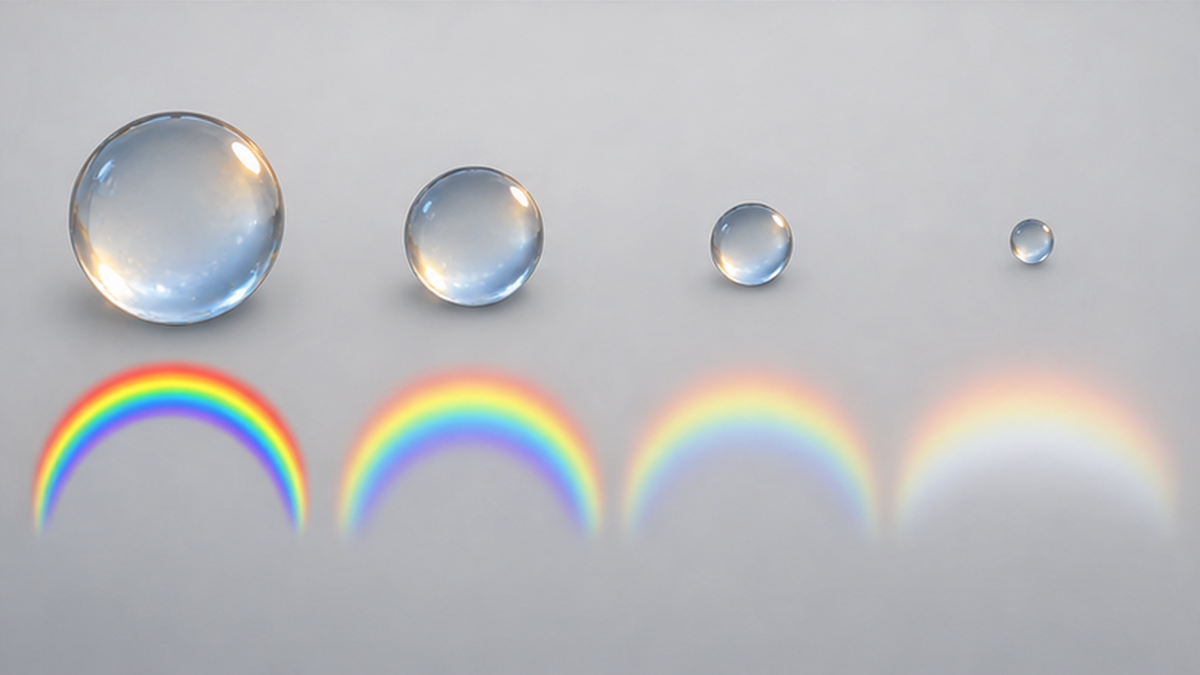
Even at the same 42 degrees, some rainbows are vivid and others washed out. The main cause of that difference is raindrop size. Larger drops separate the colours crisply; smaller drops blend them into pallor.
The width of the band has a reason too. The sun is not a point but a disc, subtending about 0.5 degrees from the ground. Light from the sun's right edge and light from its left edge therefore produce slightly offset rainbows, smearing the colours. The primary's width of roughly 2 degrees is the combination of the sun's own size and the roughly 2-degree spread between colours. Were the sun a true point source, rainbows would be narrower and their colours even more sharply divided.
Larger drops mean vivid colour, smaller drops mean white
The drops that make rainbows are roughly 0.1 millimetres to a few millimetres across. When drops of 1 to 2 millimetres dominate, red, orange, green and violet separate clearly; when only fine drops of 0.2 to 0.3 millimetres are present, the colours amount to a faint orange and green and the band widens and blurs. Vivid rainbows follow summer downpours because those showers deliver large drops.
| Drop diameter | How the colours look | Width of the band | Typical conditions |
|---|---|---|---|
| 1–2 mm | Red, orange, green and violet separate clearly | Narrow and sharp | Just after a downpour or shower |
| around 0.5 mm | Colours visible but blues are weak | Typical | An ordinary clearing after rain |
| 0.2–0.3 mm | Mostly orange and green; red is weak | Wide and blurred | Drizzle or light rain |
| 0.05 mm or less (fog droplets) | Almost entirely white | Very wide | Fog or inside a sea of cloud |
Supernumerary bows — fine fringes inside the primary
Just inside the primary bow, several fine violet and pale green fringes sometimes stack up. These are supernumerary bows, also called interference bows. Treating light as a wave, rays that have passed through a droplet interfere, reinforcing and cancelling one another, and that fringe pattern is projected on the sky. It is the wave nature of light made visible — something refraction and reflection alone cannot account for.
Supernumerary bows appear when the raindrops are uniform in size. If sizes vary, the fringes shift out of step, cancel one another and average away. Japan's National Research Institute for Earth Science and Disaster Resilience likewise explains that they are easier to see when the drops reflecting the sunlight are of similar size.
Fogbows and moonbows
When drops become extremely small, the colours mix completely and the result is a white rainbow. Seen in fog, this is called a fogbow. It forms at the same 42 degrees, yet without colour it rises as an eerily pale arc.
- Fogbow — a white bow made by fog droplets 0.05 mm or smaller. You cannot see it from deep inside the fog, so stand at its edge. Coasts with sea fog, or rivers where morning mist forms, are good bets
- Moonbow — a bow lit by the moon rather than the sun. It appears when a bright moon near full sits low in the sky with rain or waterfall spray opposite. It looks whitish to the eye, but a long exposure on a tripod records the colours
- Spray bow — formed in the spray of waterfalls, breaking waves or fountains. No rain required; a sunny day will do
What belongs to the rainbow family, and what does not
- Rainbows, fogbows and moonbows are all produced by water droplets and appear opposite the sun (or moon)
- By contrast, the halo ringing the sun and the bright sun dogs flanking it come from ice crystals in high cloud, with angular radii of 22 and 46 degrees. Different physics, different direction
- When you spot colour in the sky, first check whether it is on the sun's side or opposite — that narrows the identification immediately (see how to tell the ten cloud genera apart)
When and Where to Look for a Rainbow
Now the practical part. Rainbows look like pure chance, but the conditions for their appearance are quite specific. Know them and your hit rate rises sharply.
The 40-degree solar elevation barrier
The primary bow is a circle of about 42 degrees angular radius centred on the antisolar point. Since that point lies directly opposite the sun, the higher the sun, the deeper the antisolar point sinks below ground. Once solar elevation exceeds 42 degrees, the arc itself falls below the horizon and is essentially invisible from flat ground. Professor Steven Businger of the University of Hawaii likewise notes that a rainbow requires the sun to be within 40 degrees of the horizon.
In a Japanese summer the sun sits above 70 degrees around midday. In other words, no amount of rain will produce a rainbow at midday in high summer. If your summer rainbow memories are all from late afternoon, that is not your imagination.
| Season and time | Approximate solar elevation | Rainbow prospects |
|---|---|---|
| Summer, around midday | 70–80° | None |
| Summer evening (about 2 hours before sunset) | 20–30° | Good. The arc sits low |
| Spring and autumn, morning and evening | 10–30° | Excellent. Tall, large arcs |
| Winter daytime | 30–40° | Possible even at midday when conditions align |
| Just after sunrise or before sunset | 0–5° | Enormous near-semicircular arcs, though the light is weak |
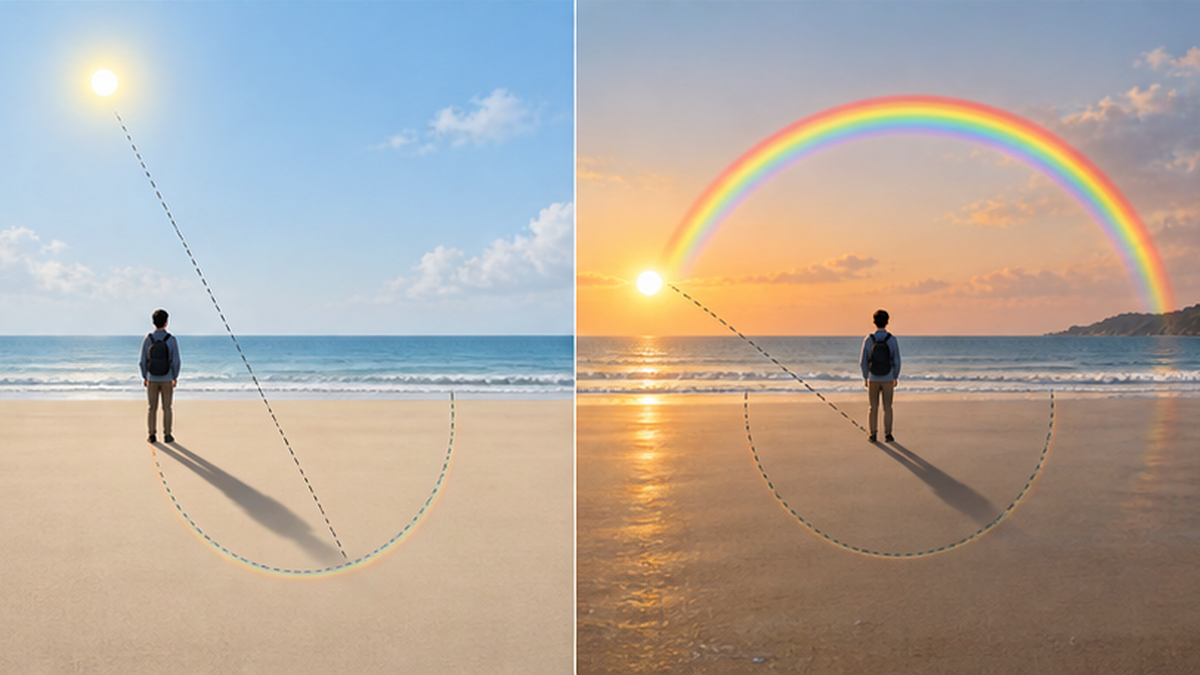
Why 'morning rainbow means rain, evening rainbow means fair'
An old Japanese weather saying holds that a morning rainbow brings rain and an evening rainbow brings fair weather. It follows from the fact that mid-latitude weather generally moves from west to east. A morning rainbow appears in the western sky because the sun is in the east — which means rain clouds lie to the west and are heading your way. An evening rainbow appears in the east, telling you the rain has already passed.
Behind the saying lies the movement of weather systems steered by the upper-level westerlies (see why a meandering jet stream drives extreme weather). It does not hold for locally brewed summer downpours, or when an approaching typhoon reverses the usual wind pattern.
Don't miss the narrow window as rain clears
Rainbows appear in the brief moment when rain and sunshine trade places. A shower cloud passes, blue sky opens behind it, the cloud edge clears the sun — and raindrops are still falling through the air. That overlap lasts tens of minutes at most, sometimes only a few. Which means that going outside after the rain has stopped is often already too late.
In practice, the moment the rain begins to ease, check which side of the sky is brightening, and if the sun looks likely to break through, move to a window or exit facing the opposite direction. Radar showing your position relative to the edge of the precipitation area will tell you roughly how many minutes until the clearing arrives. Rainbow hunting doubles as practice in reading weather data.
Forecasting rainbows with radar and satellites
Recent years have brought attempts to predict rainbows mechanically. Japan Weather Inc. offers Rainbow Nowcast, a data service that uses precipitation radar to detect raindrops and meteorological satellites to check whether cloud is blocking the sunlight, analysing rainbow visibility every ten minutes. Professor Businger of the University of Hawaii developed RainbowChase, a smartphone app that uses Doppler radar and satellite data to alert users to rainbow conditions. The trick is to pin down 'rain is falling' and 'the sun is shining' at the same time — exactly what you do when scanning the sky by eye.
Three conditions to check before hunting a rainbow
- 1. Is the sun out? — judge by whether your shadow falls clearly on the ground
- 2. Is it raining on the opposite side? — use rain radar to see whether precipitation lies toward the antisolar point
- 3. Is the sun low? — if your shadow is longer than your height, solar elevation is below 45 degrees. A handy rule of thumb
- With all three in place, turn your back on the sun and look up toward your shadow's head. The ten to twenty minutes as rain clears are the decisive window
Coasts and Waterways Are the Best Seats in the House
The places where rainbows are easiest to find cluster around water. Coastlines, waterfalls, riverbanks, islands — anywhere water is broken into fine droplets already satisfies half the requirement.
Rainbows made by sea spray
Waves breaking on rocks, spray leaping over a breakwater, the mist thrown up by a ship's bow. When sunlight strikes them, a rainbow forms with no rain at all. This spray bow is easiest to catch on clear mornings and evenings when the wind is blowing onshore. Coastlines also offer open views to the horizon, making them one of the few places where you can follow an arc from end to end.
Waterfalls work the same way. Fine droplets hang permanently around the plunge pool, so a rainbow rises almost daily whenever the sun reaches the right height. The hours when a given waterfall shows a rainbow are essentially fixed by its orientation and the season. When local tourist information lists the time of day to see the rainbow, that is not folklore — it is geometry.
Hawaii, the world's finest rainbow islands
In 2021 Professor Steven Businger of the University of Hawaii published 'The Secrets of the Best Rainbows on Earth' in the American Meteorological Society's Bulletin of the American Meteorological Society, arguing that Hawaii enjoys the best rainbow conditions on the planet. The reasons he gives include the following.
- Trade winds and passing showers — sitting in the subtropical trade wind belt, the islands alternate between brief showers and clear spells
- Mountainous terrain — wind forced up over the mountains builds rain clouds. Without those peaks, annual rainfall would be dramatically lower by his estimate
- Timing of morning and evening rain — the warm sea heats the atmosphere from below while cloud tops radiate heat to space, so showers deepen in the morning
- Clean air — far from any continent, with little pollution or dust, so light is not muddied by scattering and rainbows stay vivid
The same paper notes how rich Hawaiian vocabulary for rainbows is. A low bow that seems to touch the ground, a vertical shaft of light, a barely visible bow, a moonbow — each has its own word. Where rainbows are part of daily life, language divides them more finely. Okinawa in Japan, and the Sea of Japan coast just after the rainy season, share something of the same combination of sea, mountain and clearing sky.
Looking for similar conditions in Japan, the Okinawa and Amami islands come first. Ringed by warm seas, they see fronts and upper troughs pass in succession from winter into spring, bringing brief showers alternating with sunshine. Island-induced orographic cloud forms as well, and from the sea side you have mountains behind and open water ahead — terrain that lets you see an arc from end to end. On the Sea of Japan coast in winter, the shigure showers that accompany cold-air outbreaks play the same role, and rainbows stand often between them and the clear spells.
Rainbows written into the calendar
Japan's traditional seventy-two microseasons include two named for rainbows. Niji hajimete arawaru ('rainbows begin to appear'), the last microseason of Qingming around 14–19 April, marks the point when spring deepens, the air grows humid and rainbows start showing after rain. Its counterpart is Niji kakurete miezu ('rainbows hide and are not seen'), the first microseason of Xiaoxue around 22–26 November, when the sunlight weakens, the air dries and the conditions for rainbows fade.
It is striking how well these two microseasons track solar elevation and atmospheric moisture — the very conditions a rainbow needs. They are also a record of people in an age without instruments mapping the contours of the seasons simply by watching the sky (see why snow crystals are hexagonal).
Staying safe while rainbow hunting on the coast
- Standing at the water's edge or on the tip of a breakwater to chase spray bows is dangerous. High waves arrive without warning
- Rainbows appear exactly when rain and sunshine trade places, which can mean a thunderstorm cell nearby. At the first rumble, head for a building or car
- Absorbed in photography, people stop watching their footing. Stay off wet rocks and tetrapods
How to Watch, How to Photograph, and Why Records Matter
Finally, what to do once you have found one. Rainbows often vanish within minutes, so there is no time to dither. Deciding on a routine in advance keeps the panic away.
A routine for finding one
- As the rain begins to ease, step outside and look for your shadow. A clear shadow means the sun is out
- Check which way your shadow's head points. That is the antisolar point, the centre of the rainbow's circle
- From that direction, raise your gaze about four fists above the horizon (an outstretched fist spans roughly 10 degrees). That height is around 40 degrees
- Once you have the primary, look about one fist further out, that is higher. Any secondary bow will be there
- Look just inside the primary too. Stacked fine fringes mean supernumerary bows
Photography tips and common mistakes
- Shoot wide — the primary has a radius of 42 degrees, so a diameter of 84. A standard lens will not fit it. Use your phone's ultra-wide mode or a panorama
- Beware the polarising filter — rainbow light is strongly polarised because it comes from reflection inside droplets. Rotating a polariser can strengthen the rainbow or erase it entirely. Leave one on out of landscape habit and you may photograph a sky with the rainbow missing
- Pull the exposure down slightly — metering for a bright sky blows out the rainbow. Negative compensation darkens the background cloud and lifts the contrast of the arc
- Include a foreground — sky alone conveys no scale. Sea, breakwaters or buildings show how vast the arc is
- Frame for Alexander's dark band — include both bows and the darkness between them becomes visible in the photograph too
Keeping records turns watching into science
Note the date and time, the place, the direction, the sun's height (from the length of your shadow) and the state of the rain. Look back later and the tendencies of your own locality emerge: this season, this hour, that quarter of the sky. Accumulate a few years of it and you have a genuine local weather record.
A rainbow is a brief gift that appears only when water, light and your own position happen to align. Understanding the mechanism takes nothing away from the beauty. If anything, knowing why it is there right now makes the time you spend looking up richer. Next time the rain clears, turn your back to the sun and look toward the head of your shadow.
Summary of this article
- A rainbow is a circle, not a semicircle — a ring of about 42 degrees angular radius around the antisolar point, with its lower half hidden by the ground
- 42 degrees is the angle where light concentrates after refracting in, reflecting once and refracting out (minimum deviation, the Descartes ray)
- The secondary bow is twice-reflected light at about 51 degrees: fainter, with reversed colours. Between them lies Alexander's dark band
- The number of colours is set by language and culture, not physics. Japan's weather agency itself writes six or seven
- Larger drops give vivid colour; uniform drops give supernumerary bows; tiny fog droplets give a white fogbow
- To hunt one, aim for morning or evening with the sun below 40 degrees, in the tens of minutes as rain clears. Turn your back to the sun and look toward your shadow's head
References and Sources
- Japan Meteorological Agency – About clouds, atmospheric phenomena and atmospheric optical phenomena (rainbows, halos, sun dogs)
- NOAA NESDIS – What Causes a Rainbow? (42° primary, 50° secondary, and the colour reversal)
- National Research Institute for Earth Science and Disaster Resilience – Rainbows, from the educational poster series on everyday phenomena (double bows, Alexander's dark band, supernumerary bows)
- American Meteorological Society – Businger, S. (2021) The Secrets of the Best Rainbows on Earth, BAMS 102(2)
- University of Hawaii / SOEST – The Best Rainbows on Earth (PDF of the above paper, including the 40-degree solar elevation condition)
- Kyoto Sangyo University – Rainbows and caustics — lecture material on minimum deviation and the Descartes ray
- Gifu Prefecture Educational Network – Science experiment guide: the direction in which a rainbow appears — verifying 42 degrees by construction from the law of refraction
- Canon Science Lab Kids – Is it true that Newton decided a rainbow has seven colours?
- Collaborative Reference Database (National Diet Library) – Rainbows are said to have seven colours in Japan — how many in other countries?
- Japan Weather Inc. – Rainbow Nowcast — analysing rainbow visibility every ten minutes from precipitation radar and satellites
Ordered by reliability: government/academic institutions > peer-reviewed papers > specialized organizations > reputable media