⚡ In short
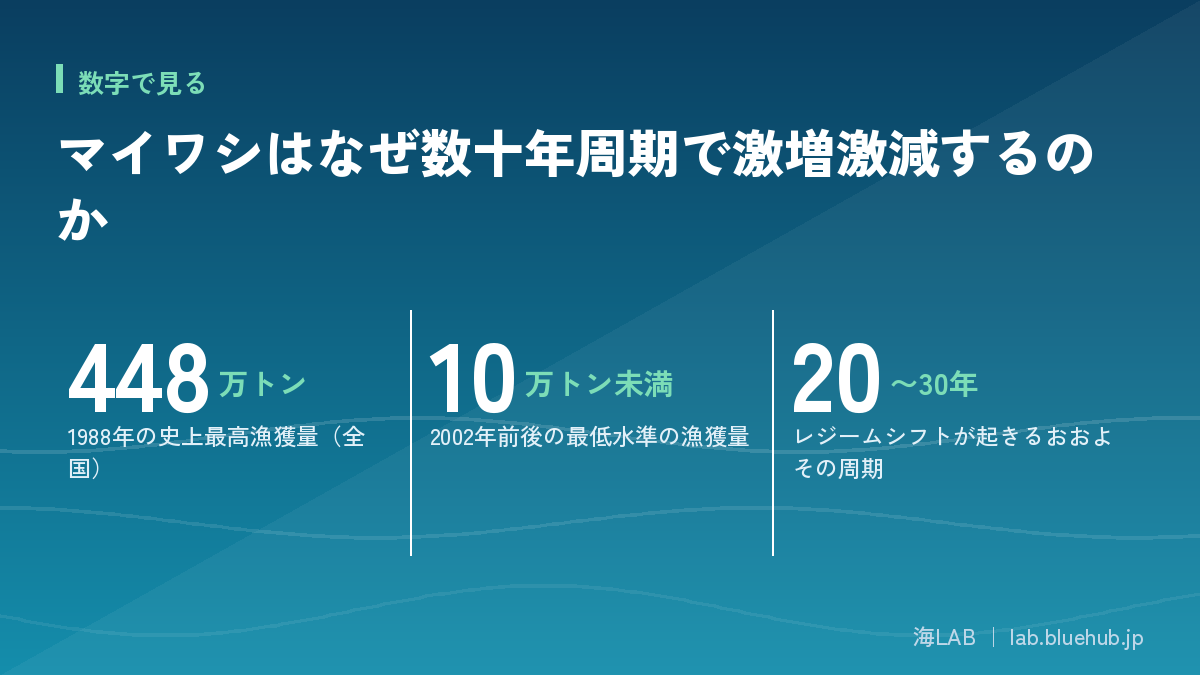
Japan's Japanese sardine catch plunged from 4.48 million tons in 1988 to under 100,000 tons in the 1990s, then began recovering after the 2010s. This article explains the 'regime shift' behind this volatility and its impact on sea temperature, currents, the food web, and fishing businesses.
Some years, Japanese sardines fill supermarket fish counters at bargain prices; other years, they all but disappear. This extreme swing is no coincidence — it is driven by a "regime shift," a phenomenon in which the entire marine ecosystem flips to a different state once every few decades.
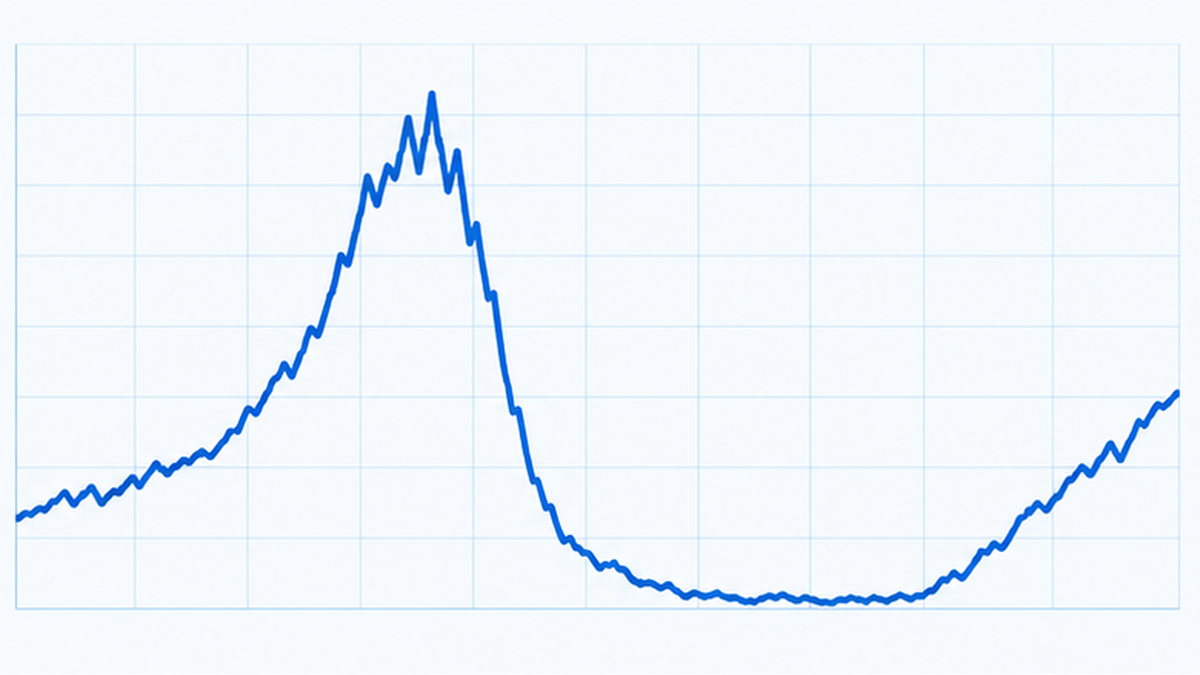
Japan's Japanese sardine catch hit an all-time high of 4.48 million tons in 1988, then went into a downward spiral through the 1990s, falling below 100,000 tons in the early 2000s. It began recovering in the 2010s, and by 2024 the stock had rebuilt to roughly 4 million tons. Behind this wild swing lies a cyclical shift in sea temperature and atmospheric circulation, and the differing survival strategies of the fish that respond to it.
This article explains the mechanism of "species alternation," in which Japanese sardine and anchovy alternately dominate, the climate system that drives regime shifts, the ripple effects on the food web — including whales and seabirds — and the impact on fishing businesses and resource management, drawing on data published by the Fisheries Agency and the Japan Fisheries Research and Education Agency. It also touches on similar phenomena observed worldwide, from off Peru to the west coast of North America, showing that regime shifts are not a local coincidence but a natural rhythm rooted in the planet's climate system.
What you'll learn in this article
- The decades-long history of boom and bust in Japanese sardine stocks
- How a "regime shift" abruptly transforms the climate and marine ecosystem
- The relationship between the Aleutian Low, the Pacific Decadal Oscillation (PDO), and stock size
- The mechanism behind "species alternation" between sardine and anchovy
- Ripple effects on the food web (whales, seabirds, large fish) and on fishing businesses
- The latest stock assessments (2024-2026) and outlook
The sardine catch rollercoaster: from the 1988 peak to collapse, and back
Japan's Japanese sardine catch rose rapidly from the 1970s, reaching an all-time high of 4.48 million tons in 1988. Landings were so strong at the time that the period was called the "sardine boom" — but the situation soon reversed completely.
| Year | Nationwide sardine catch (approx.) | Status |
|---|---|---|
| 1988 | Approx. 4.48 million tons | All-time high, "sardine boom" |
| 1993 | Approx. 1.71 million tons | Sharp drop to about 1/3 of the peak |
| Around 2002 | Under 100,000 tons | Collapse-level low |
| 2011 | Approx. 176,000 tons | Signs of recovery |
| 2016 | Approx. 375,000 tons | Recovery trend becomes clear |
| 2024 | Stock size approx. 4 million tons | Stock has recovered, but overfishing is a concern |
Falling to a third of its peak in just five years, and to a few percent of its best years within a little over a decade — such a rapid, large-scale change cannot be explained by overfishing or pollution alone. This is where the key term from climate oceanography, "regime shift," comes in.
Fortunes diverged across fishing regions nationwide
During the sardine boom of the 1980s, sardine fishing thrived at major ports from Hokkaido to Kyushu, with the catch processed into canned goods, dried fish, and aquaculture feed (fishmeal), among other uses. But during the sharp decline of the 1990s, regions that had depended most heavily on sardines suffered the biggest drops in landing value, triggering a wave of processor closures and fishing-boat decommissioning. The scale of this damage to local economies was itself one of the factors that spurred regime-shift research.
On the other hand, once the stock bottomed out in the 2000s, the pace of recovery was far from uniform. Distinct stocks (populations of the same species with different spawning grounds and migration routes) exist along the Pacific coast, the Sea of Japan coast, and the Seto Inland Sea, each showing different timing and trends. This article focuses mainly on the Pacific stock, for which the most complete published data are available.
The numbers behind the feeling that "sardines disappeared"
Many people across Japan likely felt that "sardines vanished from the table" from the late 1990s into the early 2000s. Indeed, the nationwide catch during this period fell to just a few percent of its peak level. This affected the supply of raw material for processed products such as dried sardines and small dried fish, and some processors switched to imported ingredients during this time. Conversely, in the recent recovery phase, many consumers may have noticed sardine sashimi and dried sardines appearing more often at supermarkets. This everyday, dinner-table experience is perhaps the most familiar face of the larger oceanic phenomenon known as a regime shift.
What is a regime shift? A decades-scale "regime change" in the sea
A regime shift refers to a phenomenon in which the physical marine environment — sea temperature, currents, nutrient distribution, and so on — abruptly and persistently switches to a different state at a certain point. The theory was formulated in the 1980s after Fisheries Agency researchers of the time discovered a worldwide synchrony in Japanese sardine catches and linked it to abrupt climate "jumps."
"Species alternation": the other face of regime shifts
The most representative expression of a regime shift is "species alternation." A seesaw relationship has repeatedly been observed across ocean regions worldwide: Japanese sardine tends to dominate during cold regimes, while anchovy dominates during warm regimes.
Key points about regime shifts
- The change is not gradual — it is an abrupt "regime change" that occurs within a few years
- Once the switch happens, the new state tends to persist for decades
- It affects not only sardine and anchovy but many other pelagic species, including saury, mackerel, and squid
- Long-term monitoring continues, led by the Japan Fisheries Research and Education Agency (formerly the Fisheries Research Agency)
Discovered through a "worldwide synchrony"
The starting point for regime-shift theory was the discovery in the 1980s that catches at the world's major sardine fishing grounds — not just off Japan, but off Peru, off California, and off South Africa — rose and fell at almost the same time. If the cause were overfishing or pollution confined to a single sea area, there would be no way to explain simultaneous changes across such geographically distant regions. This "global synchrony" became a crucial clue pointing to planet-scale climate change as the underlying driver.
Subsequent research analyzing historical records and fossilized fish scales in seafloor sediment cores has shown that dramatic swings in sardine stocks occurred repeatedly for centuries before modern fishing even began. In other words, regime shifts are not something created by human fishing activity — they are a natural rhythm already built into the Earth's climate system.
The "unpredictability" that has vexed ocean researchers
Even as the concept of regime shifts has become widely accepted, predicting exactly "when" and "in which direction" the next shift will occur remains far from easy. Past data suggest a rough cycle of 20 to 30 years, but the length and amplitude of that cycle are not constant, so simple calendar-based predictions are not possible. Researchers therefore continuously monitor multiple environmental indicators — sea temperature, currents, plankton abundance — to try to catch early signs that a regime is beginning to turn.
Why the switch happens: the Aleutian Low, the PDO, and the survival of eggs and larvae
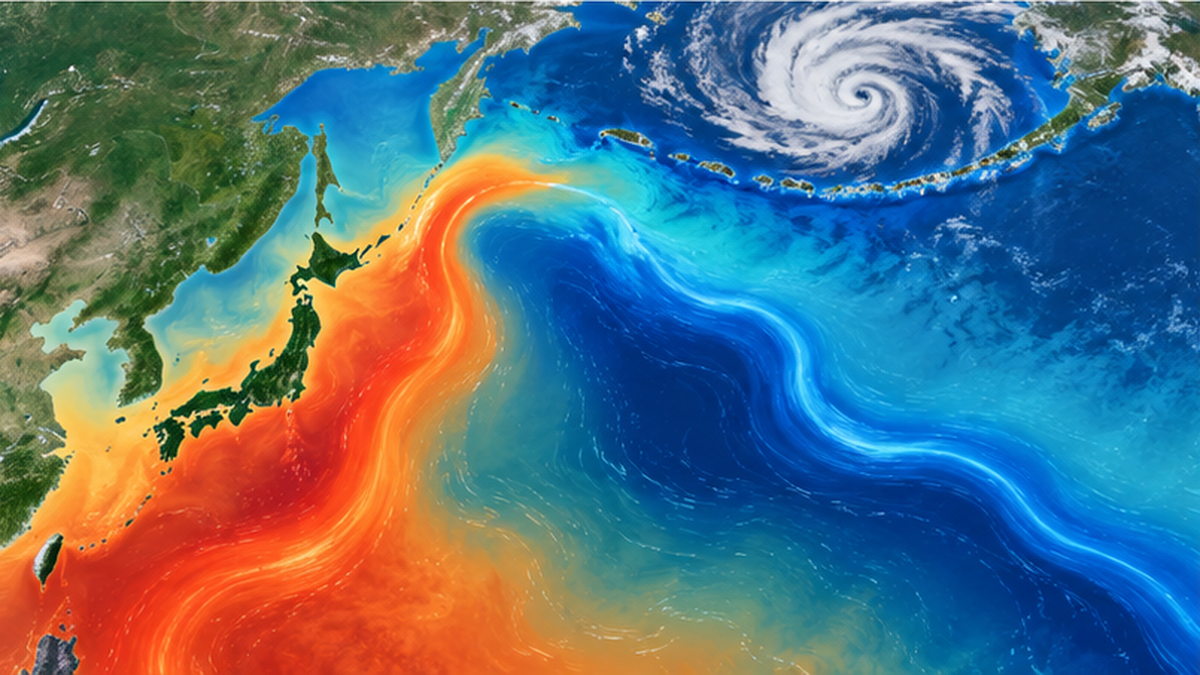
The main climate systems that drive regime shifts are the "Aleutian Low" over the North Pacific and the "Pacific Decadal Oscillation (PDO)," a decades-scale fluctuation in sea surface temperature. Sardine stocks tend to increase during cold periods when the Aleutian Low is strong, and to decline when the Low weakens and the ocean turns warmer.
Sea temperature changes both "food" and "chances of survival"
A single Japanese sardine lays tens to over a hundred thousand eggs at a time, but most die at the larval stage. The proportion that survives (early survival rate) depends heavily on the abundance and distribution of zooplankton, which in turn shifts with water temperature and currents. In cold regimes, the paths of the Kuroshio and Oyashio currents and patterns of upwelling — where nutrient-rich deep water rises toward the surface — tend to favor sardine's feeding environment; in warm regimes, conditions are thought to favor anchovy instead.
The same phenomenon on the North American west coast
This species alternation is not unique to waters around Japan. Along the California Current off North America, a regime shift in 1976-77 is reported to have flipped dominance from anchovy to sardine, and the correspondence between PDO phase and stock fluctuations has been confirmed on a scale spanning the entire Pacific.
Even spawning grounds can shift
Changes in sea temperature also affect where sardines choose to spawn. In years when the Kuroshio meanders far offshore versus years when it hugs the coast, eggs and larvae are transported to different sea areas, changing whether they end up in feeding grounds suitable for their later growth. In stock assessments, simulations of these shifts in spawning location and transport processes are used as important information for forecasting future recruitment — the number of young fish newly joining the stock.
Why sardine and anchovy alternate like a seesaw
Sardine and anchovy look similar, but they differ in how they feed and in their spawning strategies. Sardine can efficiently use phytoplankton as well as large zooplankton, while anchovy tends to prefer a narrower range of temperature and prey conditions. This ecological difference is thought to be one reason why one or the other gains the advantage when the environmental regime switches.
- Cold regime (strong Aleutian Low): favors sardine, and stock size increases
- Warm regime (weak Aleutian Low): favors anchovy, and sardine declines
- The two species rarely peak at exactly the same time, and tend to alternate in dominance
That said, this is not a simple one-to-one swap; it is intertwined in complex ways with fluctuations in other pelagic stocks such as mackerel and squid. It is closer to an image of the entire marine ecosystem reorganizing itself in response to the climate regime.
Sometimes both decline at once
Sardine and anchovy do not always sit neatly at opposite ends of a seesaw. During transition periods when conditions are unfavorable for both species, there are known periods when both stocks decline simultaneously. Conversely, favorable conditions for both species can temporarily overlap. The actual pattern of stock fluctuation is more complex than the textbook seesaw image.
| Comparison | Japanese sardine | Anchovy |
|---|---|---|
| Main food | Uses both zooplankton and phytoplankton | Mainly zooplankton, somewhat narrower food preference |
| Favorable temperature regime | Cold regime | Warm regime |
| Body size / lifespan tendency | Relatively large, long-lived | Relatively small, short-lived |
| Fluctuation characteristics | Dramatic swings of tens-fold scale | Tends to fluctuate in the opposite phase to sardine |
A "domino effect" that also involves mackerel and squid
In addition to the sardine-anchovy alternation, other pelagic stocks such as chub mackerel, spotted mackerel, and Japanese flying squid are also known to fluctuate in step with climate-regime shifts. When one species' stock declines, the food and habitat space it had been using can free up, giving a boost to another species. This kind of "domino effect" in resource alternation shows that the marine ecosystem is a complex system driven by multiple species and multiple factors, not a single cause.
Ripple effects on the food web: whales, seabirds, and large fish
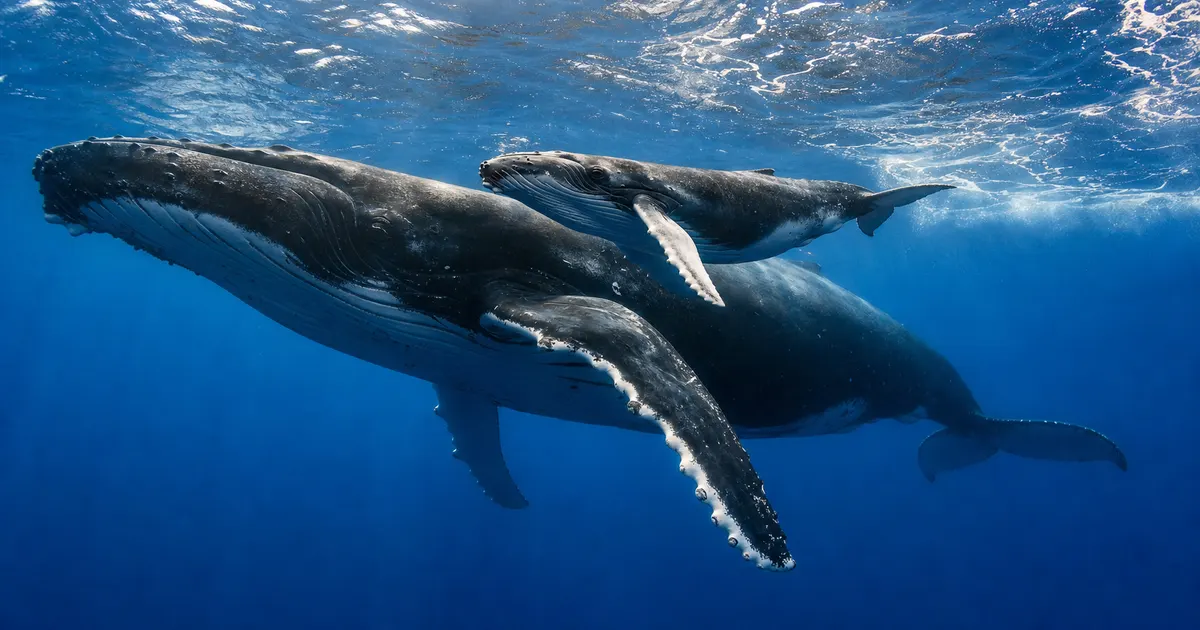
Japanese sardine plays an outsized role as "food" within the marine ecosystem — it is a textbook example of a forage fish. Its habit of forming enormous schools is also thought to be a strategy for feeding efficiently while defending against predators. When stock size drops to a fraction of its former level, it also affects the distribution and breeding success of large predators that feed on it — whales, dolphins, seabirds, tuna, and skipjack.
When prey disappears, predators move on
Sea areas rich in sardine tend to attract whales, skipjack, and other migratory predators that follow the fish. Conversely, in areas where sardine has collapsed, these predators may shift their distribution in search of other prey — sometimes changing which species fisheries end up targeting.
The relationship between seabird breeding success and sardine stock size is another topic being studied across the world's upwelling zones. Off Peru, guano birds (such as boobies and cormorants) have long been known to see their populations swing dramatically with anchovy stock size — a classic example of how the abundance of prey fish directly affects seabird survival and breeding. In waters around Japan too, it has been suggested that fluctuations in pelagic stocks, including sardine, may affect the distribution and behavior of seabirds and small cetaceans.
Points to remember
- Japanese sardine is a crucial "middle layer" supporting the marine food web
- Fluctuations in its stock ripple outward to affect the distribution of predators (whales, seabirds, large fish)
- It often fluctuates in tandem with other pelagic stocks, such as saury and squid
Indirect effects that reach our dinner tables
Fluctuations in sardine stocks are not unrelated to our dinner tables. Sardine is not only consumed as dried fish, canned goods, and fresh fish — it is also used as a raw material for aquaculture feed (fishmeal and fish oil), so changes in its abundance also ripple through aquaculture costs. It has also been pointed out that this can indirectly affect the catch of familiar table fish such as skipjack, tuna, and yellowtail, which prey on sardine.
Impact on fisheries: volatile catches and the difficulty of resource management
Stock fluctuations driven by regime shifts pose a major risk to fishing businesses. In ports where sardine fishing once thrived, many fishers were forced to close or switch businesses during periods of stock collapse. Conversely, in the recent recovery phase, a surge in landings has at times outpaced processing and distribution capacity.
Even when stocks grow, overfishing remains a risk
The Japan Fisheries Research and Education Agency has warned that continuing to apply excessive fishing pressure even while stocks are increasing risks hastening the next downturn or making its decline steeper. In fact, in recent years there have been years when recommendations were made to curb catches of the Pacific stock of Japanese sardine, underscoring the importance of setting and observing an Allowable Biological Catch (ABC) based on stock assessments.
Behind such recommendations lies a structural factor: fishers' appetite for investment tends to grow, and vessels and gear tend to expand, precisely during periods when stocks are trending upward. But a regime shift is bound to reverse eventually. Excessive capital investment during an upswing can become a heavy burden on fishing businesses during the subsequent downturn. Both long-term catch management and sound business judgment are essential for sustainable fisheries.
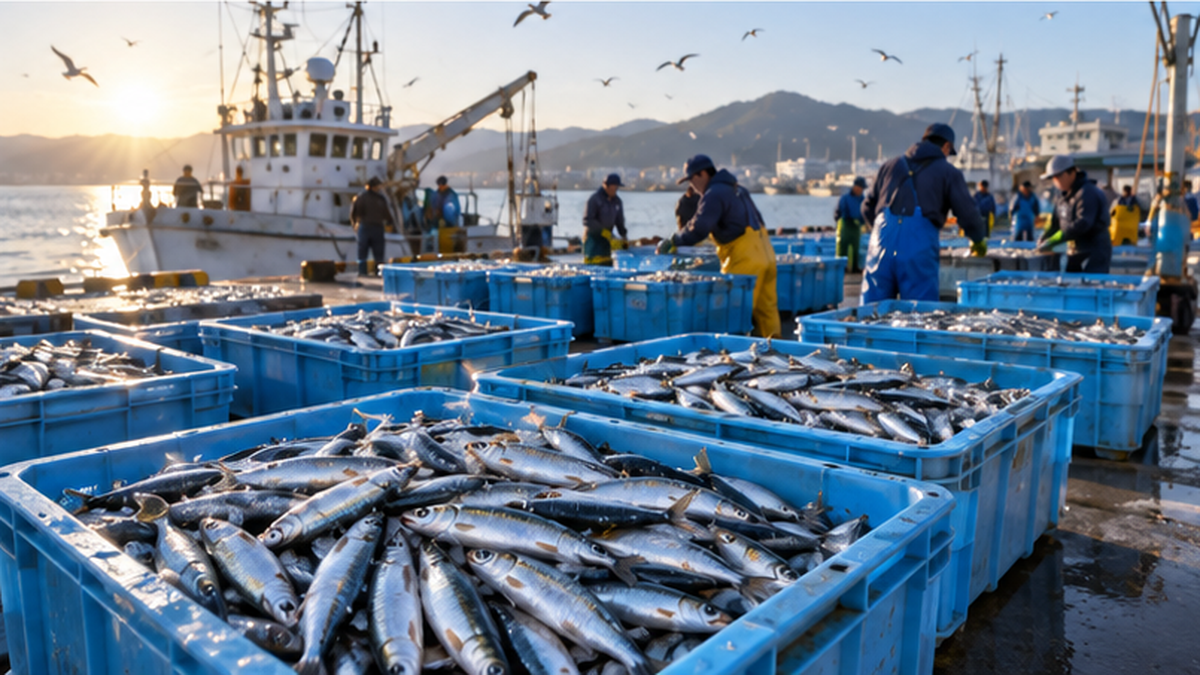
For these reasons, long-term resource management that assumes regime shifts will occur — not overfishing during good years, and softening the rebound during lean years — has become an indispensable perspective for sustainable fisheries. The recent poor catches of saury and squid linked to rising sea temperatures offer another angle on this same theme of resource fluctuation.
Cooperation between fishers and research institutions underpins management
In managing pelagic stocks like sardine, day-to-day landing data and on-the-water observations from fishers are a vital data source that improves the accuracy of research institutions' stock assessments. Conversely, the stock assessments and ABC outlooks provided by research institutions serve as material fishers use to decide on gear and fishing plans. Whether this two-way flow of information functions well is what determines whether the industry can ride out the rough waters of a regime shift.
Even during a phase of stock increase, restrained catch management informed by past lessons leads to long-term stock sustainability.
— Paraphrased from Japan Fisheries Research and Education Agency stock-assessment materials
Processors and distributors also need flexibility
Sharp increases or decreases in the stock also have a major impact on processors and distributors, not just fishers. During a sharp decline, raw-material shortages can shrink processing lines and push companies toward imported ingredients; during a sharp increase, landings can exceed freezing and processing capacity, causing prices to crash and fish to go unused. In recent years, efforts have been made to smooth out these swings — for example, by using frozen inventory and planning operations based on demand forecasts.
Current stock status and the latest outlook (2024-2026)
According to stock assessments by the Japan Fisheries Research and Education Agency, the Pacific stock of Japanese sardine was estimated at roughly 4 million tons as of 2024. That is a major recovery compared with assessments that once put the stock at around 50,000 tons, but recruitment (the number of young fish newly joining the stock) has reportedly been trending downward in recent years, raising the possibility that the stock has already passed its peak.
Catch outlook for 2026
Long-term fishing-condition forecasts continue to be updated regarding the outlook for Pacific sardine-type species in 2026, and discussions of the Allowable Biological Catch (ABC) based on stock assessments take place every year. A management approach that gradually adjusts fishing pressure has been adopted in preparation for the possibility that the stock enters a downturn.
| Period | Stock and catch status |
|---|---|
| 2011-2016 | Recovery trend in both stock and catch becomes clear |
| Early 2020s | Stock recovers to a scale of several million tons |
| 2024 assessment | Stock about 4 million tons; recruitment noted to be trending downward |
| 2025 | Japan Fisheries Research and Education Agency expresses concern over overfishing |
How the Allowable Biological Catch (ABC) is decided
Each year's stock assessment combines egg and larval distribution surveys, landing data from fisheries, and ocean observation data to estimate stock size, and from this an Allowable Biological Catch (ABC) is calculated for the following year. Scenario analyses looking roughly ten years ahead are also carried out, showing the probability that the stock will exceed management targets if current catch levels continue. This kind of scientific assessment process underpins the shift from an instinctive "catch as much as possible" approach to management-based fishing that is mindful of stock sustainability.
What a declining recruitment trend signals
The declining recruitment trend noted in the 2024 stock assessment means that, even though the stock size itself remains high, the supply of young fish that will carry the next generation is beginning to thin. Whether this decline in recruitment is a temporary fluctuation or an early sign of a shift toward the next regime change will become clearer as data accumulates over the coming years. This question of "how to identify a stock's peak" is an important challenge shared not just by sardine but by the management of many fishery resources.
Regime shifts in the age of climate change: what lies ahead
As global warming progresses, how the traditional periodic pattern of regime shifts will change is an important research topic for understanding the relationship between climate change and fishery resources. A general rise in sea temperature and more frequent marine heatwaves could alter the very framework of "cold regime" versus "warm regime."
The worry that "cold regimes" may stop returning
Traditional regime-shift theory has assumed that cold and warm regimes alternate every few decades. But as the ocean's overall average temperature rises, the temperature levels that once defined a "cold regime" favorable to sardine may become harder to reach at all. If that happens, researchers are discussing scenarios in which sardine stocks may struggle to recover to past high levels in the future, or in which recovery periods become shorter.
Links to distribution shifts across migratory species
In recent years, warm-water species such as yellowtail and Spanish mackerel have been shifting their distribution northward, while poor catches of saury and squid continue — meaning that changes in stock size and distribution range are happening simultaneously across pelagic and migratory species other than sardine. As changes on the regime-shift timescale and the global-warming timescale overlap, predicting future stock-fluctuation patterns is becoming increasingly complex.
Points to keep in mind
- Regime shifts are a natural phenomenon, but overfishing on top of them risks undermining a stock's resilience
- Research is examining whether global warming could change the very cycle length or amplitude of regime shifts
- It is important to view this not as a single-species issue, but as a change affecting the marine ecosystem as a whole
Research into "predictability" is advancing
Precisely predicting when the next regime shift will occur remains difficult, but research is advancing on detecting early signs of which direction the next regime is heading, using sea-temperature and current data from observation satellites and buoys, along with machine-learning models of stock fluctuation. Improving this predictive accuracy is also becoming an important information base for fishers making decisions about fishing plans and capital investment.
Conclusion: viewing the ocean on a decades-long timescale
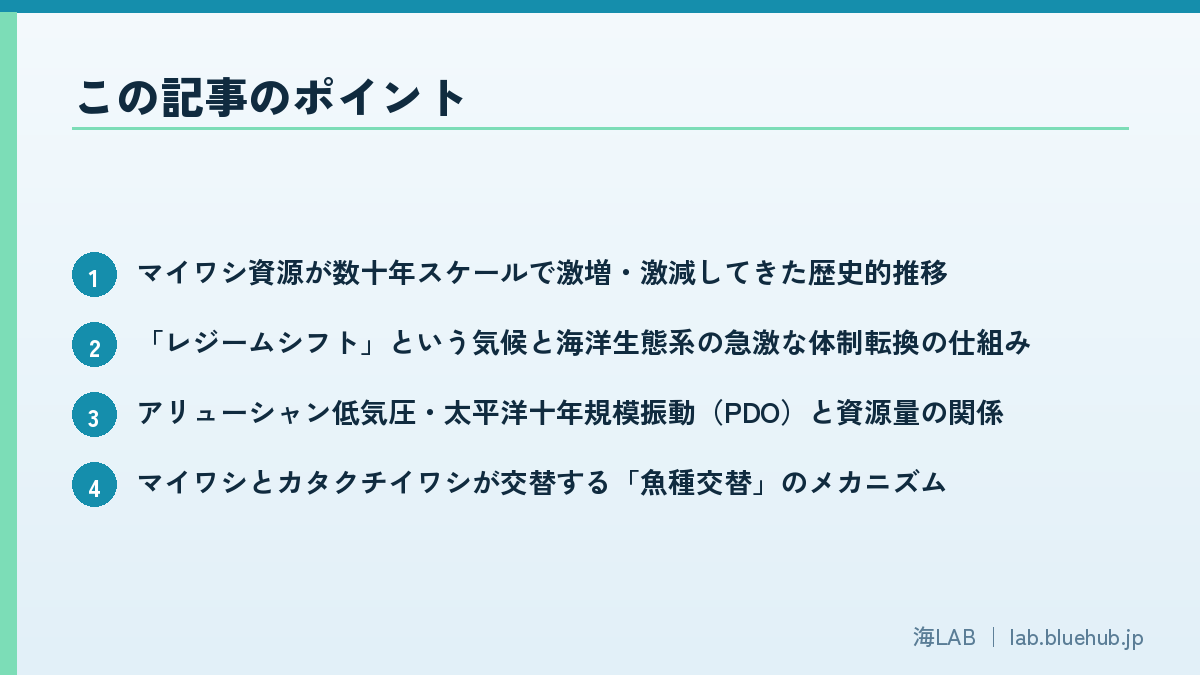
The boom and bust of Japanese sardine is not a matter of a single good or bad year — it is part of the larger rhythm of a "regime shift," in which the marine environment itself flips over on a decades-long scale. Changes in climate systems such as the Aleutian Low and the PDO ripple outward through the sardine-anchovy alternation to affect the food web and fishing businesses alike.
Reading long-term data to identify which phase the stock is currently in, and continuing to manage catches responsibly even during an upswing, is the key to softening the impact of the next downturn. For us as consumers, choosing sardine with an awareness of its season and stock status is a small step toward living alongside the ocean's fluctuations.
Learning about regime shifts through a familiar fish like the sardine is also a gateway to appreciating how closely the marine environment, the climate system, and human society are intertwined. Adopting a view of the ocean on a decades-long timescale is essential for thinking about how we will engage with fishery resources going forward.
The same pattern seen worldwide: Peru, South Africa, California
Dramatic fluctuations in sardine and anchovy stocks are observed in common across the world's upwelling zones — sea areas where nutrient-rich deep water rises to the surface. In addition to waters around Japan, the Humboldt Current off Peru and Chile, the Benguela Current off South Africa and Namibia, and the California Current off North America are known as the world's four major upwelling zones, and each has sustained large-scale fisheries for sardine-type species or their close relatives.
Peru's anchovy stocks and El Niño
The anchoveta fishery off Peru is known as one of the world's largest single-species fisheries, but in years when El Niño occurs, sea temperature rises and upwelling weakens, repeatedly causing sharp declines in stock and catch. El Niño differs from a regime shift in timescale — it operates over just a few years — but it is a good example of the shared mechanism by which temperature changes affect pelagic stocks.
A "seesaw" common to the world's four major upwelling zones
In the Benguela Current off South Africa and in the California Current, sardine-type and anchovy-type species have also been reported to alternate in dominance on a decades-long scale, and research shows a tendency for the phase of stock fluctuation to align across these geographically distant regions. The fact that similarly timed fluctuations occur in waters around Japan and along the North American west coast, separated by the entire Pacific Ocean, supports the view that regime shifts are not a local phenomenon but one linked to planet-scale atmospheric and oceanic circulation.
The need for international cooperation on resource management
Sardine-type and anchovy-type species often range and migrate across multiple countries' exclusive economic zones, so resource management by a single country alone has its limits. International bodies such as the Food and Agriculture Organization of the United Nations (FAO) have repeatedly stressed the importance of sharing stock-assessment data across countries and building joint monitoring systems for such shared resources. Findings from Japan's sardine research are sometimes referenced as a model case for resource management in other upwelling zones.
Upwelling zones worldwide and sardine-type fluctuations
- Waters around Japan (Kuroshio/Oyashio system): species alternation between sardine and anchovy
- Off Peru and Chile (Humboldt Current): a pronounced relationship between anchovy stocks and El Niño
- Off South Africa and Namibia (Benguela Current): a seesaw between sardine-type and anchovy-type species
- North American west coast (California Current): the 1976-77 regime shift is a famous example
References and sources
- Fisheries Agency of Japan, "Japanese Jack Mackerel and Japanese Sardine" - Resource management approach and trends
- Fisheries Agency of Japan, "Changes in the Marine Environment and Their Relation to Fishery Resources" - Explanation from the Fisheries White Paper
- Fisheries Agency of Japan, "Japanese Sardine (Pacific Stock)" stock-assessment materials - Published data including the catch trend chart
- Japan Fisheries Research and Education Agency, "FY2024 Stock Assessment of the Pacific Stock of Japanese Sardine" - Detailed assessment of stock and recruitment
- Japan Fisheries Research and Education Agency, "FY2025 Status of International Fishery Resources" - Overview of global fishery resource status
- Ocean Policy Research Institute, Sasakawa Peace Foundation, "Resource Fluctuations and the Marine Ecosystem: The Case of Japanese Sardine" - Explanation of regime-shift research
- AIRIES, "Changes in Resource Dynamics and Distribution of Migratory Fish and Shellfish Due to Climate Change" - Paper published in the journal Global Environment
- PNAS, "Climate, fishing, and fluctuations of sardine and anchovy in the California Current" - Research on species alternation in the California Current off North America
* Listed in order of reliability: government and academic institutions > peer-reviewed papers > specialized institutions > reputable media