⚡ The answer in 30 seconds
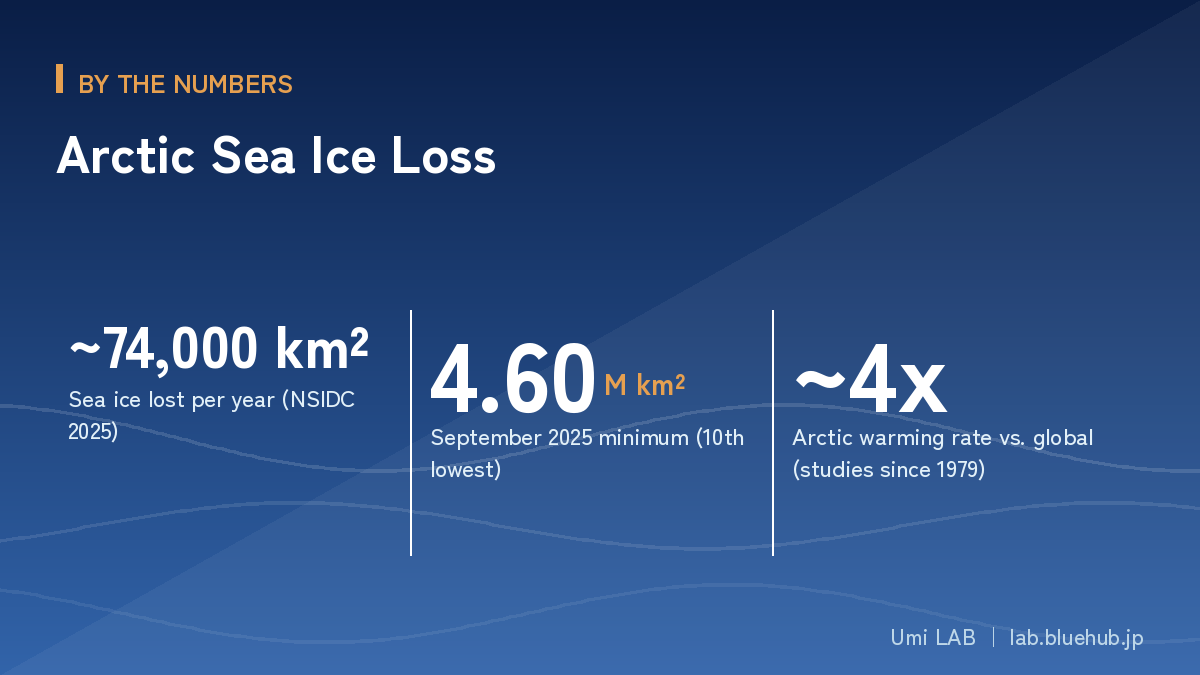
- Arctic sea ice has declined by about 74,000 km² per year since satellite observations began in 1979.
- The food web starting with ice algae is changing, and boreal fish are moving north in the Bering and Barents Seas.
- An international agreement (Japan is a party) has prevented commercial fishing in the central Arctic high seas since 2021 until stocks are surveyed.
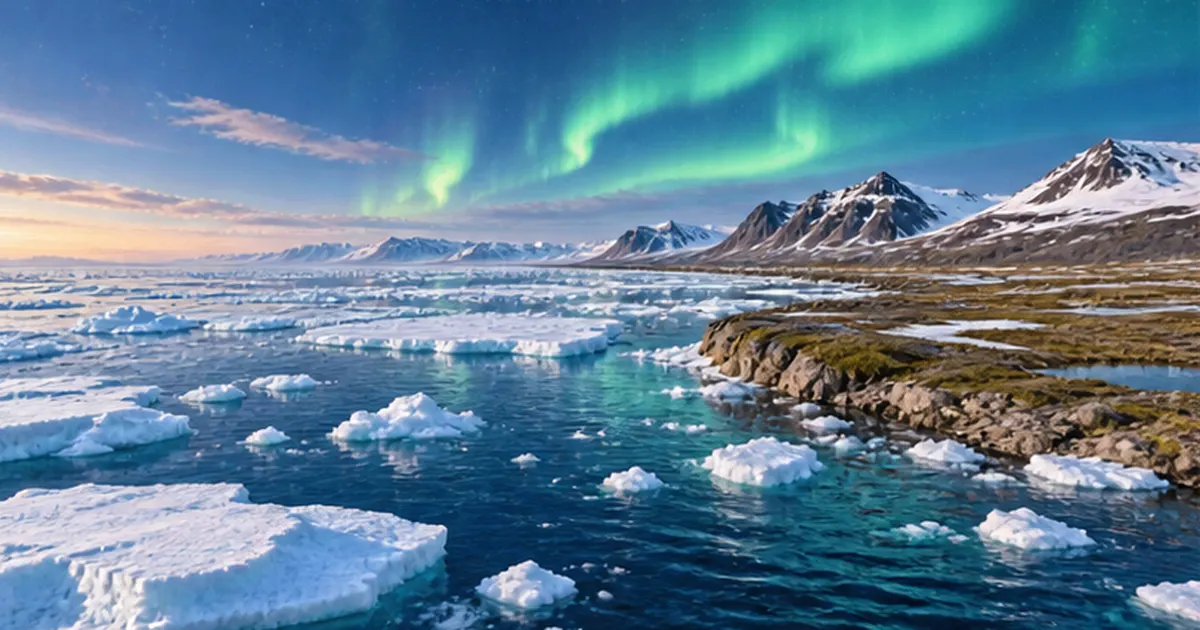
Arctic sea ice is changing at a pace rarely seen in the observational record. Since satellite observations began in 1979, the ice area has declined by about 74,000 km² per year — roughly the area of Hokkaido disappearing every year.
Sea ice is not just ice: it is the foundation of an ecosystem that supports everything from ice algae to fish, seals and polar bears. As that foundation grows thinner and smaller, change is spreading to fish distributions, fisheries, shipping routes and international rules.
Based on primary sources such as NSIDC, JMA and NOAA, this article lays out how Arctic sea ice loss affects ecosystems and fisheries.
What you will learn in this article
- How much Arctic sea ice has declined over the long term
- Why the Arctic warms faster than the global average
- The Arctic food web that starts with ice algae, and how it is changing
- Borealization — fish moving north — and its effect on fisheries
- The Central Arctic Ocean fisheries agreement and international rules for the Northern Sea Route
What is happening to Arctic sea ice?
The long-term decline seen by satellites
Arctic sea ice has been shrinking over the long term since satellite observations began in 1979. According to the 2025 analysis by the U.S. National Snow and Ice Data Center (NSIDC), the linear rate of loss is about 74,000 km² per year — roughly the area of Hokkaido (about 83,000 km²) disappearing every year. The 2024 analysis put the decline at 12.4% per decade relative to the 1981–2010 average.
Sea ice follows a seasonal rhythm, reaching its maximum around March and its minimum around September. The end-of-summer minimum is watched as a gauge of the Arctic's health that year. The 2025 minimum was 4.60 million km² on September 10, tied with 2008 and 2010 as the tenth lowest in the 47-year satellite record. The lowest on record was in 2012.
Arctic sea ice in numbers
- September 2025 minimum: about 4.60 million km² (tenth lowest on record; NSIDC)
- Linear rate of loss: about 74,000 km² per year (NSIDC 2025 analysis)
- The 19 years from 2007 to 2025 are the 19 lowest minimum extents in the satellite record
- The winter 2025 maximum extent was the smallest on record (NOAA Climate.gov)
Japan's Meteorological Agency also monitors it
In Japan, the Japan Meteorological Agency (JMA) monitors Arctic sea ice extent using satellite data and publishes the results every year in its Climate Change Monitoring Report. The 2021 annual minimum was 4.71 million km² on September 11, the 12th smallest since 1979. Whether analyzed in Japan or the U.S., the conclusion is the same: sea ice is declining over the long term.
Why are there years when it does not seem to decline?
One point is easy to misunderstand. In its 2025 analysis, NSIDC noted that although 2007–2025 were the 19 lowest extents in the satellite record, there has been no statistically significant trend in the September minimum over this period alone. After extreme years such as 2012, the minimum has fluctuated at a low level.
This does not mean warming has stopped. Sea ice is strongly affected by year-to-year weather variability, so trends are hard to see over short periods. Over the full record (since 1979) the decline is clear, and the fact that the minimum has settled at a low level is itself a major change.
| Indicator | Value | Source |
|---|---|---|
| September 2025 minimum | About 4.60 million km² (10th lowest) | NSIDC |
| Linear rate of loss | About 74,000 km² per year | NSIDC |
| Decline per decade (2024 analysis) | 12.4% (vs. 1981–2010 average) | NSIDC |
| 2021 minimum | 4.71 million km² (12th lowest) | JMA |
Why is the Arctic warming faster than the world?
Arctic amplification
The Arctic is warming faster than the global average. This phenomenon is called Arctic amplification, and one study (Rantanen et al. 2022) found that since 1979 the Arctic has warmed about four times faster than the globe. The ratio differs depending on the method, but many studies agree the Arctic clearly outpaces the global average.
Less ice, more heat absorbed: the albedo feedback
The biggest factor is the change in albedo (reflectivity). White sea ice reflects most sunlight back to space, but when ice melts and dark ocean surface is exposed, it absorbs light and the water warms. Warmer water melts more ice — a self-reinforcing loop that accelerates change in the Arctic.
- Sea ice melts and the reflective white area shrinks
- The dark ocean absorbs sunlight and its temperature rises
- The warmer sea delays new ice formation, so even more ice is lost
The quality of the ice is changing too
Not only the area but also the thickness and age of the ice are changing. The central Arctic Ocean used to be covered by thick multi-year ice that survived many summers. Today thin first-year ice makes up a larger share and is easily broken by summer heat and storms. Because thin ice melts easily, the same temperature rise causes a larger loss of area.
Key point
- Changes in the Arctic do not stay in the Arctic. Research is examining how less sea ice may affect atmospheric circulation and ocean currents, which are not unrelated to Japan's weather and fisheries. Related: The slowdown of the Atlantic circulation (AMOC)
The ecosystem under the ice: a food web that starts with ice algae
A second "meadow" on the underside of the ice
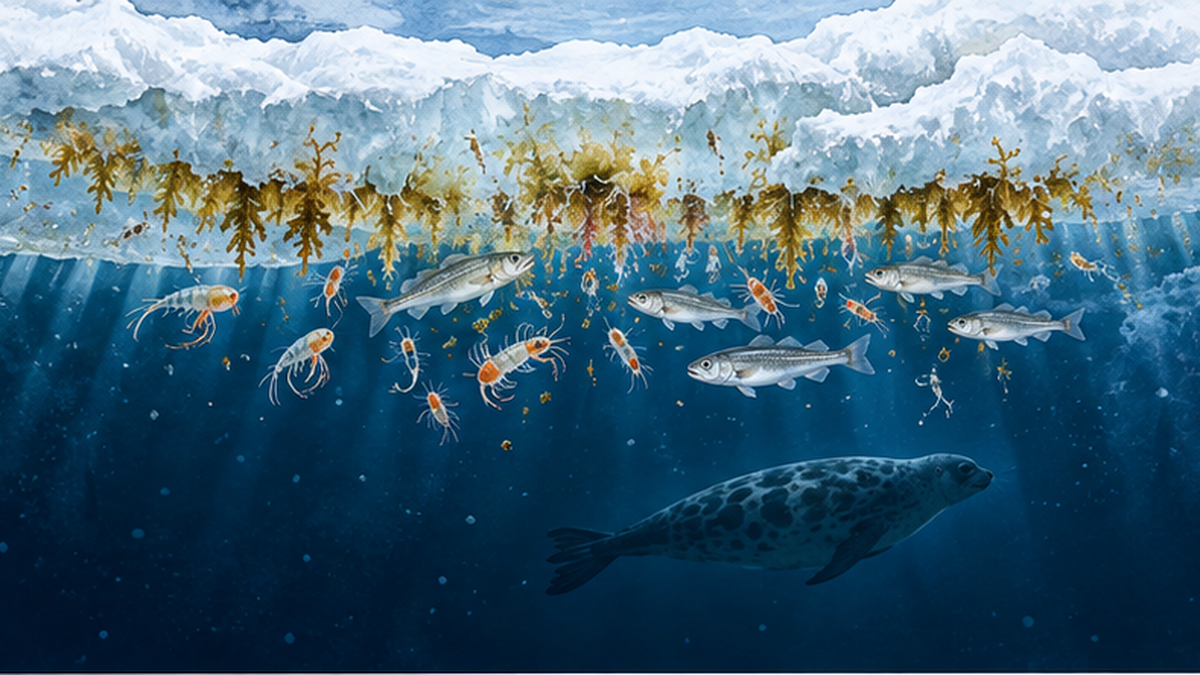
Arctic sea ice is not just a slab of ice. On the underside and in the tiny channels inside the ice, a type of phytoplankton called ice algae grows, using the first light of spring to start photosynthesis. Before plankton in the open water begin to bloom, ice algae serve as a vital first food for zooplankton and juvenile fish.
The share of Arctic primary production contributed by ice algae varies by estimate. One review cites 3–25% of the total and 50–57% in parts of the high Arctic. A 2012 study in the central Arctic Ocean reported that ice algae accounted for up to 60% of primary production at the end of summer (August–September).
Creatures linking the top and bottom of the ice
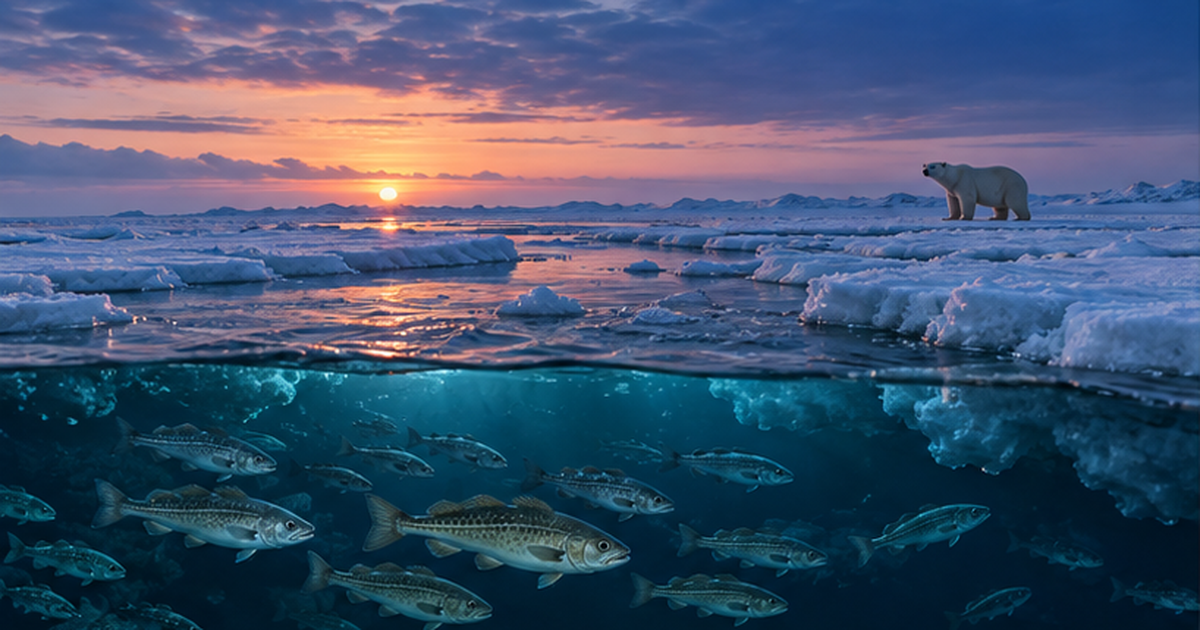
- Polar cod: gathers under the ice and feeds on zooplankton. It is a middle link in the Arctic food web, connecting plankton to seals, seabirds and whales.
- Polar bears and seals: use ice for hunting, giving birth and resting. When ice forms later and melts earlier, the time they can use it gets shorter.
- Walruses: use ice floes for resting. When the ice retreats far from the coast, they must rest far from their feeding grounds.
Research shows that polar cod survival is closely tied to ice cover and water temperature. One study warns that if ice loss and warming continue at the current pace, recruitment (the number of new young fish) could collapse. If the food web that begins with ice algae weakens, the many species above it will be affected.
With less ice, will phytoplankton actually increase?
Surprisingly, in some areas less ice lets more light reach the water and phytoplankton production in the water column may increase. However, the extra production is not necessarily used efficiently by the food web. If the timing of the plankton bloom and the breeding of the zooplankton that eat it become mismatched, the ecosystem as a whole can become unstable. As the system shifts from an ice-algae-based food web to a plankton-based one, some species are expected to gain and others to lose.
Caution
- "More plankton" does not necessarily mean "a richer ecosystem." Who can use it, when, and how much — the timing — determines the stability of the food web.
Fish move north: borealization and fisheries
What happened in the Bering Sea
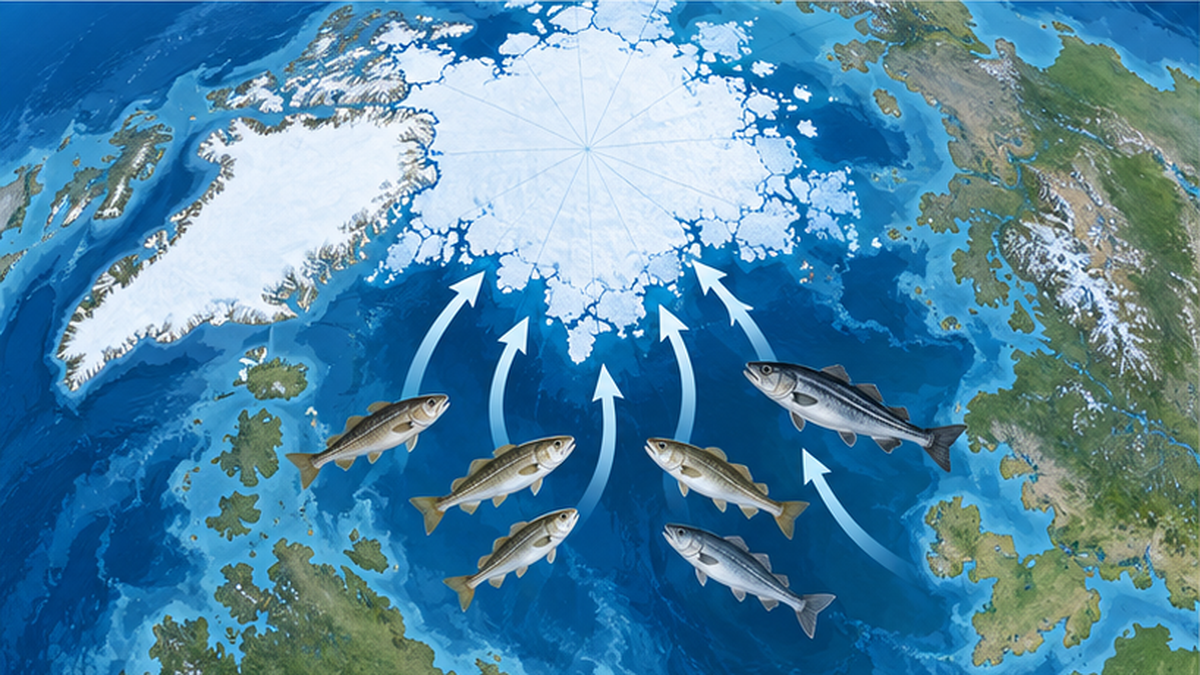
When sea ice and the cold bottom water (the "cold pool") decline, fish from the south move north. A NOAA Arctic report links the northward shift of the northern edge of walleye pollock and Pacific cod between 2010 and 2017–18 to changes in bottom-water temperature and sea ice loss. According to Franz Mueter of the University of Alaska Fairbanks, Pacific cod, which avoid the cold bottom layer, moved as far north as the Bering Strait after the cold pool disappeared in 2017–2019. Russia has already established a pollock fishery in the Chukchi Sea. Meanwhile, the United States has a moratorium on commercial fishing in its federal waters north of the Bering Strait.
The Barents Sea: Arctic fish decline, boreal fish increase
Similar changes have been observed in the Barents Sea. A Norwegian-Russian assessment found that boreal species such as cod, beaked redfish and long rough dab increased in abundance from 2004 to 2012, while Arctic species such as Greenland halibut declined. This shift of Arctic fish communities toward more temperate ones is called borealization. It has also been noted that boreal generalists moving north create many new feeding links with resident species.
| Sea area | Observed change | Source |
|---|---|---|
| Bering and Chukchi Seas | Pollock and Pacific cod move north; Russia starts a fishery in the Chukchi Sea | NOAA Arctic report, etc. |
| Barents Sea | Boreal species such as cod increase, Arctic species decline (2004–2012) | Norwegian-Russian assessment |
| Central Arctic Ocean | High seas at high latitude; no commercial fishing | Central Arctic Ocean fisheries agreement |
The connection to Japan's dining table
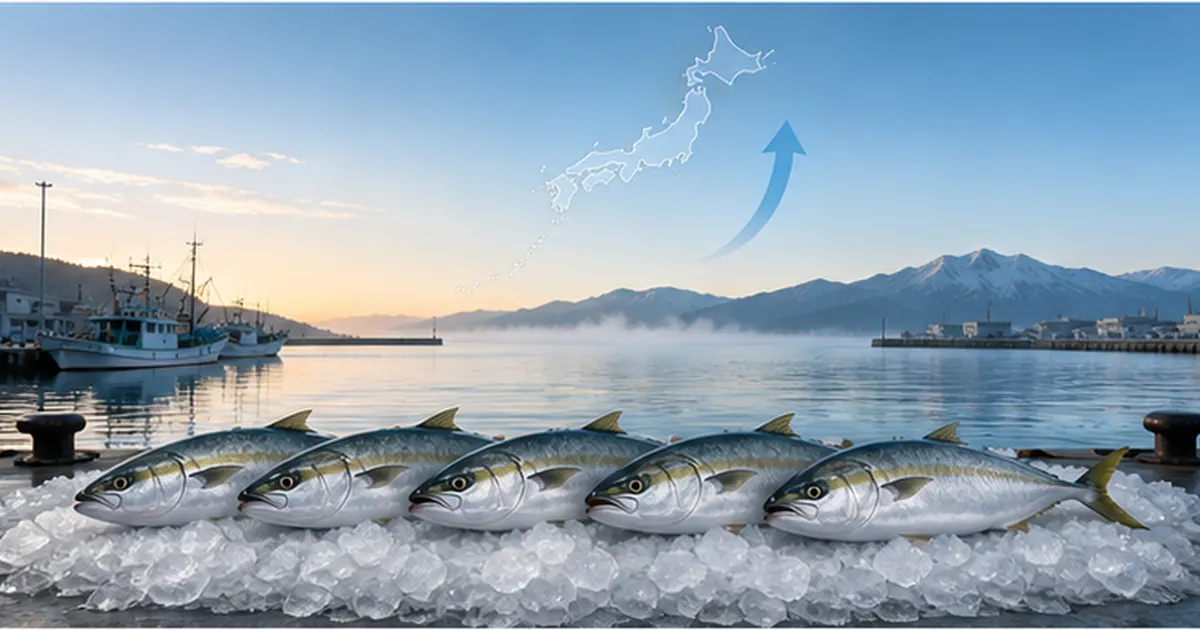
Japan does not directly fish in the Arctic, but Pacific salmon and walleye pollock (the raw material for surimi and pollock roe) are influenced by the seas connected to the Arctic. Bering Sea pollock is one of the world's key fishery resources, and a northward shift in its distribution can affect international talks on fishing grounds and catch allocation. Fish are also moving north around Japan; see Fish distributions shifting north for details.
Why it matters
- The northward movement of fish can be seen as "a new fishing ground," but also as "a threat to the native wildlife and local communities."
What to allow in a sea without ice: international rules and the Northern Sea Route
High seas where no one has fished yet
At the heart of the Arctic Ocean lie about 2.8 million km² of high seas that belong to no country's exclusive economic zone. It used to be covered by ice all year, so fishing was impossible. But as the ice retreats, fishing may become possible there someday. An international agreement was therefore concluded to avoid commercial fishing until the state of the fish stocks is understood.
The Central Arctic Ocean fisheries agreement
- Signed on October 3, 2018 in Ilulissat, Greenland
- Entered into force in June 2021, initially for 16 years (extendable in five-year increments)
- Covers about 2.8 million km² of high seas in the central Arctic Ocean
- Parties: Canada, China, Denmark (for Greenland and the Faroe Islands), the EU, Iceland, Japan, Norway, Russia, South Korea and the United States
The distinctive feature of this agreement is its precautionary idea: study first, fish later. The parties run a joint scientific research and monitoring program, and will decide how to manage future fishing once the state of the stocks is known. Japan is one of the parties.
Sources differ on how the extension works (whether it is automatic or requires agreement), and the treaty text should be checked. In any case, it is a framework under which commercial fishing will not take place until at least around 2037.
The Northern Sea Route: another change
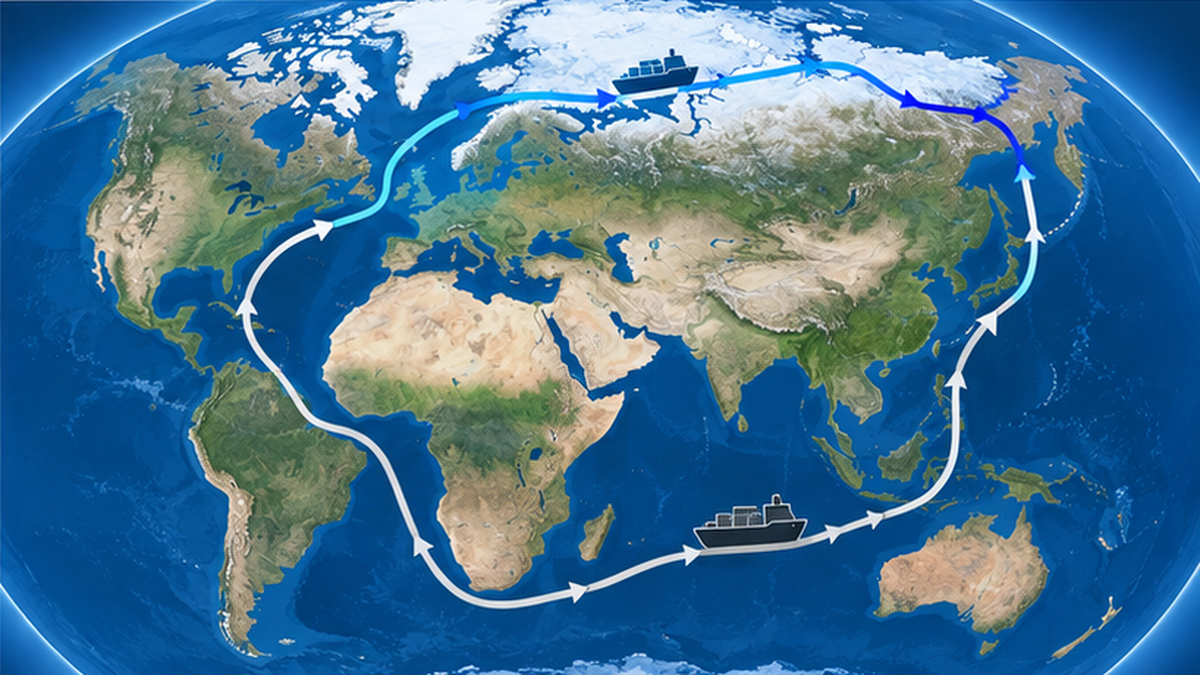
Shrinking sea ice has also changed shipping routes. According to Japan's Ministry of Land, Infrastructure, Transport and Tourism, the Northern Sea Route cuts sailing distance to about 60% of the southern route via the Suez Canal and is navigable in summer (late June to late November). According to Weathernews, in 2020 there were 1,003 transit applications to the Russian authorities, and the Northeast Passage was open for a record 88 days.
A route that opens improves logistics efficiency, but environmental risks grow: air pollution from heavy fuel oil, oil spills, the effect of ship noise on whales and seals, and impacts on Indigenous communities. With thinner ice, the sea is uncharted territory for both ships and wildlife.
Will the Arctic Ocean lose its summer ice?
What does an "ice-free summer" mean?
When researchers say the Arctic Ocean becomes "ice-free," they usually mean a September ice extent below 1 million km². It does not mean zero ice; it means a summer with so little ice that ships can pass. The sea surface freezes again in winter, so an "ice-free summer" does not mean ice-free all year round.
The IPCC Special Report on Global Warming of 1.5°C assessed that even if warming is limited to 1.5°C, an ice-free summer could occur about once per century, and at 2°C it could occur at least once per decade. In other words, how far we limit warming greatly changes how often ice-free summers occur.
| Warming | Frequency of ice-free summers (approx.) | Source |
|---|---|---|
| 1.5°C | About once per century | IPCC Special Report on 1.5°C |
| 2°C | At least once per decade | IPCC Special Report on 1.5°C |
Projections have a range
Climate models project how sea ice will decline, but results differ among models. In the observational record, there have been periods when the actual decline was faster than the models predicted, and periods like recent years when the minimum looks flat. Separating short-term variability from the long-term warming trend is essential for understanding projections.
That is why continued observation matters. Daily satellite observations, field surveys by icebreakers and autonomous instruments operating under the ice are being combined to improve the accuracy of models.
Trivia
- Sea ice extent is usually calculated as the total area of ocean with at least 15% ice cover. Because the calculation methods differ slightly among agencies, the numbers can differ slightly.
People of the Arctic and the sea ice
Sea ice is both a "road" and a "hunting ground"
Indigenous peoples, including the Inuit, have lived in the Arctic for thousands of years. For them, sea ice is a road for travel and a platform for hunting seals and whales. If the ice forms later and melts earlier, the hunting season gets shorter, and thinner ice makes travel less safe.
In coastal villages, less sea ice makes winter storm waves hit the shore directly. Sea ice acts as a natural breakwater that softens waves, so without it coastal erosion grows, and in some areas villages have had to consider relocating.
Balancing the opportunities and risks of fishing
Fish moving north and widening fishing grounds may look like an opportunity for fisheries. But there are ecological uncertainties and impacts on local communities. As Mueter points out, conflicts could arise between commercial fisheries moving north and communities around the Bering Strait.
- Sustainability of stocks: in an unknown sea, how much can be caught is not known
- Impact on ecosystems: could take away food and habitat from the species that were already there
- Rights of local communities: mechanisms are needed to protect traditional life and livelihoods
To respond to these issues, scientists, governments and Indigenous peoples are working together on frameworks for stock surveys and decision-making. The Central Arctic Ocean agreement's principle of studying before fishing is one example.
In Japan's coastal waters, too, many fishers face changes in fish distribution and poor catches. The Arctic case can be seen as a forerunner showing how climate change reshapes fisheries and local communities. See also Warming seas and disappearing fish: Japan's fisheries.
Impacts on Japan: weather, the sea and daily life
The link with cold waves and heavy rain is still under study
Whether Arctic sea ice loss affects the weather in the mid-latitudes, including Japan, is a topic researchers around the world continue to debate. One hypothesis is that less sea ice warms the Arctic atmosphere and changes the meandering of the westerly jet stream, and some studies point to a link with winter cold waves. However, researchers disagree about the strength and certainty of the effect, and it is not yet possible to say definitively that sea ice loss causes cold waves. See also The jet stream and extreme weather.
Arctic melting and sea level rise
When floating sea ice melts, sea level barely changes (the same principle as ice melting in a glass without changing the water level). The main drivers of sea level rise are the melting of ice on land such as the Greenland ice sheet and mountain glaciers, and the thermal expansion of seawater. Change in the Arctic proceeds in tandem with land-ice melt and permafrost change. For the impact on Japan's coasts see Will 90% of Japan's beaches disappear with sea level rise?, and for permafrost thaw and methane release see Arctic permafrost thaw and methane release.
International scientific assessment
The IPCC Special Report on the Ocean and Cryosphere in a Changing Climate assesses changes in the ocean and cryosphere in an integrated way. It states that Arctic sea ice loss affects marine ecosystems, fisheries and coastal Indigenous communities. See also The IPCC Ocean and Cryosphere report.
| Subject | Main change | Confidence |
|---|---|---|
| Sea ice and ice algae | Timing and location of ice algae production changes | Well observed |
| Fish | Northward shift of boreal fish, decline of Arctic fish | Observed in several areas |
| Shipping routes | Longer navigable season | Observed, with real-world use |
| Mid-latitude weather | Possible link to cold waves, etc. | Debated among researchers |
Summary: research, and what we can do
Japan's Arctic research
Japan is active in Arctic research. The National Institute of Polar Research, the Japan Agency for Marine-Earth Science and Technology (JAMSTEC) and universities study sea ice and the marine environment by combining research vessels, satellites and field observations. Japan is also a party to the Central Arctic Ocean fisheries agreement and takes part in joint scientific research.
What we can do, even from far away
- Cut greenhouse gas emissions: save energy, choose renewable energy and rethink transport. The root cause of Arctic change is rising temperatures
- Do not waste the sea's bounty: reduce food loss and choose seafood from managed stocks
- Learn and share accurate information: understand not just the "ranking of the minimum extent" but the difference between long-term trends and short-term variability
- Take an interest in your local sea: changes in fish distribution and catches are also happening in Japanese waters
For the related changes in the Antarctic see What happens when Antarctic ice melts?, and for the krill that supports the food web beneath the ice see Antarctic krill. Comparing the Arctic and Antarctic reveals the different roles sea ice plays.
Arctic sea ice has been declining by about 74,000 km² per year over the long term, and the 2025 summer minimum was the tenth lowest on record. The loss of sea ice is changing the food web that begins with ice algae, shifting fish distributions north, and forcing us to rethink shipping routes and international rules.
- Sea ice is declining over the long term, but year-to-year variability is large, so trends must be read with care
- The food web that begins with ice algae is being reorganized as ice declines
- In the Bering and Barents Seas, boreal fish are moving north and Arctic species are declining
- In the central Arctic Ocean, an international agreement (Japan is a party) is in force: no commercial fishing until stocks are surveyed
- The effect on Japan's weather is still under study; avoid definitive claims and keep up with the latest findings
What you can do today
- When you hear in the news that sea ice is "a record low" or "about average," make a habit of looking at the decades-long trend, not just that single year.
Summary of this article
Changes in the Arctic are not a distant story: they are connected to fish, shipping routes, international rules and our own climate. Understand the background of the numbers, and start with what you can do.
References and sources
- NSIDC Arctic Sea Ice News (Sea Ice Today) – Sea ice extent observation and analysis
- CIRES: Arctic sea ice has reached minimum extent 2025 – Report on the 2025 minimum
- NOAA Climate.gov: 2025 winter maximum sea ice extent in Arctic smallest on record – Winter 2025 maximum extent
- JMA Climate Change Monitoring Report 2023 – Sea ice variability
- Rantanen et al. (2022) The Arctic has warmed nearly four times faster than the globe since 1979 – Communications Earth & Environment
- Biogeosciences: Photosynthetic production in the central Arctic Ocean during the record sea-ice minimum in 2012 – Primary production by ice algae
- NOAA Arctic Program – Arctic reports; changes in fish distribution
- Nature Climate Change: changes in Arctic and subarctic fish communities – Borealization
- Ministry of Land, Infrastructure, Transport and Tourism (Japan): Northern Sea Route materials – Sailing distance and navigable season
- Maritime Executive: Landmark Arctic Fisheries Agreement Enters Into Force – Central Arctic Ocean fisheries agreement
- IPCC Special Report on the Ocean and Cryosphere (SROCC) – SROCC
※ Listed in order of reliability:Government and academic institutions > Peer-reviewed papers > Specialist organizations > Reliable media