⚡ In short
Sea snakes are reptiles that moved from land into the ocean, supplying about 30% of their oxygen through skin breathing and expelling salt via a gland beneath the tongue. Their venom is more potent than land cobras, yet they are remarkably docile. Nine species live in Japanese waters, where gillnet bycatch is a growing threat.
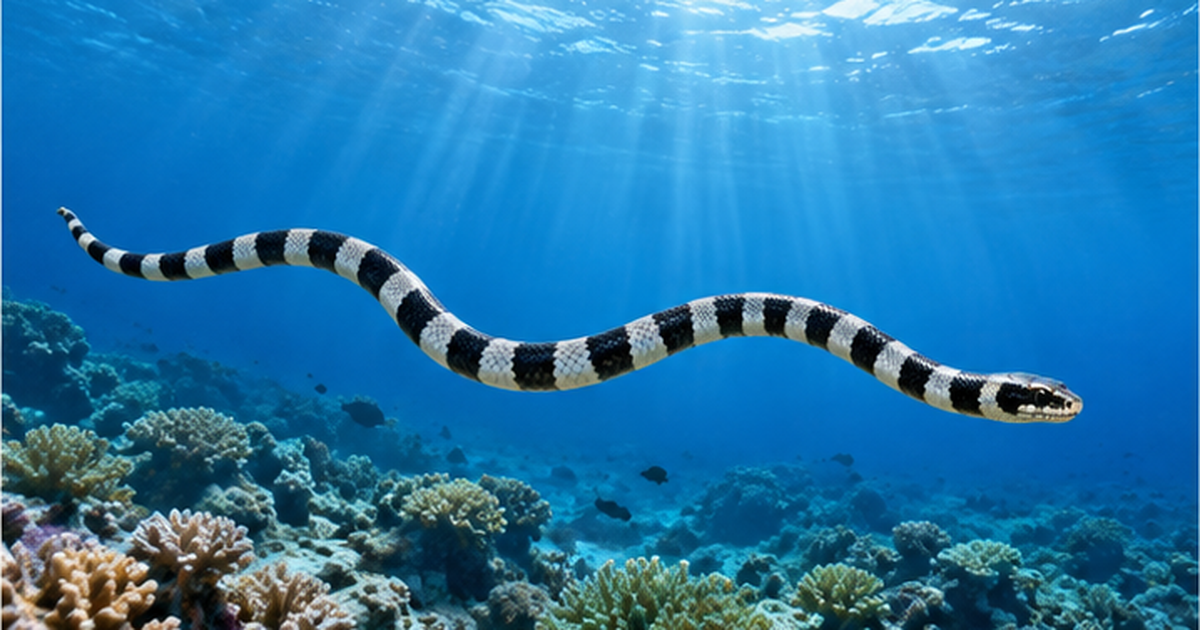
Nicknamed the "cobra of the sea" for the way it winds through the water, the sea snake is actually a true reptile in the cobra family — entirely unrelated to the fish also called "sea snakes" (eels).
Sharing a common ancestor with land snakes, how can a lung-breathing reptile spend long stretches underwater? The answer lies in special adaptations acquired through evolution, including skin breathing and salt glands.
Sea snakes also carry neurotoxic venom said to rival or exceed that of their land-dwelling cobra relatives. Yet their actual temperament is remarkably calm, and harm to humans is uncommon. This article gently explains how sea snakes adapted to marine life, and their ecology and conservation challenges in Japanese waters.
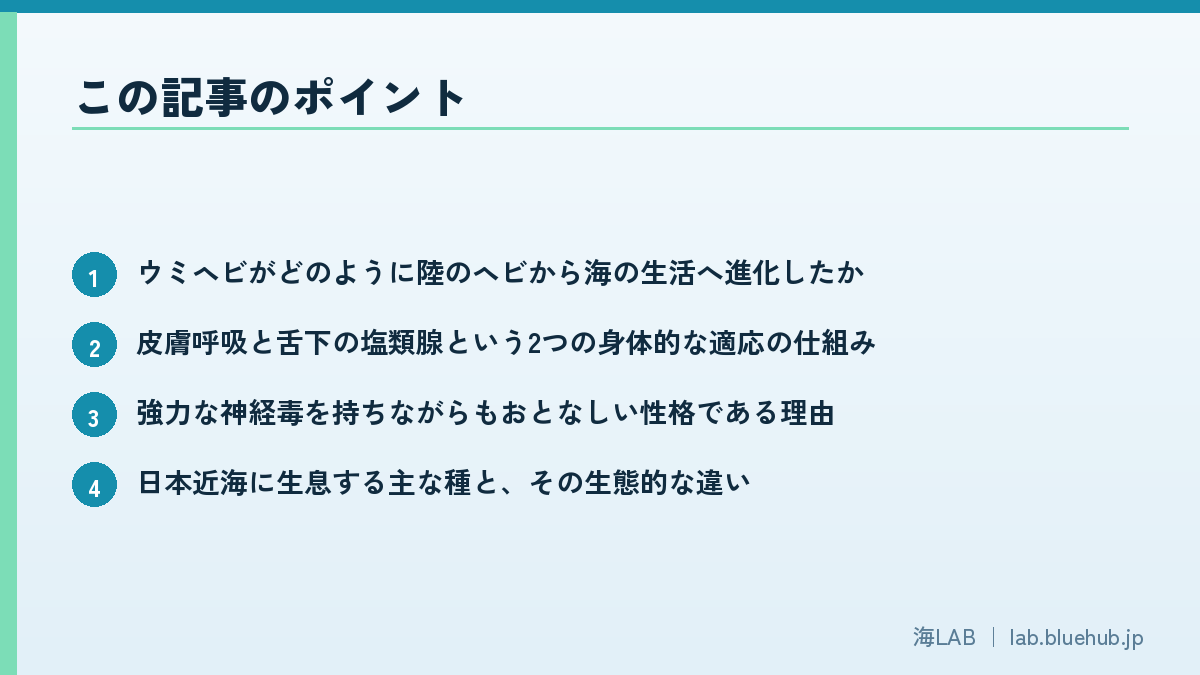
What you'll learn in this article
- How sea snakes evolved from land snakes into marine life
- Two physical adaptations: skin breathing and the sublingual salt gland
- Why sea snakes are docile despite carrying potent neurotoxins
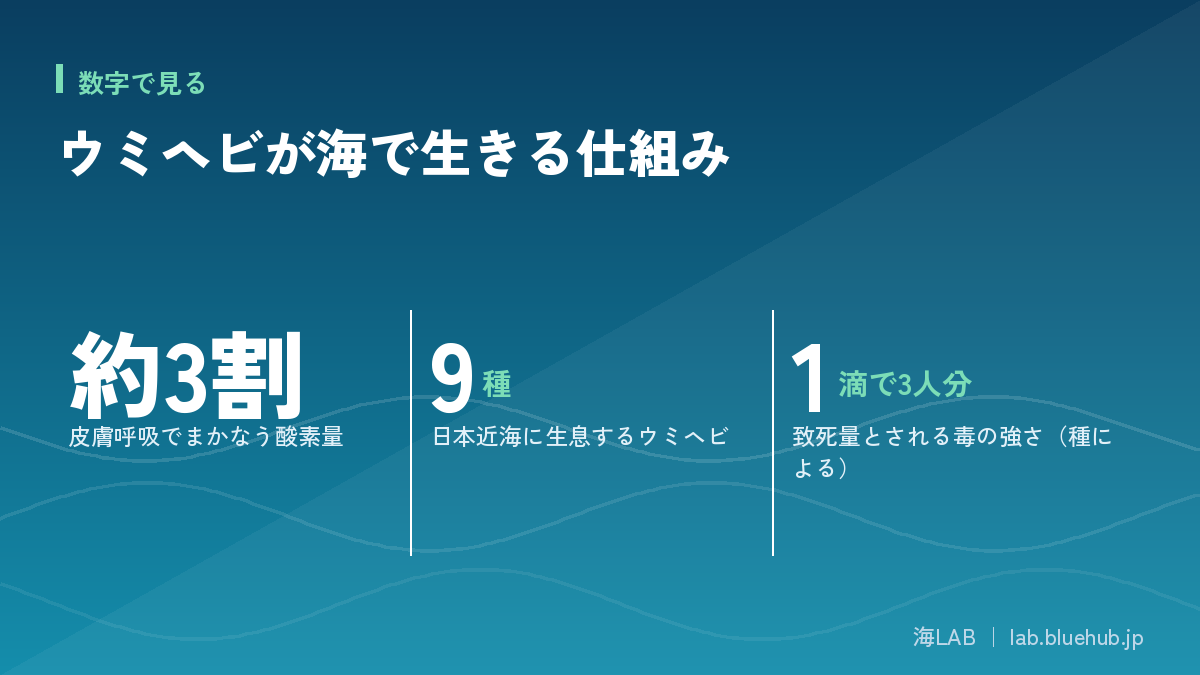
- The main species found in Japanese waters and their ecological differences
- How bycatch in gillnets affects sea snake survival
What is a sea snake: a land reptile that moved into the sea
Confusingly, the name "sea snake" can refer to two very different animals: the reptile (family Elapidae, subfamily Hydrophiinae) and the fish family Ophichthidae (relatives of eels). This article is about the former — a true reptile that breathes with lungs and lays eggs or gives live birth. Its unique sensory adaptations echo the fascinating evolution seen in a shark's electroreception.
Around 60–70 species of sea snakes are known worldwide, most distributed across tropical and subtropical coastal waters from the Indian Ocean to the western Pacific. Japanese waters sit near the northern edge of this range, and the Ryukyu Islands, centered on Okinawa, offer a valuable region for observing a wide variety of species.
Interestingly, sea snakes are almost entirely absent from the Atlantic Ocean. This has been attributed to the geological history of the Isthmus of Panama separating the Pacific and Atlantic, as well as Atlantic current patterns, though the exact reasons remain unresolved. Even the distribution of a single marine animal can reveal connections to Earth's larger geological history.
Evolutionary history branching from land cobras
The subfamily Hydrophiinae is thought to have branched from Australian terrestrial cobra ancestors and moved into the sea relatively recently in evolutionary terms. Genome studies have confirmed, at the genetic level, traces of this "secondary adaptation" to the marine environment. The evolutionary path of land snakes returning to aquatic life echoes, in some ways, how whales returned to the ocean from land mammal ancestors.
Notably, within Hydrophiinae, the degree of marine adaptation differs between the group known as "true sea snakes" and the genus Laticauda (which includes the black-banded sea krait). True sea snakes spend their entire lives at sea, and many are live-bearing with reproduction completed entirely in water, while Laticauda species still come ashore to lay eggs. This offers living evidence of an intermediate stage in evolution.
Differences from the fish family "sea snakes"
- Reptile sea snakes: breathe with lungs, have scales and dry-textured skin, and a flattened, fin-like tail
- Fish family Ophichthidae: breathe with gills, belong to the eel order, have slimy skin, and continuous dorsal/anal fins
A flattened tail and laterally compressed body built for water
A sea snake's body is flattened side-to-side compared with land snakes, and the tail in particular is oar-like and flattened, allowing it to push water efficiently for propulsion. Valved nostrils close automatically while diving to keep seawater out.
The ventral scales (belly scutes) are also reduced and simplified in many species compared with land snakes. Land snakes use their belly scutes to push against the ground for locomotion, but since sea snakes swim by undulating their whole body in water, this function has become less important. Even the body's basic structure shows traces of optimization for marine life.
Sensory adaptations for marine life
Sea snake eyes are somewhat smaller than those of land snakes, and they rely more on chemical senses (scent detection via the tongue) and on detecting pressure and vibration than on vision. For a sea snake hunting near the murky coastal seabed, a sensory balance that doesn't depend solely on sight is an important factor supporting efficient hunting.
Some species are losing the ability to move on land
Among the "true sea snakes" that have fully adapted to marine life, some species are known to have almost no ability to move on land. Their belly scutes have degenerated so much that if washed ashore, they can barely move under their own power. This is drawing research interest as a classic example of an "evolutionary trade-off," where greater adaptation to the sea comes at the cost of reduced survival ability on land.
Skin breathing: absorbing about 30% of oxygen through the skin
One of the sea snake's greatest features is cutaneous respiration (gas exchange through the skin). Research shows that skin breathing supplies roughly 30% of a sea snake's oxygen needs, and also plays a large role in expelling carbon dioxide and nitrogen.
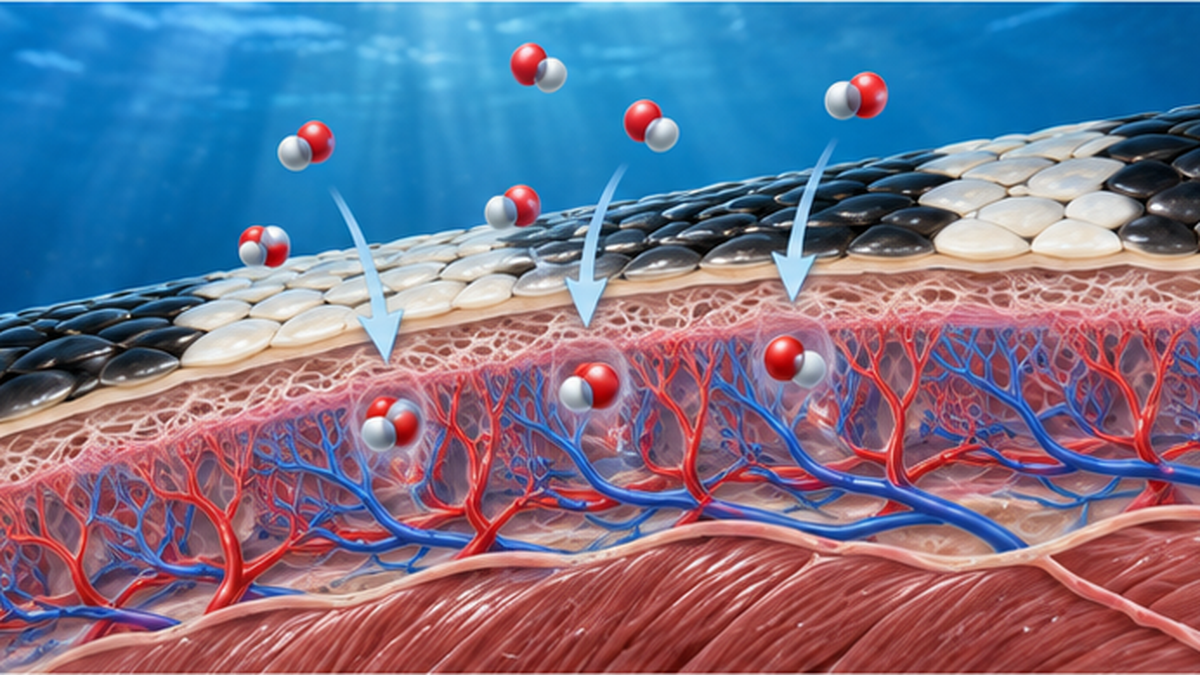
A dense capillary network just beneath the skin
Just below a sea snake's skin lies a dense network of capillaries. By shifting blood flow between the lung and the skin, the snake can efficiently absorb oxygen from whichever side has the higher partial pressure. This redistribution of blood flow enables gas exchange even through a "bypass route" that doesn't pass through the lung.
A special vascular structure supplying the brain directly
High-resolution CT scan research has revealed a novel vascular structure (a venous plexus) that delivers oxygen absorbed through the head's skin directly to the brain. This is thought to be a mechanism for prioritizing oxygen supply to the brain during dives, and one of the adaptations enabling long dive times.
This vascular structure appears to be unique among known reptiles, and researchers believe it is one reason sea snakes can stay conscious and continue hunting or evading predators during extended dives. It is, in effect, "dedicated plumbing" that exists solely for marine life, absent in land snakes.
Blood flow control during dives
In terrestrial vertebrates, blood that takes up oxygen in the lungs is sent directly throughout the body. Sea snakes, however, are thought to have a "shunt" that, while diving, preferentially circulates blood that received oxygen through the skin rather than through the lungs. During the short time spent breathing at the surface, oxygen is stored in the lungs, and during dives, skin breathing combined with this shunt mechanism supports extended activity.
Three mechanisms supporting skin breathing
- Gas exchange via the dense capillary network beneath the skin
- A bypass route (blood shunt) that avoids the lung
- Priority oxygen supply to the brain via a special vascular structure in the head
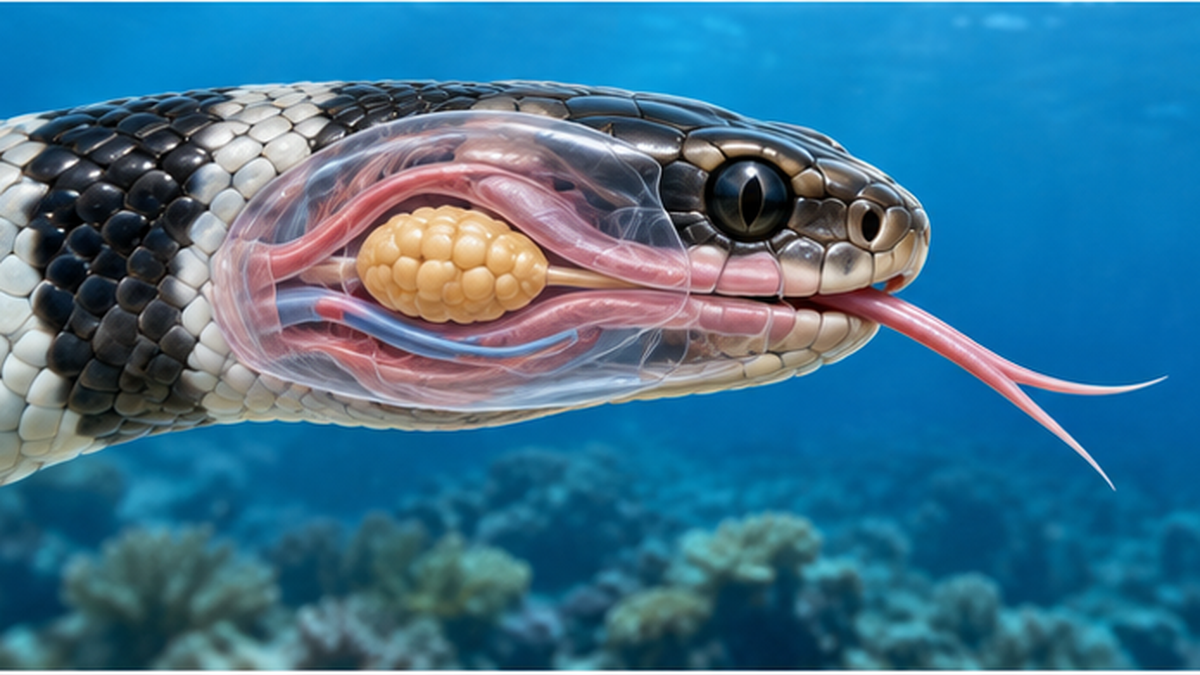
Salt glands: how sea snakes drink seawater without overloading on salt
Seawater is far saltier than fresh water, and drinking it continuously would disrupt the body's osmotic balance. Sea snakes solve this challenge with a specialized organ: the salt gland located beneath the tongue (sublingual gland).
Expelling salt every time the tongue flicks
The salt gland concentrates and secretes excess sodium and other salts from the blood, which are expelled into the surrounding seawater each time the sea snake flicks its tongue in its characteristic way. Land snakes lack this organ; it is believed to have been newly acquired in the course of adapting to marine life.
Skin that barely lets salt through
Classic physiological research has shown that a sea snake's skin allows water through but barely allows sodium ions to pass. By permitting water exchange through skin breathing while keeping salt largely out of the body, this helps support osmotic regulation.
Evidence of adaptation etched into the genome
- Genome analysis has confirmed expansion of gene families involved in osmotic regulation
- Salt gland development is thought to correspond with changes in gene expression
- Genetic changes specific to marine life, not seen in land-dwelling relatives
Actively seeking fresh water has also been reported
Even with a salt gland, expelling salt is not a cost-free process for a sea snake. Recent research has reported drinking behavior that targets the thin layer of fresh water that temporarily forms on the sea surface right after rainfall — a behavioral adaptation that reduces the burden on the salt gland whenever possible. Reports also suggest that sea snakes become dehydrated more often during prolonged dry spells, indicating that climate variation can affect survival in unexpected ways.
Kidneys work alongside the salt gland to maintain balance
Beyond the salt gland, urine concentration by the kidneys also plays a role in osmotic regulation. Many marine reptiles and seabirds have similarly developed salt glands — the salt gland around a sea turtle's eyes (which produces tear-like secretions) and the one near a seabird's nostrils operate on the same principle, believed to have evolved independently in sea snakes as well. This is a classic example of "convergent evolution," where unrelated lineages arrive at similar solutions to similar environmental challenges.
How do newly hatched young handle osmotic pressure
Egg-laying species such as the black-banded sea krait hatch on land, so hatchlings initially experience the same salt environment as land snakes. The salt gland is believed to begin functioning in earnest once the hatchling enters the sea and begins its marine life, with the transition proceeding gradually as it grows. Live-bearing species, by contrast, are exposed to a seawater environment from within the mother's body, meaning the salt gland must already be functional at birth — a different physiological preparation than that required by egg-laying species.
A surprising combination: potent venom and a gentle temperament
Sea snake venom contains neurotoxins that block nerve transmission along with myotoxins that damage muscle tissue broadly, and in some species it is said to be more potent than that of related land-dwelling cobras. Some species have been reported to carry enough toxin in a small amount of venom to be lethal to several people.
Why bites are rare despite the venom's strength
Despite carrying such potent venom, bite incidents from sea snakes are less common than those from land snakes. The reason lies largely in temperament. Sea snakes are, on the whole, remarkably docile and rarely initiate attacks on humans; even when they do bite, they often deliver a "dry bite" that injects little or no venom.
When bites tend to occur
- When trying to remove a sea snake tangled in a fishing net by hand
- When accidentally making contact while startled during diving or free diving
- When carelessly touching an individual washed up on the beach
What to do if bitten
Sea snake venom often does not cause immediate, severe pain, meaning victims may not realize right away that they've been bitten. Symptoms such as muscle pain, weakness, and heavy eyelids can progress over several hours, so anyone who has had contact with a sea snake in the water and notices any change in condition — even mild — is advised to seek medical attention promptly. Folk remedies such as cutting the wound or sucking out venom by mouth have no proven benefit and risk worsening the injury, so they should be avoided.
In practice, most reported bites occur among fishers handling sea snakes tangled in gillnets. If encountered in the sea, the risk is low as long as the snake is not provoked.
Venom components and how they act
The main components of sea snake venom fall into two broad categories: neurotoxins (mainly beta-neurotoxins) that block transmission at the neuromuscular junction, and myotoxins that destroy muscle cells. Neurotoxins can cause paralysis of the respiratory muscles, while myotoxins can lead to rhabdomyolysis and, subsequently, acute kidney injury. This dual mechanism of action is thought to be one reason sea snake bites can become severe.
Why such powerful venom evolved
Sea snakes primarily prey on fish and eels hiding in rock crevices or among coral. A powerful neurotoxin that immobilizes fast-fleeing prey the instant it bites would have provided a clear advantage. The venom evolved for predation, not for defense against humans — which is also consistent with, rather than contradictory to, the species' docile temperament.
Venom strength varies by species
Venom potency varies considerably across sea snake species. Some species found in certain regions have been reported, in toxicity assessments using laboratory animals, to exceed even some of the most potent land snake venoms, while others carry comparatively weak venom. Species such as the egg-eating sea snake, which feeds exclusively on fish eggs, have relatively degenerate venom glands — suggesting a correlation between diet and venom potency.
Progress in antivenom and treatment
Polyvalent antivenoms effective against the venom of multiple sea snake species have been developed and are stocked at medical facilities in regions with higher rates of bite incidents, such as Southeast Asia and Australia. In Japan, where bite cases are rare, dedicated antivenom stockpiles are limited, but for severe cases, intensive care focused on respiratory and systemic support is considered key to survival. As with other venomous snakebites, prompt medical attention remains the single most important factor.
Summarizing the relationship between venom strength and temperament
- Venom evolved mainly to subdue prey, not to attack humans
- As a result, sea snakes have little motivation to bite people
- Even when they bite, they are reported to tend toward venom-conserving "dry bites"
- The upshot: even highly venomous species show relatively few reported human casualties
Sea snakes found in Japanese waters
Nine species of sea snake have been confirmed in Japanese waters, and they are commonly seen especially in the waters around Okinawa and the wider Ryukyu Islands.
| Species | Characteristics |
|---|---|
| Black-banded sea krait (Erabu umihebi) | Black and tan bands; egg-laying, coming ashore to lay eggs; traditionally eaten in Okinawa |
| Broad-tailed sea krait (Hiroo umihebi) | Similar to the black-banded sea krait but with a broader tail; egg-laying |
| Black-headed sea snake (Kurogashira umihebi) | Dark-colored head; live-bearing (gives birth at sea) |
| Turtle-headed sea snake (Iijima umihebi) | Unusual diet consisting exclusively of fish eggs |
| Blue-banded sea krait (Aomadara umihebi) | Bluish mottled pattern; egg-laying, retains the habit of coming ashore |
| Yellow-bellied sea snake (Seguro umihebi) | Gathers at drifting seaweed rafts in the open ocean; one of the most widely distributed species in the world |
| Spotted sea snake (Madara umihebi) | Dark blotched pattern; prefers relatively shallow reef habitats |
The pelagic sea snake's unusual open-ocean life
While most sea snakes primarily inhabit coastal reefs and rocky areas, the yellow-bellied sea snake has the unusual habit of spending nearly its entire life in the open ocean's surface layer. It gathers beneath rafts of drifting seaweed carried by ocean currents, ambushing small fish that are drawn there. This lifestyle allows it to disperse widely on ocean currents, making it one of the most broadly distributed sea snake species.
Two reproductive styles: egg-laying and live birth
Most sea snakes are live-bearing, giving birth directly in the water, but species such as the black-banded sea krait, blue-banded sea krait, and broad-tailed sea krait are exceptions, laying eggs and retaining the habit of coming ashore (to rock crevices or caves) to do so. This is thought to be a vestige of ecology inherited from land-dwelling ancestors.
Dive duration and breathing rhythm
Because lung breathing remains fundamental even with skin breathing supplementing it, sea snakes surface roughly every 30 minutes to an hour to breathe. Their ability to sustain long dives is supported by the combination of skin breathing and the priority oxygen supply to the brain.
Dietary differences create ecological niche partitioning
Sea snakes in Japanese waters differ significantly in diet from species to species, allowing them to coexist in the same waters while avoiding direct competition. The black-banded sea krait and broad-tailed sea krait primarily prey on elongated fish such as moray eels hiding in reef and coral crevices, while the turtle-headed sea snake has the unusual habit of feeding exclusively on fish eggs. Its venom glands are relatively degenerate, likely because its diet requires no venom to subdue prey.
This dietary divergence can be seen as the result of a long process of "niche partitioning" that allows multiple species to use limited coral reef resources without directly competing. Similar species coexisting by hunting in slightly different places or targeting slightly different prey is a phenomenon widely observed among coral reef fish communities as well.
Okinawan culture and the black-banded sea krait
The black-banded sea krait is known in Okinawa as "irabu," and has long been used in traditional food culture, including the smoked dish "irabu-jiru" (irabu soup). Records show it was treasured as a nourishing food during the Ryukyu Kingdom era, making it not just an animal but a species deeply tied to local culture. This history of use is not unrelated to the resource decline caused by bycatch and overharvesting.
Japanese waters near the species' northern range limit
Since most sea snakes favor warm tropical and subtropical waters, Japanese waters — particularly around Honshu — lie near the northern limit of their range. Individuals carried northward on the Kuroshio Current are occasionally found along Honshu's coast, but established, reproducing populations are confirmed mainly in the Ryukyu Islands, centered on Okinawa and Amami. Changes in sea surface temperature are thought to influence how far north this range limit may extend, making it a subject of long-term monitoring.
Gillnet bycatch: a conservation challenge
While sea snakes have adapted to a marine life with few natural predators, human fishing activity has become a new threat. Reports frequently describe sea snakes becoming entangled and caught as bycatch in gillnets used along the coast, alongside the target fish.
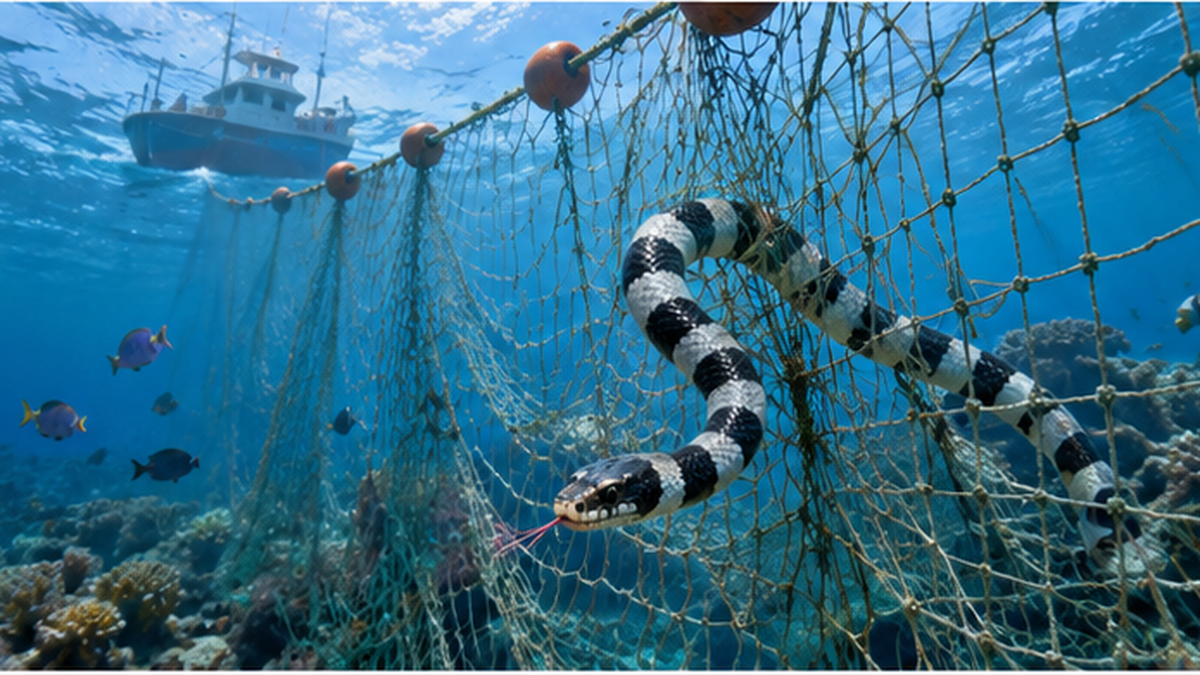
The black-banded sea krait is especially vulnerable
The black-banded sea krait, long targeted for food and frequently caught as fishing gear bycatch, is considered one of the species whose numbers may be declining. Its long periods of activity near the surface and its habit of coming ashore to lay eggs may increase its chances of encountering fishing gear.
Directions for addressing the bycatch problem
- Improving net design (introducing structures that let sea snakes escape more easily)
- Establishing guidelines for fishers to ensure bycaught individuals are released alive
- Continuing population monitoring surveys
What determines survival after being caught as bycatch
Because sea snakes breathe with lungs, being left entangled in a net underwater for an extended period can cause them to drown, unable to breathe. If pulled up shortly after being caught, there is still a chance of survival, but the longer they are left, the lower the survival rate. Whether fishers promptly return bycaught individuals to the sea is a critical factor determining life or death.
The challenge of limited data
Compared with whales and sea turtles, many regions lack formal stock assessments or population monitoring systems for sea snakes, making it difficult to grasp the full picture of bycatch impacts. Because they are an unassuming, easily overlooked species, conservation priority for sea snakes tends to be pushed down the list.
Connections to international conservation frameworks
Some sea snake species have been assessed on the International Union for Conservation of Nature (IUCN) Red List, with limited habitat range and bycatch impact cited as concerns for certain species. However, many species still lack sufficient data and are classified as "Data Deficient (DD)." Ongoing research to fill this data gap is itself considered a first step toward effective conservation.
The value of citizen science and diver observations
In the absence of comprehensive formal survey systems, everyday sightings reported by dive tour operators and local fishers are beginning to serve as valuable clues to changes in sea snake distribution and population. The accumulation of citizen-science-style information through social media and dive logs is expected to grow increasingly important as a complement to costly formal surveys.
Cooperation with fishers is key to conservation
Sea snake conservation is not a challenge that researchers and government agencies can solve alone. Fishers, who interact with sea snakes most frequently in the course of daily fishing operations, play a crucial role — their willingness to handle bycaught individuals properly and share sighting information can make or break the effectiveness of conservation measures. Dialogue aimed at balancing fishing livelihoods with the ecosystem conservation that supports a region's marine richness continues in many areas.
Like the bycatch problem affecting whales, sea turtles, and seabirds, sea snake bycatch is also a measure of the overall health of marine ecosystems. As with ongoing efforts in sea turtle conservation, various regions are seeking ways to balance fishing with marine wildlife protection.
Comparison with other marine reptiles and marine life
Sea snakes are not the only reptiles adapted to the sea. Sea turtles, marine iguanas, and other creatures have also "returned" to marine life from land ancestors. Comparing the paths each has taken reveals just how many different solutions the marine environment can produce.
Compared with sea turtles: differences in breathing and osmoregulation
Sea turtles are also lung-breathing marine reptiles like sea snakes, but rather than relying on skin breathing, they have developed a system for managing lung oxygen efficiently over long single dives. For salt excretion, sea turtles use a salt gland near the eyes (producing a tear-like secretion), differing from the sea snake's approach. It is interesting that, faced with the same challenge of "how can a reptile live at sea," different species evolved different organs to serve as salt glands.
Shared traits with seabirds and marine mammals
The salt gland mechanism itself is seen not only in sea snakes and sea turtles but also in seabirds such as albatrosses and in some marine mammals. The fact that entirely unrelated lineages independently evolved similar organs to survive on seawater is frequently cited in biology textbooks as a prime example of convergent evolution.
Comparing breathing and salt management across marine animals
- Sea snakes: skin breathing + sublingual salt gland
- Sea turtles: highly efficient lung breathing + salt gland near the eyes
- Seabirds (e.g. albatrosses): lung breathing + salt gland near the nostrils
- Whales and dolphins: extremely efficient lung breathing + water retention via powerful kidneys
The sea snake's role in coral reef ecosystems
Sea snakes serve as specialized "predators of the crevices," preying on small fish hiding in the gaps of coral reefs and rocky areas. By using their slender bodies to reach into narrow crevices that larger predators cannot access, they are thought to help maintain balance within the reef's fish community. Though inconspicuous, they occupy an indispensable position within the ecosystem.
Predators of sea snakes
Despite their potent venom, sea snakes are not entirely free of predators. Sea eagles and other raptors, as well as some sharks, are known to prey on sea snakes, with juveniles particularly vulnerable compared with adults. How much venom resistance different predators have varies by species, and researchers suggest that predators, too, may have developed countermeasures to sea snake venom over the course of a long evolutionary arms race.
Indirect effects of climate change and coral decline
Coral reefs and seagrass beds, the primary habitats of sea snakes, are being strongly affected by bleaching from rising water temperatures and by ocean acidification. If the habitats of the fish sea snakes prey on are lost, sea snake populations may be indirectly affected as well. In addition to the direct threat of bycatch, sea snakes face the indirect threat of changing habitat conditions — a challenge shared with many other marine species.
Conclusion: an evolutionary path chosen for life at sea
The sea snake is a reptile that made a bold shift from life on land to life in the sea. Supplementing oxygen through skin breathing, expelling salt through its salt gland, and swimming with a flattened body — its very form is a concentration of evolutionary ingenuity developed over a limited span of time.
The fact that such a potently venomous animal is also remarkably docile offers some reassurance for humans and sea snakes coexisting in the ocean. At the same time, sea snakes face a real, human-caused threat in the form of gillnet bycatch, and protecting the ecosystems of Japanese waters requires understanding and consideration for this unassuming but important marine species.
If you happen to encounter a sea snake while diving or snorkeling, the risk is low as long as you don't provoke it. In fact, seeing this creature — supplementing oxygen through its skin, managing salt through its salt gland, and swimming through the sea with a flattened body — as the culmination of a long evolutionary history of ingenuity offers a fresh perspective. Precisely because it is an unassuming, easily overlooked species, approaching it with accurate knowledge helps build a better relationship between people, sea snakes, and the marine ecosystem as a whole.
References and sources
- Oxford Academic (Molecular Biology and Evolution) – Shaw's Sea Snake genome study on marine adaptation
- PMC (NCBI) – Chromosome-scale genomes of Hydrophis sea snakes
- PMC (NCBI) – Novel vascular plexus in sea snake head (cutaneous respiration)
- Springer Nature Link – Sea snake skin permeability to water and sodium
- ScienceDirect – Evolution of salt glands in snakes
- NCBI Bookshelf (StatPearls) – Sea Snake Toxicity
- PMC (NCBI) – Venom proteome of Hydrophis curtus
- Oceana – Species and ecology of sea snakes found in Japan
- Wikipedia – Black-banded sea krait
Listed in order of reliability: government/academic institutions > peer-reviewed papers > specialist organizations > trusted media