⚡ In short
Seaweed bed area fell from about 183,000 ha in 1981 to about 164,000 ha. This article explains causes of isoyake, fishers’ restoration cases — urchin removal, urchin fences, mother-plant placement and rabbitfish culling — and efforts to turn urchins into a resource.
There are “forests” under the sea too. Seaweed beds, where kelp, arame and sargassum grow thick, are the cradle of fish and shellfish, but in many places they are disappearing in 藻場isoyake.
Causes differ by region: grazing by urchins and fish, rising water temperature, and a shortage of seaweed seed. Based on national materials, this article sorts out how isoyake works and the methods, cases and challenges of seaweed bed restoration led by fishers.
It also touches on research into raising removed urchins as a resource, and considers what we can do to protect the sea forest.
What You Will Learn
- The definition of isoyake and the role of seaweed beds
- Trends in seaweed bed area and how to read the numbers
- Main causes: urchins, fish, lack of seed and water temperature
- Fishers’ measures such as urchin removal and fences
- Support schemes, and turning urchins into a resource through holding culture
What Is Isoyake? The Disappearing Underwater Forest
Definition and how to recognize it
Isoyake (“rocky-shore burning”) is a phenomenon in which seaweed communities (kelp, wakame, sargassum and others) on shallow rocky seabeds decline or vanish far beyond normal seasonal fluctuation, and stay that way for a long time. Japan’s Fisheries Agency guideline on isoyake countermeasures likewise treats a persistent, non-recovering state, not a seasonal change, as the key condition.
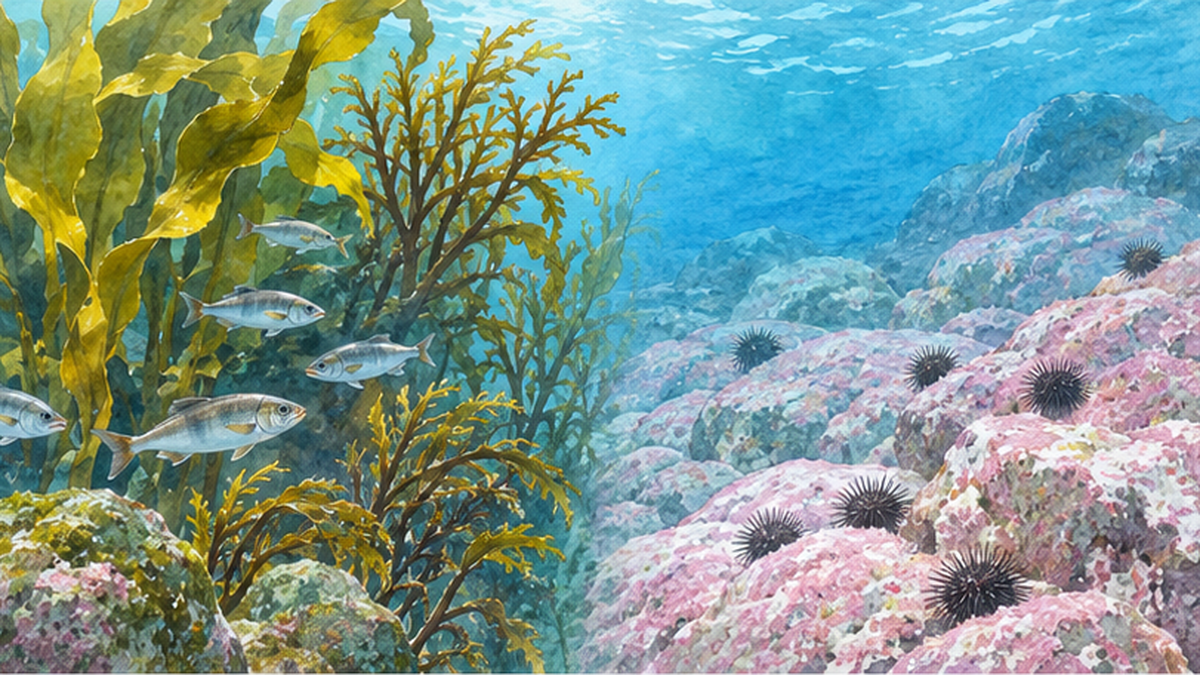
The rock surface looks whitish because coralline algae cover it in place of seaweed. Divers find what used to be a swaying “sea forest” turned into a kind of “desert.” Sea urchins packed across the rock are a common sign, which is where the name “urchin barren” comes from.
The roles seaweed beds play
Seaweed beds are the “cradle of the sea,” serving as spawning grounds, nurseries and feeding areas. Important fishery resources for fishers — abalone, turban shell, spiny lobster, juvenile yellowtail and grunt — depend on them. Seaweed also takes in carbon dioxide through photosynthesis and absorbs nitrogen and phosphorus, helping keep the water clean.
- Spawning and nursery habitat: juvenile fish and shellfish can hide from predators
- Food supply: seaweed and the small animals living on it feed abalone, urchins and fish
- Water purification: absorbs nutrients and keeps the sea clear
- Carbon storage: as blue carbon, it also relates to climate action
The link between seaweed beds and climate action is covered in CO2 absorption by seaweed beds and J-Blue Credits.
Key points of this section
- Isoyake is a state in which seaweed beds have declined so far that they do not recover
- Seaweed beds are the “cradle” of fishery resources and also purify water and store carbon
Seaweed Bed Decline and the Spread of Isoyake in Numbers
Changes in seaweed bed area
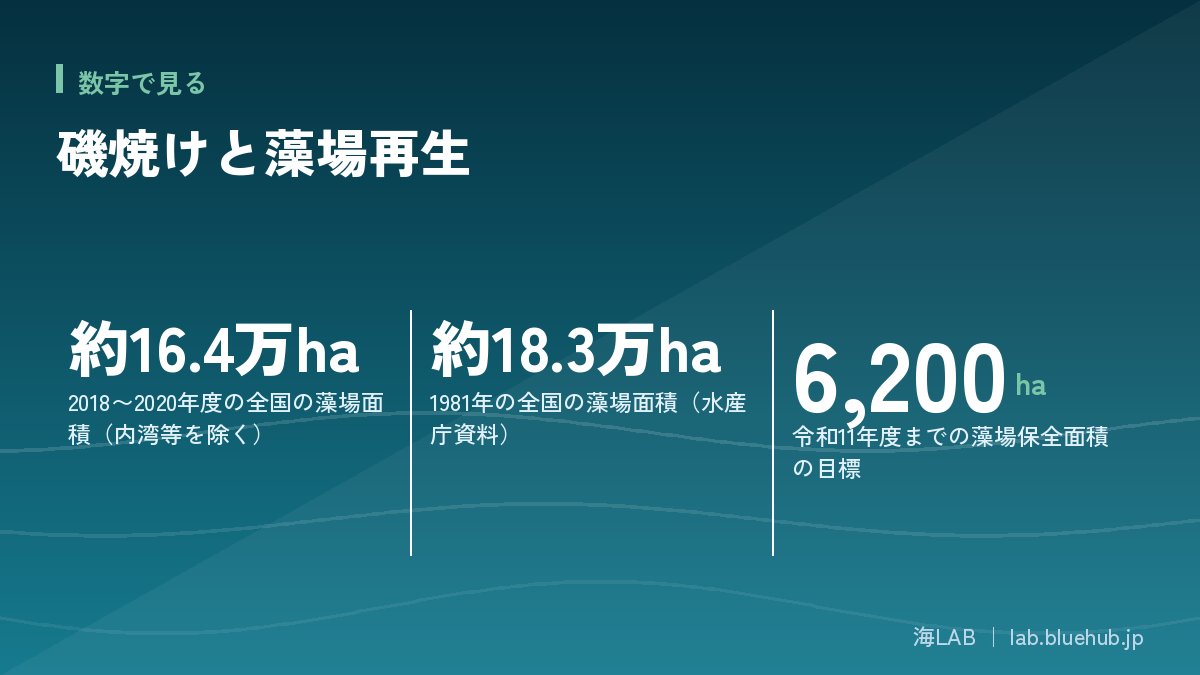
Japan’s Ministry of the Environment has repeatedly surveyed seaweed bed distribution. Fisheries Agency materials show that nationwide seaweed bed area (excluding inner bays and similar areas) fell from about 183,000 ha in 1981 to about 164,000 ha in FY2018–2020. However, the FY2018–2020 survey used a new satellite-image method, so it cannot be compared directly with earlier figures.
Ministry of the Environment materials also state that in the main sea areas where seaweed beds occur, about 3.1% of them disappeared over roughly ten-odd years from the late 1970s to the early 1990s. Causes were direct alteration such as reclamation (28.1%), isoyake (14.7%), other changes in sea conditions (16.2%) and unknown (40.6%).
| Period / survey | Result | Note |
|---|---|---|
| Late 1970s – early 1990s | About 3.1% of seaweed beds in main sea areas lost | Breakdown: reclamation 28.1%, isoyake 14.7%, etc. |
| 1981 | Nationwide seaweed beds about 183,000 ha (excluding inner bays, etc.) | Based on Fisheries Agency materials |
| FY2018–2020 | Nationwide seaweed beds about 164,000 ha | New satellite-image method; not directly comparable |
Changes in quality, not just decline
Area statistics do not show changes in the “quality” of seaweed beds. When tall, large seaweeds such as kelp and arame are replaced by small seaweeds or coralline algae, the fish and shellfish that grow there change too. Fishers on site often feel such changes before they appear in the numbers.
It also matters that the causes of isoyake differ by region. In Hokkaido and Tohoku, urchin grazing in cold-current waters is a major factor; in western Japan and Kyushu, herbivorous fish (such as rabbitfish) and rising water temperatures play a large part, so countermeasures differ even for the same “isoyake.” How urchin barrens form is explained in Why do isoyake and urchin barrens happen?.
A note on reading the numbers
The methods for measuring seaweed bed area have changed over time. When reading a figure such as “down X%,” check whether it compares results from the same method.
Main Causes of Isoyake: Urchins, Fish, Water Temperature and Nutrients
Grazing by sea urchins
The best-known cause of isoyake in Japan is grazing by sea urchins such as the purple sea urchin, bafun urchin, northern purple sea urchin and long-spined urchin. Even when seaweed becomes scarce, urchins stay on the rock and keep eating tiny sprouts and coralline algae. Seaweed is eaten before it can grow back, so the forest cannot return.
Herbivorous fish and rising water temperature
In western Japan, grazing by herbivorous fish such as rabbitfish, parrotfish and drummers is a problem. When winter water is warm, these fish keep eating seaweed through the winter and grow faster. The Fisheries Agency’s third-edition guideline gives large weight to measures against herbivorous fish and the effects of ocean warming. For the impact of ocean warming on fisheries, see also Fish disappearing as seas warm.
Nutrients, seed supply and sea conditions
Seaweed also cannot grow when nutrients (nitrogen and phosphorus) are short. And if mother plants (mature seaweeds that release spores) disappear nearby, spores do not arrive, so seaweed beds may fail to return even when conditions improve.
| Cause | Main regions / features | Typical countermeasures |
|---|---|---|
| Urchin grazing | Nationwide; prominent in cold-current areas | Urchin removal and thinning, urchin fences |
| Grazing by herbivorous fish | Western and southern Japan | Culling of rabbitfish etc., protective nets |
| Rising water temperature | Affects the whole country | Selecting heat-tolerant species |
| Lack of nutrients or seed supply | Depends on the area | Placing mother plants, spore bags, seedling transplants |
Misjudging the cause leads to failure
Leaving urchins in place where they are the cause, or removing only urchins where seed supply is short, will not bring seaweed back. Investigating the cause first and choosing measures that fit it is the starting point.
How Fishers Restore Seaweed Beds
Removing and thinning urchins
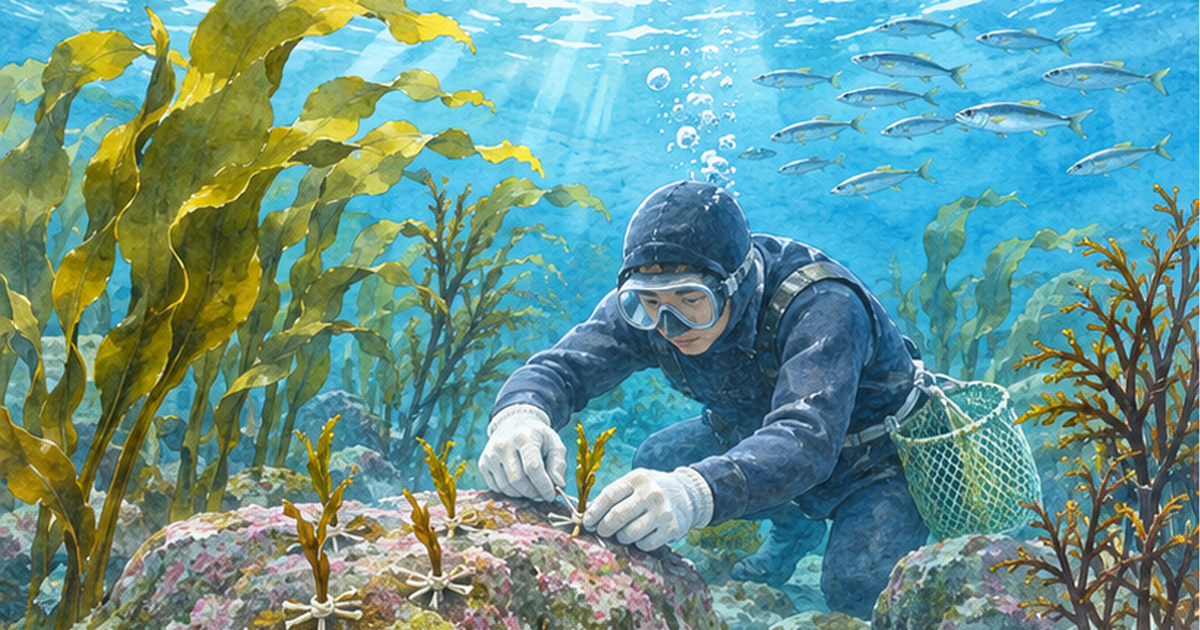
The easiest and most widely practiced method nationwide is urchin removal. Fisheries Agency materials note that in grazing-type isoyake, removing urchins is known to bring back seaweed beds, and because it is easy to carry out it is widely practiced across Japan. Free divers and scuba divers break and remove urchins with hammers, spatulas and special tools.
Urchin fences and anti-grazing nets
Another method is to enclose the area where seaweed grows with nets or fences to keep out urchins and fish. Because an urchin fence is built so that the net does not touch the seabed, it keeps urchins out, and herbivorous fish such as rabbitfish are expected to stay away from the wary-looking net, according to Fisheries Agency materials.
Placing mother plants and spore bags
When seaweed seed is lacking, fishers place mature mother plants, set bags that release spores (spore bags), or transplant artificially grown seedlings. Fisheries Agency materials say these are effective when the cause is a shortage of seed supply.
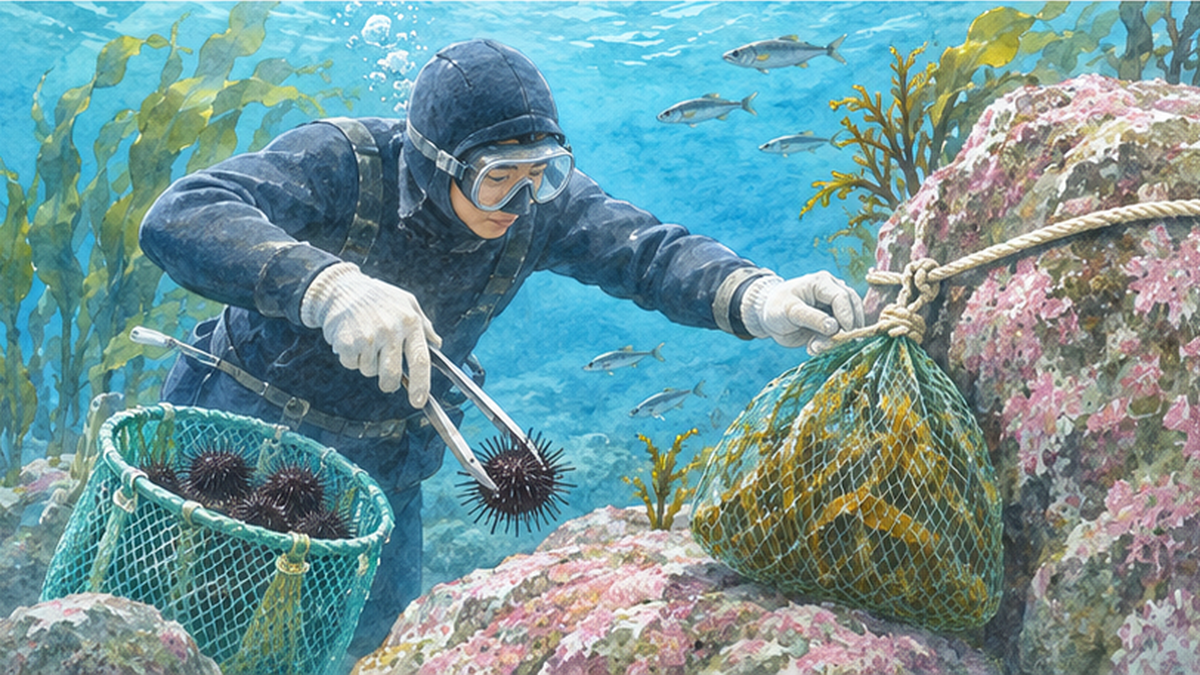
- Investigate the cause of isoyake (urchins, fish, lack of seed, water temperature)
- Decide the area to protect and the goal
- Carry out measures such as urchin removal and fences
- If needed, supply seed by placing mother plants or transplanting seedlings
- Record urchin density and seaweed amount regularly, and review the plan
Cases Across Japan: Removal, Fences and Fish Culling
Nagoya Bay (Saga): urchin removal and mother-plant input
Case studies in the Fisheries Agency guideline describe removing urchins in about 1.4 ha divided off by urchin fences in Nagoya Bay, then adding mother plants of Sargassum in the following spring. Through the third year, urchin density stayed low at 0.6–3.4 individuals per square metre, and perennial seaweeds such as hijiki, mametawara, yatsumatamoku and isomoku were confirmed.
Nagasaki: recovery with urchin fences
In the Osasa area of Nagasaki, anti-grazing urchin fences are described, with results showing seaweed beds recovering about a year after removal. The seaweed bed recovery effort in Iki City of the same prefecture is also taken up as a regional report in national materials.
Shizuoka: culling rabbitfish
In the Shinnan area of Shizuoka, Fisheries Agency materials report that kajime beds have begun to recover in places in waters where rabbitfish were thoroughly culled with gill nets. Against fish grazing, a strength is that fishers can use the gear and skills they already have.
Tottori: concentrated removal of purple sea urchins
In Tottori, concentrated removal of purple sea urchins has been carried out and introduced in national materials. The idea is that focusing effort on chosen sites, rather than treating a wide area thinly, makes it easier to create a foothold for seaweed to return.
What the cases have in common
- Tools are chosen to match the cause (urchins, fish or lack of seed)
- They do not stop at removal; they set up the “conditions for return” with mother plants and fences
- They continue for years until effects appear, and keep records
Supporting Schemes: Fisheries Multifunctional Role Program
How national support works
Seaweed bed conservation by fishers is supported under frameworks such as the Fisheries Agency’s program for realizing the multifunctional roles of fisheries. Eligible work includes removing urchins and grazing fish, putting in seaweed seedlings, and setting protected zones. The FY2025 budget (approved estimate) was 3.481 billion yen and FY2026 is stated as 1.35 billion yen; amounts vary by program category.
FY2025 materials give a target of 6,200 ha of conserved seaweed bed area by FY2029. This shows that the national government treats seaweed bed conservation as a long-term goal.
Strengths and challenges of activity groups
Seaweed bed conservation is carried out by “activity groups” such as fishery cooperatives and fisher groups. In Mugi Town, Tokushima, the Mugi Seaweed Bed Protection Society, made up of divers who harvest abalone and other catch, continues conservation work. Meanwhile, Fisheries Agency–related materials point to labor shortages, a lack of leaders and aging as challenges.
- People: securing members able to dive
- Continuity: results take years, so a long-lasting structure is needed
- Records: summarize mother-plant amounts and urchin removal by year to make results visible
The scheme is a “trigger”
Even with subsidies, it is the fishers on site who decide what to do and keep doing it. The scheme’s role is to back up local efforts.
Turning Urchins into a “Resource”
The problem of “empty” urchins
Urchins in isoyake seas lack seaweed to eat and become thin, in a state called “empty urchins.” They are not targeted for harvest, and in some cases removed urchins are simply discarded. Removal takes effort but brings no income, which has been a burden.
Improving meat content through holding culture
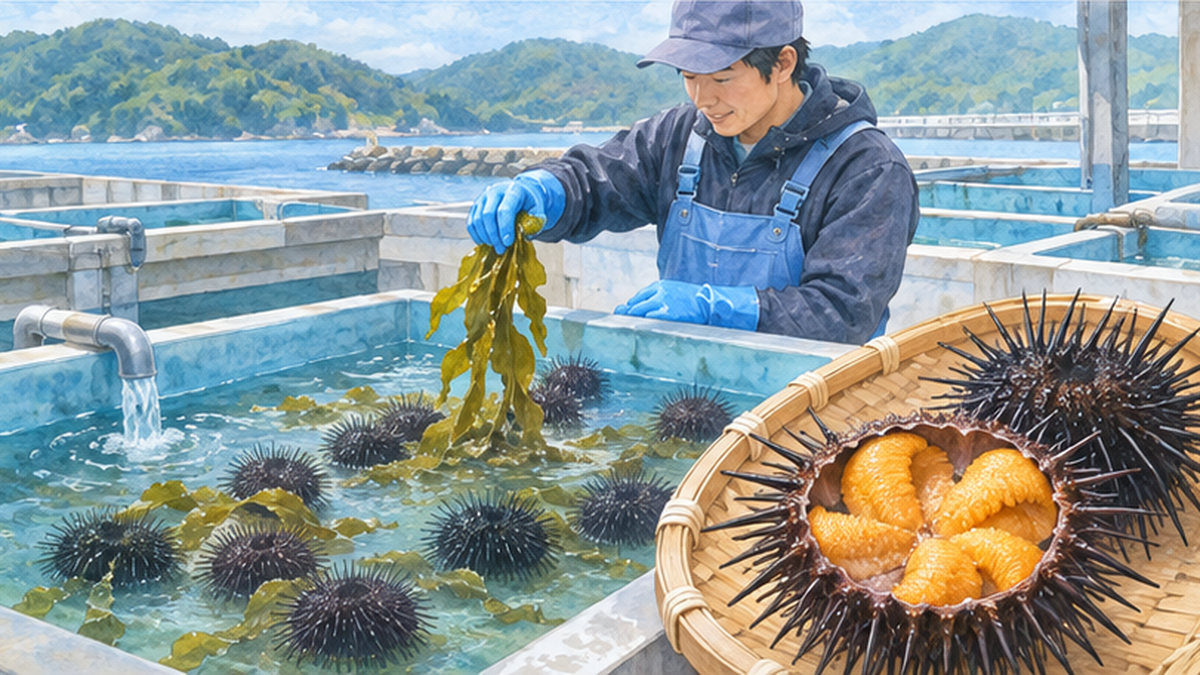
So research is under way in many places on collecting urchins from isoyake areas, feeding them, restoring their meat content and shipping them. In Hokkaido, it has been reported that raising northern purple sea urchins from isoyake areas in cold water without letting them mature can yield good-quality urchins at times when wild urchins cannot be caught. In a trial in Kesennuma Bay, Miyagi, urchins were fed discarded fish heads and entrails for one month and kelp for the second month to adjust flavor, with a final survival rate of 94%.
Remaining challenges
Hokkaido research shows that urchins aged ten or more stay dark in color even after their meat content improves, so quality remains a problem. For long-term profitability and full-scale operation by a fishery cooperative, much is still at the research stage, and commercialization is expected. The idea is to combine removal and utilization so that income helps sustain isoyake countermeasures.
| Challenge | Result | Direction |
|---|---|---|
| Meat color | Older urchins are dark | Select younger urchins; improve feed |
| Cost | Feed and facility costs | Use unused parts; lower feed cost |
| Profitability | Few commercial results so far | Step by step from research to demonstration |
What We Can Do: Building the Sea Forest of the Future
Know the field and choose
Restoring seaweed beds is not only the job of fishers who dive. Choosing local seafood also supports fishers’ activities economically. You can also choose to support sustainable fishing, such as blue carbon efforts and seafood eco-labels.
Learn about and share the state of isoyake
Local governments and fisheries experiment stations publish reports on isoyake conditions and countermeasures. Divers and anglers who notice changes in seaweed beds and tell the local fishery cooperative also help early detection.
A long time frame for protecting the sea
It takes years for seaweed beds to return, and in some places removing urchins alone does not bring recovery. In a case in Kumamoto, a report says that even with various activities such as placing mother plants, removing urchins and culling fish, grazing by urchins and herbivorous fish has kept large seaweed beds from forming in some areas. Even so, fishers who keep going are the foundation that carries the sea forest into the future.
Three things you can do today
- Choose local seafood and support fishers’ work
- Tell the local fishery cooperative or municipality about changes you see while diving or fishing
- Tell family and friends about isoyake and seaweed bed restoration
Summary
- Isoyake is a phenomenon in which seaweed forests stay unrecovered
- Causes — urchins, fish, lack of seed, water temperature — differ by region and call for matching measures
- Fishers are taking on restoration with urchin removal, fences, mother plants and fish culling
- Research on raising urchins as a resource may help sustain these activities
参考文献・出典
- Fisheries Agency, Isoyake Countermeasure Guideline (Ch. 8: Case studies) – Case studies of grazing countermeasures
- Fisheries Agency, Isoyake Countermeasure Guideline (Ch. 3: What is isoyake) – Definition of isoyake
- Fisheries Agency, Progress on creating heat-tolerant seaweed beds – Trends in seaweed bed area (FY2022 national isoyake council materials)
- Ministry of the Environment, Isoyake countermeasures across Japan – The guideline and fishers’ efforts (January 2025)
- MAFF, Realizing the multifunctional roles of fisheries (FY2025 budget) – Support for seaweed bed conservation and targets
- MAFF, Program to strengthen fishing-ground productivity and fisheries’ multifunctional roles (FY2026) – Details of support for seaweed bed conservation
- Fisheries Agency, Survey report on the multifunctional roles support program (FY2023) – Results of activity groups
- Hokkaido Research Organization, report on improving meat content of northern purple sea urchins – Holding culture of urchins from isoyake areas
* Listed in order of reliability: government/academic institutions > peer-reviewed papers > specialized organizations > reliable media