⚡ In short
A tide pool is a small puddle of seawater left behind in a hollow in the rocks. In summer the water can climb to nearly 40°C, and a downpour can dilute the salt in minutes. Crabs, hermit crabs, sea anemones and snails survive there with remarkable tricks. This guide covers their adaptations, when and how to explore a rocky shore, and the rules and hazards you need to know.
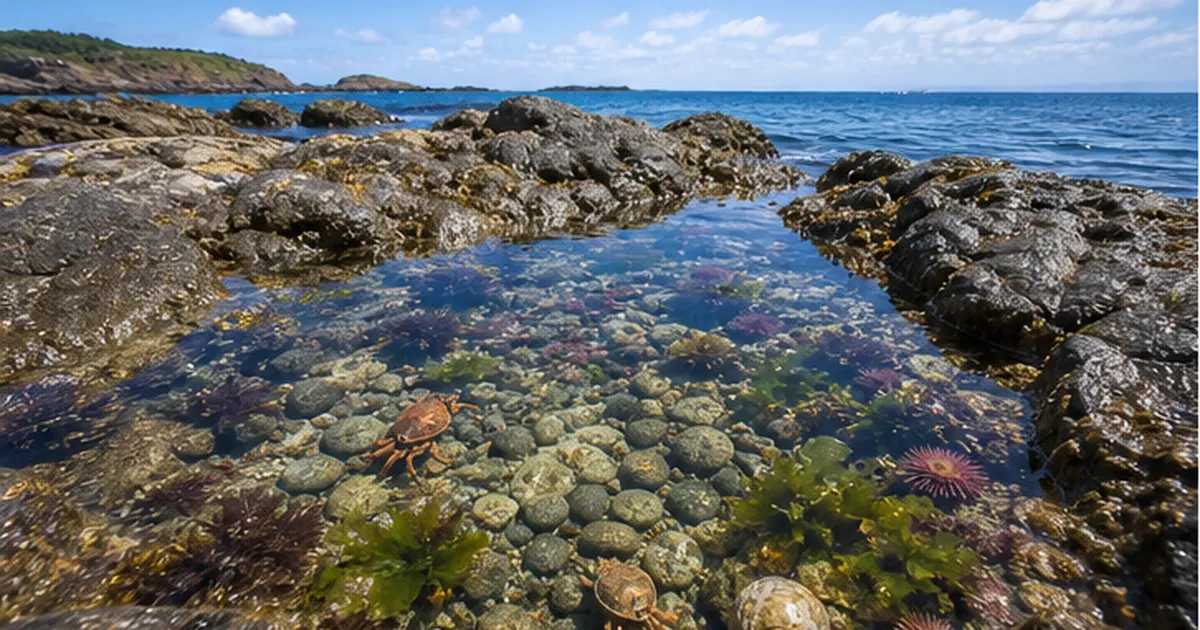
Walk along a rocky shore and you will find small puddles of seawater left behind in hollows in the rock. These tide pools (also called rock pools) are surprisingly busy when you look into them. A crab the size of your fingertip darts away, a hermit crab totters along carrying its borrowed shell, a sea anemone spreads its tentacles, and a small goby peers out from the shadow of a stone. It is a dense little ecosystem — an aquarium tank set down in the wild.
But this small world is no relaxed paradise. When the tide goes out, the sun beats down and the water heats up; at the height of summer it can reach nearly 40°C. Rain floods it with fresh water and dilutes the salt; a run of clear weather evaporates it and makes the water saltier than the sea. At night the animals' respiration strips out the oxygen; by day the seaweed's photosynthesis floods it back in. Because temperature, salinity, oxygen and pH can all be replaced within a few hours, a tide pool is one of the most physically demanding aquatic habitats on the planet.
And yet life is there. In fact, tide pools hold a cast of species that never appears in the open ocean. This article first sets out how the stage is built and just how harsh it is, then follows the specific tricks the residents use, and finally turns to the practical question: how do you actually go and enjoy a rocky shore? From choosing the right hour to the etiquette and safety rules you must keep, this is a guide to the most accessible form of ocean observation there is — one that needs only boots and a bucket.
What you'll learn in this article
- How tide pools form, and the differences between the supratidal, intertidal and subtidal zones
- Why temperature, salinity, oxygen and pH swing wildly within a single day, making this one of Earth's harshest shorelines
- The survival strategies of periwinkles, barnacles, chitons, crabs, hermit crabs, sea anemones and rocky-shore fish
- What happens inside the body — heat shock proteins, cross-tolerance and other mechanisms for coping with extremes
- How to use the Japan Meteorological Agency's tide tables to pick the best day and time, plus the gear and the observation routine
- The rules and safety essentials: fishing rights, poaching, dangerous animals and why you must put every rock back
What is a tide pool?
A tide pool is a puddle of seawater left behind in a hollow or crack in the rock of a rocky shore after the tide retreats. It belongs to the landscape of rocky coasts rather than sandy beaches, and pools range from the size of a palm to shallow basins several metres across.
How a tide pool forms
The mechanism is simple. At high tide the whole rock platform is submerged and the pool is part of the sea, connected to the water beyond. As the tide falls, the sea surface drops and water on the flat rock drains away — but water trapped in a hollow has nowhere to go, and stays put. That is a tide pool.
The crucial point is that a tide pool alternates between being "the sea" and being an isolated little pond within a single day. Along most of the Japanese coast the tide rises and falls roughly twice a day, so a tide pool is cut off from the open sea twice a day and reconnected to it twice a day. That repetition is the starting point for every one of the violent environmental swings, and every one of the unusual adaptations, described below.
Three worlds: the supratidal, intertidal and subtidal zones
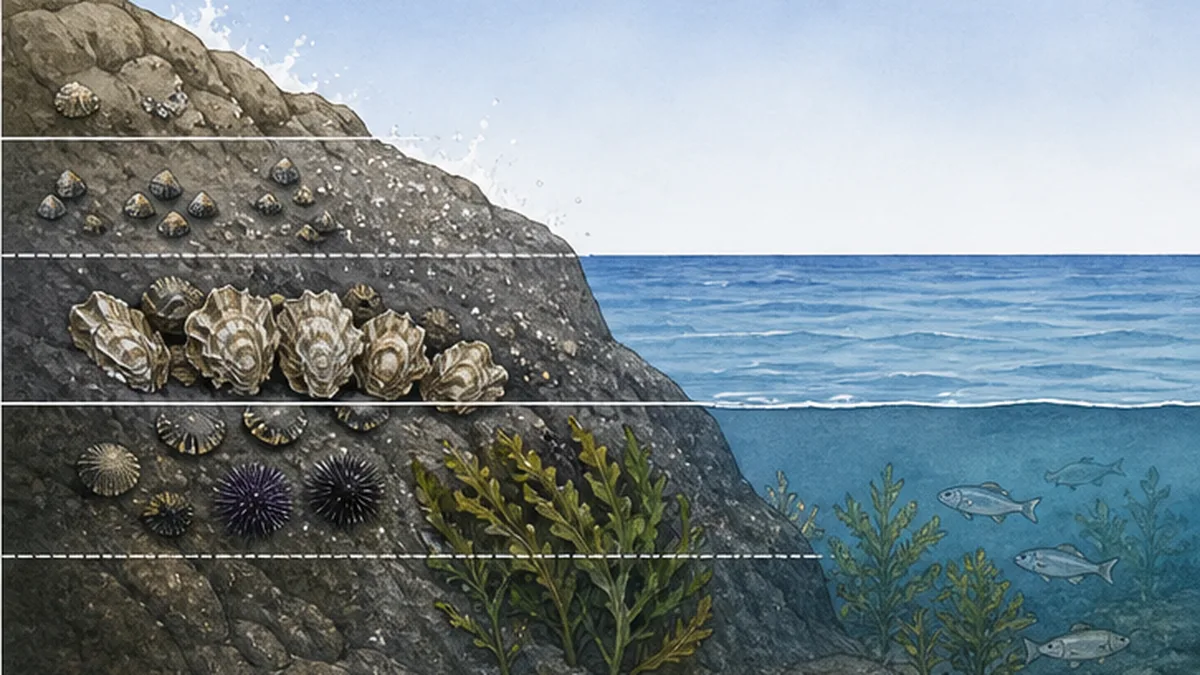
Walk across a rocky shore towards the water and you notice that the cast of species changes distinctly with height. Setouchi Net, run by Japan's Ministry of the Environment, divides the shore into the following three levels.
| Zone | Relationship with seawater | Examples of characteristic species |
|---|---|---|
| Supratidal zone | Never submerged even at high tide; only reached by spray | The periwinkle Nodilittorina radiata ("arare-tamakibi") |
| Upper intertidal zone | Submerged at high tide, exposed to air for long stretches at low tide | Limpets (Nipponacmea concinna), the barnacles Chthamalus challengeri and Tetraclita japonica |
| Mid intertidal zone | Around mean sea level; roughly half submerged, half exposed | Pacific oyster, the tube worm Hydroides ezoensis |
| Lower intertidal zone | Exposed only briefly | The orange sponge Hymeniacidon sinapium, chitons, the drill snail Reishia clavigera, the sea urchin Hemicentrotus pulcherrimus, limpets and crabs of the genus Ozius |
| Subtidal zone | Remains submerged even at low tide | Seaweeds and subtidal fish and invertebrates |
This layering of species by height is called zonation. Teaching material from Hokkaido University's practical course in marine ecology explains that the higher you go in the intertidal zone the longer organisms are exposed to air, and the lower you go the longer they stay submerged; zonation arises because each species occupies the niche where conditions suit it best. In other words, zonation is the ranking of "how much desiccation can you tolerate?" made visible as height above the water.
Why life is "concentrated" in tide pools
Look into a tide pool and the density of life is visibly higher than on the surrounding rock. There are several reasons.
- There is still water at low tide: for animals that cannot tolerate drying out — fish, shrimp, sea anemones, urchins — the pool is the only refuge that gets them through low tide
- There is nowhere to escape: anything caught in the hollow the moment the tide drops is confined there
- Food accumulates: plankton, organic matter and torn-off seaweed carried in at high tide settle in the hollow
- There are many crevices: stones, seaweed and barnacle shells create complex hiding places that shelter small animals
- Large predators struggle to get in: the pool is shallow and narrow, so big fish cannot enter
Key points so far
- A tide pool is seawater left behind in a hollow in the rock — a place that shifts between "the sea" and "an isolated pond" twice a day
- Rocky-shore species form layers by height in order of their tolerance to drying out (zonation)
- Tide pools are refuges at low tide where food and shelter collect, so the density of life is high
The harshest water on Earth, remade by every tide
People often assume a tide pool is safe "because it always has water in it". The truth is the opposite: precisely because the water stays, the water quality itself changes. Open-ocean seawater is remarkably stable in temperature, salinity and pH, but a few litres to a few hundred litres of water cut off from the sea can be transformed at will by the sun, the rain and the breathing of the animals inside it.
Temperature swings widely within a day
Hokkaido University's teaching material on intertidal organisms notes that in a tide pool "at the height of summer the water temperature reaches nearly 40°C" and that "the daily variation in water temperature is considerable". The pool is shallow, small in volume, and surrounded by rock that also stores heat, so when a midsummer low tide falls in the middle of the day the pool becomes an enormous bowl of sun-warmed water. Then the tide comes in and chilly ocean water floods in all at once. For the animals, this means enduring a swing of more than ten degrees within a few hours, every single day.
English-language explanations likewise describe intertidal water temperatures varying by more than 20°F (about 11°C) in a day, and the idea that variability itself is the stress sits at the heart of intertidal ecology. High summer temperatures are a problem in the open ocean too (see What is a marine heatwave?), but tide pool animals experience heatwave-like conditions on a daily, not seasonal, cycle.
Salinity goes both down and up
The same material explains that "if heavy rain falls, fresh water flows in and salinity drops", while "if fine weather continues, evaporation raises the salinity". A tide pool is a small container, so a single summer downpour can leave its surface layer almost fresh, while a spell of hot sun can turn it into a pool saltier than the sea. Marine animals maintain their internal salt concentration by exchanging with the water around them, so a change in external salinity translates directly into a disturbance of their body fluids.
Oxygen and pH swap places between day and night
The variation people most often overlook is in oxygen and acidity. When a pool holds plenty of seaweed, daytime photosynthesis is vigorous: dissolved oxygen becomes supersaturated, carbon dioxide is taken up and pH rises towards the alkaline. At night photosynthesis stops and every organism, seaweed included, simply respires — oxygen is consumed and falls, carbon dioxide accumulates and pH drops towards the acidic.
In other words, tide pool animals taste something close to the ocean acidification and deoxygenation now advancing on a global scale — nightly. The reason so much laboratory work on hypoxia responses uses tide pool fish (the tidepool sculpins) is that these animals are ideal material for studying a physiology built for variability.
| Environmental factor | What happens in a tide pool | Effect on the animals |
|---|---|---|
| Water temperature | Rises during a daytime low tide, reaching nearly 40°C in summer; drops abruptly when the tide returns | Protein denaturation, sudden metabolic shifts, risk of heat death |
| Salinity | Falls with rainfall, rises with evaporation; can do both within a day | Loss of osmotic balance in the body fluids |
| Dissolved oxygen | Supersaturated by day through photosynthesis, depleted at night by respiration | Night-time hypoxia limits activity and risks suffocation |
| pH | Rises during the day, falls at night | Affects the building of calcium carbonate shells |
| Waves and flow | The impact of breaking waves at high tide, complete stillness at low tide | Resistance to being torn off the rock is essential |
| Exposure | Animals around the rim of the pool are left in the air | Desiccation, ultraviolet light, predation by birds |
The rule that smaller means harsher
- The smaller the volume of water, the larger the swings in temperature, salinity and oxygen
- Even on the same shore, a small high pool and a large low pool hold different species
- Asking "how high up is this pool?" while you observe reveals why the residents differ

Residents I: the snails and barnacles that cling to rock
The first thing you notice on a rocky shore is the snails and barnacles packed across the rock face. They are easy to overlook because they do not move — but they are the group that conquered the intertidal zone through the strategy of not fleeing.
Limpets and chitons — clamped down by a foot that works like a suction cup
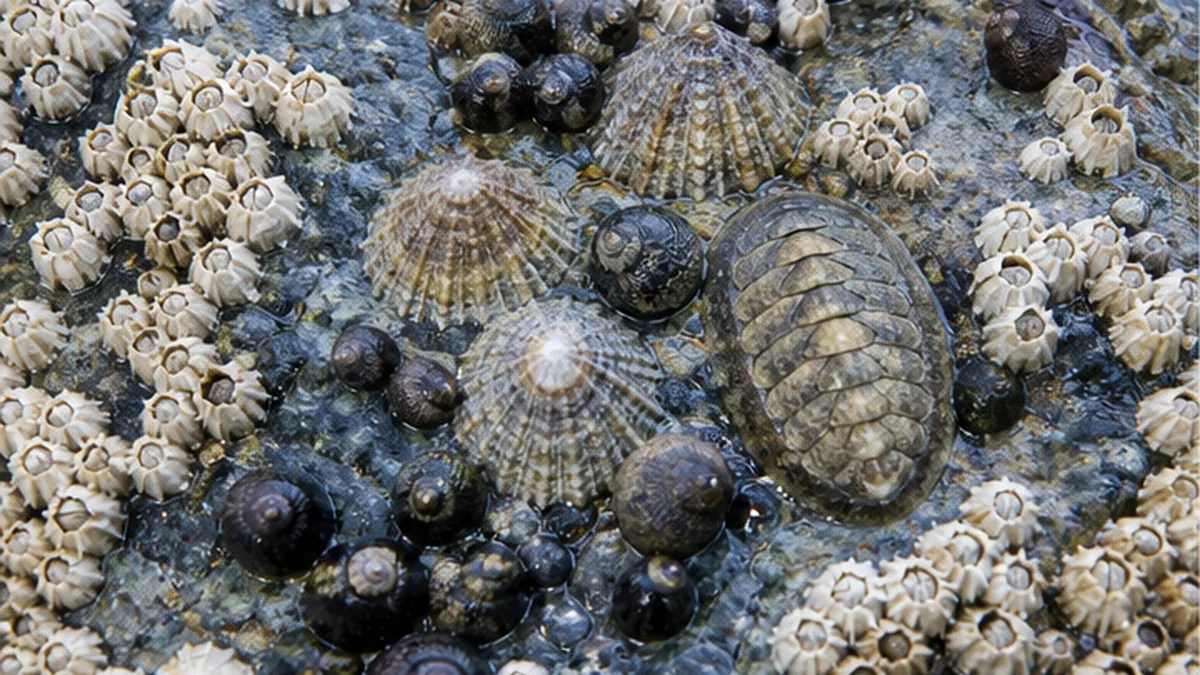
Limpets, with their conical hat-shaped shells, and chitons, whose oval bodies carry eight overlapping plates, both press themselves onto the rock with a large muscular foot. That grip does two jobs: it stops them being torn off by waves, and it traps a film of water between shell and rock to prevent drying out. If you try to prise them off at low tide they do not come away easily — and since that seal is their lifeline, please do not try during observation.
Their feeding is distinctive too. Limpets and chitons both have a radula, a file-like organ they use to scrape the thin film of microscopic algae growing on the rock surface. The dark, smooth appearance of rock on a shore is partly the trace of their daily "cleaning". Some species travel tens of centimetres to feed while the tide is in and return to a fixed resting spot (a home scar) before it goes out, and their shells are known to grow to match the contours of that exact hollow.
Periwinkles — the curious snails that dislike being underwater
High on the rock, where little more than spray arrives, you sometimes find small black snails packed together. These are periwinkles — in Japan the littorinids known as tamakibi and arare-tamakibi. Although they are marine snails, they tend to avoid prolonged immersion; put them in a tank and they will climb above the waterline.
Their defences against drying are thorough. When the water drains away they close the operculum tightly and seal the gap between shell and rock with secreted mucus so that no moisture escapes. Because they shut themselves in while holding a measure of seawater inside the shell, neither fresh water nor wind gets in. By this method they are said to survive weeks to months out of water. The periwinkle's answer is not to endure drying but to carry a small sea around with it.
Barnacles — crustaceans that chose not to move
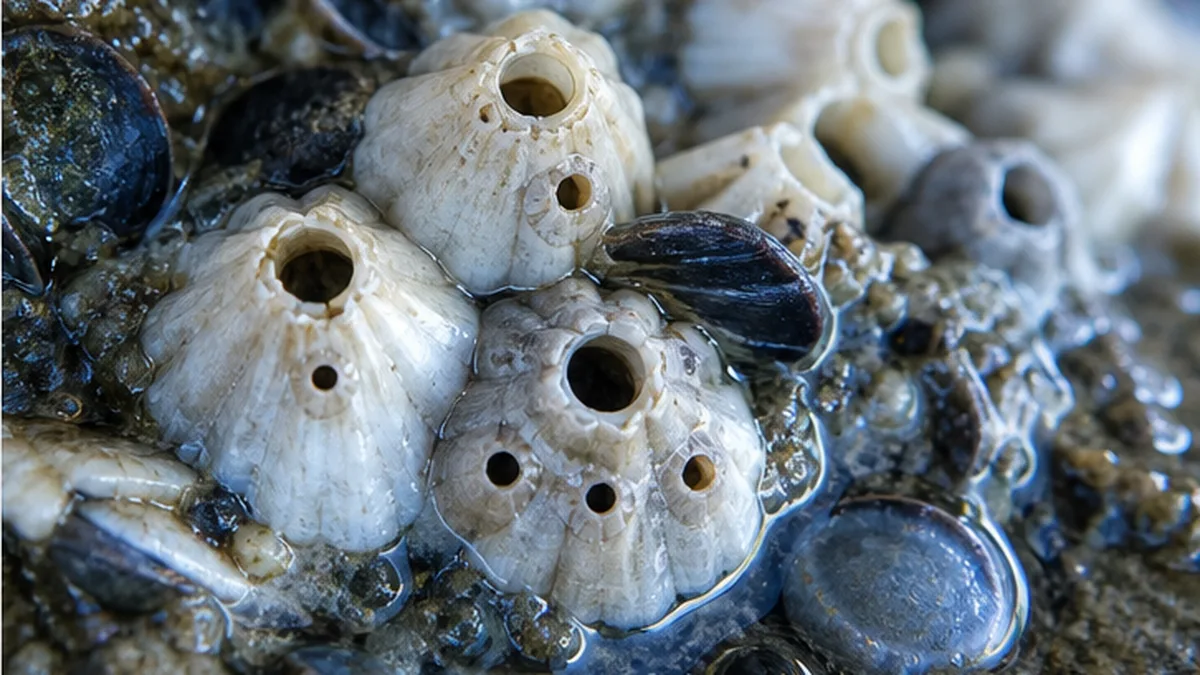
A barnacle is not a mollusc but a crustacean, like shrimps and crabs. As a larva it swims freely as plankton; once it settles it cements its head to the rock, builds a calcareous shell and never moves again. When the tide covers it, it opens the aperture and fans out its legs to filter plankton from the water. Those "white flowers" waving underwater are barnacles feeding.
At low tide the aperture closes tightly and the animal seals itself off from the outside world with seawater held inside. According to an aquarium's account, the striped barnacle Amphibalanus amphitrite can survive roughly ten days without seawater, enduring cold, drying and wind and rain with no food. Choosing not to move was a trade: surrender your freedom of movement and gain a house that can be sealed shut.
The drill snail — a small carnivore of the tide pool
The drill snail Reishia clavigera, common in the lower intertidal zone, is not an algae grazer but a carnivorous snail. Using its radula and a secreted acid, it bores a hole through the shells of barnacles, oysters and mussels and eats the flesh inside. If you find a neat little round hole in a barnacle shell in a tide pool, that is the mark of a drill snail or a relative. Predator and prey coexisting centimetres apart on the same rock is one of the pleasures of the rocky-shore food web.
Strategies shared by sessile animals
- Cling hard to the rock to withstand waves (limpets, chitons, barnacles)
- Trap seawater inside the shell to prevent drying (periwinkles, barnacles)
- Feed intensively during the few hours of high tide and spend low tide in "pause mode"
- Because they cannot move, competition for space is fierce — which is why zonation is so sharply drawn
Residents II: crabs, hermit crabs and shrimp
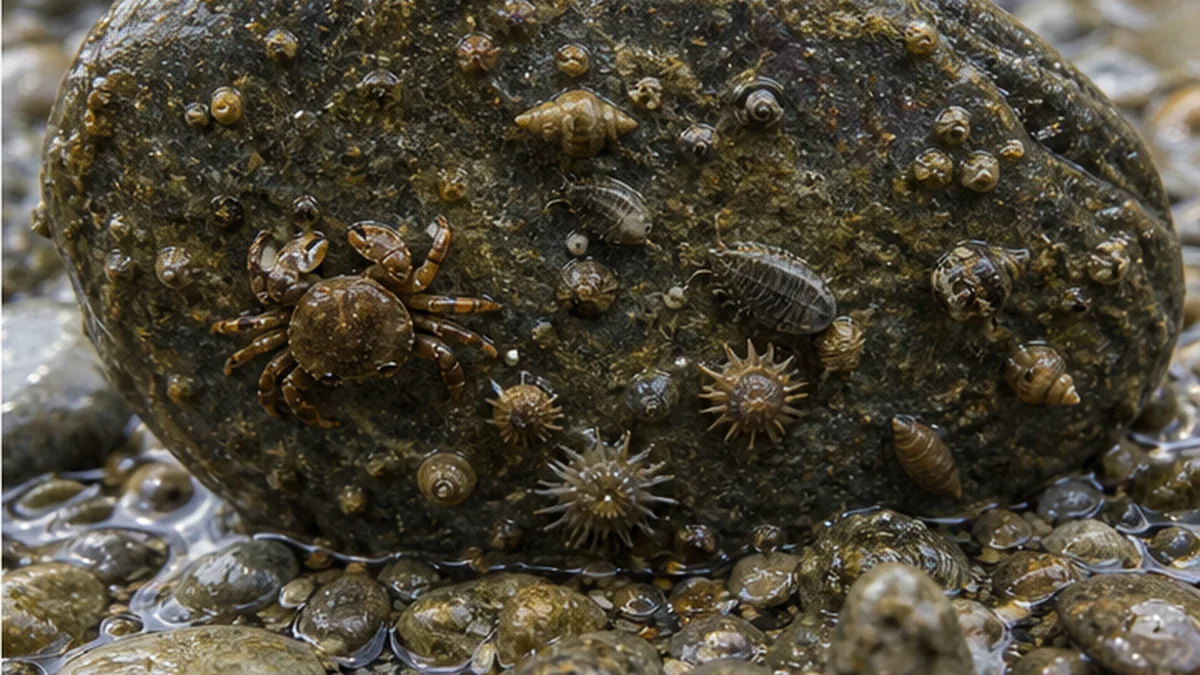
Lift a stone gently and a scatter of small shapes bolts in every direction. It may be the most thrilling moment in rocky-shore observation. The area around a tide pool holds a very high density of crustaceans.
The crabs you meet under stones
On Japanese shores the common finds are the shore crabs Hemigrapsus sanguineus and Hemigrapsus takanoi, the rock crab Grapsus albolineatus, the spiny rock crab Plagusia dentipes, and crabs of the genus Ozius in the lower intertidal. Their greatest weapon is the ability to move. When the tide drops they slip under stones and seaweed or into cracks in the rock, shifting to somewhere damp and cool; when it returns they come out to eat algae, carrion and small animals. The problem that sessile animals solved by enduring, crabs solve by relocating.
Their gills are adapted too. A crab's gills sit inside a branchial chamber that can hold water, so it can keep breathing in air for a while as long as the chamber stays wet. A rock crab scampering across dry rock is untroubled because it is carrying a reservoir of seawater in its gill chamber.
Watching a hermit crab move house
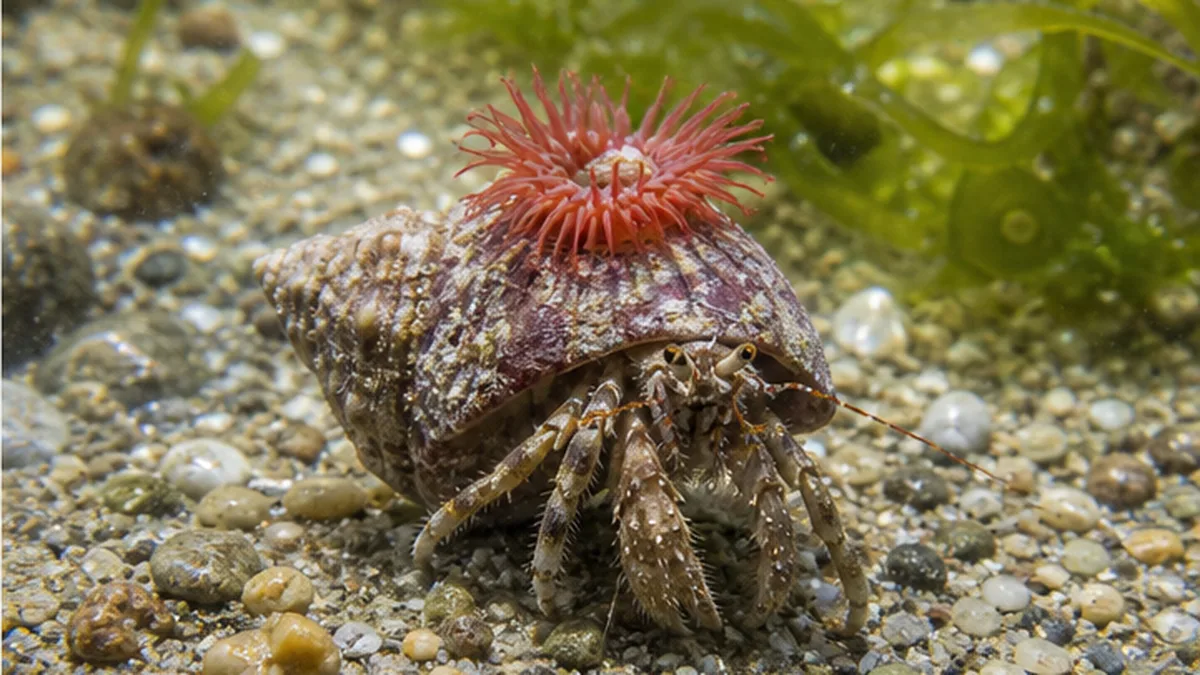
The star of the tide pool is surely the hermit crab; Pagurus filholi and Clibanarius virescens are ordinary sights on Japanese shores. A hermit crab's abdomen is soft and defenceless, so it borrows the empty shell of a sea snail for protection. As it grows the shell becomes cramped and it must move to a larger one.
The move is a careful business. The hermit crab rolls a candidate shell with its claws and inspects it thoroughly for sand packed inside, for holes, for excess weight. If the shell passes, it transfers its body from old to new in an instant. Empty shells are a limited resource on a shore, so fights over shells — and chains of animals swapping shells in sequence — are both well documented. Drop a few empty snail shells into a pool, stand back and wait, and you may see the inspection for yourself (leave the shells there when you go).
The unexpected partnership of hermit crab and sea anemone
Sometimes a sea anemone rides on a hermit crab's shell. This is no accident but symbiosis. The anemone's tentacles carry stinging cells, so the hermit crab gains protection from predators such as octopus; the anemone, which can barely move on its own, is carried to new feeding grounds and picks up the crab's scraps.
Research on this relationship continues. In 2025 a team from Kumamoto University, Fukuyama University, the Natural History Museum and Institute, Chiba, and Kyushu University reported a new species of hermit-crab-associated sea anemone, Paracalliactis tsukisome, from deep water off the Kumano-nada coast of Mie Prefecture and off Suruga Bay in Shizuoka Prefecture. This anemone "extends" the snail shell with its own secretions, enlarging the space the hermit crab can live in. Because usable shells are scarce in the deep sea, the relationship is one in which the anemone provides the house for the hermit crab. The hermit-crab-and-anemone pairing you see in a tide pool is the most accessible doorway into that astonishing deep-sea symbiosis.
Shrimp, amphipods and sea roaches — the overlooked supporting cast
Part the seaweed in a tide pool and transparent little shrimp (grass shrimp, snapping shrimp and their relatives) will spring away. Move a stone and countless millimetre-long amphipods will squirm. They serve as the shore's decomposers, breaking torn seaweed and dead animals into fragments and returning the nutrients to the system. The sea roaches that scuttle across the rock do the same work; disliked for their looks, they are indispensable as the shore's cleaning crew.
The knack for understanding a tide pool ecosystem is to follow the eat-and-be-eaten relationships with your own eyes. Limpets scrape off the microscopic algae; drill snails and starfish hunt the limpets; amphipods and sea roaches clear away the dead. A few litres of water hold a miniature of the entire ocean food web. Even the larger question of why Japan's seas support so much life (see Why Japan's seas rank among the world's most biodiverse) becomes tangible through observing this small puddle.
Residents III: sea anemones, urchins, starfish and fish
A sea anemone is an animal, not a flower
On the walls of a tide pool and beneath its stones sit soft masses of red, green or brown. Submerged, they spread their tentacles in a radial crown; exposed at low tide, they pull the tentacles in and become a blob of jelly. These are sea anemones — cnidarians, like jellyfish and corals.
The surface of each tentacle carries stinging cells, firing venomous threads into any small animal that touches them, paralysing it and carrying it to the mouth. Common species on Japanese shores include the green anemone Anthopleura fuscoviridis, Anthopleura uchidai and the striped anemone Diadumene lineata. Touch a tentacle lightly and it feels as though it sticks to your finger — that is the stinging cells firing, so anyone with sensitive skin, and small children, should not touch.
Sea anemones are also famous for their skill at symbiosis. Some host symbiotic algae internally and take a share of the products of photosynthesis; some partner with hermit crabs, as above; and in the tropics some partner with fish (see Why clownfish are not stung). Looking at anemones in a tide pool is also practice for understanding symbiosis on a coral reef.
Urchins and starfish — echinoderms that walk on tube feet
Pools in the lower intertidal zone hold sea urchins such as Hemicentrotus pulcherrimus and Heliocidaris crassispina, along with starfish such as Patiria pectinifera. Both urchins and starfish are echinoderms, and the underside of the body carries countless fine tubes called tube feet, extended and contracted by water pressure to walk. Turn an urchin over gently and you can watch those slender tubes ripple.
Urchins also hold the balance of the rocky-shore ecosystem in their grazing. If their numbers grow too high and they eat out the seaweed, the result is bare rock — a state known in Japan as isoyake, or barren ground. Japan's Fisheries Agency issued guidelines for countering isoyake in 2007 (revised in 2015), setting out a staged workflow from detecting the barren, through setting recovery targets and removing the factors blocking seaweed growth, to monitoring. Whether there is abundant seaweed around a tide pool is a sign of that shore's health (see Restoring eelgrass beds, the cradle of fish).
The fish of the tide pool
Some fish spend their whole lives in tide pools; others use them only as juveniles. Common finds on Japanese shores are gobies such as Chaenogobius annularis and Chaenogobius gulosus, blennies such as Parablennius yatabei and Petroscirtes breviceps, and in warmer waters the rockskippers.
Their bodies bear the marks of tide pool life. Most have a small swim bladder or none at all, living pressed against the bottom rather than floating in mid-water. In gobies the pelvic fins are modified into a sucker that grips rock so the fish is not swept away. Rockskippers have a high capacity for cutaneous respiration and will sometimes leave the water altogether, hopping across wet rock. They are also tolerant of low oxygen, and experiments show they can lower their respiration and ride out the oxygen-poor night in a pool.
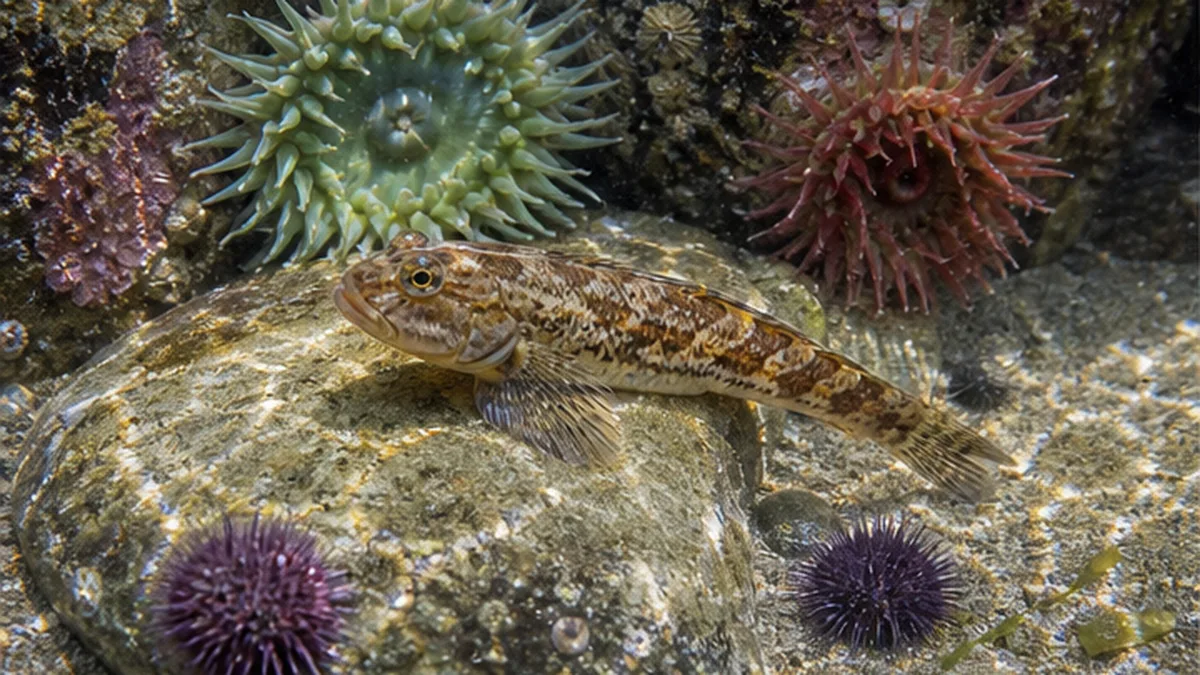
| Group | Representative species | How to find them in a pool |
|---|---|---|
| Sea anemones | Anthopleura fuscoviridis, Anthopleura uchidai | On submerged rock walls and under stones; a shrunken blob when exposed |
| Sea urchins | Hemicentrotus pulcherrimus, Heliocidaris crassispina | In hollows and under seaweed in the lower intertidal |
| Starfish | Patiria pectinifera, Coscinasterias acutispina | On the underside of stones and in the shade of seaweed |
| Gobies | Chaenogobius annularis, Chaenogobius gulosus | On stones on the bottom; they dart under a stone as you approach |
| Blennies | Parablennius yatabei, Petroscirtes breviceps | Peering out from holes in the rock or from empty shells |
| Shrimp | Palaemon pacificus and relatives | Inside clumps of seaweed; transparent and hard to spot |
| Crabs | Hemigrapsus sanguineus, Grapsus albolineatus, Plagusia dentipes | Under stones and in cracks in the rock |
The bodily machinery that survives extremes
The tricks described so far are visible from outside — shapes and behaviour. So what is happening inside the body? Intertidal animals attract research attention worldwide in physiology, for a simple reason: they experience naturally, every day, the sort of extreme variation a laboratory has to manufacture.
1. Sealing up and holding water — a physical solution
The most basic strategy is the sealing that has come up again and again. The periwinkle closes its operculum and seals with mucus; the barnacle shuts its aperture; the limpet clamps its foot to the rock; the crab holds water in its gill chamber. All arrive at the same idea: carry a small sea around with you. Transporting the environment is more reliable than rebuilding your physiology.
2. Heat shock proteins — the emergency repair crew
Under high temperature, proteins inside cells lose their proper three-dimensional shape and stop working. Against this, organisms produce large quantities of molecules called heat shock proteins (HSPs), which refold proteins that have begun to collapse and route the unsalvageable ones for degradation.
Work on tide pool fish has reported that individuals exposed to the natural tidal cycle show HSP patterns different from those of fish held experimentally at a constant temperature. In short, intertidal animals most likely use HSPs not as an emergency trump card but as a routine maintenance system. Some species are known to maintain higher baseline HSP levels than their counterparts in the stable open ocean.
3. Cross-tolerance: salinity stress that builds heat resistance
The most striking phenomenon in tide pool physiology is cross-tolerance — the mechanism by which exposure to one kind of stress raises resistance to another.
A study of a copepod living in splash pools, published in a journal of the US National Academy of Sciences family, showed that simply raising the salinity rapidly increased subsequent tolerance to high temperature. Experiencing a single sublethal thermal event, or an abrupt shift in salinity, quickly raises heat tolerance through physiological plasticity. The researchers frame this as the mechanism that lets physiology "keep pace" with a hypervariable, unpredictable environment.
The finding changes how we see a tide pool. For the animals in it, variability is not merely a misfortune; it is also training for the next round of variability.
4. Regulating temperature and moisture through behaviour
Behaviour itself, not just physiology, is a genuine adaptation. Work on barnacles reports that metabolism and behaviour differ according to the intertidal height at which an individual settled. Crabs go under stones, snails into the shade of rock, fish into deeper hollows — each gaining several degrees of cooling from a movement of a few centimetres. For a shore animal, shade is life-support equipment. Which is exactly why leaving a stone you turned over lying upside down deprives the animals beneath it of shade and moisture at the same time (this leads directly into the etiquette below).
| Type of adaptation | The specific mechanism | Where you see it |
|---|---|---|
| Form and structure | The shell operculum, the clamping foot, the gill chamber, sucker-like pelvic fins | Periwinkles, limpets, crabs, gobies |
| Physiology (molecular) | Constant production of heat shock proteins, osmotic regulation | Most intertidal fish, crustaceans and molluscs |
| Physiology (plasticity) | Cross-tolerance, in which salinity or heat experience raises heat resistance | Splash-pool copepods and others |
| Behaviour | Moving under stones, into cracks or into deeper water; returning to a home scar | Crabs, shrimp, fish, limpets |
| Life history | Dispersing as planktonic larvae, then settling | Barnacles, molluscs and many invertebrates |
Three answers shared by tide pool life
- Carry it: seal seawater inside a shell or gill chamber and take the environment with you
- Repair it: keep mending the parts that break daily, using heat shock proteins and the like
- Prepare for it: let one bout of stress raise resistance to the next (cross-tolerance)
How to explore a rocky shore: when to go, what to bring, how to look
Tide pool observation needs no qualification and no expensive equipment. But when you go is decisive. Get that wrong and the pools are simply under the sea and there is nothing to see.
Use a tide table to target the low tide of a spring tide
Tides are driven by the gravity of the moon and the sun. When moon and sun line up — around new moon and full moon — the tidal range is at its largest (a spring tide), and at low tide the shore reveals the lower intertidal zone that is normally submerged. Conversely, at the half moon (first and last quarter) the range is small — a neap tide — which is poor for observation.
For exact times, use the Japan Meteorological Agency's tide tables. The agency publishes hourly tide levels and predicted times and heights of high and low water (astronomical tide) for locations across the country, with 2026 data available. The procedure is as follows.
- In the JMA's "Tide table" pages under tidal and sea level data, choose the station nearest the shore you plan to visit
- Check the time and height (in cm) of low water for the date you intend to go
- Prioritise days on which the low-water height is low (a small number)
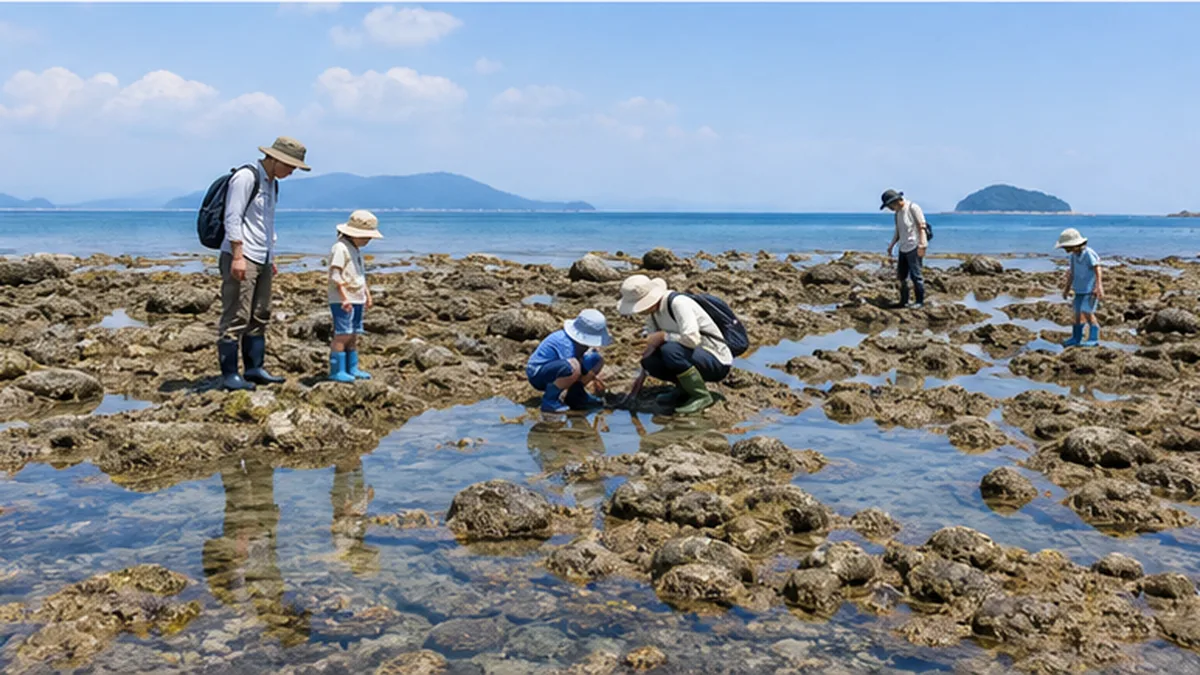
- Arrive on site one to two hours before the time of low water and work seaward as the tide falls
- Once low water has passed, head back to shore early, so the incoming tide cannot surround you

How you use the time is a safety matter
- The tide starts rising from the moment of low water, so heading seaward after low water is dangerous. Go out before low water; come back after it
- Tide table values are predictions (astronomical tide); real levels shift with air pressure and wind. The JMA's tide level observation pages show measured values
- Do not go on days with a high-wave advisory, forecast heavy waves, or lingering swell
What to bring
- Footwear that protects your feet: rock and shell make a shore extremely slippery and easy to cut yourself on. Marine shoes or well-worn trainers (never flip-flops)
- Work gloves: so you do not cut your hands on rock or barnacles. Grip-coated is better
- Hat, sunscreen and drinking water: a summer shore has no shade and a high risk of heat illness
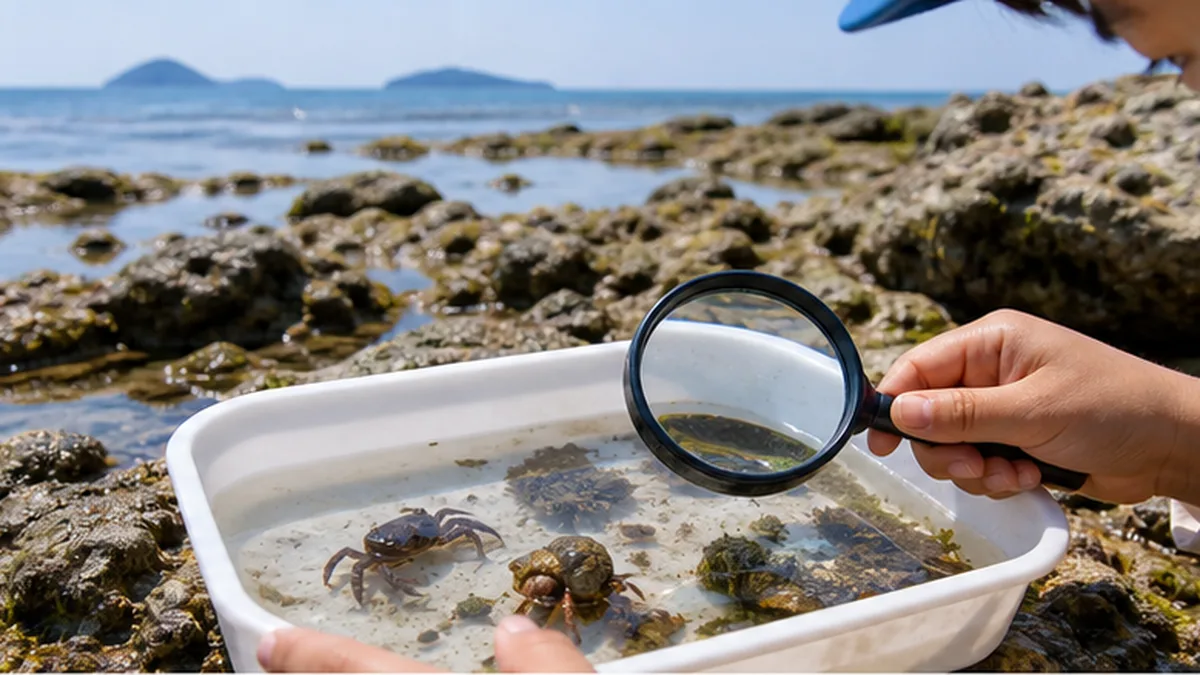
- A white tray (shallow container) or bucket: to hold animals briefly for observation. White makes colour and movement far easier to see
- A hand lens: amphipods, juvenile snails and feeding barnacles are a different world under a lens
- A viewing box: it removes surface reflection so you can see clearly into the water. You can make one from a plastic bottle
- A smartphone or camera: record rather than collect. A waterproof case helps
- A field guide or identification app: being able to name things on site multiplies the enjoyment
- A life jacket: advisable with small children, or on shores where the footing drops away
How to look — the knack is lift, wait, replace
- Start by keeping still: move as soon as you arrive and everything hides. One or two minutes of quiet watching is enough for crabs and fish to start moving
- Compare pools at different heights: confirm for yourself that a high pool near the land and a low pool near the sea hold different residents. You can see zonation with your own eyes
- Lift stones gently and always put them back: under a stone is home to many animals. Once you have looked, return it quietly to the same place, the same way up
- Part the clumps of seaweed: shrimp, amphipods and juvenile fish live inside. Part it by hand rather than pulling it out
- Photograph rather than collect: shoot so that colour, tentacles and the number of legs are visible. Noting the date, the place and the height of the pool makes later identification much easier
- Return everything to the pool it came from: water in a container warms quickly, so keep each observation to a few minutes
Keep records and build your own map of the shore
Visit the same shore across the seasons and you notice the cast changing. Spring brings many juvenile snails and fish; in summer the water warms and animals vanish from the higher pools; in autumn grown individuals stand out. Keep photographs together with the date and the height of low water, and in a few years you will have a genuine fixed-point record. When you cannot identify something you photographed, the surest route is to ask at a local aquarium or museum, or at an observation event run by certified nature guides. In the Seto Inland Sea, the Seto Inland Sea Research Conference publishes a shore-organism survey manual for assessing water and biological conditions from rocky-shore species, so citizens can follow the same procedure.
Etiquette and safety: keeping the shore a place you can return to
Exploring a rocky shore means stepping into nature. Before you enjoy it, get three things straight: the law, the etiquette and the safety.
1. Some animals must not be collected (fishing rights)
Most of Japan's beaches and rocky shores carry a Class 1 common fishing right. That means the local fisheries cooperative holds the right to harvest sedentary aquatic species such as shellfish and seaweed. According to Hiroshima Prefecture's guidance, taking sedentary species covered by a fishing right without permission can lead to prosecution for infringement of fishing rights and a fine of up to one million yen. "It was only for my own dinner" and "it was only a few" can still amount to poaching — a point on which the authorities are consistent.
Abalone, turban shells and sea cucumbers may additionally fall under the heavier penalties applied to specified aquatic species. The principle for enjoying a shore safely is simple.
- Keep to look, photograph, replace — and take nothing home; that is the safest course by far
- If you want to gather shellfish or seaweed, use a managed shellfish-gathering site run by a municipality or fisheries cooperative, where the fishing-rights question has already been settled
- Always read the signs and notices on site. Access may be restricted while wakame and hijiki seaweed are growing
- When in doubt, check in advance with the local fisheries cooperative or the municipal fisheries department
- Do not use prohibited gear (dredges, or the combination of goggles and tools, for example — rules differ by prefecture)
2. Always put an overturned stone back
This is etiquette rather than law, but for the shore's ecosystem it matters more than a fine. The underside of a stone is the only refuge where crabs, amphipods, starfish, small fish and juvenile anemones can secure shade and moisture at the same time. Leave a stone lying upside down and the animals attached beneath it are exposed to direct sun and drying, and die; it takes a long time before anything can live there again. Lift quietly, and return it the same way up in the same position. That alone keeps a shore a place you can observe again and again.
Five promises you can keep from today
- Lift stones gently and return them the same way up, in the same place
- As a rule, take nothing home. Keep each observation to a few minutes and return the animals to their pool
- Do not touch what should not be touched (if you cannot tell, not touching is the right answer)
- Take your rubbish with you, and pick up as much washed-up litter as you can carry
- Follow the parking and access rules, and obey the local notices
3. Animals you must not touch
A rocky shore holds a small number of genuinely dangerous animals, and warmer waters call for particular care. It is well worth reading through the marine hazard information published by municipalities and tourism bodies before you set out.
| Animal | Features | Danger and response |
|---|---|---|
| Blue-ringed octopus | A small octopus around 10 cm long; vivid blue rings appear when it is provoked | A bite delivers potent tetrodotoxin and can be serious. Never touch it; go to hospital immediately |
| Long-spined urchin (Diadema) | A black urchin with long, sharp spines | A puncture is intensely painful, and spines snap off inside; get medical treatment |
| Cone snails (including Conus geographus) | A beautiful conical snail, common in southern waters such as Okinawa | Fires a venomous tooth; deaths have occurred. Do not pick up the shells |
| Matamalu anemone (Phyllodiscus semoni) | A disc 10–20 cm across; it may not look like an anemone at all | Highly venomous, with intense pain on contact. Do not touch rock faces bare-handed on southern shores |
| Sea snakes | Occasionally appear in shallow water in the south | Strongly venomous. Do not approach even if you only see one |
| Venomous fish such as Plotosus and Siganus | Venomous spines in the dorsal and pectoral fins | A sting is very painful. Never grip them bare-handed |
The shared precautions are three: never put a bare hand into a crack in the rock, never touch anything unfamiliar, and always wear shoes. If you are stung or bitten, photograph the animal if you can — knowing the species speeds up treatment — and seek medical attention immediately.
4. The pleasure of watching the shore change
Tide pools are close at hand, but they are not shielded from climate change. The Biodiversity Center of Japan, part of the Ministry of the Environment, runs a long-term programme called Monitoring Sites 1000. Its coastal "rocky shore survey" photographically records the presence or absence of indicator sessile species in quadrats at 30 points per site at six sites nationwide, and also measures rock temperature through the year using temperature loggers. Detailed five-yearly surveys are combined with annual surveys, and the reports and data are published.
Long-term data of this kind is the foundation that turns "I feel as though that snail has become scarcer on that shore" into a verifiable fact. Our own observation records can play the same role, as long as the photograph, the date and the place are all there. The northward shift in the distribution of fish and invertebrates as the sea warms (see Fish are moving north) shows up in the cast of species on a shore as well. And the idea that human involvement can make the sea richer (see What is satoumi?) is something a rocky shore, more than anywhere, lets you feel.
Summary of this article
- A tide pool forms where seawater is left in a hollow in the rock, and it shifts between "the sea" and "an isolated pond" twice a day
- In summer the water reaches nearly 40°C, and salinity, oxygen and pH also swing widely within a day: an extremely harsh environment
- Snails and barnacles seal up, crabs and hermit crabs relocate, sea anemones form partnerships — each group reached a different answer
- Inside the body, heat shock proteins and cross-tolerance provide the machinery for "keeping pace" with variability
- Aim for the low water of a spring tide. Pick the day and hour from JMA tide tables, and head back to shore once low water has passed
- Most shores carry fishing rights, and collecting without permission may be illegal. Look, photograph and replace is the best practice
References and sources
- Ministry of the Environment, Japan – Setouchi Net – Creatures found on rocky shores (zonation of the supratidal, intertidal and subtidal zones and their characteristic species)
- Biodiversity Center of Japan, Ministry of the Environment – Monitoring Sites 1000 coastal survey, rocky shore survey data files (six national sites, 30 quadrat points per site, rock temperature measurement)
- Biodiversity Center of Japan, Ministry of the Environment – Monitoring Sites 1000 survey reports (rocky shore and tidal flat survey reports)
- Japan Meteorological Agency – Tidal and sea level data: tide tables (predicted times and heights of high and low water by station)
- Japan Meteorological Agency – Tide level observation information (measured levels; lets you check the gap from predictions)
- Hokkaido University LASBOS – Practical course in marine ecology 3, survey of vertical distribution of intertidal organisms: "Tide pool" (records water temperature near 40°C in summer and salinity variation)
- Kyushu University – New species: a pale pink sea anemone that builds a home for a hermit crab (Paracalliactis tsukisome, 2025)
- Fisheries Agency of Japan – Conservation and creation of seaweed beds, and countermeasures against isoyake (guidelines issued 2007, revised 2015)
- Hiroshima Prefecture – Shellfish gathering and rocky shore play (explains Class 1 common fishing rights and the fine of up to one million yen)
- Chiba Prefecture Official Tourism Site – Illustrated guide to dangerous marine animals (features of and responses to the blue-ringed octopus, Diadema urchins and others)
- PNAS Nexus / PMC – Elevated Salinity Rapidly Confers Cross-Tolerance to High Temperature in a Splash-Pool Copepod
- Seto Inland Sea Research Conference – Manual for surveying coastal organisms of the Seto Inland Sea: assessing water and biological conditions from rocky-shore species (PDF)
※ Listed in order of reliability: government/academic institutions > peer-reviewed papers > specialized organizations > reputable media