⚡ In short
Modern sails on cargo ships cut fuel use. We cover four types (rigid wing sails, rotors, suction sails, kites), results from Shofu Maru and Pyxis Ocean, IMO goals and challenges, from primary sources.
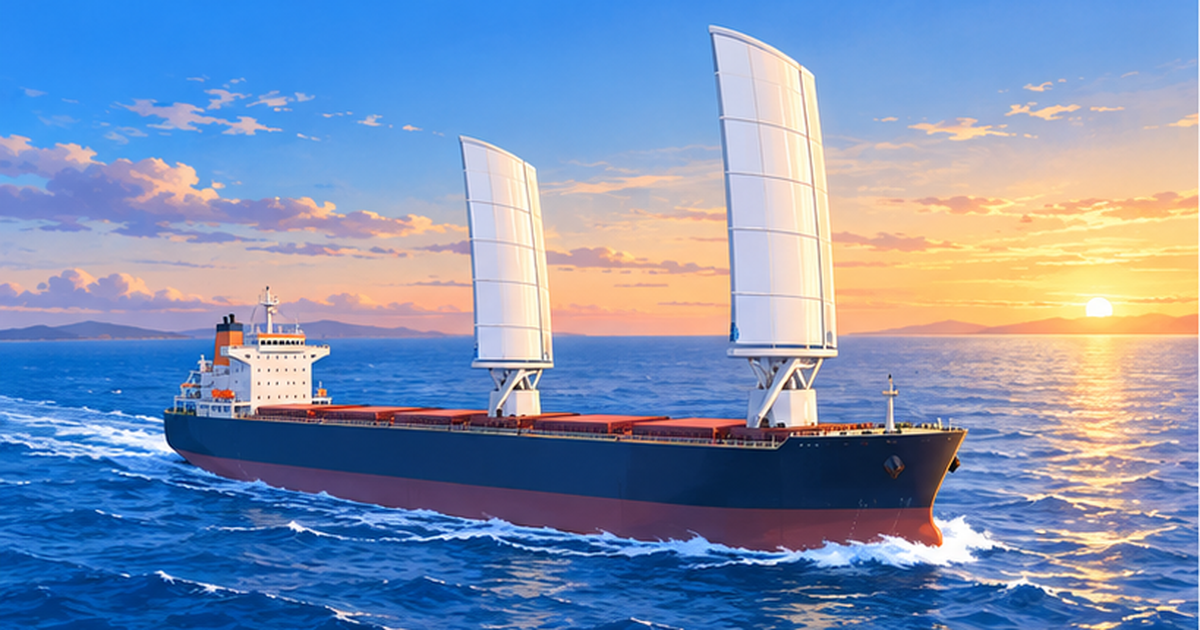
Giant sails rising from the deck of a cargo ship: this sight is becoming reality.Wind-assisted propulsion keeps the engine but uses wind power to cut fuel use, and is one way to decarbonize international shipping.
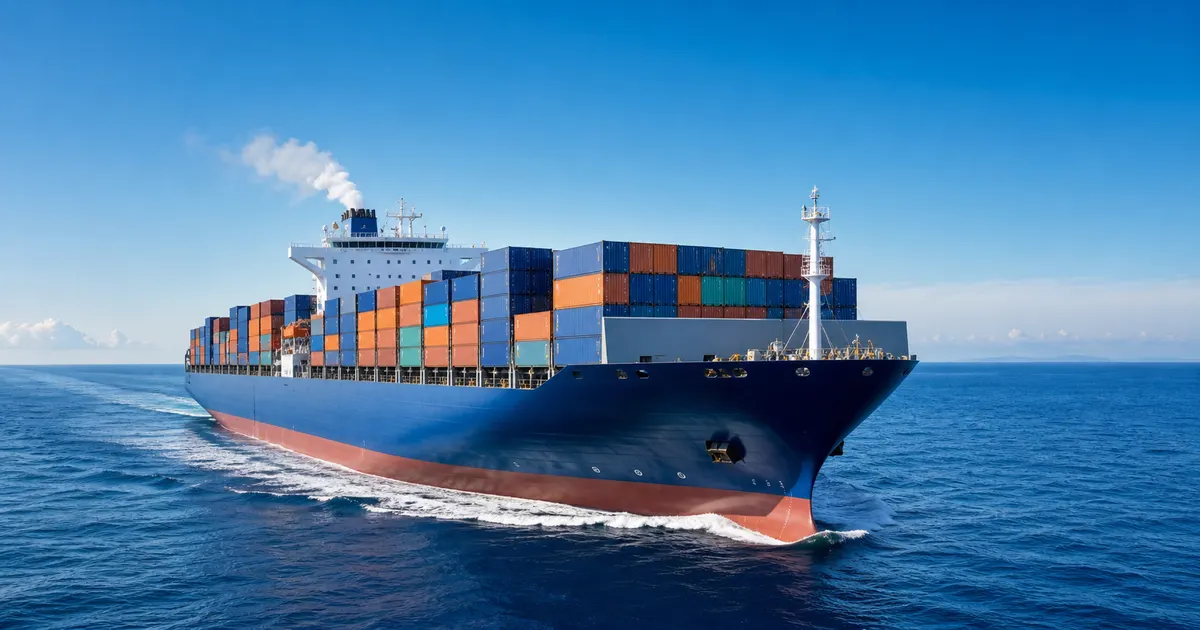
International shipping accounts for about 3% of global greenhouse gas emissions, and the IMO aims for zero emissions around 2050. Until new fuels are widely available, energy-saving technologies that can be retrofitted to existing ships are drawing attention.
This article summarizes how it works, the four main types, published results from Mitsui O.S.K. Lines and Cargill, and the challenges of adoption, based on primary sources.
What you will learn
- Shipping's decarbonization goals and where wind-assisted propulsion fits
- How propulsion is drawn from the wind
- The differences between rigid wing sails, rotor sails, suction sails and kites
- Published results from the Shofu Maru and Pyxis Ocean
- Adoption challenges and combining other decarbonization measures
Why sails are returning to cargo ships
It is said that around 80% of world trade by volume is carried by sea. Most of these ships run on fossil fuels such as heavy fuel oil, so international shipping is a major source, accounting for about 3% of global greenhouse gas emissions. For large ocean-going ships, where "replacing with batteries" like electric cars is difficult, changing the fuel itself and reducing the amount of fuel used must be combined.
One approach drawing attention is wind-assisted propulsion (Wind-Assisted Propulsion System, WAPS). Keeping the engine, it supplies part of the thrust with wind power and reduces fuel consumption. Rather than a return to old sailing ships, think of adding high-tech "sails" to modern cargo ships.
The background: shipping decarbonization goals
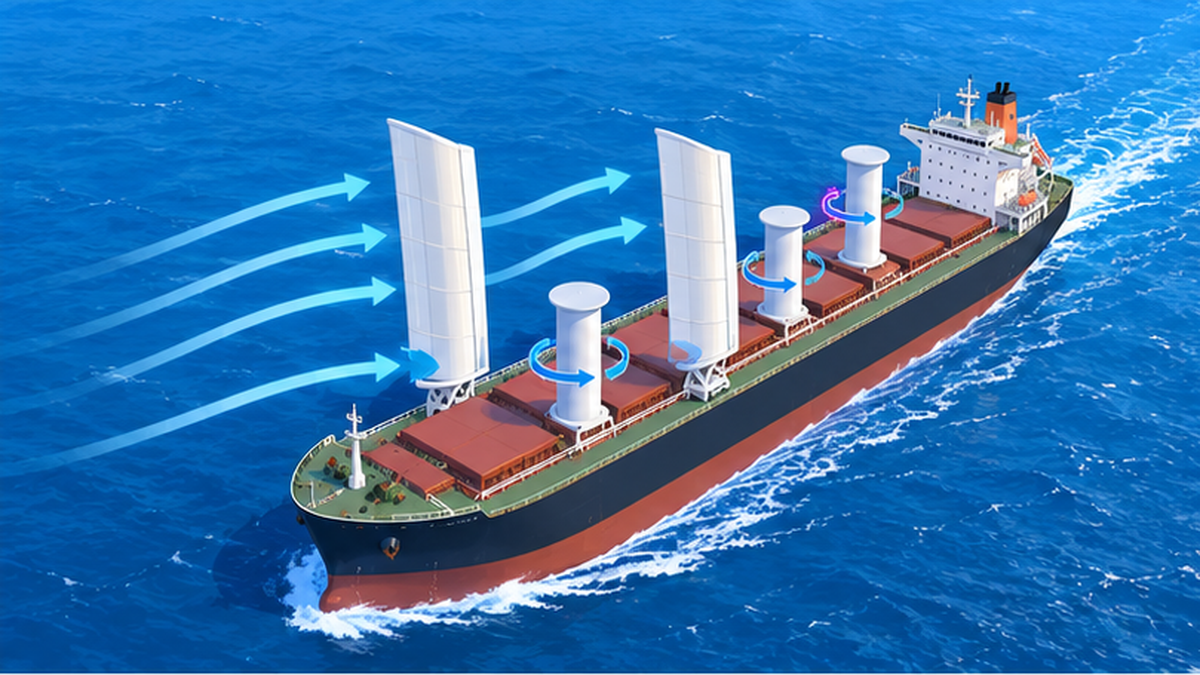
In July 2023 the International Maritime Organization (IMO) revised its greenhouse gas reduction strategy. According to Japan's Ministry of Land, Infrastructure, Transport and Tourism, it aims for zero emissions from international shipping around 2050, with interim goals including a 40% cut in CO2 emissions per unit of transport work by 2030 compared with 2008, and a 5–10% share of zero-emission fuels by 2030.
- 2030: cut CO2 per unit of transport work by 40% versus 2008 (efficiency target)
- 2030: cut greenhouse gas emissions by 20–30% versus 2008 (indicative)
- 2040: cut by 70–80% (indicative)
- Around 2050: zero greenhouse gas emissions
New fuels (ammonia, hydrogen, methanol and others) take time to build supply chains. Wind-assisted propulsion, by contrast, has the strength of being retrofittable to existing ships and able to cut fuel use on ships running on any fuel. For trends in next-generation fuels such as ammonia, see the related article "Shipping decarbonization and ammonia fuel".
The value of "using less fuel"
New fuels tend to be expensive, so the less fuel a ship uses, the lower both fuel costs and emissions. Wind-assisted propulsion does not compete with "fuel switching"; it is also expected to be a way of saving the expensive fuel after switching.
Key points of this chapter
- International shipping accounts for about 3% of global greenhouse gas emissions
- The IMO aims for zero emissions around 2050
- Wind-assisted propulsion can be retrofitted to existing ships
How wind-assisted propulsion works: drawing thrust from the wind
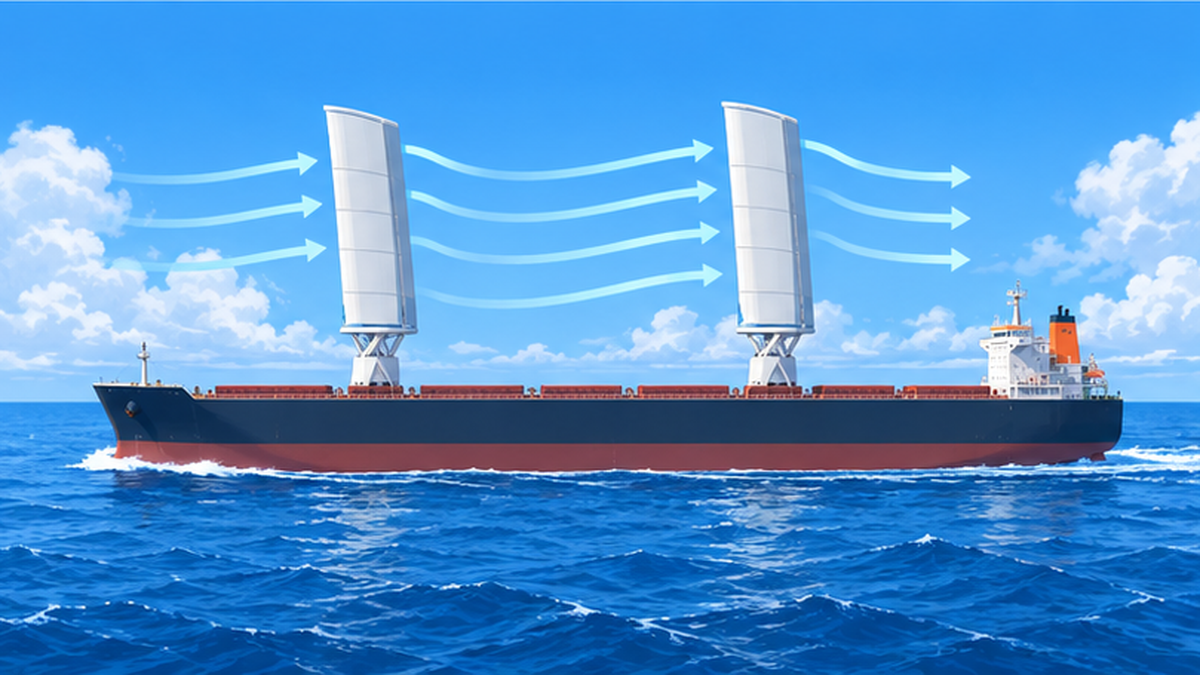
The basic idea is to catch the wind with a structure on the ship and generate forward force (thrust). Unlike old sailing ships, however, it is not just "being pushed by the wind." Modern devices use lift, the same force as an airplane wing.
Strong with crosswinds, not just tailwinds
When wind hits a wing, lift arises at right angles to the flow. When the ship receives wind from the side, part of this lift becomes forward force. For this reason, wind-assisted propulsion is said to work better with wind from the side or forward of the beam than with a direct tailwind.
The apparent wind is the key
Because the ship itself moves, the wind felt on board (the apparent wind) combines the real wind and the ship's speed. The effect varies greatly with wind direction and strength along the route, so which sea area the ship sails determines the reduction rate.
| Factor | Effect |
|---|---|
| Wind strength | Stronger wind gives more thrust, but very strong wind requires safety measures such as lowering the device |
| Wind direction | Works best with crosswinds to forward-quartering winds |
| Ship speed | The faster the ship, the more the apparent wind shifts forward, changing conditions |
| Route | Sea areas with steady winds, such as the westerlies and trade winds, are advantageous |
Reducing the load on the engine
The thrust gained from wind reduces the force the engine must produce. As a result fuel consumption falls, and CO2 and air pollutants fall too. The effect is small on calm days and large when the wind is right, so it is used with route planning on the premise that it is a variable energy saving.
The four main types: wing sails, rotors, suction sails and kites
There are several types of wind-assisted propulsion, each suited to different ship sizes, deck space, routes and cargo-handling methods. Industry materials generally sort them into the following four.
Rigid wing sails
These are sails with a rigid, airplane-wing-like structure. Mitsui O.S.K. Lines' "Wind Challenger" and BAR Technologies' "WindWings" adopted by Cargill belong here. A key feature is that the angle can be adjusted to the wind and they can be lowered or shortened in strong wind or in port.
Rotor sails (Flettner rotors)
A cylinder on deck is spun, and the force produced when wind hits it (the Magnus effect) provides thrust. Because it can be made compact relative to the ship's height, it is said to have relatively many installations. Companies in Norway, Finland and elsewhere have commercialized it.
Suction sails
Air is drawn in through the surface of an oval-shaped column to control the flow around the wing and raise lift. Its advantages are said to be few moving parts and a low overall height.
Kites
A kite is flown high ahead of the ship to catch the strong, steady wind at altitude. The structures on deck can be small, but launching and recovering the kite is an operational challenge.
| Type | Features | Image of suitable ships |
|---|---|---|
| Rigid wing sail | Large thrust; many designs can be lowered or shortened | Bulk carriers, LNG carriers, tankers, etc. |
| Rotor sail | Relatively compact; many installations | Tankers, ro-ro ships, cargo ships |
| Suction sail | Few moving parts; easy to keep low | Ships on routes with height limits, etc. |
| Kite | Small deck installation; needs operational know-how | Ships with little free deck space |
The best choice depends on the ship and route
- There is no single "right answer"; the choice depends on ship type, route and cargo handling
- Constraints such as passing under bridges or using cranes affect the choice
- Combining several types on one ship is also being considered
What real ships have shown: representative cases
Wind-assisted propulsion has moved beyond the experimental stage, and effects are now being confirmed on real ocean-going ships. Here we summarize representative published cases as figures announced by each company. Note that these are not independent third-party verifications.
Mitsui O.S.K. Lines' Shofu Maru: Japan's rigid wing sail
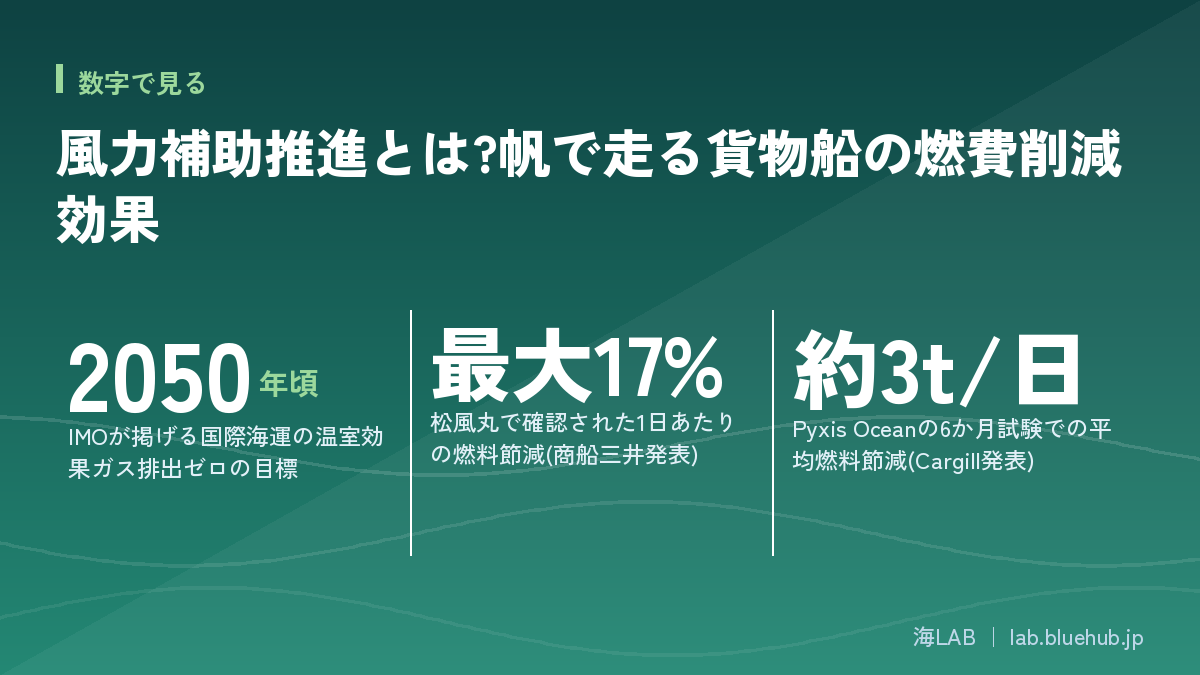
The coal carrier Shofu Maru, the first ship in the world fitted with the Wind Challenger developed by Mitsui O.S.K. Lines, was completed in October 2022 and entered service carrying coal for Tohoku Electric Power. According to the company, as of May 2024 it confirmed fuel savings of up to 17% per day, and 5–8% on average over a voyage. For details of the mechanism, see "Mitsui O.S.K. Lines' Wind Challenger".
In September 2025 the company also announced that Lloyd's Register had granted approval in principle for the basic design of an LNG carrier fitted with four sails. The company expects up to 30% fuel savings per voyage and 15–20% per year. These are design estimates, not measured values.
Cargill's Pyxis Ocean: two WindWings retrofitted
The commodities company Cargill retrofitted two WindWings rigid wing sails from BAR Technologies to Pyxis Ocean, a Kamsarmax bulk carrier built in 2017. In a trial of about six months, an average fuel saving of about 3 tonnes per day (about 14%) was reported, consistent with predictions from computer analysis. Under favorable conditions on the open sea, a saving of 11 tonnes per day, and a 37% cut in emissions measured from fuel production to combustion, were reported.
The company estimates that three wings on a newbuild could cut fossil fuel use by about 30%. This too is only an estimate.
Where adoption stands: from 70+ ships to 100+
According to reports of an announcement by the International Windship Association (IWSA), about 70 ships had wind-assisted propulsion as of June 2025, with about 130 on order. Later reports said more than 100 ships were equipped with or prepared for wind propulsion. The figures are counted differently, so they cannot simply be compared. By type, rotor sails and suction sails are reported to account for the majority.
Routing decides the effect: combining with weather routing
Even with the same device, the effect varies greatly with route and departure time. That is why combining it with weather routing, which picks the most efficient route from weather and sea-state forecasts, is emphasized.
The idea of "seeking out" wind
Optimal routes used to focus on minimizing distance, time and wave impact. For ships with wind-assisted propulsion, a course that makes the wind an ally is also evaluated. Even a somewhat longer route may be chosen if it cuts fuel.
Data and the operator's experience
The more measurement data from real ships, the easier it is to predict thrust by wind direction and speed. Cargill's trial also reported measured values close to prior analysis, and narrowing the gap between prediction and measurement becomes a basis for adoption decisions.
- Route planning before departure using weather forecasts
- Adjusting sail angle to wind conditions during the voyage
- Safely stowing or shortening in strong wind
- Accumulating voyage data and feeding it into the next voyage
Barriers to adoption: an honest look at effects and challenges
Wind-assisted propulsion is promising but not a cure-all. Here are the challenges that shipowners and cargo owners actually face.
Effects must be judged by averages
Figures such as "up to 17%" or "up to 30%" are maxima under good conditions or in design. On real voyages there are weak-wind days and headwind days. What matters is the average reduction over a year, and a figure like the "5–8% voyage average" shown by Mitsui O.S.K. Lines for the Shofu Maru is closer to reality.
Balancing deck space and cargo handling
Sails and rotors put large structures on deck. On bulk carriers they easily interfere with cranes and hatch covers, and routes under bridges impose height limits. Mechanisms to lower, shorten or move them, and careful placement, are therefore essential.
Cost and payback
Device prices vary by type and ship size, and published information is limited. The higher fuel prices are, or the greater the burden of emission regulation, the faster the payback. If the international fuel standards and pricing mechanisms the IMO is considering are put in place, the value of technology that cuts fuel is expected to rise.
- Effects depend on route and wind
- Coordination is needed between installation location on deck and cargo handling
- Review of hull structure and stability (for retrofits)
- Operator training and support for voyage planning that reads wind conditions
- Financial and insurance uncertainty due to few installations
Cautions when reading the numbers
- "Maximum" and "average" are different things
- Figures from makers and shipowners may not be independently verified
- The same device performs differently on a different route
Benefits for the marine environment and open questions
Wind-assisted propulsion is expected to help not only with CO2 reduction but also with the marine environment.
Indirect effects on air pollutants and ocean acidification
Using less fuel also reduces sulfur oxides, nitrogen oxides and particulate matter in addition to CO2. Because CO2 dissolves into the sea and contributes to ocean acidification, cutting emissions also helps protect marine life. For the effects of ocean acidification, see the related article "How long will the ocean's carbon uptake last?".
Noise and ecosystem effects are still being studied
When sails take over part of the ship's propulsion, the load on the engine and propeller drops. In theory underwater noise could fall, but this is a field where systematic evaluation on real ships has not progressed enough. Other points, such as bird collisions and visual impact, also remain to be considered after installation.
Combining with other decarbonization measures
Ship decarbonization is not completed by one technology. Roles are divided as follows.
| Measure | Aim | Related article |
|---|---|---|
| Wind-assisted propulsion | Reduce the amount of fuel used | This article |
| New fuels such as ammonia and hydrogen | Reduce the CO2 of the fuel itself | Shipping decarbonization and ammonia fuel |
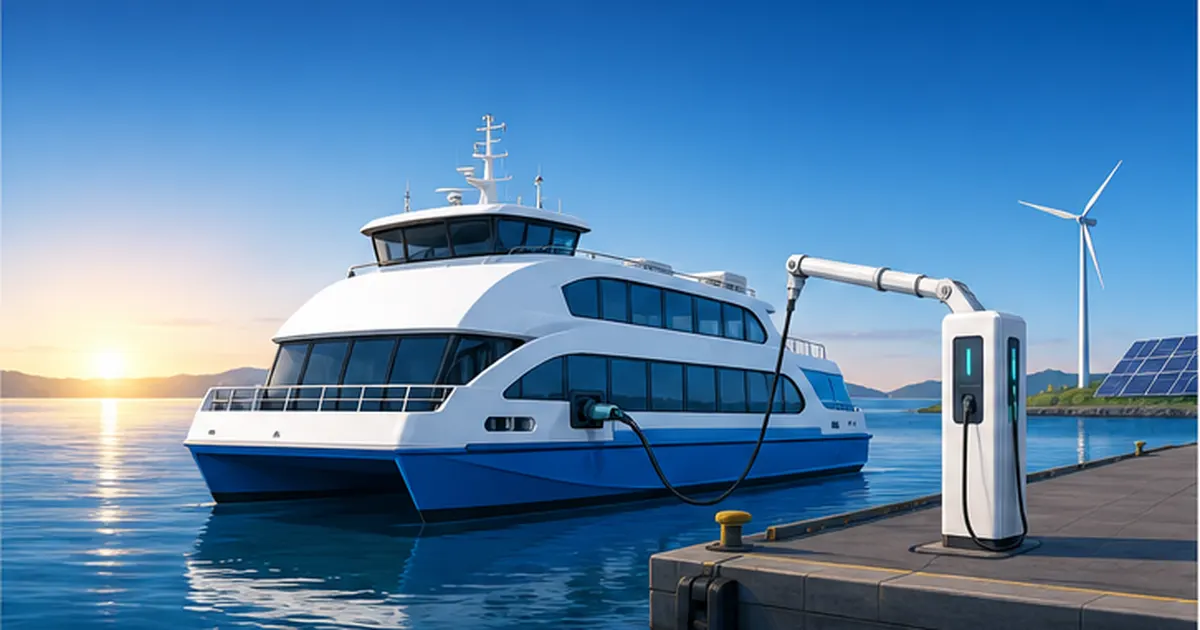
| Electrification | Make short-distance ships zero-emission | Electric ferries |
| Hydrogen use at ports | Reduce emissions on the land side | Hydrogen decarbonization of ports |
Japan's moves and the outlook
In Japan, shipping and shipbuilding companies including Mitsui O.S.K. Lines are moving forward with installing rigid wing sails and rotor sails. Japan's shipbuilding and shipping industries are among the largest in the world, and wind-assisted propulsion is considered a field where both technology and operating know-how can be a strength.
Relationship with offshore wind
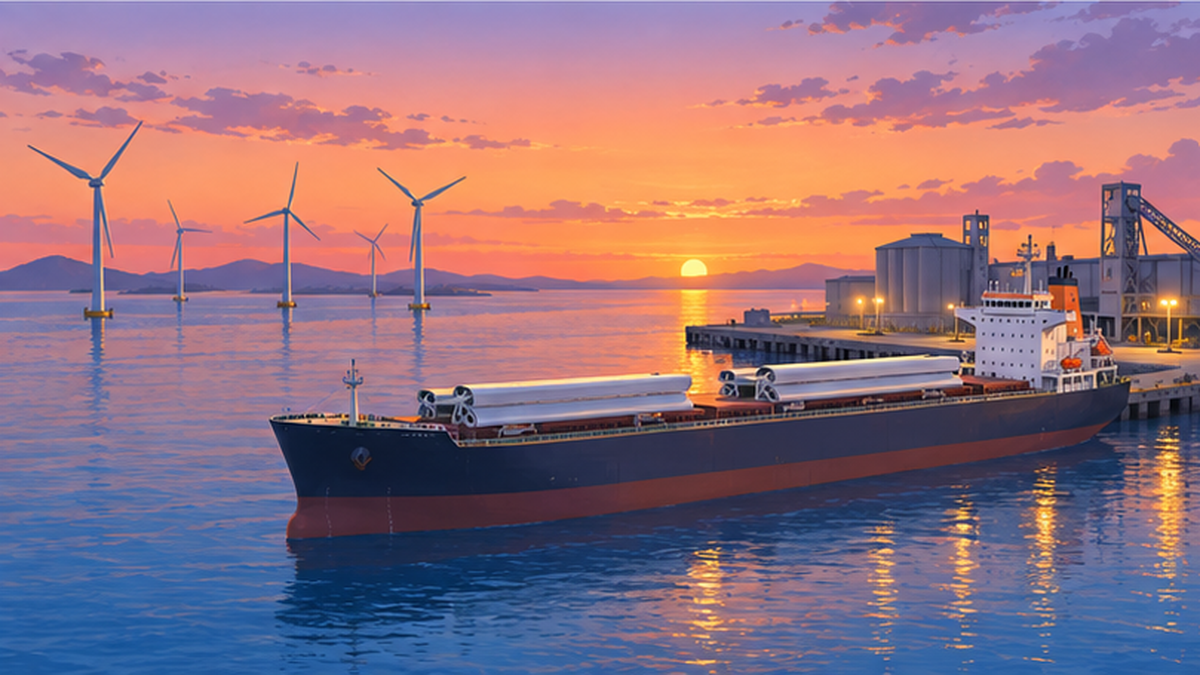
Offshore wind power is expanding off Japan's coasts. Offshore wind turns sea wind into electricity, while wind-assisted propulsion turns sea wind into thrust: two ways of using the same resource. For offshore wind, see "Offshore wind power in Japan".
Spreading to fishing and small vessels
Wind-assisted propulsion is mostly discussed for ocean-going ships, but the idea may also be applied to fishing boats. Because vessel size and fishing methods differ, the challenges are different. For low-carbon fishing vessels, see "Low-carbon fishing vessels".
What to watch toward 2030
- Moves in international rules the IMO is considering, based on the greenhouse gas intensity of fuels
- The number of newbuild orders with wind-assisted propulsion
- Accumulation of real-ship data and third-party verification of effects
- Standardization by type, and development of insurance and finance
Wind-assisted propulsion will not cut the world's emissions all at once. However, it is expected to spread alongside other measures as a realistic way to steadily reduce the amount of fuel used.
What we can do
- Take an interest in how the imported goods around us are transported by ship
- Check announcements of decarbonization efforts by shipping companies and cargo owners
- Read official materials on shipping decarbonization and confirm what the numbers mean
Summary
- Wind-assisted propulsion is a technology that cuts a ship's fuel with the power of wind
- Types include rigid wing sails, rotors, suction sails and kites
- Reductions of several percent to over ten percent on average have been reported on real ships
- The effect depends on route and wind. It is not a cure-all and is used together with other measures
References and sources
- Ministry of Land, Infrastructure, Transport and Tourism: announcement on the IMO GHG reduction strategy (MEPC 80) – Zero GHG emissions around 2050 and 2030 interim goals
- Ministry of Land, Infrastructure, Transport and Tourism, Maritime Bureau – Policy on decarbonization of international shipping
- International Maritime Organization (IMO): reducing greenhouse gas emissions – The IMO's climate action
- Mitsui O.S.K. Lines – Announcements on Wind Challenger and Shofu Maru results
- Cargill official site – Pyxis Ocean and WindWings trial results
- BAR Technologies – Developer of WindWings
- International Windship Association (IWSA) – Status of wind-propelled ship adoption
- UNCTAD Review of Maritime Transport – International shipping trade volume and emissions
* Sources are listed in descending order of reliability: government and academic institutions > peer-reviewed papers > specialized organizations > reliable media