⚡ The answer in 30 seconds
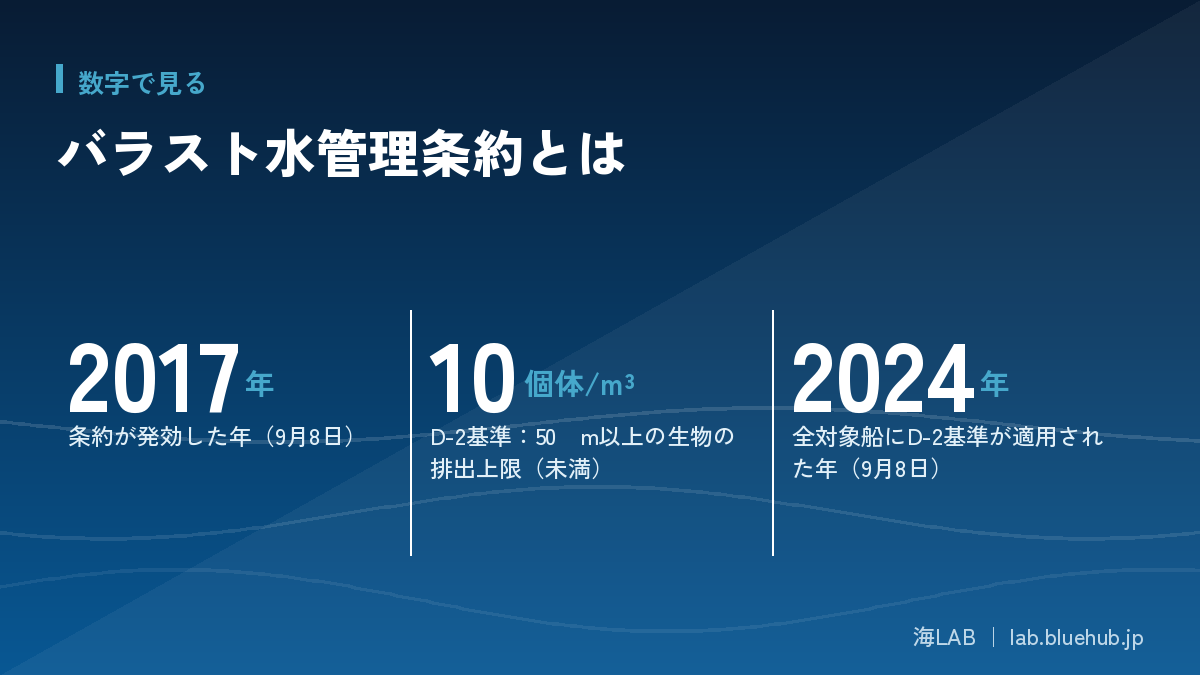
- The Ballast Water Management Convention, adopted in 2004 and in force since 8 September 2017, is an international treaty that prevents organisms and pathogens in ships’ ballast water from being carried to other sea areas and causing alien species problems.
- The D-2 discharge standard sets strict numerical limits, for example fewer than 10 individuals per m³ for organisms of 50 μm or more.
- Since 8 September 2024, all covered ships must meet the D-2 standard, for example with treatment systems.
- Japan acceded in 2014 and responds through domestic legislation and an approval system for treatment systems.
The Ballast Water Management Convention is an international rule meant to keep living things hidden in the seawater that ships take on for safe sailing from being carried to other seas and becoming alien species. It was adopted in 2004 and entered into force on 8 September 2017.
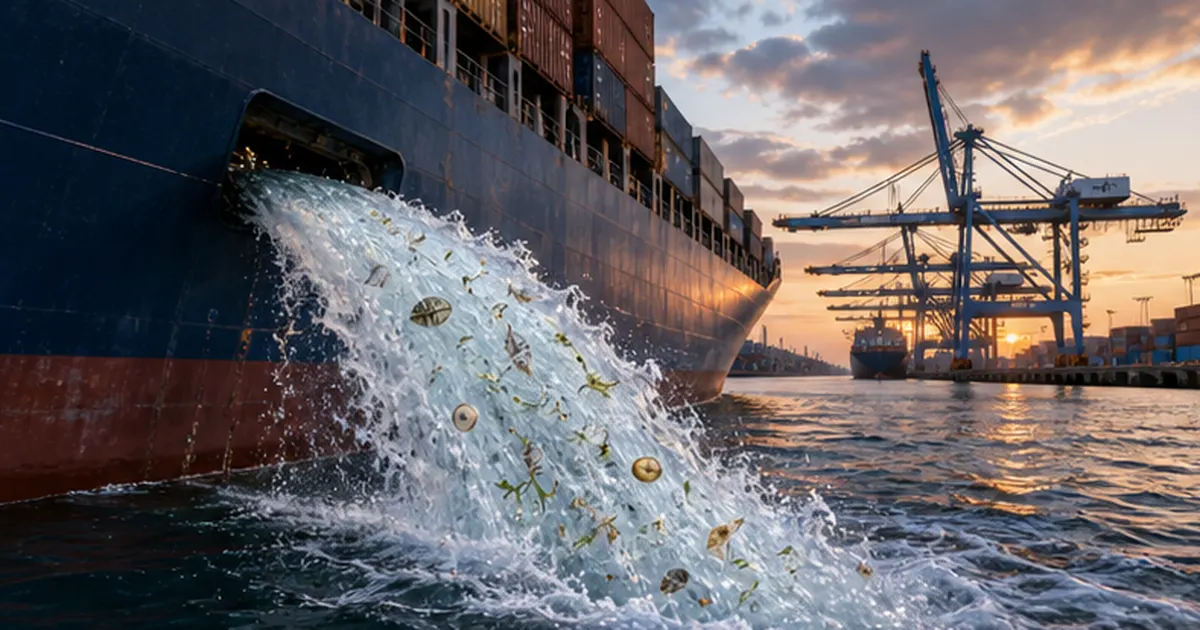
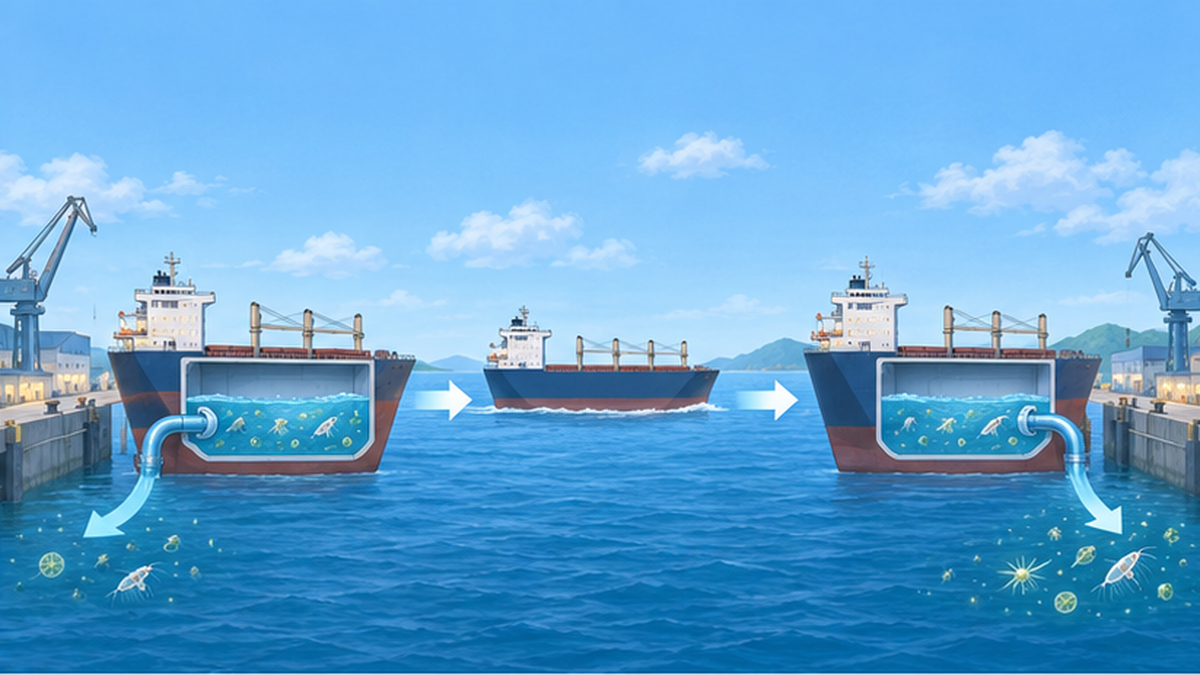
When empty, cargo ships take on large amounts of seawater to stay stable and discharge it at distant ports. Each time, plankton, eggs, larvae and even bacteria cross national borders. This invisible movement has harmed fisheries, ecosystems and port facilities.
This article summarizes, based on information from public institutions, the convention’s purpose and history, the two standards D-1 and D-2, how treatment systems work, and Japan’s efforts and challenges.
What You Will Learn
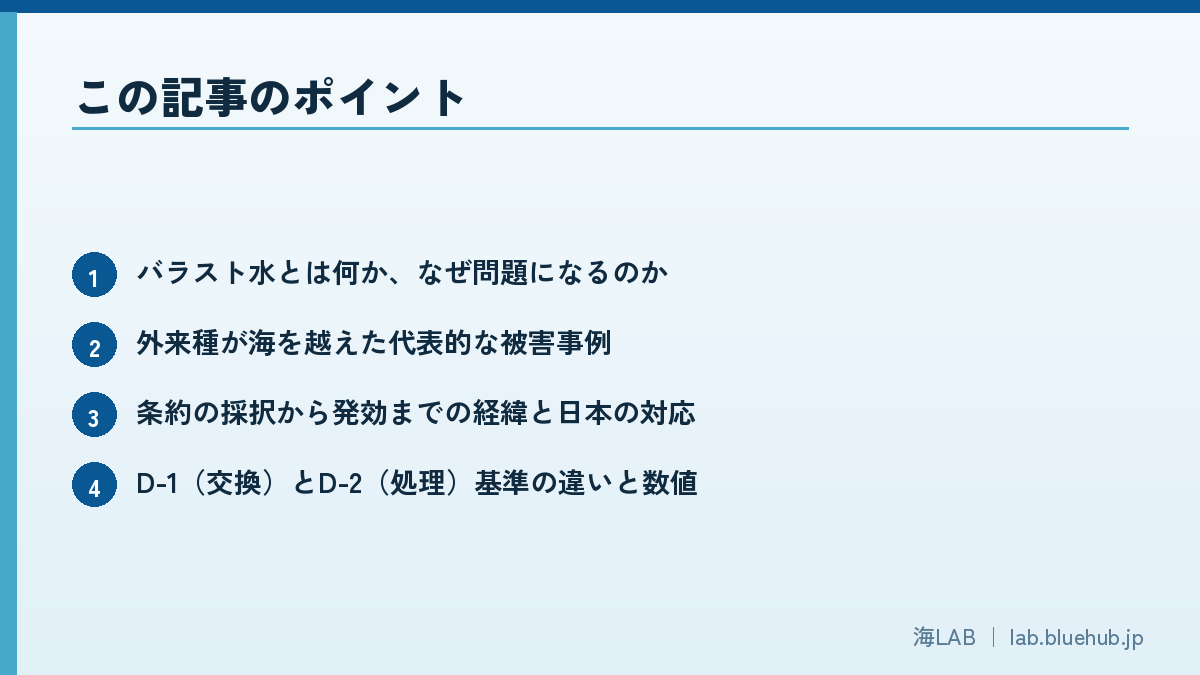
- What ballast water is and why it is a problem
- Representative cases of damage when alien species cross the sea
- How the convention developed from adoption to entry into force, and Japan’s response
- The difference between the D-1 (exchange) and D-2 (treatment) standards, and their values
- Main treatment methods and the approval and inspection system
What Is Ballast Water? Why Empty Ships Take On Seawater
Why Do Ships Carry Seawater?
The weight and center of gravity of a cargo ship or tanker change greatly depending on whether it is loaded or empty. A ship that has unloaded its cargo rides too high in the water, so its propeller may come close to the surface, propulsion efficiency drops, and it can lose stability in wind and waves. To prevent this, a ship takes seawater into its ballast tanks at the port where it unloads, sinking the hull to an appropriate depth and keeping its attitude steady. This seawater is ballast water.
Ballast water may look like a nuisance, but it is indispensable for safe voyages. In the age of sailing ships, stones and sand served as ballast; modern large vessels use seawater because it can be loaded and discharged quickly and its quantity is easy to adjust. Ballast water itself therefore cannot be banned, and the international challenge has become how to handle it without disturbing marine ecosystems.
The Starting Point of the Problem: Loading Port and Discharge Port Differ
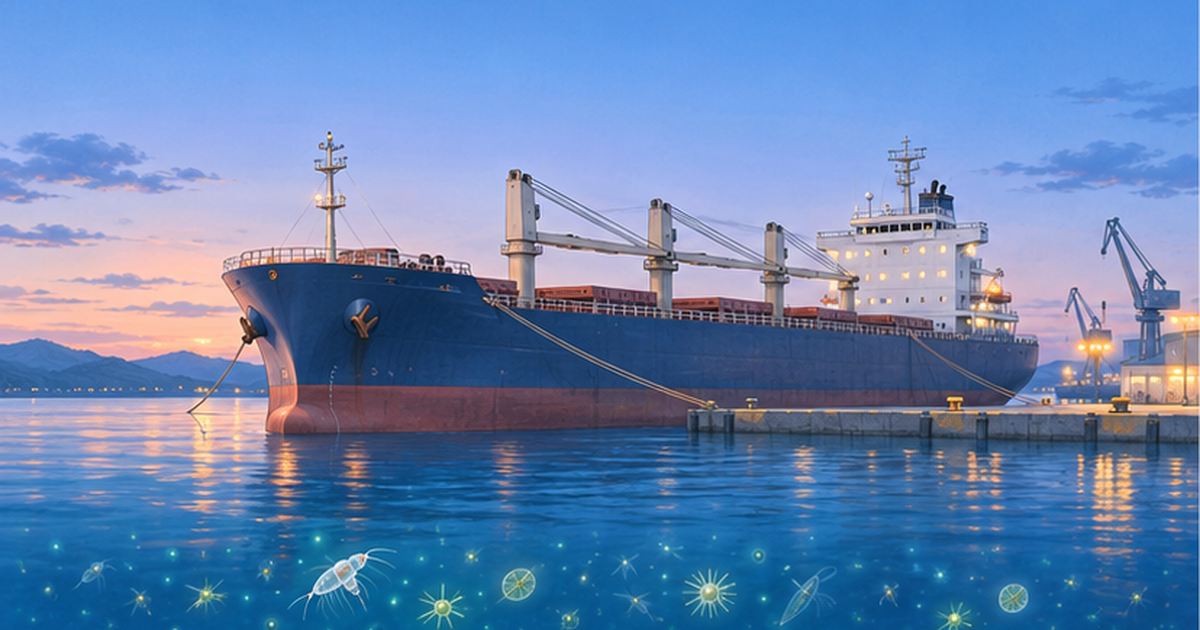
Ballast water is taken on at the port where cargo is unloaded (often on the importing side) and discharged at the next port where cargo is loaded (often on the exporting side). Plankton, fish eggs and larvae, shellfish larvae, bacteria and other organisms in the seawater at the loading point are drawn into the tank along with the water. Organisms that survive the long voyage in the dark tank are released into the sea at a distant port.
Sea areas that were once separated by natural barriers such as ocean currents, distance, water temperature and salinity are now connected by ships within days to weeks. This is the essence of the ballast water problem. Because people carry living things unintentionally, it differs in nature from, for example, the release of pets or aquarium fish; it is an “invisible movement” built into the operation of shipping itself.
Ballast Water at a Glance
- Purpose: seawater is taken on to keep an empty ship stable and maintain its draft and propeller efficiency
- Where it is loaded: the port where cargo is unloaded. Where it is discharged: mostly the port where cargo is loaded
- Problem: organisms and pathogens in the intake water are carried to another sea area
- Regulatory framework: an international convention adopted in 2004 (the Ballast Water Management Convention)
When Alien Species Cross the Sea: Concrete Cases of Damage
Zebra Mussels in the Great Lakes
The best-known case of damage caused by ballast water is the zebra mussel that invaded North America’s Great Lakes. This small bivalve, believed to originate around the Black Sea and Caspian Sea, was confirmed in the Great Lakes in the late 1980s and spread rapidly. Because it attaches in large numbers to intake pipes and waterworks and clogs them, power plants and water utilities have had to bear large removal costs.
Zebra mussels filter huge amounts of plankton from the water, depriving native fish and shellfish of food and changing the lake’s food web itself. Ship ballast water is considered one of the main invasion routes, and the case became a lesson showing that alien marine organisms can harm not only ecosystems but also infrastructure and the economy.
Comb Jellies in the Black Sea
Another famous example is the comb jelly Mnemiopsis leidyi, native to the Atlantic coast of North America. It was confirmed in the Black Sea in the 1980s, and its heavy predation on zooplankton and on fish eggs and larvae is said to have severely damaged fisheries such as anchovy. Transport in ballast water is cited as a likely route.
This case shows that when an alien species increases, it directly affects local fisheries through the decline of native fishery resources. The problem of marine alien species concerns not only nature conservation but also food and the livelihoods of fishing communities.
From Japan to the World, and from the World to Japan
Japan is not simply on the receiving end of ballast water damage. Wakame (Undaria pinnatifida), native to Japan’s coasts, has become established in Australia, New Zealand, Europe and elsewhere, and is treated as an invasive alien species in some regions there. Shipping activity, including attachment to hulls and ballast water, is thought to have been involved.
Conversely, along Japan’s coasts too, alien shellfish believed to be of foreign origin, such as the blue mussel and the Asian date mussel, have become established, and impacts such as attachment to rocky shores and aquaculture facilities have been reported. The movement of organisms by sea occurs in both directions of trade, so it is important to recognize that Japan can be both a source and a recipient.
For the big picture of marine alien species, see Where Do Marine Alien Species Come From?, which explains in detail the kinds of organisms ballast water carries and their impacts.
Pathogen Risks Also Matter
What these cases have in common is that by the time damage becomes visible, it is too late. Both the zebra mussel and the comb jelly had already multiplied explosively when their invasion was confirmed, and control and damage countermeasures continued for many years. It is hard to notice an invasion at an early stage, and because ships travel between ports around the world every day, a single ballast discharge can have consequences decades later.
Some researchers have pointed out that thousands of species may be moved around the world every day by ballast water, but the exact figure varies greatly by sea area and season, and there is no established value. What matters is not the size of the number itself but understanding that human activity can rapidly rewrite the distribution of marine life.
Ballast water contains not only plankton. Bacteria and viruses may also be carried, and the risk of spreading pathogens such as cholera bacteria has been debated internationally. The convention’s discharge standard includes limits for indicator microorganisms such as E. coli, intestinal enterococci and Vibrio cholerae in order to protect human health.
Origins of the Ballast Water Management Convention and the Road to Entry into Force
Adoption in 2004 and Its Purpose
On 13 February 2004, at a diplomatic conference in London, the International Maritime Organization (IMO) adopted the International Convention for the Control and Management of Ships’ Ballast Water and Sediments (the Ballast Water Management Convention, or BWM Convention). Its purpose is to reduce risks to the environment, human health, property and resources by controlling and managing ballast water and its sediments.
The convention requires ships to carry a ballast water management plan, keep a ballast water record book and hold an International Ballast Water Management Certificate, and obliges them to ensure that discharged ballast water meets specified standards. In other words, it is a rule that changes ballast water, used for “the ship’s safety,” into a form that also takes “the safety of the sea” into account.
Why It Took About 13 Years to Enter into Force
Even after adoption, a convention does not enter into force unless enough countries accede and their merchant fleets exceed a certain share of the world total. For the Ballast Water Management Convention, the requirements were accession by at least 30 countries representing at least 35% of the world’s merchant shipping tonnage.
Ratification did not progress as quickly as hoped, because developing and approving treatment systems took time, the investment burden on shipowners was heavy, and countries’ interests differed. The entry-into-force requirements were finally met on 8 September 2016, and the convention took effect for all parties on 8 September 2017, roughly 13 years after adoption.
Japan’s Response
Japan deposited its instrument of accession on 10 October 2014. Domestically, the convention’s framework has been incorporated through measures such as amendments to the Act on Prevention of Marine Pollution and Maritime Disaster. Japan is a major shipping nation with strong shipbuilding and marine equipment industries, so responding to the convention was also important for domestic industry.
The Ministry of Land, Infrastructure, Transport and Tourism began approving domestically made ballast water treatment systems in January 2008 and later revised procedures to make it easier to approve foreign-made systems as well. In anticipation of the convention’s entry into force, preparations advanced on both the institutional and technical fronts.
| Year | Event |
|---|---|
| February 2004 | The IMO adopts the Ballast Water Management Convention |
| January 2008 | Japan begins approving domestically made ballast water treatment systems |
| October 2014 | Japan deposits its instrument of accession to the convention |
| September 2016 | Entry-into-force requirements (30 countries and 35% of tonnage) are met |
| 8 September 2017 | The convention enters into force |
| 8 September 2024 | The D-2 standard (treatment) becomes mandatory for all applicable ships |
Behind the convention also lies the trend, from the 1990s, of the international community treating alien species as an issue of “environment and development.” The Convention on Biological Diversity also requires countries to prevent the introduction of alien species and to manage those that have invaded, and the BWM Convention is the concrete measure for the shipping sector. It is often cited in environmental policy education as an example of an international environmental agreement translated into ship equipment and operating rules.
2004, the year of adoption, was also a time when environmental regulation in shipping began in earnest. Several environmental conventions were developed in parallel, such as Annex VI of MARPOL, which regulates air pollutants, and the AFS Convention, which regulates harmful anti-fouling paints on ship bottoms, and ships came to be required to respond to environmental demands from many directions. The BWM Convention shone a light on the hard-to-see pollution of living organisms.
D-1 and D-2: Understanding the Two Standards
D-1: The Ballast Water Exchange Standard
Regulation D of the convention contains two standards. The first, the D-1 standard, is for “exchanging” ballast water at sea. As a rule, at least 95% of the ballast water by volume must be exchanged at least 200 nautical miles from the nearest land and in water at least 200 m deep. Where this is not possible, exchange at least 50 nautical miles from the nearest land and in water at least 200 m deep is permitted.
Open-ocean water contains fewer organisms than coastal water, and coastal organisms struggle to survive in the open ocean, so replacing coastal water with open-ocean water was thought to lower the risk. However, this is only an interim measure and cannot remove organisms completely. Depending on the weather, exchange may also be impossible for safety reasons.
D-2: The Ballast Water Discharge Standard
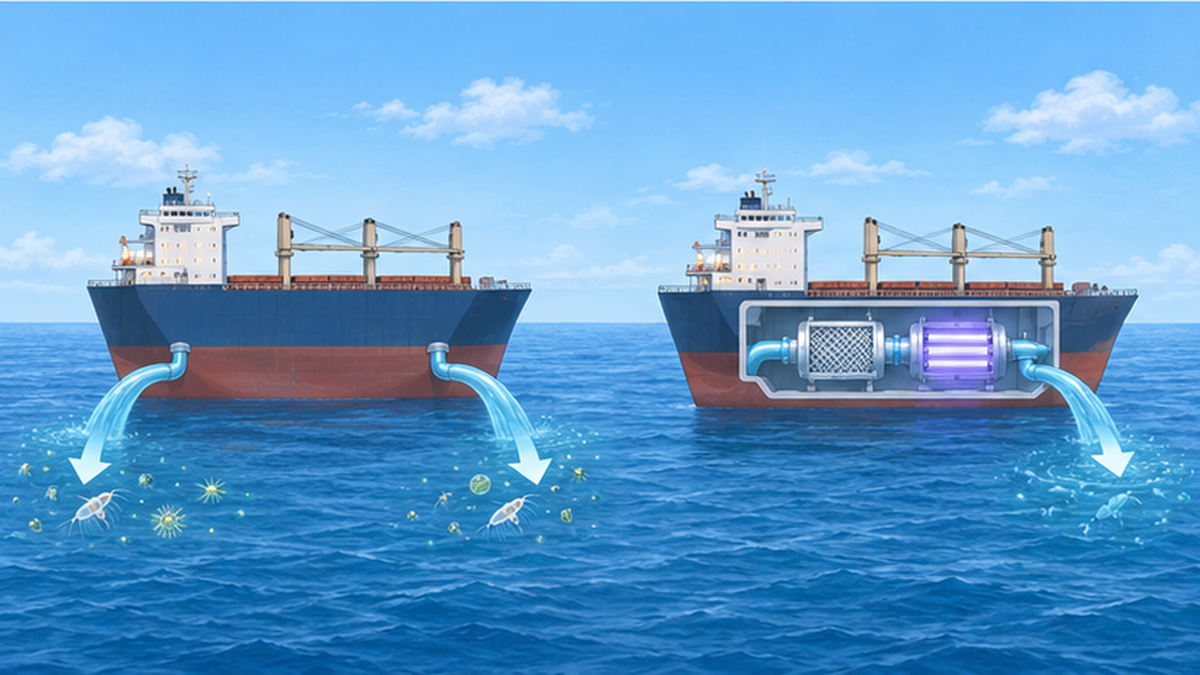
The second, the D-2 standard, directly regulates the number of organisms contained in discharged ballast water. A ship must use a ballast water treatment system to bring the water to a quality that meets the standard before discharge. The main D-2 values are as follows.
| Target | Discharge standard |
|---|---|
| Organisms with a minimum dimension of 50 μm or more (mainly zooplankton) | Fewer than 10 individuals per m³ |
| Organisms with a minimum dimension of 10 μm or more but less than 50 μm (mainly phytoplankton) | Fewer than 10 individuals per mL |
| Vibrio cholerae (O1 and O139) | Fewer than 1 cfu per 100 mL |
| Escherichia coli (E. coli) | Fewer than 250 cfu per 100 mL |
| Intestinal enterococci | Fewer than 100 cfu per 100 mL |
Getting a Feel for the Numbers
One m³ is 1,000 liters. A standard of fewer than 10 living large plankton in that volume is a level that removes nearly all organisms from the seawater and cannot be achieved by simply “exchanging” it. This is why treatment by equipment is required.
Transition from D-1 to D-2
After entry into force, newly built ships were required to meet the D-2 standard from delivery, while existing ships installed treatment systems in turn at their scheduled surveys. With this transition period over, from 8 September 2024 all ships covered by the convention are required to meet the D-2 standard.
For shipowners, the wave of capital investment and retrofit work lasting several years has finally come full circle. Meanwhile, amendments to the convention and revisions to operating guidance continue in order to address issues that have emerged in actual operation.
The D-2 values were decided after discussion among international scientists. Rather than demanding zero, they were set at a level that is realistically achievable and yet greatly reduces the risk of alien species becoming established. If the standard is too strict, equipment becomes expensive and bulky and does not spread; if it is too lax, the convention loses its meaning. Striking a balance between technical feasibility and environmental effect is what makes international rule-making difficult.
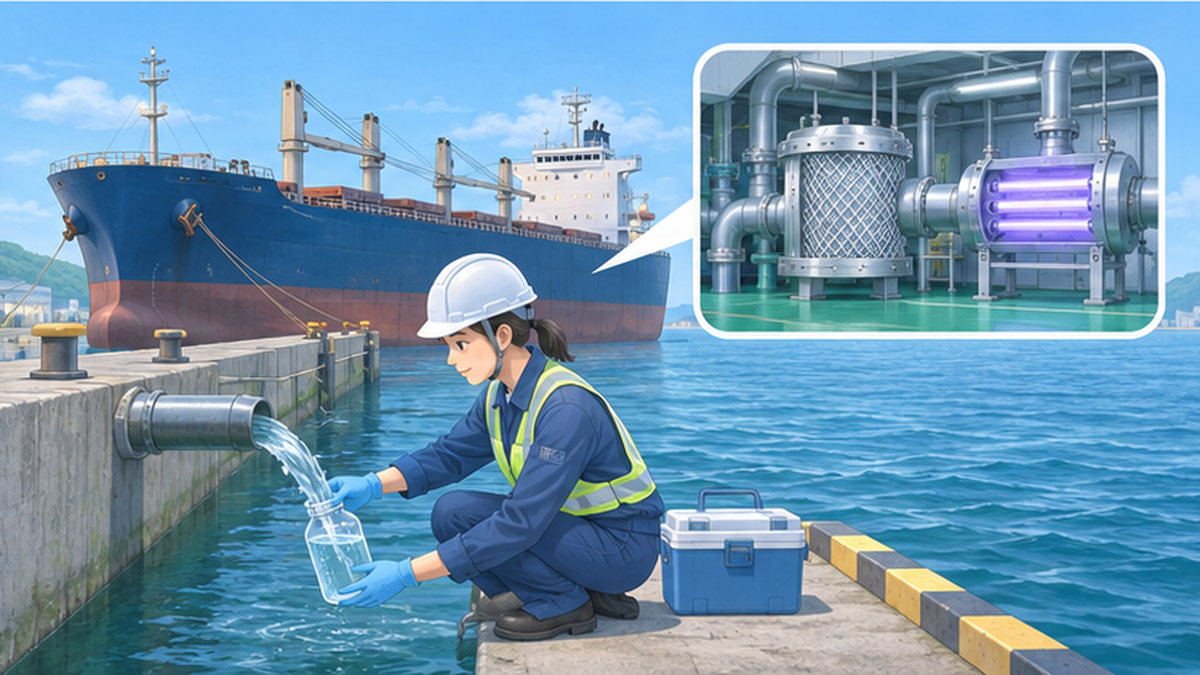
Verification of the standard also relies on the painstaking work of “taking samples and counting living organisms.” Judging whether an organism is alive or dead takes effort such as microscopic observation, staining and culturing, and simple indicative analysis methods have been developed for quick judgment during shipboard inspections. How to combine accuracy and speed in inspection remains an active research field.
How Ballast Water Treatment Systems Work: Combining Filtration and Disinfection
The Basics: “Remove” and “Neutralize”
A ballast water treatment system combines two broad steps. The first is physical separation, in which filters or cyclones remove large organisms and sediment. The second is disinfection or inactivation, in which ultraviolet light or chemical methods kill the remaining small organisms and microorganisms or leave them unable to multiply.
Because ballast water is loaded and discharged in large volumes, treatment demands high flow rates. Running equipment that treats hundreds to thousands of m³ per hour reliably within a ship’s limited space and power is not technically easy.
Main Treatment Methods
- Ultraviolet (UV) irradiation: filtered water is exposed to UV light, which damages the DNA of organisms so that they cannot multiply. No chemicals are used and few chemical residues remain in the discharge
- Electrolysis: seawater is electrolyzed to produce chlorine-based disinfectants such as hypochlorous acid, which kill organisms. The water is neutralized before discharge
- Chemical injection: chlorine-based or other chemicals are injected to disinfect the water and neutralized before discharge
- Ozone: the strong oxidizing power of ozone inactivates organisms
- Deoxygenation and others: methods that remove oxygen to suffocate organisms have also been studied and put to practical use
Methods differ in treatment speed, power consumption, use of chemicals and tolerance to salinity, water temperature and turbidity. Because the best method differs between ships that enter fresh water and ships that sail only in saltwater areas, selection must match the ship’s operating pattern.
Safety Review of Active Substances
Methods that use active substances such as chemicals must confirm that the components released into the sea after discharge do not themselves harm the environment. For this reason, the IMO’s Marine Environment Protection Committee (MEPC) has a mechanism to review the safety of active substances in advance. In Japan, the Maritime Bureau of the Ministry of Land, Infrastructure, Transport and Tourism handles approval of treatment systems, and information on approved systems is registered with the IMO.
| Method | Main features | Points to note |
|---|---|---|
| UV irradiation | No chemicals; low chemical risk in discharge water | Effectiveness may drop in turbid water; high power consumption |
| Electrolysis | Generates chlorine-based disinfectant on board | Hard to use in fresh water; neutralization needed before discharge |
| Chemical injection | Simple structure | Storage and handling of chemicals; active-substance review required |
| Ozone | Strong oxidizing power | Equipment tends to be large; management of residual components |
In UV systems, filters generally remove large particles beforehand. Strong turbidity blocks ultraviolet light in the water and lowers effectiveness, so each system incorporates measures to cope with differences in intake water quality. Electrolysis systems make chlorine-based disinfectant from chloride ions in seawater, so they may not treat brackish or fresh water sufficiently, and selection must match the waters in which the ship operates.
Japanese manufacturers have also worked on developing treatment systems since before the convention entered into force. As a country with shipbuilding and marine equipment technology, setting up a domestic approval system and demonstrating the performance of domestic equipment also contributes to the competitiveness of Japan’s shipping and shipbuilding industries. It is a typical example of environmental regulation creating new markets and technologies.
From Approval to Operation: Mechanisms That Make the Convention Effective
Type Approval and the BWMS Code
A treatment system cannot simply be installed; a system that has received type approval must be used. In approval testing, performance is verified both on land and on board ships to confirm that the D-2 standard is met. Guidelines known as G8 were used previously, but they were replaced by the BWMS Code, made mandatory in 2018, and approval is now carried out under stricter test conditions.
Behind this change lay reports that systems approved under the old guidelines did not perform as expected on actual ships. A convention is not finished once decided; it is an international rule revised in light of experience in the field.
Commissioning Tests on Board
A framework for commissioning tests, which confirm after installation that a system actually meets the D-2 standard, has also been developed. Actual onboard piping and operating conditions differ from onshore test conditions, so confirmation after installation is important.
Records and Certificates: Documents on Board
Ships need documents such as a ballast water management plan, a ballast water record book and an International Ballast Water Management Certificate. The record book records where ballast water was taken on, how it was treated, and where and how much was discharged. Amendments revising the record book format and introducing electronic record books have also been adopted, and the way records are kept is changing.
Main Documents and Procedures Required on Board
- Keeping a ballast water management plan on board
- Entries in the ballast water record book
- Obtaining and holding an International Ballast Water Management Certificate
- Type approval of the treatment system, and proper operation and maintenance
Inspection by Port States
What underpins the convention’s effectiveness is inspection by port states (port state control). Foreign ships entering port have their documents checked and, where necessary, ballast water sampled and tested. Ships that do not meet the standard are required to take corrective action and may in some cases be detained.
Environmental rules for ships extend beyond ballast water to fuel and ship dismantling. Reading Ship Recycling and Decarbonizing International Shipping together gives a fuller picture of how ships respond to environmental demands.
For crew who operate ships, running the treatment system and managing ballast water records have become part of daily work. Water quality differs by port, and troubles such as treatment stopping when intake water is very turbid can occur. Training for crew and support from equipment makers and classification societies are therefore important. Regulation works only when people operate equipment correctly, not merely when it is installed.
Japan’s Efforts and Challenges Beyond the Convention
Organisms Carried on Hulls (Hull Fouling)
While ballast water measures advance, another route by which alien species travel on ships is attachment to hulls. Barnacles, mussels, algae, hydroids and other organisms travel long distances attached to the hull bottom, sea chests and around propellers. Fouling organisms increase a ship’s resistance and worsen fuel consumption, so shipping companies cannot ignore the problem either.
The IMO has guidelines to reduce the transfer of organisms by hull fouling, recommending choice of anti-fouling paint, periodic hull cleaning and keeping records of fouling. However, unlike the BWM Convention there are no mandatory numerical standards, and responses vary by country and region. Organisms and anti-fouling components dislodged during hull cleaning may also be released into port waters, so the way cleaning is done also needs care.
In other words, ballast water management is an important part of alien species control, but not the whole of it. To reduce organism transfer via ships comprehensively, we need a perspective that looks at several routes together, including ballast water, hull fouling and the transport of seed stock and live seafood for aquaculture.
Rules That Differ by Country and Region
The convention is a common international rule, but in practice some countries and regions have added their own regulations or approval systems. For example, the United States Coast Guard operates its own approval system for treatment systems, and IMO approval under the convention alone may not satisfy regulations in US waters. Shipowners who travel between several countries must check both the convention and each country’s regulations.
Such dual compliance increases equipment investment and administrative burden for shipowners. How to balance international uniformity with operation suited to each country’s circumstances is a continuing issue around the convention.
Freshwater and Inland Water Issues
The convention mainly targets ocean-going ships, but in regions such as the Great Lakes, where sea and freshwater areas are connected, there are issues specific to fresh water. Electrolysis becomes less efficient in low-salinity water, so the strengths and weaknesses of treatment methods depend on water quality. How domestic coastal vessels and ships moving around lakes are treated is left to national systems in some respects.
“Treated” Does Not Mean “Completely Safe”
- The D-2 standard is meant to greatly reduce the organisms surviving in discharged water; it does not require zero. Even when the standard is met, a very small number of individuals may survive, so precautionary management and monitoring must continue.
Efforts by Shipping Companies
Major Japanese shipping companies advanced the installation of treatment systems ahead of the convention’s entry into force. For example, on environmentally friendly ships, some cases combine ballast water measures with a switch of fuel. The article NYK’s LNG-fueled Ships and Alien Species Measures introduces how a shipping company is addressing this issue.
For shipping companies, the ballast water issue is not only a cost of regulatory compliance but also a matter of responsibility as a company that does business using the sea. If marine ecosystems are damaged, fisheries and port operations will eventually be affected too.
Challenges Seen in Actual Operation
- Treatment systems may have difficulty performing in very turbid ports or cold waters
- The burden of maintenance, response to breakdowns, and crew education and training
- Increased power consumption and the resulting rise in fuel use and greenhouse gas emissions
- The accuracy of discharge-standard inspection and sampling methods, and differences in enforcement between countries
- Dual compliance for shipowners because some countries, such as the United States, have their own regulations and approval systems
In particular, the energy used for treatment conflicts in some respects with another issue, the decarbonization of shipping. We need to balance measures so that protecting one part of the environment does not create other environmental burdens, looking at the whole picture.
Review of the Convention and the Future
At the IMO, provisions are reviewed and operating guidance is updated on the basis of experience in applying the convention. Type approval procedures, electronic record books and the handling of active substances are among the topics discussed. International rules are updated little by little through technological progress and feedback from the field.
In addition to ballast water, the movement of organisms attached to ship hulls (hull fouling) is also attracting international attention. As ballast water measures advance, responding to movement by hull fouling is becoming the next challenge.
Glossary, and What We Can Do
Key Terms
- IMO (International Maritime Organization): a United Nations specialized agency that develops international rules on shipping safety and protection of the marine environment
- MEPC (Marine Environment Protection Committee): the IMO committee that discusses and decides matters concerning marine pollution prevention
- Ballast tank: a tank inside the hull used to store ballast water
- Sediment: mud and sand that accumulate at the bottom of ballast tanks. It may contain resting eggs of organisms and bacteria, and is covered by the convention
- Type approval: an approval system that confirms through testing that a treatment system meets the standard
- Port state control (PSC): a system in which the port state inspects whether foreign ships entering port meet international standards
- cfu (colony-forming unit): a unit expressing the number of living bacteria by the number of colonies that appear on culturing
Answering Common Questions
Q. Why are sediments a problem? Over years of use, mud and sand accumulate at the bottom of ballast tanks. This sediment may contain resting eggs (cysts) and other forms of organisms, which can re-enter the water when tanks are cleaned or when the next ballast water is taken on. The convention also requires appropriate management of sediments and handling during tank cleaning.
Q. Are small ships or certain ships exempt? The convention has exemption provisions. For example, ships that sail only in the waters of their own country, warships and government non-commercial ships are in principle excluded. Exemptions may also be granted under certain conditions, such as for ships constructed so that they do not discharge ballast water. The exact scope must be checked in the convention text and each country’s domestic law.
Q. How much does a treatment system add to a ship’s costs? The price varies greatly with method and capacity, and is generally said to be in the range of tens of millions to hundreds of millions of yen per ship. In addition there are power consumption, consumables such as filters and lamps, maintenance and inspection costs, and the burden of crew training. The exact amount depends on ship size and method, so only a sense of scale is given here.
Q. What other environmental impacts does shipping have? Besides ballast water, they include air pollutants and greenhouse gases from fuel combustion, spills of oil and waste into the sea, the effect of ship noise on marine life, and environmental pollution during ship dismantling. The IMO has established conventions and rules for each of these, and the BWM Convention is one of them.
Q. Is it really impossible to remove an alien species once it is established? On land or in small ponds, there are cases where thorough control achieved eradication. In a wide, continuous environment like the sea, however, detection tends to be late and the area to be controlled is vast, so eradication is extremely difficult. That is why prevention, keeping species out, is considered the most cost-effective measure.
The basis of alien species control is preventing invasion. Eradicating or managing a species after it is established costs far more in money and effort than prevention.
― A widely shared principle in alien species management (common to basic policies such as those of Japan’s Ministry of the Environment)
How to Use This in Marine Learning
The ballast water issue is a good theme for social studies, science and inquiry-based learning at junior and senior high school. Because several viewpoints meet in it, namely shipping, international rules, ecosystems and technology development, it becomes teaching material for thinking about how trade and environmental protection can be reconciled. It is also worth tracing shipping routes on a map and finding out from which ports the goods that reach your daily life come.
Japanese Life Is Supported by Shipping
Japan carries most of its energy, food and industrial raw materials from overseas by ship, and shipping accounts for an overwhelming share of trade volume. Many of the things we eat and use every day are delivered by ships carrying ballast water. The ballast water issue is therefore not a distant sea story, but also a question of the environmental cost behind the convenience of our lives.
Starting by Learning About Alien Species
A defining feature of alien species problems is that once established they are extremely hard to eradicate. In the sea, detecting invasion and removing species are even harder than on land, so prevention is considered the most effective measure. The Ballast Water Management Convention turns this idea of prevention into an international rule.
Alien species problems also exist close to us, on land and by the water. Japan’s approach to alien species control is outlined in What Are Invasive Species? The Designated Invasive Alien Species System and the Three Principles.
Small Actions You Can Take Starting Today
- Do not carelessly take sea or river creatures to other places or release them
- After fishing or diving, wash your gear and shoes and do not take attached organisms home
- Check news and public information on marine alien species and shipping’s environmental measures
- Discuss ballast water and alien species in school or local study groups
Summary of This Chapter
- The ballast water problem is about reconciling ship safety and marine ecosystem conservation
- The convention emphasizes prevention and reduces the movement of organisms through the D-2 standard using treatment systems
- Each of our own actions also contributes to preventing alien species problems
In school classes and local study groups, a workshop that asks “If a foreign ship entered our town’s port, what rules would we use to protect the sea?” is also effective. Bringing the significance of international rules close to our own sea turns the numbers and terms of the convention into living knowledge.
Summary: International Rules Reduce the Sea’s “Invisible Movement”
Ballast water is seawater needed for empty ships to sail safely, but it tends to carry living things from the loading port to distant seas. Like the zebra mussel in the Great Lakes and the comb jelly in the Black Sea, alien organisms that become established can have long-term effects on ecosystems, fisheries and infrastructure.
The Ballast Water Management Convention entered into force on 8 September 2017, about 13 years after its adoption in 2004, and since 8 September 2024 all ships covered have been required to meet the D-2 standard (a discharge standard achieved through treatment). Treatment systems, type approval, records and certificates, and port state inspection work together to support its effectiveness.
Challenges remain, however, including operational issues with equipment, energy consumption, and movement of organisms by hull fouling. International rules are not finished once decided; they are updated while taking in experience from the field and scientific progress. Being aware of the sea connections on which our lives depend is the first step in thinking about this problem.
- Ballast water is essential for ship safety but causes the movement of organisms
- The convention entered into force on 8 September 2017, and since 8 September 2024 the D-2 standard applies to all ships
- Treatment systems basically combine filtration and disinfection
- Prevention is the most effective alien species measure, and individual action matters too
For related background, please also see The Alien Species Problem Carried by Ballast Water.
References and Sources
- MOFA: Entry into force of the Ballast Water Management Convention – Date of entry into force and Japan’s accession status
- MLIT: Review of approval procedures for ballast water treatment systems – Domestic approval system for treatment systems
- Ministry of the Environment: Regulation of harmful ballast water discharge – Domestic discharge regulation and explanation of the convention
- IMO: Ballast Water Management – Overview of the convention and latest developments (English)
- IMO: BWM Convention – Convention framework (English)
- Japan Coast Guard – Marine pollution prevention and marine environment information
- MLIT Maritime Bureau – Maritime administration and environmental policy
- Ministry of the Environment: Alien species measures – Japan’s alien species control
※ Listed in order of reliability: government and academic institutions > peer-reviewed papers > specialist bodies > reputable media