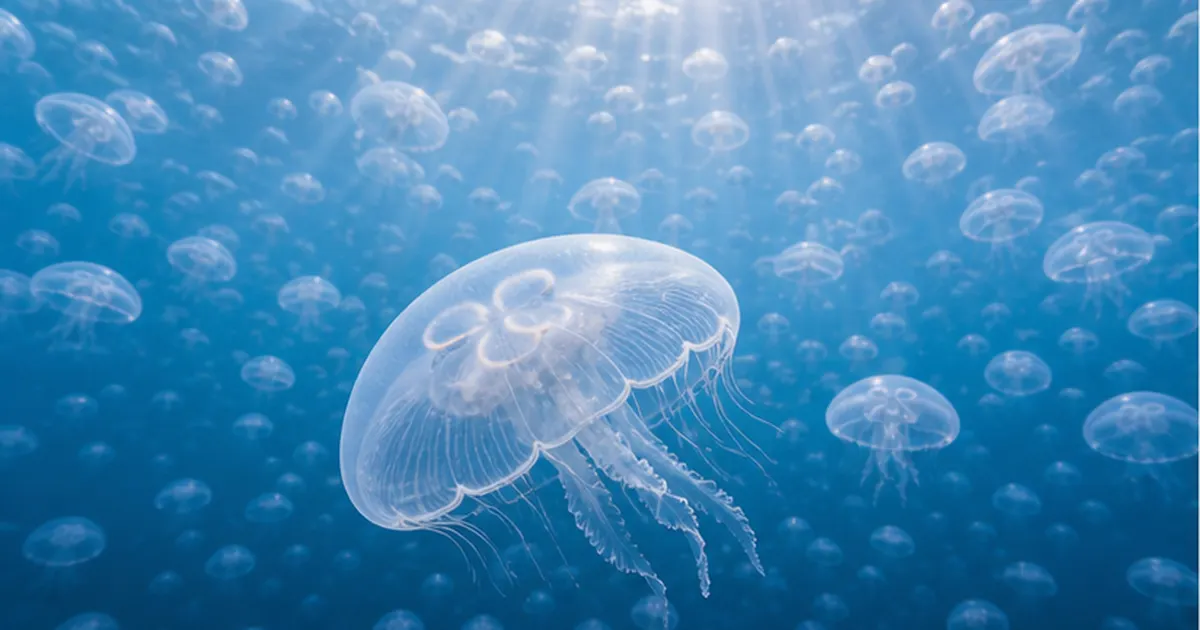
One day, without warning, the sea fills with jellyfish. Haul in a net and hundreds of kilograms of jelly pour in instead of fish; power plants lose cooling water and dial down their output. The "jellyfish bloom" is one of the most troublesome phenomena facing the world's coastal waters today.
In Japan in the 2000s, giant Nomura's jellyfish—with bells over 2 m across and weighing more than 150 kg—repeatedly swept into the Sea of Japan coast, and in 2009 more than 55,000 fishery damage reports were filed nationwide. Nets tore, catches were rendered unsellable, and a fishing boat was even capsized by the sheer weight of jellyfish.
Why do jellyfish suddenly multiply? Researchers point to links with human activities—overfishing, eutrophication, warming and coastal development—yet the more fundamental question of whether jellyfish are actually increasing worldwide turns out to be surprisingly hard to answer. This article digs into the mechanics of jellyfish blooms, the damage they cause, the scientific frontier of the debate over their causes, and the monitoring and utilization efforts under way.
What you will learn in this article
- How jellyfish blooms happen and the key role of the "polyp" stage
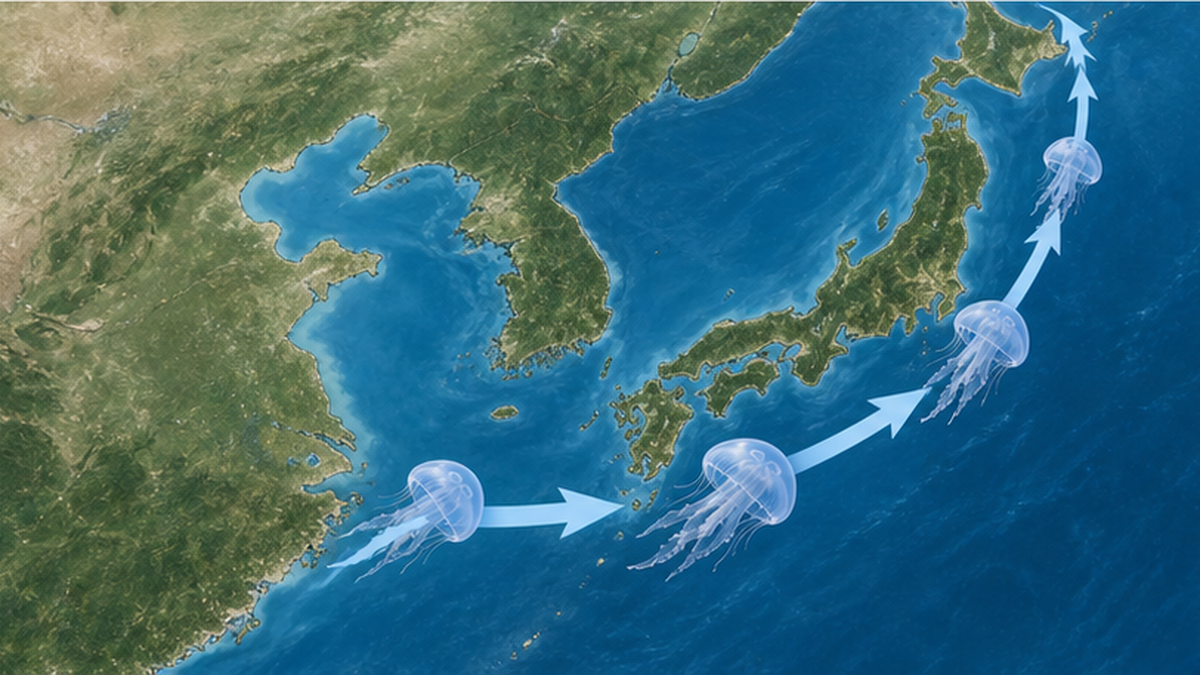
- What Nomura's jellyfish is and its drift route from the Chinese coast to Japan
- The real damage to fisheries and power plants—from torn nets to a capsized boat and a halted nuclear reactor
- Why overfishing, eutrophication, warming and coastal development are thought to boost jellyfish
- The scientific debate over whether jellyfish are really increasing, and the Japan-China-Korea monitoring and forecasting frontier
What Is a Jellyfish "Bloom"? The Basics
The phenomenon of jellyfish multiplying explosively in a short time and blanketing the sea surface or coastline is called a "jellyfish bloom." The word "bloom" originally referred to the mass proliferation of phytoplankton, but the same term is used for jellyfish. The first thing to understand is that mass occurrences are not necessarily abnormal—they are, in a sense, a built-in "feature" of the jellyfish life cycle.
Blooms are a natural part of the jellyfish life cycle
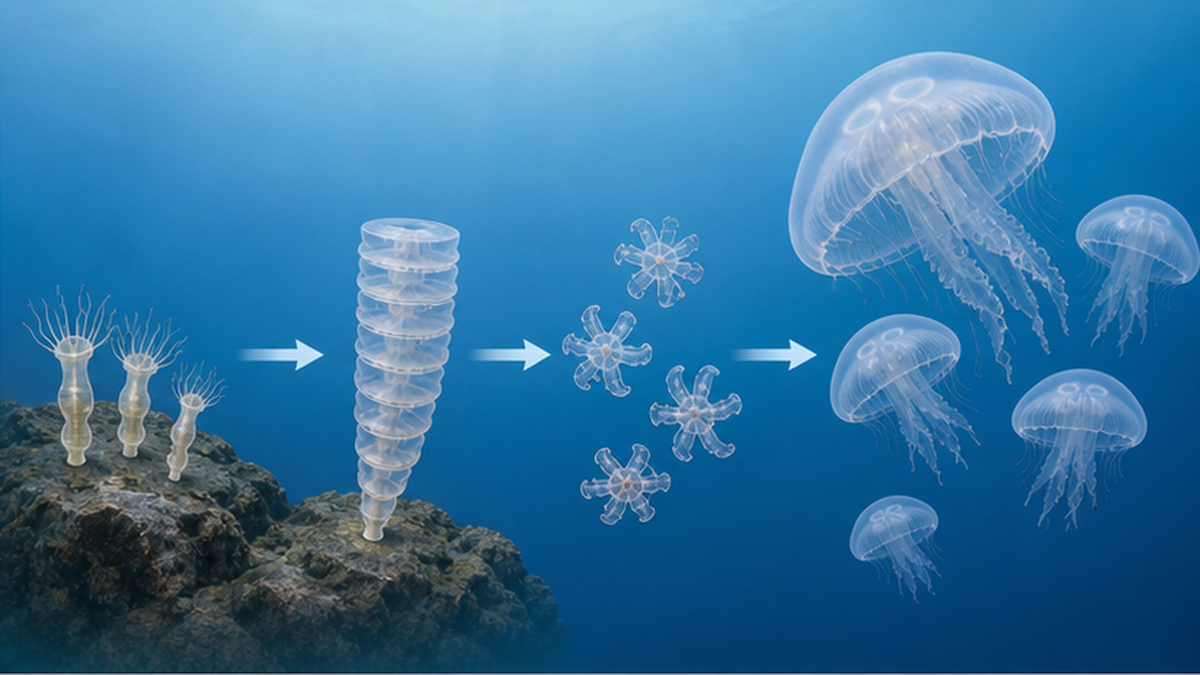
Many jellyfish (scyphozoans), including moon jellyfish and Nomura's jellyfish, live a complex life that alternates between two utterly different stages: the familiar bell-shaped "medusa" form, and a sea-anemone-like "polyp" form attached to rocks. We cover this life cycle in detail in Why is the jellyfish life cycle so complex?, but the polyp is the decisive player in understanding mass occurrences.
The polyp holds the key—how one individual is "copied" into hundreds
Polyps attached to seafloor rocks and shells keep producing clones of themselves by fission and budding when conditions are good. Then, triggered by cues such as changes in water temperature, they undergo a metamorphosis called "strobilation," slicing their bodies crosswise to release baby jellyfish called "ephyrae" one after another. Because a single polyp releases multiple ephyrae, and the polyps themselves have already multiplied many times over, the descendants of a single parent can gush forth by the hundreds or thousands when conditions align.
In other words, jellyfish numbers are determined not by the visible medusae at the surface but by the "invisible inventory of polyps" lurking on the seafloor. The key to the mystery of mass occurrences lies in where, and how much, these polyps are proliferating.
How big can it get? Belts of jellyfish filling the sea
The scale of blooms defies imagination. Moon jellyfish form huge swarms almost every year in semi-enclosed bays such as the Seto Inland Sea and Tokyo Bay, sometimes covering the surface with white bells as far as the eye can see, or stretching in ribbon-like bands several kilometers long. In the Harima Nada area of the Seto Inland Sea, a major bloom occurred as recently as 2025, with swarms reported pouring into set nets. In mega-bloom years of Nomura's jellyfish, the number drifting in the Sea of Japan has been estimated in the hundreds of millions. Because the ocean is connected, a swarm born in one place can ride the currents into fishing grounds or power plants elsewhere—this is what makes the jellyfish problem so far-reaching.
Key Points
- Jellyfish blooms are, in part, a natural phenomenon built into the life cycle
- Seafloor "polyps" multiply asexually and release baby jellyfish all at once, producing explosive increases
- The concern is that human activities may now be amplifying the scale and frequency of these events
The Giant That Invaded the Sea of Japan: Nomura's Jellyfish
In Japan, the icon of jellyfish blooms is Nomura's jellyfish (scientific name: Nemopilema nomurai). One of the largest jellyfish in the world, the biggest specimens reach 2 m in bell diameter and 150 kg in wet weight. These "swimming giant jellies," far heavier than an adult human, surge into the Sea of Japan in numbers reaching hundreds of millions in peak years.
Born off the Chinese coast, carried to Japan by currents
According to Japan's Fisheries Agency, Nomura's jellyfish originates in the shallow waters around the Yangtze River estuary in China, grows while drifting through the Yellow Sea and East China Sea, passes through the Tsushima Strait carried by currents and winds, and rides the Tsushima Current northward along the Sea of Japan coast. In autumn some individuals slip through the Tsugaru Strait into the Pacific; in 2009 they reached as far as the waters off Chiba Prefecture. Most of the giant jellyfish sighted along Japanese coasts are thus not born in Japan—they are "drifters from across the sea."
Despite its bulk, the venom of Nomura's jellyfish is not strong enough to be life-threatening to humans, but its tentacles carry stinging cells that can cause dermatitis on bare skin. For fishers, tentacles brushing faces and arms while handling netted jellyfish are an added torment that makes sorting through a jellyfish-clogged catch all the more grueling.
2002: the mega-blooms began abruptly
Interestingly, mega-blooms of Nomura's jellyfish were not always frequent. In the 20th century there were only sporadic records—1920, 1958, 1995—yet from 2002 massive blooms suddenly began recurring almost every year. Even the Institute for Space-Earth Environmental Research at Nagoya University notes that "why the mega-blooms occur is not well understood," while links to environmental changes in the source waters off the Chinese coast (eutrophication, overfishing and the like) are drawing international attention.
From a few millimeters to over a meter in months—astonishing growth
The growth rate of Nomura's jellyfish is astonishing. When born in spring around the Yellow Sea it is a mere ephyra larva a few millimeters across, but it grows rapidly while feasting on zooplankton during its voyage on the currents, and by the time it reaches the Japanese coast in autumn it has become a giant with a bell over 1 m across. That is a several-hundred-fold increase in body size in roughly half a year. Sustaining such growth requires an enormous amount of food, and there is concern that swarms strip the zooplankton from the waters they pass through, indirectly affecting the fish that depend on the same food.
| Year | Scale and events |
|---|---|
| 2002 | Sudden mega-bloom; the era of recurring mass occurrences begins |
| 2003 | Mega-bloom continues; severe damage to set nets along the Sea of Japan coast |
| 2005 | Exceptionally large bloom; fishery damage becomes a social issue |
| 2006–2007 | Medium to large blooms continue |
| 2009 | Among the largest on record; 55,000+ damage reports nationwide and a boat capsizing |
| 2010 | Almost no appearance—a complete reversal (cold spring waters suspected) |
| 2021 | First major bloom in years confirmed; alert bulletins issued |
As this timeline shows, Nomura's jellyfish does not "increase a little every year"—it swings between extremes: massive appearances in some years and near-zero in others. In 2010, for instance, the species all but vanished after the previous year's mega-bloom. This capriciousness is precisely what makes prediction and countermeasures so difficult.
Damage to Fisheries: Torn Nets and Unsellable Catches
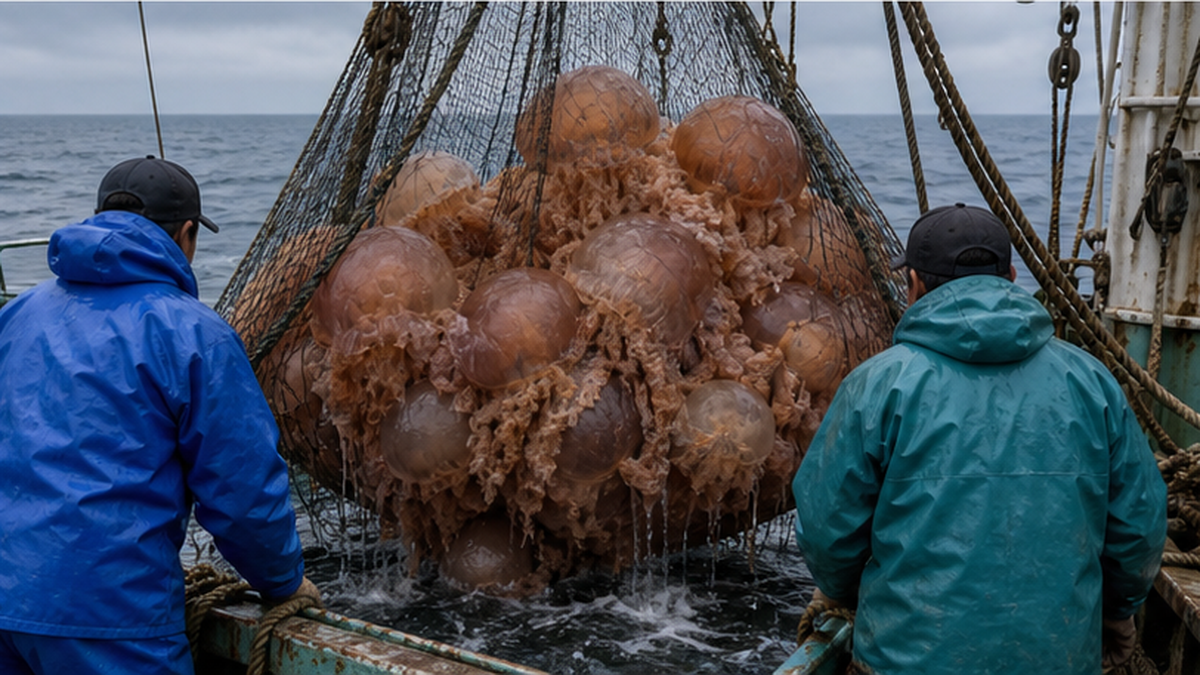
Fisheries bear the most direct brunt of jellyfish blooms. In 2009, when the Nomura's jellyfish bloom was among the largest on record, more than 55,000 fishery damage reports were filed across Japan. In Wakasa Bay there were days when over 10,000 sighting reports came in within 24 hours.
The damage goes far beyond broken nets
- Destroyed gear—dozens of 150 kg jellyfish will split a net, rendering a set net unusable
- Degraded catch quality—fish in the net are crushed by jellyfish or weakened by stinging venom, slashing their market value
- Heavier workloads—sorting fish from jellyfish devours time and gut fishing efficiency
- Abandoned operations—crews are forced to skip fishing days or move grounds to dodge the jellyfish
Beaches and tourism suffer too
The damage is not limited to fisheries. At summer beaches, sting injuries from box jellyfish (sea wasps) and Portuguese man o' war (strictly speaking a jellyfish-like relative) occur every year, and in heavy-outbreak years swimming advisories or bans are imposed. Mediterranean tourist beaches, too, have repeatedly made news with jellyfish-driven swimming restrictions, raising concern over tourism revenue. If the impression spreads that "you can't get in the water" or "you'll get stung," marine leisure as a whole suffers. Jellyfish blooms are a problem that cuts across multiple industries—fisheries, energy and tourism.
On the Shonai coast of Yamagata Prefecture in 2009, crews reportedly faced the decision to cut away entire nets to keep their boats from capsizing under massive jellyfish loads. Nets are expensive equipment; cutting one away means losses running to millions of yen. The terror of jellyfish damage is not "no catch, no income"—it is that the longer you operate, the deeper the losses grow.
The latest sighting conditions are published in rolling press releases by the Fisheries Agency, so anyone can check the scale and reach of the influx.
Official announcementsStatus of Giant Jellyfish Appearances (Fisheries Agency of Japan)Press releases from the Fisheries Agency on giant jellyfish (Nomura's jellyfish) sightings—the official word on the influx.🔗 jfa.maff.go.jpThe boat that capsized under the weight of jellyfish
In November 2009, off the coast of Chiba Prefecture, the trawler Daisan Shinsho-maru (about 10 tons) capsized while trying to winch up a net packed with Nomura's jellyfish. Fortunately its three crew members were rescued by a nearby fishing boat, but the sea was reported calm at the time—a fact that impressed upon the world that jellyfish weight alone can flip a small fishing vessel.
Caution: Jellyfish damage is not just a fisher's problem
- Reduced catches and quality ripple through seafood prices and supply to the consumer's table
- Mass jellyfish appearances at beaches cause sting injuries and drive away swimmers, hitting tourism
- If damage drives fishers out of the trade, regional fishing industries themselves may wither
Power Plants Grind to a Halt: The Blind Spot of Intake Clogging
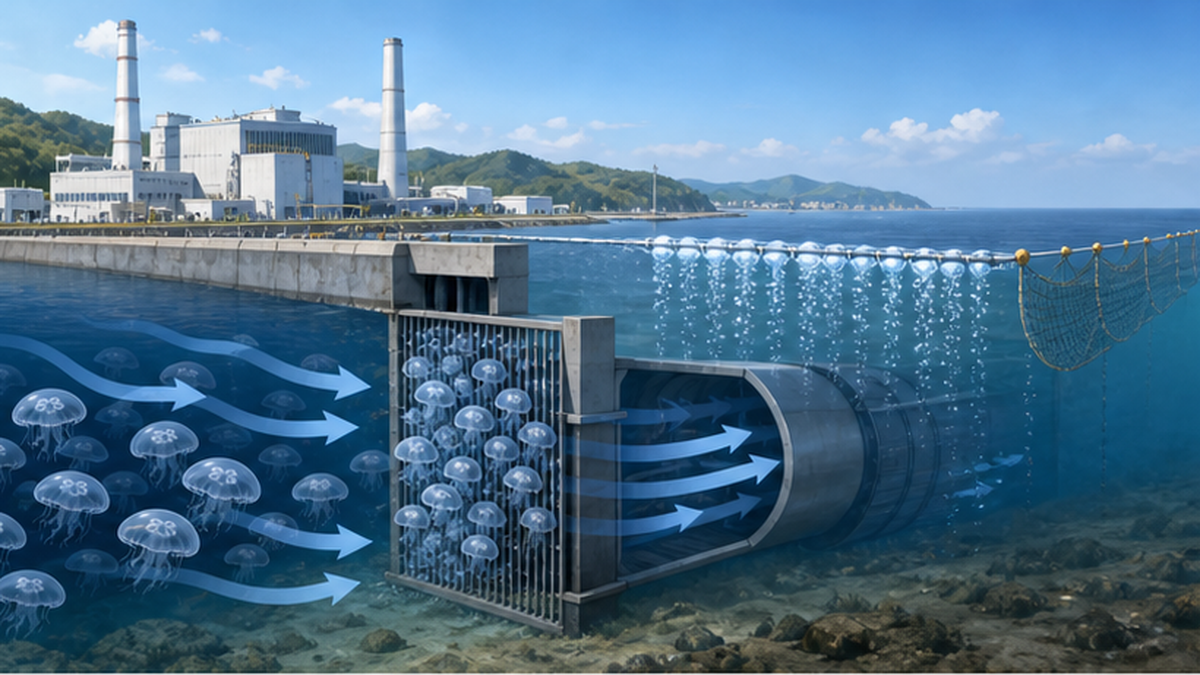
A power plant may not be the first thing that comes to mind when you hear "jellyfish damage." Yet thermal and nuclear power plants draw in vast quantities of seawater to condense the steam that spins their turbines, and when jellyfish swarms descend on the intake, serious trouble follows.
Jellyfish sucked in with the cooling water
Moon jellyfish form great swarms along the coast from late spring through summer. When such a swarm flows into an intake, the debris-removal screens become clogged with gelatinous jellyfish bodies, and the plant can no longer secure enough cooling water. With cooling capacity down, output must be cut—and in the worst case the plant is forced to shut down. Indeed, Kansai Electric Power announced in 2012 that it had curtailed output at thermal power plants due to a jellyfish bloom. If this happens in midsummer, when electricity supply and demand are tightest, the impact on society at large cannot be ignored.
In Sweden, a nuclear reactor stopped for three days
Nor is this a uniquely Japanese problem. In 2013, Unit 3 of Sweden's Oskarshamn nuclear power plant was manually shut down because of a massive swarm of moon jellyfish besieging its intake, and it took three days to restore operation. The unit is one of the largest boiling-water reactors in the world. Similar jellyfish-induced power plant troubles have been reported in the United States, Israel, Scotland, India and elsewhere—"jellyfish versus power plants" has become a shared global challenge.
Countermeasures: barrier nets, bubbles and monitoring
Power plants are not sitting idle. Countermeasures deployed at many sites include stretching jellyfish barrier nets seaward of the intake, installing bubbling systems that create curtains of air bubbles to deter approaching jellyfish, and reinforcing the debris screens. More recently, plants are testing early detection of approaching swarms with cameras and sensors so that operating plans can be adjusted before the jellyfish arrive.
According to analyses by Japan's Central Research Institute of Electric Power Industry and others, jellyfish swarms are pushed shoreward by wind and tidal currents, so the risk of an influx can be estimated to some degree from weather and sea conditions. Even so, swarm appearances remain sudden, and the structural headache persists: the midsummer peak of electricity demand tends to coincide with the peak of jellyfish season. A single sea creature can rattle the stable supply of electricity—the jellyfish problem is a vivid reminder that social infrastructure is bound to nature.
Why Are They Increasing? Four Suspected Human Factors
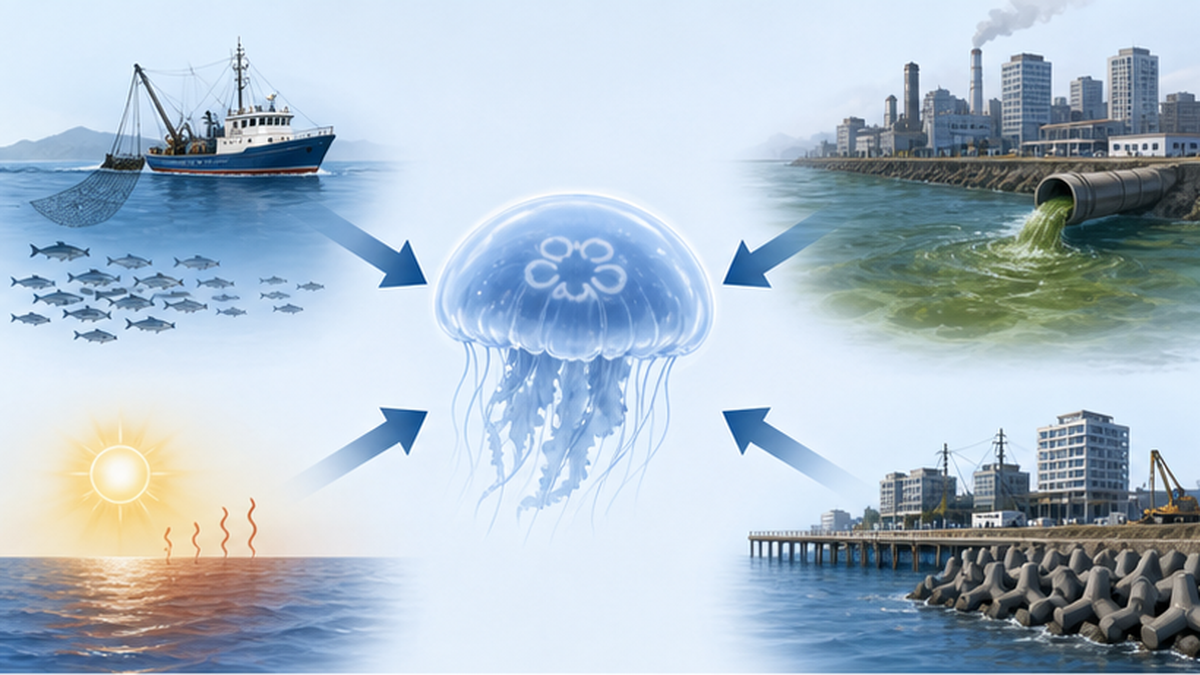
So why do jellyfish blooms happen? The prevailing view among researchers is that there is no single culprit but rather a "compound of factors" in which multiple human activities intertwine. Let us walk through the leading hypotheses organized by Professor Emeritus Shin-ichi Uye of Hiroshima University and others.
1. Overfishing—removing the jellyfish's rivals and predators
Jellyfish and small fish such as sardines are competitors for the same food: both eat zooplankton. When fisheries remove too many fish, the surplus food flows to jellyfish, and the fish that once preyed on jellyfish eggs and larvae also decline—a doubly favorable turn of events for jellyfish.
The emblematic case is the Benguela Current region off Namibia in southwestern Africa. Once one of the world's great sardine fisheries, it changed after overfishing decimated the fish in the late 20th century: the biomass of jellyfish is reported to now exceed that of fish. Jellyfish fill the gap left by fish, and a jellyfish-dominated sea does not easily revert. This shift of marine ecosystems from fish-centered to jellyfish-centered is called "jellification" and stands as a warning against excessive fishing.
2. Eutrophication and hypoxia—polluted seas favor jellyfish
When nitrogen and phosphorus from domestic wastewater and agricultural fertilizer flow in and the sea becomes eutrophic, phytoplankton multiply and food becomes abundant—while oxygen-poor hypoxic water masses form near the seafloor. Fish are vulnerable to oxygen shortage, whereas jellyfish tolerate low oxygen well, so polluted semi-enclosed bays tend to become jellyfish strongholds. In the Yangtze estuary region, the suspected source of Nomura's jellyfish, the link to eutrophication accompanying economic development is drawing international attention.
Eutrophication is a tailwind for polyps, too. In turbid, plankton-rich water, less light reaches the seafloor, weakening the seaweeds that compete with polyps for space and the animals that eat them. More food, fewer predators and competitors—a eutrophic bay becomes the ideal place for polyps to quietly build up their "inventory."
3. Rising sea temperatures—faster growth and reproduction
Experiments have confirmed that higher water temperatures speed up polyp proliferation and growth in many jellyfish species and extend their breeding seasons. With ocean warming already reshaping fisheries, warming may act as an "amplifier" that raises the baseline of jellyfish outbreaks.
4. Coastal development—artificial structures become polyp "housing estates"
An often-overlooked but important factor is coastal development. Jellyfish polyps attach to hard substrates such as shaded rock faces, and the undersides of breakwaters, quay walls, floating piers, buoys and aquaculture rafts make superb polyp habitat—sheltered from predators and well supplied with food. Surveys in South Korea found more polyps attached to the undersides of floating piers and buoys than to natural rock, and in Tokyo Bay moon jellyfish surged in the 1960s just as waterfront development and eutrophication advanced. The structures humans build in the sea are unintentionally serving as "jellyfish nurseries."
The uninvited jellyfish carried in ballast water
Jellyfish and their larvae can also cross oceans in ballast water—the seawater ships take on as weight when sailing empty. The famous case is the Black Sea in the 1980s, when the North American comb jelly Mnemiopsis leidyi arrived in ballast water, exploded in numbers, and helped accelerate the collapse of the anchovy fishery. Today the Ballast Water Management Convention mandates onboard treatment systems, an international mechanism to prevent such trans-boundary movements of organisms.
"Are They Really Increasing?"—Why the Causes Are So Hard to Pin Down
Reading this far, you may be ready to conclude that "jellyfish are increasing because of humans." In science, however, the fundamental question—are the world's jellyfish really on a sustained increase?—has not been settled.
A surprising result from 37 regions and 200 years of data
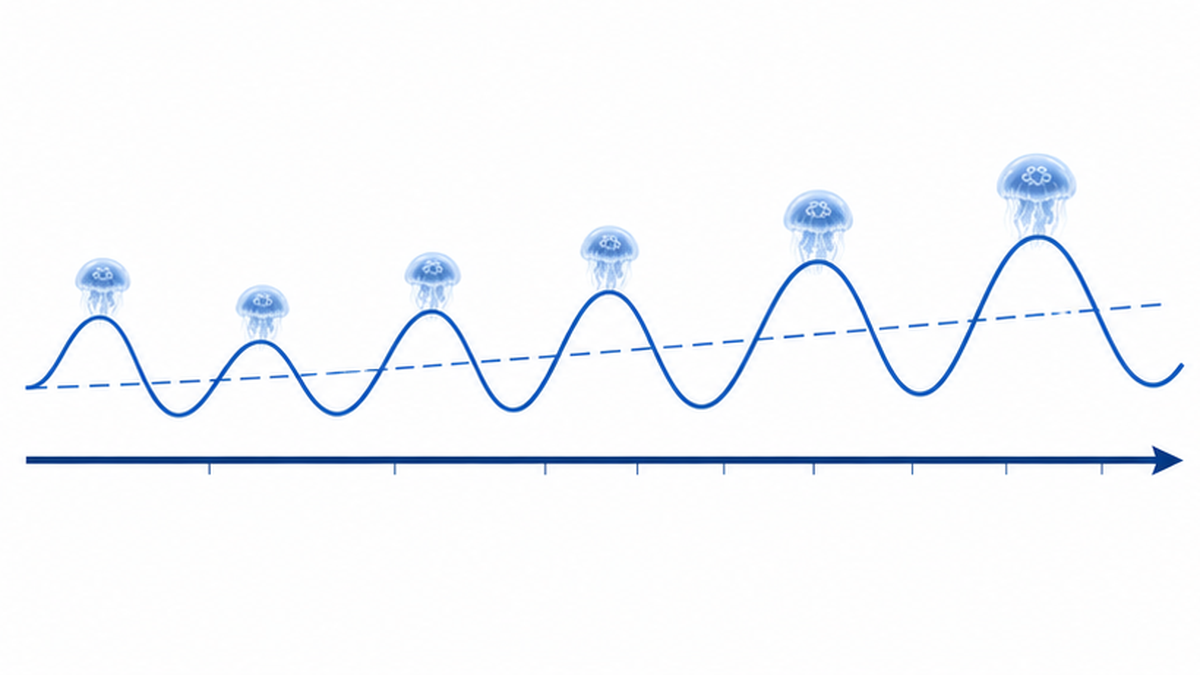
An international study led by Dr. Condon, published in 2013 in the Proceedings of the National Academy of Sciences (PNAS), became a turning point in this controversy. Compiling jellyfish population data from 37 regions worldwide spanning 1790 to 2011, the analysis revealed a pattern of oscillations repeating on a roughly 20-year cycle. The apparent worldwide "jellyfish surge" of the late 1990s and 2000s may have been the rising phase of this oscillation. At the same time, a weak but statistically significant increasing trend since the 1970s was also detected—a two-layer structure of "cyclical swings plus a gentle baseline rise."
The high wall of missing data
The biggest reason jellyfish science is hard is the scarcity of long-term observational data. Jellyfish bodies are mostly water; no catch statistics were compiled for them as they were for fish, and even when caught in survey nets they are fragile and hard to count. As for polyps, merely finding where they live on the seafloor is a challenge. "Without data from the past, we cannot judge whether the present is abnormal"—this is the wall that has long vexed jellyfish researchers, and it is the heart of why the causes are so hard to establish.
Why East Asia still warrants vigilance
But "verdict withheld at the global average" does not mean "nothing to worry about around Japan." The East Asian marginal seas (the Yellow Sea and East China Sea), source of Nomura's jellyfish, are waters where all four factors—eutrophication, overfishing, coastal development and warming—are advancing at among the fastest rates in the world. The observed fact that mega-blooms have recurred since 2002 strongly suggests that, locally, a shift toward a jellyfish-friendly sea is genuinely under way. The debate over global averages and the changes unfolding in the waters before our eyes must be considered separately.
A further difficulty is that experiments to isolate individual factors are all but impossible. In the real ocean, overfishing, warming and eutrophication advance simultaneously, so proving "which factor contributed how much" from field data alone is daunting. Researchers are filling in the puzzle piece by piece—tank experiments relating polyp proliferation to temperature, food and substrate; excavation of old plankton survey records; and numerical drift simulations. In jellyfish research, the patient accumulation of long-term observation is the mightiest weapon.
The Front Line of Monitoring and Forecasting: Japan-China-Korea Joint Surveys
Even without a complete explanation of the causes, there is much that can be done to reduce damage. The pillar is a "find early, warn early" monitoring and forecasting system. Nomura's jellyfish takes months to drift from its source to the Japanese coast, so observations made upstream buy time to prepare.
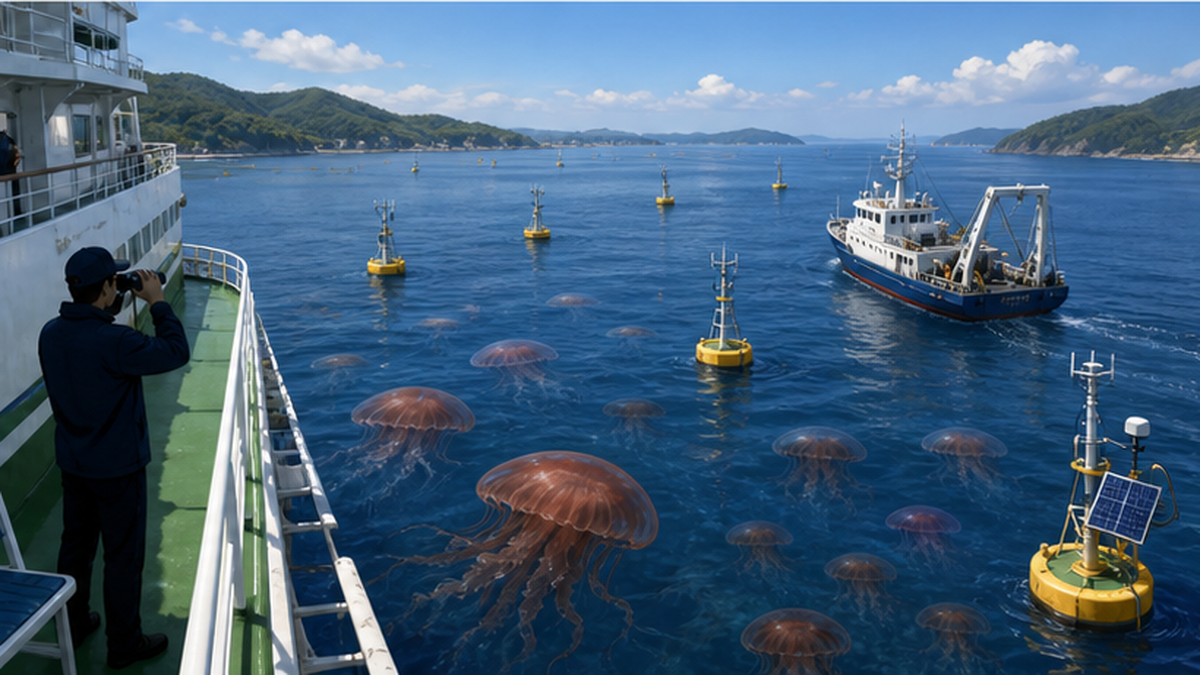
What makes the Nomura's jellyfish problem distinctive for Japan is that the source lies beyond its borders, meaning no single country can complete the monitoring or the countermeasures alone. That is why a framework of international joint surveys among research institutes in Japan, China and South Korea was built, establishing a system to catch outbreaks "upstream" in the East China Sea.
Counting jellyfish from the decks of international ferries
The Japan Fisheries Research and Education Agency, as part of the Japan-China-Korea joint monitoring program, conducts annual visual surveys from the decks of international ferries crossing the East China Sea and the Sea of Japan, along with distribution surveys by research vessels and drift-buoy tracking. Because ferry routes cross the same waters on a regular schedule, they are a precious observational platform for tracking changes in jellyfish abundance over time.
Sighting bulletins and early bloom forecasts
Survey results are published continually by the Fisheries Agency and the Fisheries Research and Education Agency as "giant jellyfish sighting bulletins," letting fishers know the scale and timing of the influx in advance. Furthermore, an early-forecast method that predicts the autumn influx from visual densities observed in the East China Sea in early summer has been put into practical use. If word comes months ahead that "this year threatens a mega-bloom," fishers can act preemptively—temporarily removing set nets or switching to modified nets fitted with jellyfish-excluding devices.
Official informationGiant Jellyfish Information (Japan Fisheries Research and Education Agency)Sighting status and distribution forecasts for Nomura's jellyfish based on Japan-China-Korea joint monitoring—primary information for the fishing industry.🔗 fra.go.jpIngenuity on the water: jellyfish-excluding nets and offshore culling
On the fishing grounds, modified gear has spread—set nets fitted at the entrance or midway with separation grids and outlets that selectively release only the jellyfish. Offshore culling is also practiced in the early phase of an influx, towing nets to slice the jellyfish apart. Because concerns were raised that cut jellyfish might spawn and paradoxically multiply, culling is carried out with careful attention to timing and method.
From Nuisance to Resource: Using Jellyfish, and What We Can Do
Finally, let us flip the perspective. Research and product development that treats the surging jellyfish not as "garbage" but as "an untapped marine resource" is gradually spreading.
Food, cosmetics, even farm soil—expanding uses
- Food—jellyfish is a prized ingredient in Chinese cuisine; Nomura's jellyfish is salted and processed into crunchy delicacies and has even flavored local ice cream
- Cosmetics and medical materials—research is advancing on using mucin, a protein in jellyfish bodies, as a moisturizing ingredient and a material for regenerative medicine
- Soil conditioners and fertilizer—Ehime University and others have pursued R&D on using jellyfish as water-retaining soil conditioners for greening deserts and for agriculture
Admittedly, with demand hostage to weather-dependent blooms, stabilizing this as an industry is no simple task. Still, the attempt to find new value in jellyfish that were once merely culled and discarded holds the potential to shore up, even a little, the economies of affected regions.
Jellyfish are not villains—their role in the ecosystem
We must not forget that jellyfish themselves are legitimate residents of the sea, present since ancient times. They are food for sea turtles, ocean sunfish and many other creatures, and juvenile fish shelter beneath their bells—jellyfish play genuine roles in marine ecosystems. Recent research has also revealed that masses of dead jellyfish sinking to the seafloor ("jelly-falls") are a precious food source for deep-sea life. The problem is not the existence of jellyfish, but that humans have upset the ocean's balance and arranged conditions in which jellyfish alone can win.
The fundamental fix: change the "jellyfish-friendly" ocean
As we have seen, jellyfish blooms are in part a mirror of the burdens humans have placed on the sea—overfishing, eutrophication, warming and coastal development. If so, the fundamental countermeasure is not to battle the jellyfish themselves but to restore a balanced ocean where fish can thrive and jellyfish hold no special advantage. That is contiguous with the themes this lab has covered again and again: sound management of fishery resources, wastewater measures and cutting greenhouse gas emissions.
Indeed, in some semi-enclosed seas such as the Seto Inland Sea, advanced sewage treatment has begun to reverse eutrophication, and efforts continue to restore the balance between water quality and the ecosystem. Jellyfish trends serve as a kind of "thermometer" reflecting the ocean's health. A sea where jellyfish have exploded may be signaling that, behind the scenes, fish are declining, oxygen is thinning and the ecosystem's balance is crumbling—see it that way, and the next jellyfish headline will read quite differently.
What we can do
- Choose certified seafood such as MSC and ASC to support fisheries free of overfishing through your purchases
- Keep drains clean (no oil down the sink, measured detergent use) to ease the eutrophication load on coastal waters
- Save energy and use renewables to cut CO2 emissions and help curb rising sea temperatures
- If you notice a mass jellyfish appearance while swimming or fishing, report it to your local government or the Fisheries Research and Education Agency's information desk

Summary
- Jellyfish blooms are rooted in the proliferation of seafloor "polyps" and erupt explosively when conditions align
- Nomura's jellyfish originates around the Yangtze estuary and drifts to Japan on the currents; mega-blooms have recurred since 2002, and 2009 brought 55,000+ fishery damage reports and a boat capsizing
- Intake clogging at power plants is a worldwide problem—in Sweden a nuclear reactor stood idle for three days
- The compound-factor theory (overfishing, eutrophication, warming, coastal development) is influential, but with natural ~20-year global oscillations, definitive attribution remains difficult
- Japan-China-Korea joint monitoring, early forecasts and modified fishing gear are reducing damage; the fundamental fix is to reduce the environmental burden on the sea itself
References and Sources
- Fisheries Agency of Japan – Fishery damage caused by giant jellyfish (materials on fishery damage from harmful organisms)
- Fisheries Agency of Japan – Status of giant jellyfish appearances (press release)
- Japan Fisheries Research and Education Agency – Giant jellyfish information (Japan-China-Korea joint monitoring surveys)
- Institute for Space-Earth Environmental Research, Nagoya University – 50 Whys of the Ocean, No. 26: The mystery of Nomura's jellyfish
- Ocean Policy Research Institute, Sasakawa Peace Foundation – Ocean Newsletter No. 133, "Nomura's jellyfish mega-blooms and the sustainability of East Asian marginal seas" (Shin-ichi Uye)
- Ocean Policy Research Institute, Sasakawa Peace Foundation – Ocean Newsletter No. 295, "Early forecasting of Nomura's jellyfish mega-blooms becomes possible"
- PNAS (Proceedings of the National Academy of Sciences) – Condon et al. (2013) Recurrent jellyfish blooms are a consequence of global oscillations
- Association of International Research Initiatives for Environmental Studies (AIRIES) – Global Environment Vol. 16, "Globalizing jellyfish blooms: causes and countermeasures"
- Kansai Electric Power – On output curtailment at thermal power plants due to a jellyfish bloom (2012)
- AFPBB News – Swedish nuclear plant halted for three days by jellyfish swarm (2013)
* Ordered by reliability: government and academic institutions > peer-reviewed papers > specialized organizations > trusted media