⚡ The answer in 30 seconds
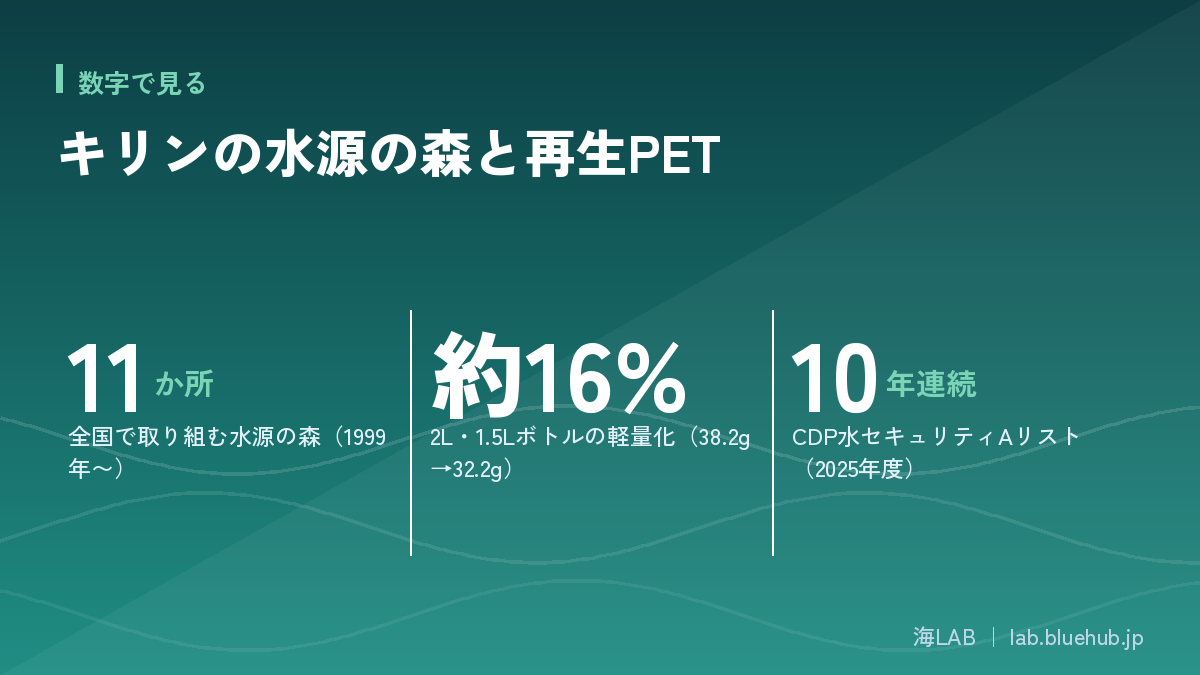
- Kirin began its water source forest activity in 1999 at the Yokohama Brewery's source area (Tanzawa) and now works at 11 sites across Japan.
- For packaging, Kirin aims for recycled resin to make up 50% of PET resin used in Japan by 2027, advancing lightweighting, R100 bottles and label-less products.
- CDP's Water Security A List is a rating of disclosure, not proof of zero environmental impact, and should be read with that in mind.
Beer and Kirin Gogo no Kocha alike are mostly water. For a beverage maker, protecting water sources and circulating used containers are environmental issues that underpin the business itself. How far has Kirin gone, and what challenges remain?
Based on Kirin Holdings' environmental reports, news releases and information published by local governments, this article organizes Kirin's water source forests, factory water saving and Sri Lankan spring protection, together with its packaging measures such as recycled PET and lightweighting.
Because the sources are mainly the company's own announcements, we separate facts from evaluation and note challenges and limits as well. Keeping the connection to the ocean in mind, we read through the circulation of water and resources.
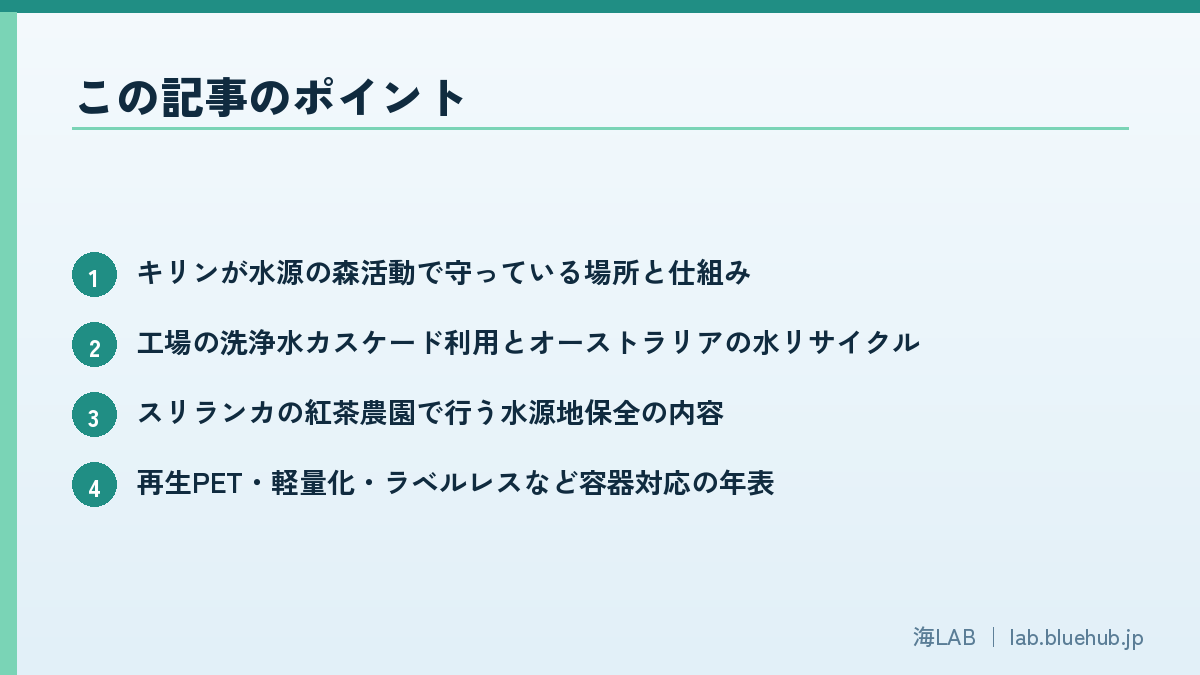
What you'll learn in this article
- Where and how Kirin protects its water source forests
- Factory wash-water cascade reuse and water recycling in Australia
- What water source protection looks like at Sri Lankan tea estates
- A timeline of packaging measures: recycled PET, lightweighting, label-less bottles
- How to read corporate environmental efforts such as the CDP rating
What Are Kirin's Water and Packaging Efforts? An Overview
Kirin Holdings is a corporate group in beer, soft drinks, pharmaceuticals and health science. Beer and bottled drinks such as "Gogo no Kocha" and "Namacha" are mostly water. Water is both a raw material and an essential resource for cleaning and cooling production equipment. This article focuses on two pillars, protecting water source areas and environmental measures for packaging (PET bottles), and organizes them from publicly available official materials.
The sources are Kirin Holdings' environmental reports (2022 and 2024 editions), news releases from 2020 and 2024, the release of December 11, 2025 on obtaining the CDP "Water Security" A List, public pages of Kanagawa and Shiga Prefectures, and materials from the Ministry of Land, Infrastructure, Transport and Tourism. Since they center on the company's own statements, we separate facts from evaluation and mark evaluative parts as "the company explains that...".
Why look at "water" and "packaging" together?
Protecting water sources is the "entrance" before resources are used; packaging measures are the "exit" after use. The Kirin Group's Environmental Vision 2050 takes an integrated view of biological resources, water resources, packaging and climate change. Looking at entrance and exit together makes the whole picture of a beverage maker's resource circulation easier to grasp. In relation to the sea, healthy forests and rivers feed the nutrient cycle of coastal waters, and collecting and recycling containers helps prevent marine plastic litter.
Our stance in this article
- We center on facts written in the company's official materials (years, quantities, place names)
- We do not assert that something is "eco-friendly" and also note remaining challenges and limits
- Figures are updated every year, so please check each company's latest report in the end
Scope of this article
- Water source forest activity (11 sites in Japan) and groundwater recharge
- Factory water saving (cascade reuse of wash water) and water recycling in Australia
- Spring protection at tea estates in Sri Lanka
- Packaging measures such as recycled PET (R100 bottles), lightweighting and label-less products
- How to read evaluations (the meaning and limits of the CDP Water Security A List)
Japan's Water Situation: Plentiful Overall, but Little per Person
Japan is often seen as a country blessed with water. Annual precipitation is indeed high: reference materials of the Ministry of Land, Infrastructure, Transport and Tourism's Water Cycle White Paper describe Japan's annual precipitation as about 1,668 mm, about twice the world land average (about 815 mm). Per person, however, the picture changes. The same materials give water resources per capita as about 3,400 m³ per person per year, about half the world average (about 6,800 m³ per person per year).
| Indicator | Japan | World average | Comparison |
|---|---|---|---|
| Annual precipitation | about 1,668 mm | about 815 mm | Japan: about 2x |
| Water resources per capita | about 3,400 m³/person/year | about 6,800 m³/person/year | Japan: about half |
This gap arises because Japan's terrain sends much of the rain to the sea in short, steep rivers, and because population density is high. That is why water source recharge, in which rain falling on mountains is held in forests and soil and released slowly into rivers and groundwater, matters.
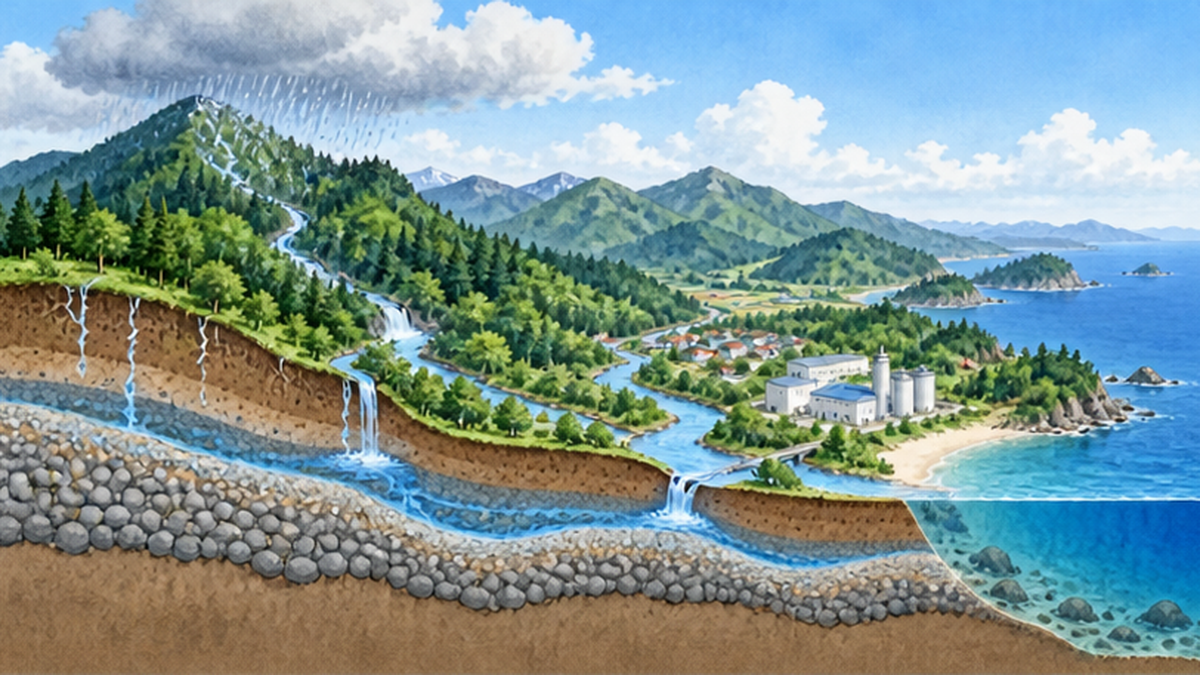
The idea of water source recharge
Forest soil absorbs rain like a sponge and sends it to rivers over time. How large this effect actually is has been debated among researchers, including how the term "green dam" should be used. We summarize it in What Do Headwater Forests Do? on this site. Here we limit ourselves to the general understanding that forest care (thinning, undergrowth clearing and so on) helps keep soil and undergrowth in good condition, which is the background of companies' water source forest activities.
Connection to the sea
Mountain water reaches the sea through rivers. If forests deteriorate and sediment flows in, coastal environments can be affected; healthy forests, conversely, carry nutrients to the sea in moderation. Protecting water sources is not only a story about distant mountains but also relates to the richness of the sea.
Water Source Forests: From the 1999 Yokohama Brewery to 11 Sites Nationwide
At the center of Kirin's source protection is its "water source forest activity." According to the 2024 environmental report, the activity began in 1999, ahead of the industry, in the forests of the Tanzawa area of Kanagawa Prefecture, the water source of Kirin Brewery's Yokohama Brewery, and continues today at 11 sites across Japan. Based on medium- to long-term agreements with local governments and related parties who manage the source-area forests, it carries out tree planting, undergrowth clearing, pruning and thinning.
Kanagawa Prefecture: agreements keep being renewed
According to the public page of Kanagawa Prefecture, Kirin Holdings works at "Kirin Kanagawa Water Source Forest" as a forest restoration partner under an agreement period from February 1, 2024 to January 31, 2029. The prefecture's page also notes support since January 12, 1999, dating back to the predecessor "Water Source Forest Partner System." That means Kirin has been involved with the same source area for more than a quarter century.
Shiga Prefecture: Lake Biwa Water Source Forest
Shiga Prefecture's public page lists 596.09 ha as the agreement area of Kirin's "Lake Biwa Water Source Forest" (the counterpart is the Otakiyama forestry association; the agreement is extended in fixed terms). Lake Biwa is known as the water tank of the Kansai region, and the activity is positioned as protecting the source area of Kirin Brewery's Shiga Brewery.
| Name (as shown in the report's figure) | Related factory/site |
|---|---|
| Kirin Chitose Water Source Forest | Hokkaido Chitose Brewery |
| Kirin Kita-Zao Water Source Forest | Sendai Brewery |
| Kyowa Kirin Takasaki Water Source Forest | Takasaki Plant |
| Kirin Kanagawa Water Source Forest | Yokohama Brewery (birthplace of the activity) |
| Lake Biwa Water Source Forest | Shiga Brewery |
| Water source recharge at Senbo Reservoir | Kobe Brewery |
| Kirin Okayama Water Source Forest | Okayama Brewery |
Key points to note
- The unit of activity is "each factory's source area," and agreements with forest owners and local governments are the premise
- Area and results are published in different formats by site, making side-by-side numerical comparison difficult
- The report states that at some sites, interested customers can take part in the activity
Customer participation
According to the report, at some water source forests customers who wish to take part also join in forest work. Rather than the company managing alone, it can also be an opportunity for people who drink the beverages to experience the relationship between forests and water, which has value for environmental education. However, quantitative results such as participant numbers were not found in the materials we checked.
Factory Water Saving: Cascade Reuse of Wash Water and Water Recycling in Australia
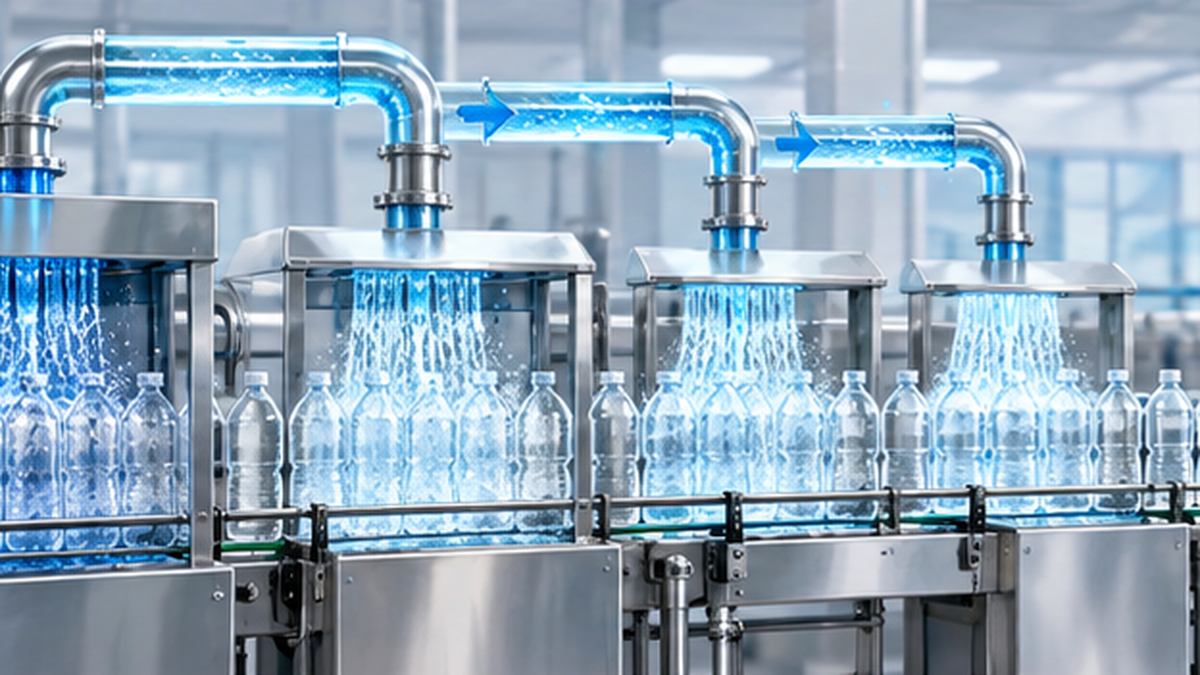
Besides protecting source areas, efforts to reduce the water used in factories are described in parallel. According to the environmental report, most of the water used in factories goes into the cleaning and sterilization steps of equipment and piping. To reduce it, cascade reuse is practiced, in which wash water is reused for purposes matched to its quality.
How cascade reuse works
For example, the "rinse water" used at the end of a washing process is relatively clean, so next time it can be used for the pre-rinse that first washes the piping. Water is reused in order of cleanliness, which reduces the fresh water taken in. However, the report explains that it must be guaranteed on quality grounds that cleaning is reliably done, and the operating know-how to match the timing and balance between the amount of water that can be recovered and the amount used is essential.
- Collect the relatively clean "rinse water" used at the end of cleaning
- Reuse the recovered water at the start (pre-rinse) of the next cleaning
- Use reused water mainly in the dirtier steps
- Set up quality-check systems and guarantee that cleaning is reliably done
Areas of high water stress: Lion (Australia)
The Kirin Group also owns Lion, an Australian alcoholic and non-alcoholic beverage company. Australia has experienced major droughts in the past and has high water stress (the degree of water scarcity). According to the report, in 2009 Lion partnered with the Queensland government to install a reverse osmosis (RO) plant at the Castlemaine Perkins Brewery to recover and reuse wastewater. The treated water is used in processes that do not directly touch the product, such as cleaning, cooling and pasteurization.
In addition, the release of December 11, 2025 explains that a water recycling plant (reverse osmosis) was introduced in 2024 at the Tooheys Brewery. In water-stressed Australia, this is the second brewery after Castlemaine Perkins.
| Item | Details (from the Environmental Report 2024 and the CDP release) |
|---|---|
| Target sites | Tooheys, Castlemaine Perkins, James Boag, etc. (scope differs by target) |
| Water-use intensity target | 2.4 kl/kl or less in 2025 (non-financial target) |
| 2024 target | 3.0 kl/kl or less (non-financial target) |
| Water recycling plants | Castlemaine Perkins (2009), Tooheys (2024) |
What is water-use intensity?
- An indicator showing the amount of water used to make one unit of product
- Useful for checking whether water use rises in proportion to production
- On the other hand, this indicator alone does not show total water use at the factory or the impact on the watershed it draws from
As a future direction, the report says the aim is not just to save water but to understand the impact on natural capital across the whole watershed and set targets to reduce that impact. This can be read as saying the next challenge after water saving is how to relate to the local water environment.
Water in the Supply Chain: Protecting Water Sources at Sri Lankan Tea Estates
Water issues do not end inside one's own factories. Sri Lanka is one of the main tea-producing areas for Kirin Beverage's "Gogo no Kocha." Since 2013 the Kirin Group has supported tea estates in Sri Lanka in obtaining Rainforest Alliance certification; the environmental report says that by the end of 2023 a cumulative 94 estates had been certified, equivalent to about 30% of certified large estates in the country.
Protecting micro-watersheds
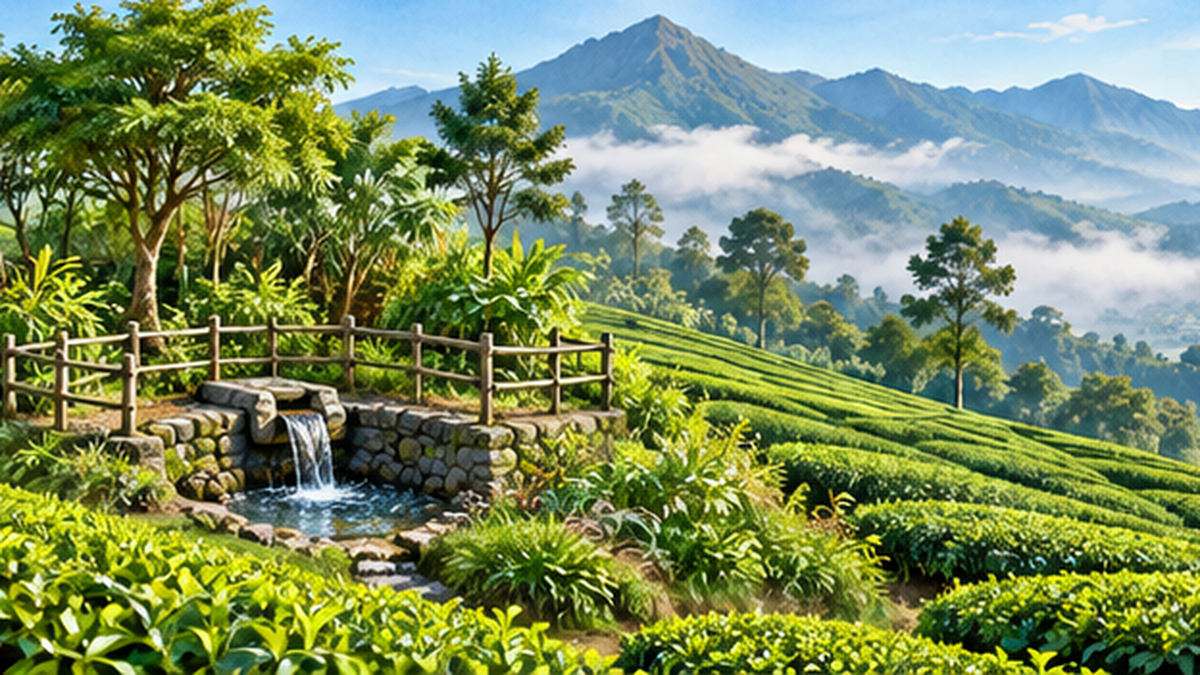
Spring protection began in 2018. On tea estates in Sri Lanka's central highlands there are places where rainwater soaks into the ground and wells up as a spring in a corner of the estate. The report calls these micro-watersheds. Even if small in area, they are mostly the headwaters of rivers flowing toward coastal cities and are valuable sources.
- The springs are fenced to keep animals out and prevent other uses
- Native species are to be planted around them, adding vegetation diversity to monoculture estates
- This also prevents sediment washed off slopes by heavy rain from flowing into the springs
Education for residents: training for 1,750 people and awareness for 15,000
By the end of 2023, protection had been completed at a cumulative 22 sites. In addition, 1,750 people living near the springs received group training, and about 15,000 people were given pamphlets on water conservation and watershed protection. At some estates, the pamphlets are incorporated into the programs of nurseries and primary schools for harvest workers' children.
As background, the CDP release names Sri Lanka, the main source of Gogo no Kocha tea leaves, as a place where, in the supply chain analysis, WASH (access to water, toilets and sanitation) issues are particularly large. The thinking is to engage with water problems at sourcing locations as well.
Points to note
- The completed protection (22 sites) are springs inside estates, a small part compared with the scale of Sri Lanka's water problems as a whole
- The materials we checked did not contain figures quantitatively showing results (improvement in water quality or quantity)
- The efforts rest on cooperation with local government bodies (such as PHDT) and certification organizations
Packaging Measures: The Path of Recycled PET, Lightweighting and Label-less Bottles
We follow the "exit" side, packaging, along a timeline confirmable in official releases. In February 2019 the Kirin Group formulated the "Kirin Group Plastic Policy," aiming to raise "the share of recycled resin in Japan to 50% by 2027." In February 2020 it formulated "Kirin Group Environmental Vision 2050," declaring its goal of "a society that circulates packaging sustainably."
| Date | Details | Source |
|---|---|---|
| February 2014 | Introduced the "R100 PET bottle" of 100% recycled PET for "Gogo no Kocha Oishii Muto" (according to media reports and company announcements) | Kirin announcement |
| February 2019 | Plastic Policy formulated (recycled resin to make up 50% of PET resin in Japan by 2027) | December 2020 release |
| June 2019 | R100 PET bottle adopted for "Namacha Decaf" | December 2020 release |
| February 2020 | Environmental Vision 2050 formulated | December 2020 release |
| December 2020 | About 16% lighter large 2L/1.5L bottles (38.2 g → 32.2 g) | December 2020 release |
| 2021 onward | Wider use of R100 in the "Namacha" series and others; label-less products launched | January 2024 release |
| 2024 | Some small "Namacha" bottles lightened from 20 g to 18 g (announced for June onward) | January 2024 release |
Lightweighting: large bottles in December 2020
In December 2020, Kirin Beverage announced that for 2L and 1.5L large PET bottles such as "Gogo no Kocha" and "Namacha," it would modify the preform (the test-tube-shaped molded piece that becomes the bottle) mold to cut weight from 38.2 g to 32.2 g, about 16% lighter. The company estimates it can cut about 439 tons of PET resin and about 1,515 tons of CO₂ emissions per year (company estimate based on production plans).
R100 PET bottles and label-less products
The R100 PET bottle is a bottle made with 100% recycled PET resin. The January 2024 "Namacha" renewal release explains that since 2021 the "Namacha" brand has been positioned as a CSV flagship brand for environmental measures, advancing R100 PET bottles in some containers, roll labels and label-less products. Label-less products are limited to retailer-exclusive 6-packs and case sales, and have not spread to all products.
Similar efforts are spreading at other companies. Comparing Asahi's label-less bottle, Coca-Cola's 100% recycled PET bottle and Suntory Tennensui's bottle-to-bottle shows that each company combines recycled material use, lightweighting and label reduction in its own way.
What is bottle-to-bottle?
Collecting used PET bottles and turning them back into PET bottles is called bottle-to-bottle horizontal recycling. Compared with turning them into other products such as fibers or trays, resources keep circulating in the same use. For details on the domestic collection and recycling system, see What Is Bottle-to-Bottle Horizontal Recycling?.
Kirin's public information reports a plan to make bottle preforms from 100% resin derived from used bottles at its Shonan Brewery (Samukawa, Kanagawa), a collection initiative with Tokyo Tatemono at Nakano Central Park since October 2023, and work on chemical recycling from non-food PET. These include media-based information, so please check official announcements for the latest status.
How to Read External Ratings: 10 Straight Years on CDP's Water Security A List
On December 11, 2025, Kirin Holdings announced that it was selected for the highest A List in the FY2025 "Water Security" assessment by the international nonprofit CDP. It is the company's 10th A List (10 years in a row). CDP is an organization that, at the request of investors and purchasing companies, asks companies and local governments to disclose environmental information and encourages action.
What was evaluated (the company's explanation)
- Evaluates water risks across the supply chain and its own sites, and sets targets and strategies emphasizing high water-stress areas
- Sets an ambitious water-use intensity target at Lion in water-stressed Australia
- Introduced a water recycling plant (reverse osmosis) at the Tooheys Brewery in 2024
- Expanded spring protection at tea estates in Sri Lanka, where WASH issues are particularly large
Cautions when reading the rating
CDP's score evaluates a company's level of information disclosure and management. It is not a certification that water use is low or that environmental impact is zero. Note also that the reasons for selection are what the company itself "believes were evaluated." Rather than judging a company on whether it is on the A List, look also at concrete figures, continuity and third-party verification.
Putting it together
- Entrance: protecting source areas through water source forests (11 sites) and Sri Lanka (22 sites)
- Factories: cascade reuse of wash water and water recycling in Australia
- Exit: packaging measures such as lightweighting (about 16%), R100 PET bottles and label-less products
- Rating: 10 straight years on CDP's Water Security A List (note that it is a disclosure rating)
Remaining Challenges and Points to Discuss: Reading the Numbers and Impact on the Sea
The efforts seen so far are all facts based on official materials, but that does not let us conclude that "therefore Kirin's environmental response is sufficient." Here we organize points worth keeping in mind when reading the materials. Evaluating efforts and finding challenges are compatible.
Point 1: How are the "results" of water source forests measured?
For water source forest activities, the work carried out, such as planting and thinning, is explained, but figures for results, such as how much groundwater increased or how water quality changed, were not found in the materials we checked. Because the water source recharge function of forests depends on many factors including soil, geology and climate, directly linking one company's activity to changes in water volume is not easy. This is less a problem of the company than of the difficulty of environmental evaluation itself.
- "Inputs" such as area worked or number of trees are relatively easy to publish
- "Results" such as groundwater level, flow and biodiversity require long-term continuous observation
- Third-party verification and watershed-level data disclosure would make it easier for readers to judge
Point 2: Water-use intensity does not tell the whole story of "water-saving quality"
Lion's water-use intensity target is an indicator that lowers water use per kl of product. It is useful for checking whether efficiency is maintained as production grows, but it does not show total water withdrawal at the factory or the impact on local water supply and demand. The report itself shows a direction toward understanding impact on natural capital across the watershed, so the indicator can be read as being on the way to its next stage.
Point 3: The share of recycled PET and the reality of bottle-to-bottle
The Plastic Policy target of "50% of PET resin in Japan as recycled resin by 2027" is about the share of recycled resin. How much of it comes from bottle-to-bottle (horizontal recycling) and how chemical recycling is positioned differ by year's results and each company's definitions. Since the supply of food-grade recycled PET raw material available in Japan is also limited, each company's target needs to be read together with growth in supply and collection rates.
| Point | What official materials show | What is hard to see |
|---|---|---|
| Water source forests | Activities, agreement periods, number of sites (11) | Figures for results such as groundwater volume and quality |
| Factory water saving | Cascade reuse, water-use intensity targets | Total withdrawal, impact on watersheds |
| Sri Lanka | 22 sites protected, 1,750 trained, about 15,000 reached | Improvements in water quality and quantity |
| Packaging | Lightweighting rate, products adopting R100, 2027 target | Latest share of recycled PET across all products |
Point 4: Relationship with marine plastics
PET bottles circulate as a resource if properly collected, but those that escape collection may flow through rivers into the sea. We summarize the actual state of plastic waste flowing from rivers to the sea in Plastic Waste Flowing from Rivers to the Sea. Lightweighting and recycled-material use by beverage and container makers are effective in reducing new petroleum-derived resin, but reducing disposable waste itself and keeping it out of the environment remain separate challenges.
Points to avoid asserting
- We cannot say "lightweighting will clean the sea" (it only helps reduce generation)
- We cannot simplify to "recycled PET means low environmental impact" (collection, washing and recycling also use energy)
- We also cannot say "being on the A List means no problems" (it is a disclosure rating, not a guarantee of results)
Point 5: Looking across the whole supply chain
A beverage's environmental load extends beyond the factory to growing raw materials (tea leaves, barley, hops and so on), transport, container manufacturing, collection and recycling. Kirin's work on Sri Lankan springs and its support for certification of tea estates is based on this value-chain thinking. On the other hand, the more suppliers there are, the harder it is to verify effects at each site. Readers, too, can sort information more easily by being aware of which stage a statement concerns.
What We Can Do: Choosing with Water and Packaging in Mind
Knowing about corporate efforts gives consumers clues for choosing. However, which product is "good for the environment" varies with how it is used and with local collection systems. Below we organize generally meaningful actions based on facts.
When choosing and discarding PET bottles
- Remove the label and cap, rinse the inside and put it out according to local rules (the first step in keeping recycling quality)
- If you see label-less or recycled-PET packaging, check what the label says
- Keep the option of a reusable bottle to cut the total amount of disposables itself
- The share of recycled PET and collection systems differ by company, so check the latest reports for figures
Getting involved with water source forests
Some water source forest activities allow volunteers to take part. Joining local forest volunteer programs or experience programs by companies and NPOs makes it easier to feel where water comes from. Even investigating a nearby river or spring shows how water is connected. Our article Submarine Groundwater and Groundwater Conservation is also a useful reference.
Perspectives for viewing corporate efforts
- Is the target specific about "by when, what and how much" (e.g., 50% recycled resin by 2027)?
- Are results published and trackable year by year?
- Does the company look beyond itself to raw-material origins and watersheds?
- Is an external rating about the quality of disclosure or about actual reduction of environmental impact?
Neither water nor packaging circulates through the efforts of one company alone. Water and resources circulate only when local governments and communities that manage forests, local governments and businesses that collect, and consumers' actions come together.
References & Sources
- Kirin Holdings | Obtaining CDP Water Security A List (December 11, 2025) – 10 straight years on the A List, water recycling at Tooheys, spring protection in Sri Lanka
- Kirin Group Environmental Report 2024 (Water Resources) – 11 water source forests, 22 sites in Sri Lanka, Lion's water-use intensity
- Kirin Group Environmental Report 2024 (Biological Resources) – Support for certification of tea estates in Sri Lanka
- Kirin Group Environmental Report 2022 (Packaging) – Plastic Policy, R100 PET bottles
- Kirin Beverage | About 16% lighter large PET bottles (December 2, 2020) – 38.2 g → 32.2 g, about 439 tons of resin saved per year
- Kirin Beverage | Major renewal of "Namacha" (January 25, 2024) – R100 PET bottles, label-less products, 20 g → 18 g lightweighting
- Kanagawa Prefecture | Kirin Holdings (Water Source Forest Partner) – Agreement period February 1, 2024 – January 31, 2029
- Shiga Prefecture | Forest-building and water source forest pages – Agreement area of the Lake Biwa Water Source Forest
- Ministry of Land, Infrastructure, Transport and Tourism | Materials on the water cycle – Japan's annual precipitation and water resources per capita
- CDP – International nonprofit that promotes environmental disclosure
* Listed in order of reliability: government and academic institutions > peer-reviewed papers > specialist organizations > reliable media