⚡ The answer in 30 seconds
- Ishigaki's reef manta ray is Vulnerable on the IUCN Red List, and the related oceanic manta ray is Endangered.
- Breeding is slow at about one pup per two years, so recovery takes a long time.
- Main threats are fishing (targeted and bycatch), climate change, injuries from boats and gear, and tourism impacts.
- CITES Appendix II listing, decided in 2013 and in force on Sept. 14, 2014, is part of the international framework.
- When viewing, do not touch, chase or crowd them; photos can support research.
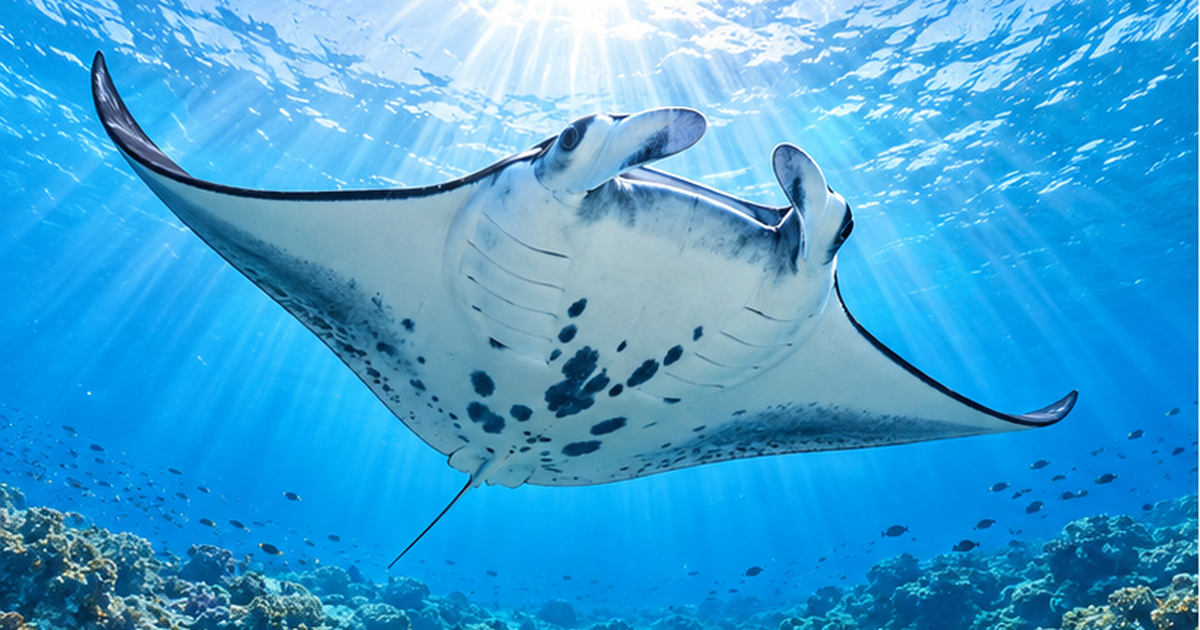
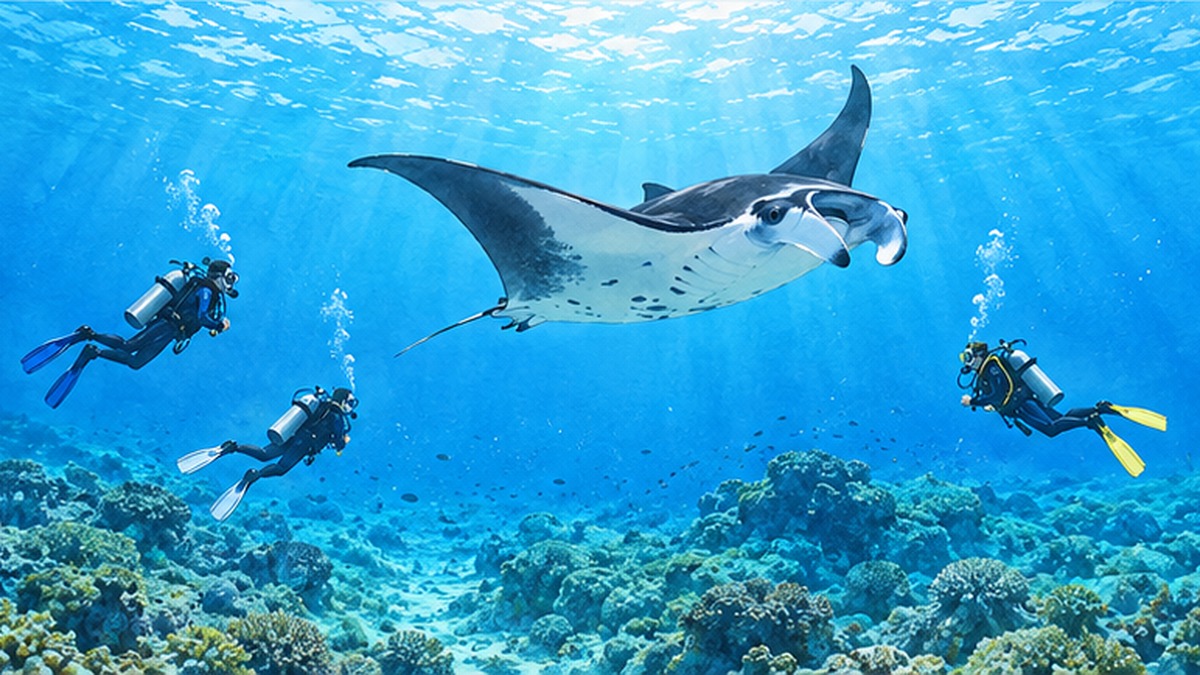
Off Ishigaki Island, manta rays with wingspans of several meters glide through the water, drawing divers from around the world. We can meet them because mantas return to the same places again and again.
Globally, however, mantas are declining because of fishing and environmental change. They breed very slowly, so once their numbers fall they recover only with great difficulty.
This article summarizes the biology of Ishigaki's mantas, global declines, international protection frameworks, photo-identification research and viewing rules, based on primary sources.
What you will learn
- Manta rays are split into two species, and Ishigaki's are mainly reef manta rays
- Why manta populations recover so slowly
- Reported declines worldwide and the main threats
- CITES, CMS and IUCN protection frameworks
- Photo-ID and citizen science in manta research
- Viewing rules and manners to follow in Ishigaki
What Are Ishigaki's Manta Rays?
Two species are called “manta”
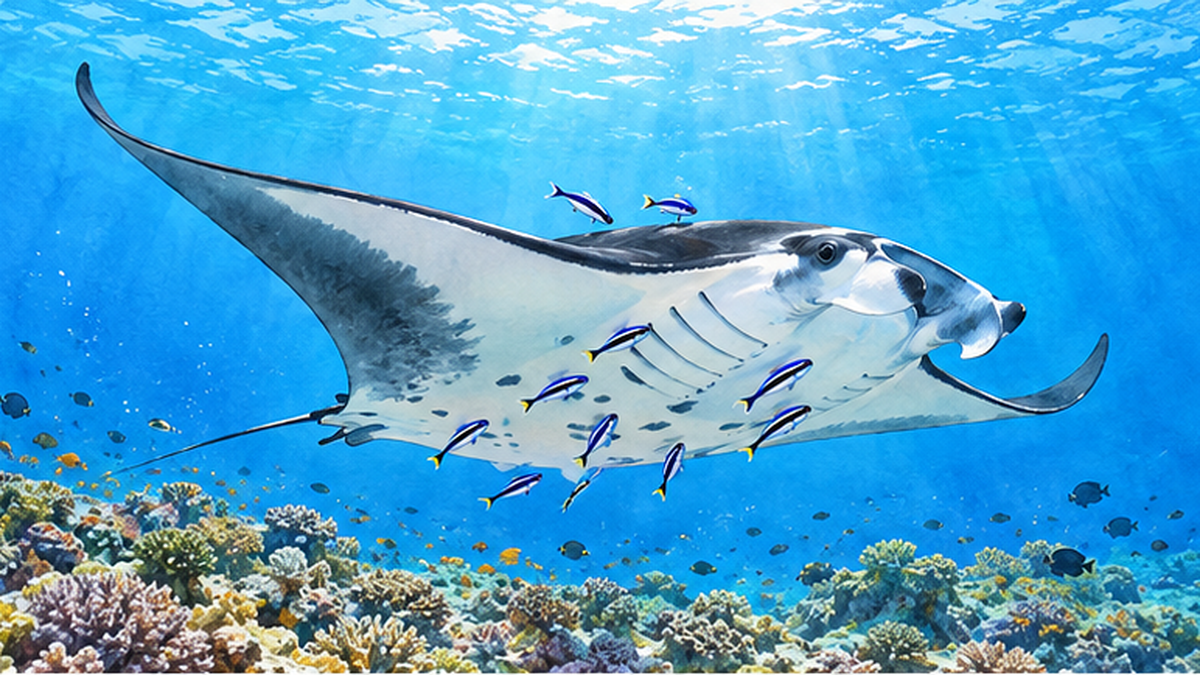
The large rays known as “mantas” in diving and aquariums are divided into two species: the oceanic manta ray (Mobula birostris), which mainly roams offshore, and the reef manta ray (Mobula alfredi), which tends to stay near coral reef coasts. They were once treated as one species but are now classified separately. Divers around Ishigaki mainly meet reef manta rays.
On the IUCN Red List, the oceanic manta ray is assessed as Endangered and the reef manta ray as Vulnerable. Even the reef manta ray that tourists see is regarded as a species needing protection worldwide.
Why they appear at Ishigaki: cleaning stations
“Manta Scramble,” off Kabira Ishizaki in northern Ishigaki, is known as a place where mantas gather repeatedly. It is a “cleaning station,” where small fish eat parasites and dead skin from the ray's body, like a car wash of the sea. Mantas are thought to visit often to be cleaned. The depth is only about 5–10 m, and in good conditions they can even be seen while snorkeling.
Key point
- Manta tourism works because mantas “return to the same place.” That habit makes them easy to watch, but also vulnerable to the effects of tourism.
Size and lifespan
Around Ishigaki, individuals with a disc width of 4–5 m have been recorded. Popular accounts put their lifespan at 40–50 years, though more research is needed to establish it precisely. They are clearly long-lived, which directly leads to the trait discussed below: they are slow to recover once reduced.
For how mantas feed and how their gills work, see How Manta Rays Eat Plankton. This article focuses on conservation and viewing rules.
Why Mantas Decline Easily: A Slow Life History
Few young are born
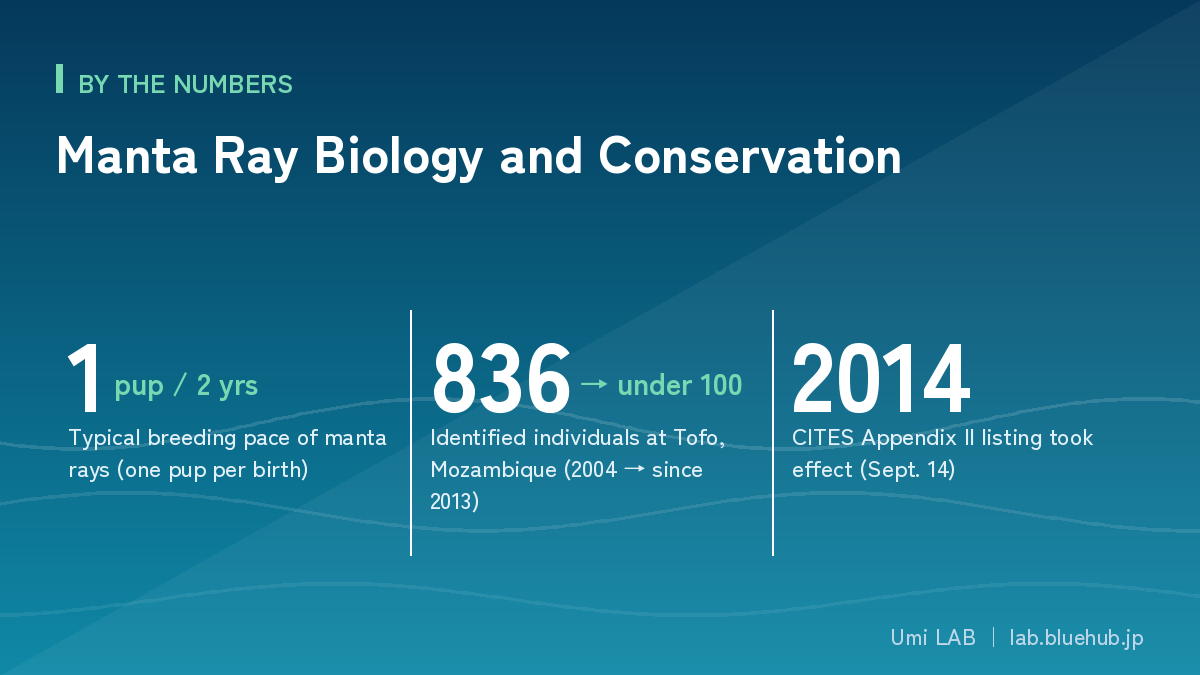
Manta reproduction is extremely slow for a fish. Research on reef manta rays describes their low fecundity as “one pup per two years.” A female basically gives birth to one pup at a time, and not every year. This is the opposite of the usual fish strategy of laying many eggs and letting a few survive.
A 2023 paper in Frontiers in Marine Science estimates the median population growth rate (rmax) of manta rays at 0.116 per year, among the lowest of the 106 elasmobranch (shark and ray) species assessed. Once numbers fall, recovery takes a very long time.
| Trait | Manta rays | Most fish |
|---|---|---|
| Young per birth | Basically one | Thousands to millions of eggs |
| Breeding interval | About one pup per two years | Every year or several times a year |
| Lifespan | Thought to be 40–50 years (needs study) | Several to a dozen or so years |
| Recovery speed | Very slow | Relatively fast |
What is happening around the world
Declines have been reported in many regions. According to the same paper, around Tofo in Mozambique the number of identified reef manta rays fell from 836 in 2004 to fewer than 100 since 2013. A reported 88% drop in sightings between 2003 and 2011 has also been noted.
In KwaZulu-Natal, South Africa, mantas caught in shark-protection nets for bathers died at an average of 13 confirmed per year, peaking at 38 in 2001. Long-term catch records show that manta catches have declined significantly since the late 1990s.
Note
- These figures come from specific sea areas and do not directly give the global population. They still show an important point: when many animals are lost in one place, recovery can take decades.
Four Threats to Manta Rays
1. Fishing: targeted catch and bycatch
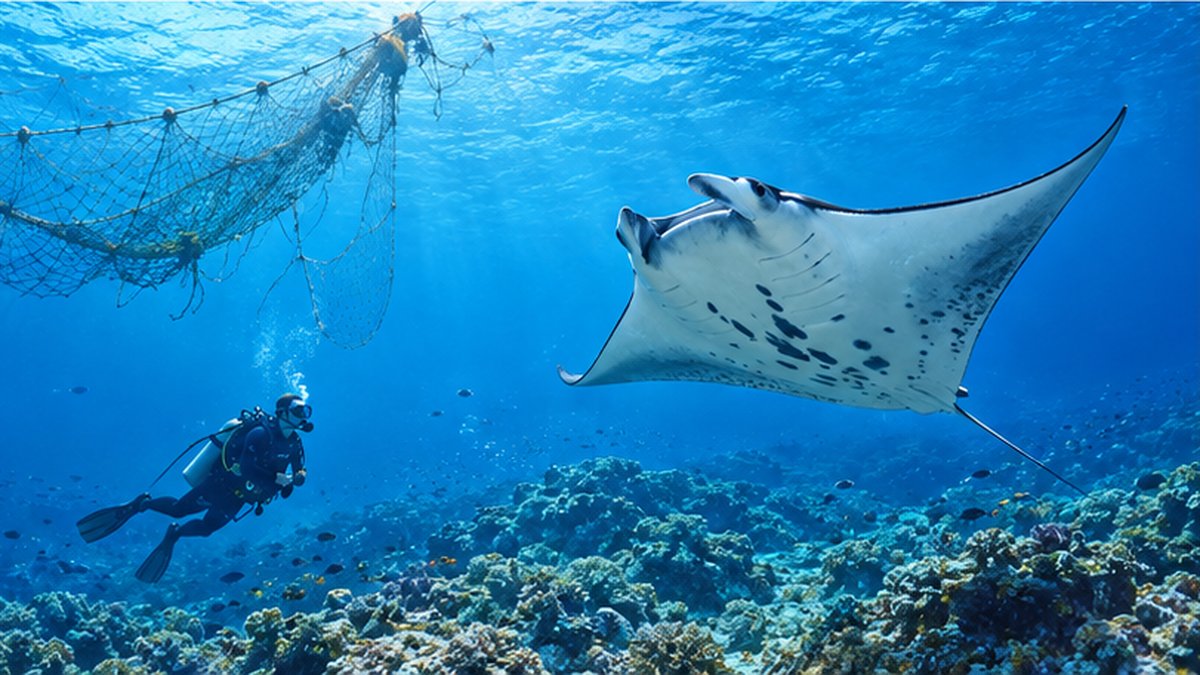
Fishing is the biggest threat. Mantas are caught for meat and for gill plates (the organs that filter plankton), and also die as bycatch in nets. Gill plates are traded in some countries for supposed medicinal uses, and this international demand is cited as a background to the declines. A similar pattern is seen in fishing for shark fins (see Shark Finning: The Reality of Overfishing).
2. Climate change and reef degradation
Reef manta rays depend on coral reefs and plankton-rich waters nearby. Coral bleaching from warming seas and shifts in plankton change their habitat itself. For the reefs of Yaeyama, see also Protecting the Coral Reefs of Okinawa and the Nansei Islands.
3. Injuries from boats and fishing gear
Research around Ningaloo in Western Australia lists, besides coastal development and tourism, injuries from boat propellers and fishing gear. Because mantas swim leisurely in shallow water, they can easily be hit by boats or tangled in line and nets.
4. Impacts of tourism
As visitor numbers grow, so do concerns about effects on manta behavior. Chasing, touching or blocking their path stresses them and may keep them from visiting the cleaning station. Whether tourism helps or harms conservation depends on how the rules are run.
International Protection Frameworks
CITES (Washington Convention)
In March 2013, the CITES Conference of the Parties decided to list both manta species (then Manta birostris and M. alfredi) in Appendix II. The rule took effect on September 14, 2014. Appendix II species cannot be traded internationally without an export permit. Because exporters must show that trade does not threaten the species, the listing is expected to curb international trade in gill plates and other products.
Convention on Migratory Species (CMS)
Under the CMS (Bonn Convention), which protects animals that cross borders, the oceanic manta ray was reported to have been listed in Appendices I and II at the 10th Conference of the Parties in 2011. Fiji and others have also proposed listing the reef manta ray.
IUCN Red List
The IUCN Red List is not a legally binding regulation, but it is an important indicator for setting conservation priorities worldwide. As noted above, the oceanic manta ray is Endangered and the reef manta ray is Vulnerable.
| Framework | Subject | Details |
|---|---|---|
| IUCN Red List | Oceanic manta ray | Endangered |
| IUCN Red List | Reef manta ray | Vulnerable |
| CITES | Both manta species | Appendix II listing decided 2013; in force Sept. 14, 2014 |
| CMS | Oceanic manta ray | Listed in Appendices I and II in 2011 |
Note
- International frameworks do not necessarily mean a direct “ban” in fisheries or tourism on the ground. For how Japan treats them domestically, check the latest information from the Ministry of the Environment and local governments.
Photo-ID: Telling Mantas Apart by Their Bellies
How individuals are tracked by photo
Each manta has a unique pattern of dark spots on its underside, like a human fingerprint. Photographing and recording it lets researchers recognize an individual over many years. Photo-identification is said to have started in the mid-1970s and is now a core method in manta research.
Photo-ID accumulates data on when, where and with whom each animal was seen, helping reveal life-history traits such as lifespan, age at maturity, gestation and birth intervals. A 2013 study by O'Malley and colleagues named the Yaeyama Islands as one of the world's important manta tourism sites.
Mantas that keep coming back
In research at Ningaloo, Western Australia, more than 1,100 reef manta rays were identified from about 5,000 sightings. About 10% of them visited the same marine park for over ten years, and some for up to about 15 years. A 2019 study by Perryman and colleagues showed that mantas repeatedly use particular cleaning stations, and that social relationships with other individuals may be involved.
The fact that the same animals visit the same place for years also means that damage to that place has a large impact. That is why viewing rules matter.
Surveys citizens can join
In Ishigaki, the Japan Manta Project is reported to run a citizen-science effort that collects sighting reports and photos from divers, with a system for submitting them via LINE. Photos divers take anyway become valuable research data.
What you can do
- Share photos of the manta's underside along with the date and place. Check the survey group's official guidance for current submission methods.
The Role of Japan's Aquariums
The world's first birth in captivity
In June 2007, Okinawa Churaumi Aquarium announced a manta ray birth in captivity. According to AFP, the pup was a female with a disc width of about 1.9 m, and the parents' mating had been confirmed more than a year earlier. The pup swam with its parents in the large tank right after birth. It is said to be the world's first captive manta birth.
In October 2017, the online edition of the journal BMC Zoology reported that a captive-raised male had matured and mated with a female in the same enclosure. Because manta reproduction and growth are hard to observe in the wild, aquarium findings help conservation too.
Why aquarium research supports conservation
- Growth rates and breeding behavior hard to confirm in the wild can be observed continuously
- Health and behavior can be recorded in detail and used to interpret wild animals
- Exhibits and commentary tell visitors that mantas are in a precarious situation
Captive breeding alone cannot directly stop declines in wild populations. What matters is combining conservation at sea with communication of research results.
Rules for Watching Mantas in Ishigaki
Basic rules
PADI blog articles and others introduce the following manners for Ishigaki. Details may differ between operators, so always check the briefing from the shop you join.
- Do not touch, chase or block the path of mantas
- Do not get too close to the cleaning station; watch from designated spots
- Keep neutral buoyancy and do not touch corals or the seabed
- Avoid crowded times, use other points, and respect the decision to skip a day
Boat operations
Boats are also asked to follow procedures and waiting methods so that they do not concentrate on one point. Local dive operators are working to set common rules and explain them to divers beforehand.
Why “keep your distance” matters
- If mantas leave the cleaning station, they cannot get rid of parasites, which may affect their health. Quiet watching by visitors ends up protecting the environment where you can meet them.
What divers can do themselves
Improving buoyancy control protects not only mantas but the whole reef. Courses such as PADI Peak Performance Buoyancy can help. For tips on enjoying reefs while protecting them, see Etiquette for Enjoying Okinawa's Coral Reefs.
Balancing Tourism and Conservation
Thinking about sustainable tourism
Manta tourism brings large economic benefits to the region. But too many visitors can drive mantas away. The key is to set limits on “how many are shown,” “how close people get” and “how often.” This is a common challenge for reef tourism in general (see Sustainable Ocean Tourism: Travel That Protects Coral).
Cooperation among locals, researchers and travelers
As the PADI article describes, operators share daily records of manta appearances and ocean conditions with researchers, and travelers provide photos and sighting reports. This cooperation is the foundation of conservation. Rather than one person doing everything, each of the three parties adding small actions is the realistic way to protect animals that live for decades.
Summary
- Reef manta rays seen at Ishigaki are Vulnerable on the IUCN list, and the related oceanic manta ray is Endangered. They breed slowly and recover poorly. Protection frameworks such as CITES are in place, and photo-ID and citizen science support conservation. When viewing, do not touch, chase or crowd them.
- Manta tourism rests on their habit of returning
- Following the rules preserves a future in which we can meet mantas
- Sharing photos and sightings lets you take part in conservation
References and Sources
- IUCN Red List of Threatened Species – assessments of Mobula alfredi and Mobula birostris
- CITES – Appendix II listing of manta rays (decided 2013, in force 2014)
- CMS – conservation of sharks and rays
- Frontiers in Marine Science (2023) paper on manta populations – Tofo decline, rmax, bycatch data
- Frontiers news: reef manta rays make long-term use of marine protected areas – Ningaloo photo-ID and satellite tagging
- PADI Japan: Ishigaki mantas, tourism and conservation – photo-ID, viewing rules, Japan Manta Project
- AFPBB News: manta birth in captivity (2007) – announcement by Okinawa Churaumi Aquarium
- Okinawa Churaumi Aquarium – manta keeping and research
- Manta Trust – international manta research and conservation group
* Ordered by reliability: government and academic bodies > peer-reviewed papers > specialist organizations > reliable media