⚡ In short
Some 6,305 species have been recorded in Japan's rice paddies and their surroundings. Frogs, loaches, giant water bugs — this article explains the role the paddy plays as a wetland built by human hands, the decline of its wildlife as paddy area shrinks to about two-thirds of its 1969 peak, and the front line of recovery through paddy fishways and winter flooding.
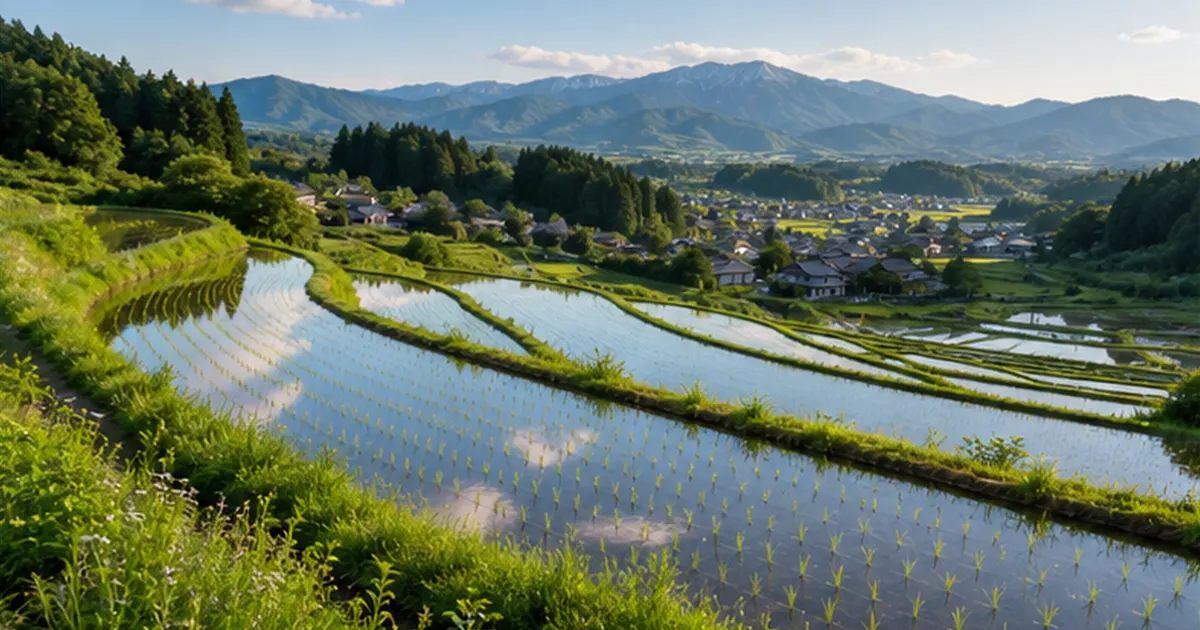
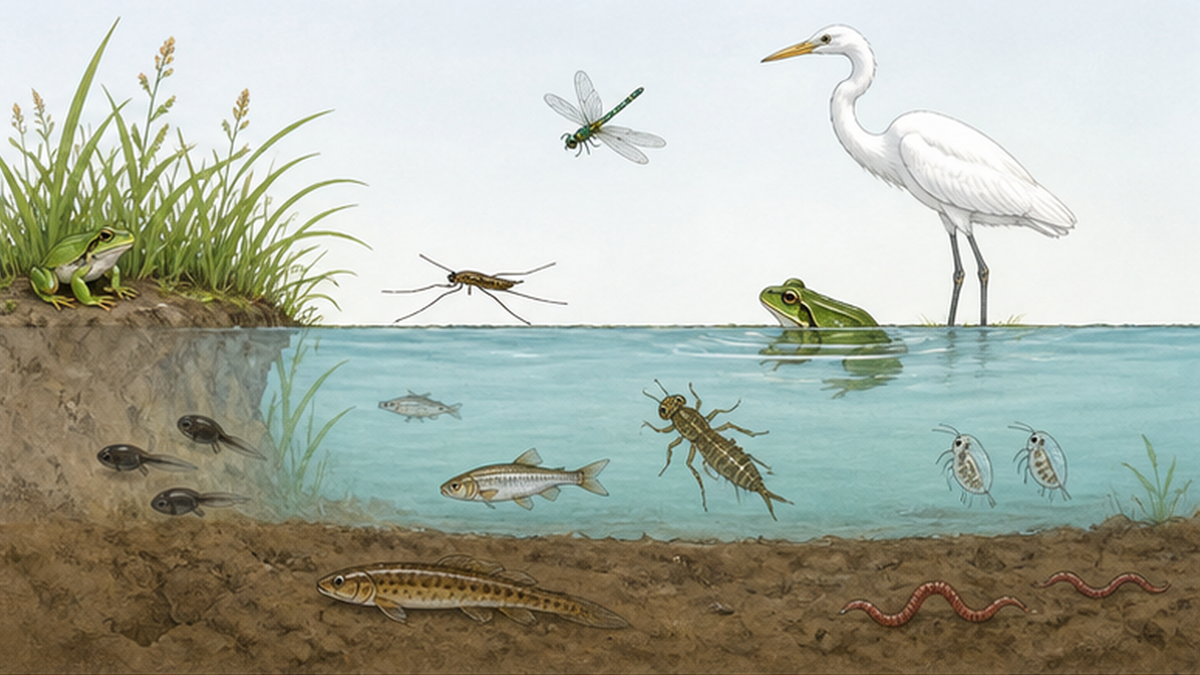
Stand on a paddy path at dusk in early summer and the chorus of frogs is loud enough to hurt your ears. Look into the shallow water at your feet and tadpoles stir up the mud, water striders skate across the surface, and dragonfly nymphs lie still in the silt. Many people have taken this scene for granted as ordinary countryside. Scientifically, though, a rice paddy is a vast wetland, rebuilt by human hands every single year — something rare anywhere in the world, and one of the most important ecosystems underpinning Japan's biodiversity.
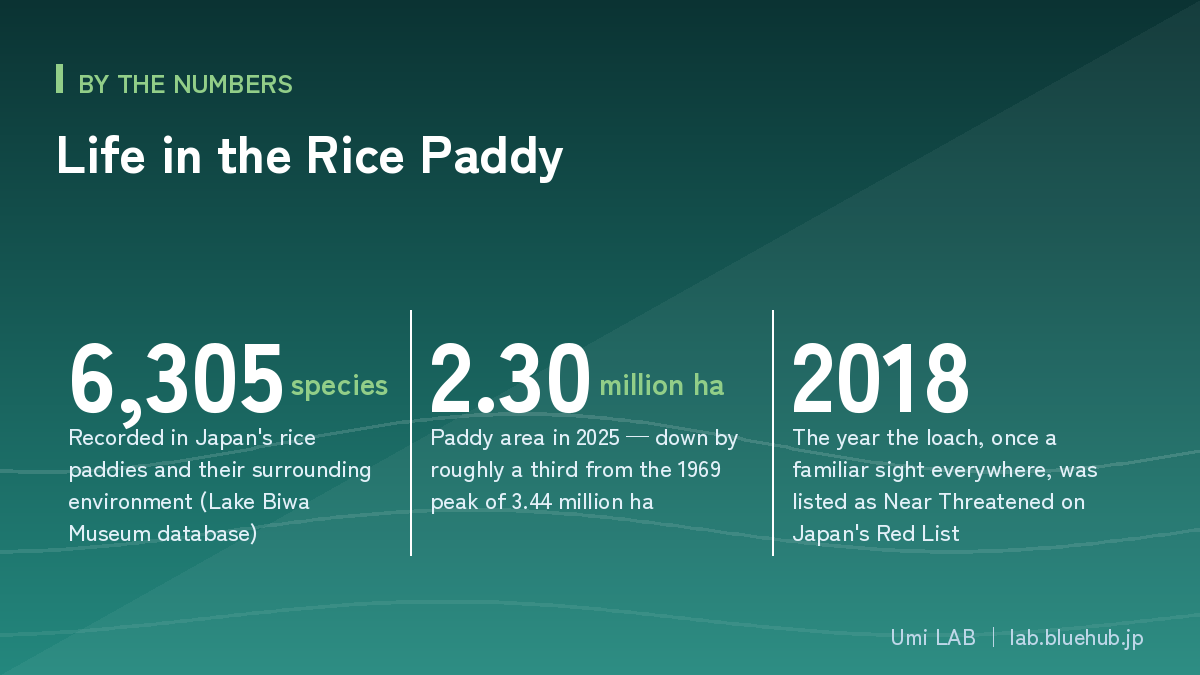
The "Complete Species Database of Rice Paddy Life" published by the Lake Biwa Museum in Shiga Prefecture lists 6,305 species found in Japan's rice paddies and their surrounding environment. Fish, frogs, aquatic insects, molluscs, water plants and organisms too small to see are all counted. That much life is concentrated in paddies covering only about 6% of the country's land area.
Yet paddy wildlife is quietly disappearing. Paddy area peaked in 1969 at 3.441 million hectares and has fallen ever since, reaching 2.30 million hectares in 2025. The loach, once found everywhere, was listed as Near Threatened on Japan's Red List in 2018; the medaka is listed as Vulnerable. This article unpacks how the paddy works as a wetland from the point of view of the creatures living in it — why they declined, and how they can be brought back — working from primary sources throughout.
What you will learn
- Why rice paddies are internationally recognised as man-made wetlands, and what the Ramsar Convention's rice paddy resolution actually says
- How frogs, loaches, medaka, giant water bugs and dragonflies use the paddy's rhythm of water to complete their life cycles
- How shrinking paddy area, drainage improvement and the separation of irrigation and drainage channels severed the pathways wildlife depends on
- How pesticides applied in paddies can reach fish in estuaries and inner bays (the Lake Shinji eel and pond smelt study)
- Concrete methods for bringing wildlife back — paddy fishways, winter flooding, delayed mid-season drainage and stork-friendly farming
- How to think about the trade-off between climate action (methane cuts through longer mid-season drainage) and biodiversity conservation
The Paddy as a Wetland Built by People — a Watery Ecosystem Holding 6,305 Species
Seen only as farmland, a rice paddy looks like a factory for producing rice. Seen ecologically, it is a seasonal (temporary) wetland in which shallow water a few to a dozen or so centimetres deep appears simultaneously across the country from spring into summer. In Japan, where natural wetlands have largely been lost to land reclamation and river engineering, these artificial shallows have served as a last refuge for wetland-dependent species.
Shallow, warm, hard for large predatory fish to enter, and flooded with sunlight that lets algae and plankton multiply explosively — no better conditions exist for frog spawning, for crucian carp and loach reproduction, or for dragonfly nymphs to grow. A paddy is a place to grow rice and, at the same time, an incubator that raises an enormous number of small lives in a short window.
International treaties recognise paddies as wetlands too
The view that a rice paddy is a wetland is not a local Japanese claim. In October 2008, at the 10th Conference of the Contracting Parties to the Ramsar Convention in Changwon, South Korea, Resolution X.31, "Enhancing biodiversity in rice paddies as wetland systems" (the rice paddy resolution), jointly proposed by Japan and South Korea, was adopted. Under Ramsar's wetland classification, paddies fall under "human-made wetlands / Type 3 irrigated land (including irrigation channels and rice fields)", and where the criteria are met they can even be registered as wetlands of international importance.
In 2010 the 10th Conference of the Parties to the Convention on Biological Diversity, held in Nagoya, welcomed the Ramsar rice paddy resolution and decided to call on its parties to implement it. In other words, the position that protecting paddy wildlife is part of an international commitment was already shared more than a decade ago.
Where does the figure of 6,305 species come from?
The 6,305 figure cited at the outset comes from the "Complete Species Database of Rice Paddy Life", published in November 2020 by the Lake Biwa Museum, which built on and digitised the Revised Complete Species List of Rice Paddy Life edited by Keiji Kiritani (2010). Twenty-five fields including scientific name, Japanese name, habitat and diet (host) are published, searchable by taxon or free keyword. It is the product of collaborative research involving some 60 contributors.
View this databaseComplete Species Database of Rice Paddy Life (Lake Biwa Museum, Shiga)A public database of the 6,305 species found in Japan's rice paddies and their surroundings, searchable across 25 fields including scientific name, habitat and diet.🔗 biwahaku.jpThe Ministry of Agriculture, Forestry and Fisheries also worked with the Ministry of the Environment to run a nationwide "paddy wildlife survey" from fiscal 2001 to 2009, recording what lived in paddies, channels and irrigation ponds with the cooperation of farmers and local residents. A defining feature of that effort was that the people who actually till the fields, and children from the surrounding communities, were the main surveyors — not only researchers.
The idea of "secondary nature"
Discussions of paddy biodiversity often invoke the term "secondary nature": nature that is not pristine, but maintained by repeated human intervention. Coppiced woodland in the satoyama, irrigation ponds, regularly mown grassland and rice paddies are the classic examples. A substantial share of Japan's threatened species is known to depend on this kind of secondary nature.
Here lies a twist that conservation debates often miss. In pristine nature, conservation means not intervening; in secondary nature, the reverse is true — degradation sets in when people stop intervening. A field that is no longer cultivated and no longer flooded turns within a few years from dry grassland into scrub, and its aquatic life vanishes. Protecting paddy wildlife is therefore almost synonymous with continuing to farm the paddy.
That, in turn, cannot be separated from the economics of whether anyone is left to farm and whether the rice sells. It is why biodiversity debates overlap so closely with agricultural policy and the question of who will keep working the land.
Four qualities that make a paddy an excellent wetland
- Shallow: at a few to a dozen or so centimetres deep, sunlight reaches the bottom and algae and plankton multiply quickly
- Warm: water temperature rises readily from spring into early summer, so cold-blooded animals grow fast
- Extensive: about 2.3 million hectares are distributed across Japan, giving each community a contiguous block of habitat
- Renewed annually: tillage and flooding reset the system every year, creating openings for pioneer water plants and aquatic insects
The Yearly Rhythm of Water That Raises the Paddy's Wildlife
The key to understanding paddy wildlife is that the farming calendar doubles as the ecological calendar. When water goes in and when it is drained — each of those decisions determines life or death for hundreds of species living there. Unlike a natural wetland, a paddy is a wetland whose water level is entirely controlled by people.
Puddling to transplanting: shallow water appearing all at once
From April to June, water is drawn into dry fields and the mud is churned during puddling. At that moment dormant eggs and seeds wake, and loaches, crucian carp and catfish try to move up from the channels into the paddy to spawn. Frogs lay egg masses at the surface and tadpoles hatch within days. Water fleas and midge larvae multiply explosively, small fish and aquatic insects gather to feed on them, and herons drop in to hunt those fish — in a matter of weeks, a food web assembles from nothing.
Mid-season drainage: a sudden drying out
From late June into July, the water is drained and the soil dried — the practice known as mid-season drainage (nakaboshi) — to regulate the rice plants' growth and get oxygen to the roots. It is sound rice-growing technique, but for wildlife it amounts to the lake they live in vanishing overnight. Tadpoles that have not yet grown legs, nymphs not yet ready to emerge, and small fish with nowhere to escape are lost in large numbers at this point.
That is precisely why "how many days to delay mid-season drainage" becomes the single most important management decision for paddy biodiversity. As discussed later, this one point is also where climate policy and biodiversity conservation collide.
From draining to winter: dry fields and fields kept under water
Water is drained before harvest, and the winter field lies dry. In the past, paddies were connected to channels and rivers, so wildlife could move to where water remained and overwinter. In most modern paddies, however, the separation of irrigation and drainage and the resulting drop in level cut off those routes, leaving nowhere to shelter in winter. To compensate, the practice of deliberately keeping fields flooded through winter — fuyumizu-tanbo, or winter flooding — is spreading.
Channels, ponds and levees — the paddy alone is not enough
What is easily overlooked is that the structures around a paddy are part of the ecosystem. Irrigation channels are both a corridor for fish and a refuge when the paddy holds no water. Ponds hold water year-round and act as a source population for aquatic insects and molluscs. Levees are where frogs that have come ashore hide, and the route adults travel when heading to spawn.
For wildlife, in other words, the habitat is not the plot called a paddy but a single landscape of paddy plus channel plus pond plus levee plus surrounding woodland. Protecting only one element has limited effect, and losing any one of them can stop the whole thing working. This is why paddy biodiversity is described as a problem of areas rather than points.
| Period | State of the paddy | What wildlife is doing | What management can do |
|---|---|---|---|
| April–May | Flooding and puddling | Loaches and crucian carp move up from channels; frogs spawn | Install paddy fishways; flood early |
| May–June | Flooded, tillering stage | Tadpoles and nymphs grow fast; aquatic insects breed | Keep water shallow and avoid sudden draining |
| June–July | Mid-season drainage | Pre-metamorphosis individuals and nymphs are easily lost to drying | Delay drainage; leave pools in the furrows |
| July–August | Intermittent irrigation | Dragonflies emerge; frogs come ashore | Avoid extended completely dry spells |
| September–October | Draining and harvest | Aquatic life retreats to channels and ponds | Drain slowly and secure escape routes |
| November–March | Dry field or winter flooding | Whether overwintering sites exist decides next year's numbers | Winter flooding; create deep refuge ditches (e) |
Star Species 1: Frogs — a Chorus That Measures Ecosystem Health
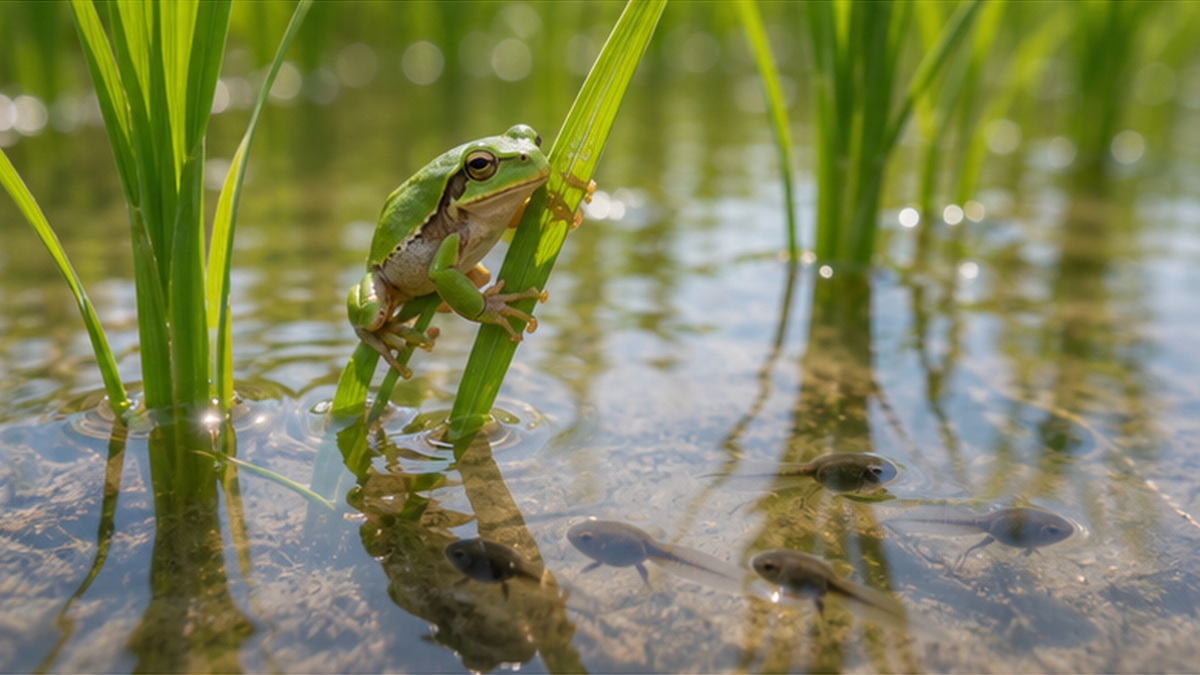
Frogs are the emblematic paddy species. Japan's amphibians depend heavily on paddies and their surroundings, and frogs breeding in paddies act as a bridge between land and water, and between farmland and forest. Tadpoles eat algae and detritus in the water; frogs that come ashore consume large numbers of insects, pests included; and the frogs themselves feed snakes, herons, crested ibises and storks. They sit at the centre of the food web, a knot tying it together.
Tree frogs, black-spotted pond frogs and Daruma pond frogs
The most familiar species, the Japanese tree frog, perches on levee grass and rice leaves, changing colour as it goes. The black-spotted pond frog is a medium-to-large species holding territory in paddies and nearby channels; once common in fields nationwide, it has been reported in decline in many regions and is listed as Near Threatened on Japan's Red List. The closely related Nagoya Daruma pond frog is in worse shape still, placed in a higher category of extinction risk.
The shared causes of decline are the concreting and drying of levees through land improvement, earlier and longer mid-season drainage, and the loss of surrounding wetlands and ponds. Because frogs move between water and land across their life cycle, they need both water to breed in and grassy cover to hide in once ashore. Lose either one and the population cannot persist.
When frogs decline, herons and storks suffer too
The decline of frogs does not stop with frogs. Large waterbirds depend on the paddy's animal prey — frogs, loaches, aquatic insects — so when a paddy's productivity falls, the bird life resting on top of it cannot be sustained either. This is exactly why reintroducing storks and crested ibises in Japan has never been a matter of releasing birds alone, but has always come paired with a change in farming practice itself.
Frogs are also unpaid pest-control workers
The value of frogs is not merely scenic or sentimental. Adult frogs are insectivores, routinely preying on planthoppers, leafhoppers and adult moths that appear in and around paddies. The intake of any single frog is small, but where numbers per unit area are high, the predation pressure of the population as a whole is far from negligible. The idea that a paddy with a thick layer of predators — frogs, spiders, dragonflies — is less prone to pest outbreaks is widely shared among practitioners of environmentally friendly farming.
Put the other way round, using insecticides that also wipe out the prey base, or managing water in a way that halts the frogs' generational turnover, means giving up that free pest-control service. Consideration for wildlife is a cost to farming, but it is also an investment that puts ecological processes on the farmer's side.
A frog chorus is free environmental monitoring
- Calls differ by species, so presence or absence can be roughly judged by ear alone
- When and where they call is tied directly to breeding, so it responds sensitively to changes in water management
- Local schools and residents can take part easily, making long-term records feasible
- Recording the same paddy over several years reveals the effect of a change in farming practice
Star Species 2: Loaches and Medaka — Fish That Spawn in the Field
Some may be surprised to hear that there are fish in a rice paddy. Yet loaches, crucian carp, catfish, field gudgeon and common carp all follow a life cycle in which they move from channels into the paddy from spring into early summer, spawn there, raise their fry and return to the channels. For them the paddy is a time-limited spawning and nursery ground with few predators and abundant food. Research has shown that loaches use paddies not only for breeding but as a habitat throughout the irrigation season.
What it means that the loach became "Near Threatened"
In 2018 the Ministry of the Environment listed the loach as Near Threatened (NT) in its Red List revision. The stated reasons were a contraction of its range centred on paddy country, competition with non-native loaches introduced from abroad, and genetic disturbance through hybridisation with foreign lineages of the same species. That a fish once synonymous with "found everywhere" became a subject of assessment is itself emblematic of how paddy environments have changed.
The same applies to medaka (the southern and northern Japanese ricefish), classified as Vulnerable (VU) on Japan's Red List. Deteriorating water environments, alteration of rural landscapes and predation by non-native fish are cited as the main causes, and in some regions the species has been reported as all but gone from lowland paddy areas.
Being unable to enter the paddy was the decisive blow
What is most often overlooked in the decline of fish is neither water quality nor food but the physical question of whether they can move at all. Land improvement separated irrigation from drainage channels, and drainage channels were dug deep and lined with concrete. As a result a drop of tens of centimetres to more than a metre opened up between the channel water surface and the paddy floor, and fish became physically unable to climb into the field. The spawning ground is right there, and they cannot reach it. This structure is the single biggest reason fish disappeared from paddies.
The stars of the mud — molluscs, crustaceans and sludge worms
Less conspicuous than fish or frogs, the mud of a paddy is packed with the organisms that form the foundation of the ecosystem. Pond snails and blackfly snails eat attached algae and organic matter and clean the water; small crustaceans such as freshwater shrimp, clam shrimp and fairy shrimp are adapted to temporary waters and turn over generations quickly. Sludge worms eat mud and pile their castings at the surface, forming what farmers call the "soft layer", which is said to suppress weed germination and is valued by those practising winter flooding.
These benthic organisms occupy the second tier from the bottom of the food web. If they decline, the fish and birds that eat them decline too. What the Lake Shinji research demonstrated was exactly this sequence of collapse from the bottom up. The reason it is said that assessing a paddy's health means looking at the mud before the larger animals is that this is where change shows up first.
This story about fish bears directly on marine resources. For migratory species moving between fresh water and the sea, paddy, channel, river and estuary form one continuous habitat. Our article on the front line of Japanese eel conservation covers the damage that habitat fragmentation inflicts on stocks. The story of the paddy is also, directly, the story of the estuary and the coast.
Star Species 3: Aquatic Insects — Why Giant Water Bugs and Diving Beetles Vanished
Aquatic insects are the most sensitive indicator group for measuring paddy biodiversity. Many species spend their larval stage in water and fly to other water bodies as adults. Because their survival depends on water bodies being distributed at a certain density, when paddies and ponds disappear patchily, the life cycle itself ceases to work.
The giant water bug: the first species designated under a new category
Japan's largest aquatic bug, the giant water bug (tagame), was designated a Class II Specified Nationally Rare Species of Wild Fauna and Flora from 10 February 2020, banning its sale and its capture for sale. It was the first designation since the category was created, covering three species: the giant water bug, the Tokyo salamander and the golden venus chub. The move followed a run of species at growing risk of extinction among the insects, freshwater fish and amphibians of "secondary nature" such as satoyama landscapes and paddies.
The Class II category is designed to regulate commercial trade without banning ordinary collecting or private keeping. The judgement is that protecting satoyama wildlife requires both habitat conservation and restraint on excessive commercial collection.
View the guidanceGuidance on Conserving the Giant Water Bug (Ministry of the Environment, May 2023)Guidance on the habitat requirements of the giant water bug, designated a Class II Specified Nationally Rare Species, and how to conserve it in paddies and ponds.🔗 env.go.jpDiving beetles lost their earthen banks
A frequently cited reason for the decline of large diving beetles is the concreting of channels. Diving beetle larvae leave the water when grown and burrow into the soil of the bank to pupate. Where the bank becomes vertical concrete, that place to come ashore and pupate is lost, and even if adults fly in, no next generation follows. Not water quality, not food — whether there is an earthen bank decides whether the species persists.
Dragonflies: paddies are Japan's largest nursery for nymphs
Many dragonflies, the autumn darter among them, lay eggs in paddies, grow in the water as nymphs, emerge in early summer and move to the hills. The richness of Japan's dragonfly fauna has been sustained by the vast shallow water that paddies provide. If mid-season drainage removes the water before nymphs emerge, that year's production is badly damaged. Conversely, shifting the timing of mid-season drainage by a few days can restore dragonfly numbers — from the wildlife's point of view, a handful of days decides whether a generation succeeds.
What is happening when aquatic insects decline
- Water bodies shift from scattered to isolated, so insects that fly in cannot settle (habitat fragmentation)
- Concrete banks eliminate places to come ashore, pupate and lay eggs (loss of micro-habitat)
- Mid-season drainage or early draining removes the water before emergence (mistimed management)
- Pesticides reduce the small aquatic organisms they feed on, and the predators disappear first (a collapsing food web)
Why the Wildlife Declined — Three Pressures of Area, Structure and Chemicals
The decline of paddy wildlife cannot be explained by any single cause. Broadly, three pressures have operated at once: the shrinking area of paddies themselves, changes in paddy structure, and the effects of chemicals.
1. Area: from 3.44 million to 2.30 million hectares
According to the Ministry of Agriculture, Forestry and Fisheries' arable land statistics, Japan's paddy area peaked in 1969 at 3.441 million hectares and has declined since, reaching 2.405 million hectares in 2018 (69.9% of the peak) and 2.30 million hectares as of 15 July 2025. In the single year to 2025, 19,000 hectares (0.8%) were lost. The main drivers are conversion to upland fields under rice production adjustment, conversion to residential and other uses, and degradation through abandonment.
Shrinking area means more to wildlife than simply less room. Once wetlands remain only as scattered isolated fragments, a local extinction is no longer made good by individuals arriving from nearby, and regional populations fall like dominoes.
2. Structure: drying and channel separation severed the pathways
Postwar land improvement dramatically raised the efficiency of farm work. Plots became large and rectangular, drainage was improved so heavy machinery could enter, and channels were lined with concrete. In productivity terms it was a major success. From the ecosystem's side, however, it was a decisive change: the year-round damp "wet paddy" disappeared, and the continuity linking channel and field was lost. Fish cannot climb in, frogs cannot overwinter, aquatic insects cannot pupate.
3. Chemicals: the chain from paddy to estuary revealed at Lake Shinji
The third pressure is chemical. A research team led by Masumi Yamamuro of the University of Tokyo analysed long-term data from Lake Shinji in Shimane Prefecture and published the results in Science in November 2019. Large benthic animals on the lake bed, such as the midge Chironomus plumosus, collapsed in 1993 — matching the period when neonicotinoid insecticides are thought to have first come into use in Japan. Immediately afterwards, catches of eel and pond smelt, which fed on those benthic animals, collapsed as well.
Neonicotinoid insecticides act selectively on insects, are water-soluble and break down slowly. The study indicated that compounds applied in paddies could flow through channels into the lake and reduce fishery resources indirectly — not by killing the fish, but by eliminating what they ate.
View the researchInsecticides emerge as a factor in the decline of eel and pond smelt (University of Tokyo)Press release on the Science paper showing that eel catches in Lake Shinji collapsed as neonicotinoid insecticides came into use.🔗 k.u-tokyo.ac.jpThis research covers a single lake, and debate continues over how far the magnitude of the effect can be generalised. But the basic picture — substances used on land travelling down the water system into a different ecosystem — is exactly the same as with plastics or nutrients.
Abandonment is a pressure too
Loss of area includes not only changes of use such as conversion to housing but abandonment, where land ceases to be farmed and degrades. Terraced fields in hilly and mountainous areas, hard for machinery to reach and low in efficiency, are the most likely to be abandoned — yet those are exactly the paddies most often flanked by woodland and spring water, and the most valuable for wildlife. Here lies the paradox that the paddies most important for biodiversity are the hardest to keep economically viable.
An abandoned field dries within a few years, is overtaken by reeds and goldenrod, and eventually invaded by shrubs. Its function as a water body is essentially gone. Given the nature of "secondary nature" described earlier, this is less a return to the wild than the quiet disappearance of an ecosystem type. That is why agricultural policy questions — securing farmers, supporting hilly and mountainous areas — are biodiversity questions.
| Pressure | What changed | Wildlife most strongly affected |
|---|---|---|
| Shrinking area | 3.44 million ha in 1969 to 2.30 million ha in 2025; abandonment and conversion | Waterbirds needing large water bodies; species with poor dispersal |
| Drying of fields | Loss of wet paddies; no water at all in winter | Loaches, frogs, molluscs, overwintering aquatic insects |
| Channel separation and drops in level | Movement between channel and paddy becomes impossible | Crucian carp, catfish, loaches and other fish that move up to spawn |
| Concrete bank protection | Loss of earthen banks and shallows | Diving beetles, dragonflies, emergent plants |
| Longer mid-season drainage | Drying before metamorphosis and emergence | Tadpoles and dragonfly nymphs |
| Pesticides | Fewer prey organisms and runoff into the water system | Aquatic insects, and the fish and birds that eat them |
Paddies and the Sea Are Connected — Farmland as the Uppermost Wetland
This is why an ocean-focused site takes up rice paddies. A paddy is a vast shallow water body spread across the very top of a water system, and what happens there reaches the estuary and the coast without fail, via channels and rivers. Seen from the sea, a paddy is the wetland furthest upstream.
Water always heads for the sea
Water flowing out of a paddy carries nutrients, sediment, organic matter and chemicals including pesticides. Moderate nutrient loads support coastal primary production; excess causes red tides and hypoxic water masses; and too little — as in the Seto Inland Sea in recent years — causes nori seaweed to lose colour and catches to fall. Managing water on land is also managing coastal productivity. The idea that systematises this thinking is the concept of satoumi, which we cover elsewhere on this site.
For migratory species it is all one habitat
For creatures that move between fresh water and the sea — eels, mitten crabs, ayu, gobies — paddy, channel, river and estuary form one seamless habitat. If channels are fragmented by drops in level, their range narrows accordingly. Improving weirs and drop structures, and installing paddy fishways, is a matter of farmland and of coastal fish stocks at the same time.
Nor is it only water and nutrients that travel from land to sea. Litter takes the same route. As covered in our article on plastic waste flowing from rivers to the sea, the main battleground for marine litter is on land. Paddy wildlife, river water quality and marine debris are not separate problems but one problem, bound together by the unit of the watershed.
A paddy is also a device for slowing water down
Another watershed-scale function of paddies is receiving rainfall and slowing its runoff. Enclosed by levees, a field acts as a temporary storage basin during heavy rain, lowering peak flows downstream. In recent years the "paddy dam" approach — fitting small regulating devices to levee outlets to deliberately increase storage — has spread across the country.
This is usually discussed as flood control, but it matters ecologically too. A sudden surge of water sweeps away channel life and carries sediment and turbidity to the estuary in one go. Slowing the flow creates gentler conditions both for the wildlife inside the paddy and for the tidal flats and seagrass beds at the river mouth. What is called the multifunctionality of paddies is a bundle in which disaster prevention, biodiversity, landscape and culture are all intertwined.
Three flows that link the watershed
- Water: the timing of flooding and draining affects river flow and salinity conditions at the estuary
- Substances: nutrients, sediment and pesticides reach the coast through channels
- Wildlife: migratory fish and aquatic insects travel along channels, and fragmentation stops the traffic
Bringing Wildlife Back — Fishways, Winter Flooding and Wildlife-Friendly Farming
The account so far has been one of decline, but there is an encouraging side to paddy biodiversity: change the management and wildlife returns comparatively quickly. Restoring a natural wetland can take decades; because a paddy is a wetland rebuilt every year, changing next year's water management changes next year's wildlife.
Paddy fishways: small steps over the drop
A paddy fishway is a simple structure that turns the drop between a drainage channel and a field, created by land improvement, into a gradient and flow velocity that fish can climb. Low-cost designs that local farmers can build themselves are widely practised — PVC pipe fitted with baffles, corrugated pipe, or concrete blocks arranged as steps. The Ministry of Agriculture, Forestry and Fisheries publishes the thinking and case studies as "A Guide to Building Paddy Fishways".
See how to build oneA Guide to Building Paddy Fishways (Ministry of Agriculture, Forestry and Fisheries)The ministry's explanation of the thinking, structures and case studies behind paddy fishways, which let fish cross the drop between channel and field.🔗 maff.go.jpThe ministry describes the purpose of a paddy fishway as "conserving freshwater fish that use paddies for spawning and growth", and states that installing one is effective for the upstream movement of loaches, catfish, field gudgeon, crucian carp and common carp from channel into field, and for their descent from field back into channel. What matters is that this is not major civil engineering but a measure at a scale a village can install through joint work, reconnecting a severed fish highway. Data on which fish use them, and how much, is still being accumulated region by region.
Winter flooding and delayed drainage: extending the period with water
Winter flooding (fuyumizu-tanbo) keeps water in the field through the winter after harvest. It provides refuge for overwintering aquatic life, serves as feeding and resting habitat for migratory birds, and is said to build a soft surface layer through the activity of sludge worms that helps suppress weeds. Delayed mid-season drainage means waiting until tadpole metamorphosis and dragonfly emergence are largely complete before starting to drain — easy to adopt, because it raises survival rates without greatly altering farm operations.
Stork-friendly farming and "the village where the ibis lives"
The leading example of wildlife-friendly farming established as a brand is stork-friendly farming in Toyooka, Hyogo Prefecture. The city has practised it since fiscal 2003. Its defining feature is thorough water management: winter flooding, keeping water in the field through winter, and early flooding, filling the field a month before transplanting, together maintain water in the paddy almost year-round. The creatures storks feed on are thus raised along with the crop, and the rice is marketed as a brand.
See this initiativeStork-Friendly Farming (Toyooka City, Hyogo Prefecture)The city's official account of the method that keeps water in the paddy almost year-round through winter and early flooding, raising the rice together with the creatures storks feed on.🔗 city.toyooka.lg.jpIn Sado, Niigata Prefecture, the "Village Where the Crested Ibis Lives" certification scheme was launched in 2007 alongside the reintroduction of the crested ibis, and paddy habitat was improved to provide feeding grounds ahead of the 2008 release. A distinctive feature of the scheme is that every certified producer is required to survey paddy wildlife twice a year. Because farmers count the creatures in their own fields, environmental change accumulates as data in the producers' own hands. In 2011 Sado was also designated a Globally Important Agricultural Heritage System (GIAHS) by the Food and Agriculture Organization of the United Nations.
See this certified riceCertified rice "The Village Where the Crested Ibis Lives" (Sado City, Niigata)Sado's rice certification scheme, which builds feeding grounds for the crested ibis into its conditions. Every certified producer surveys paddy wildlife twice a year.🔗 city.sado.niigata.jp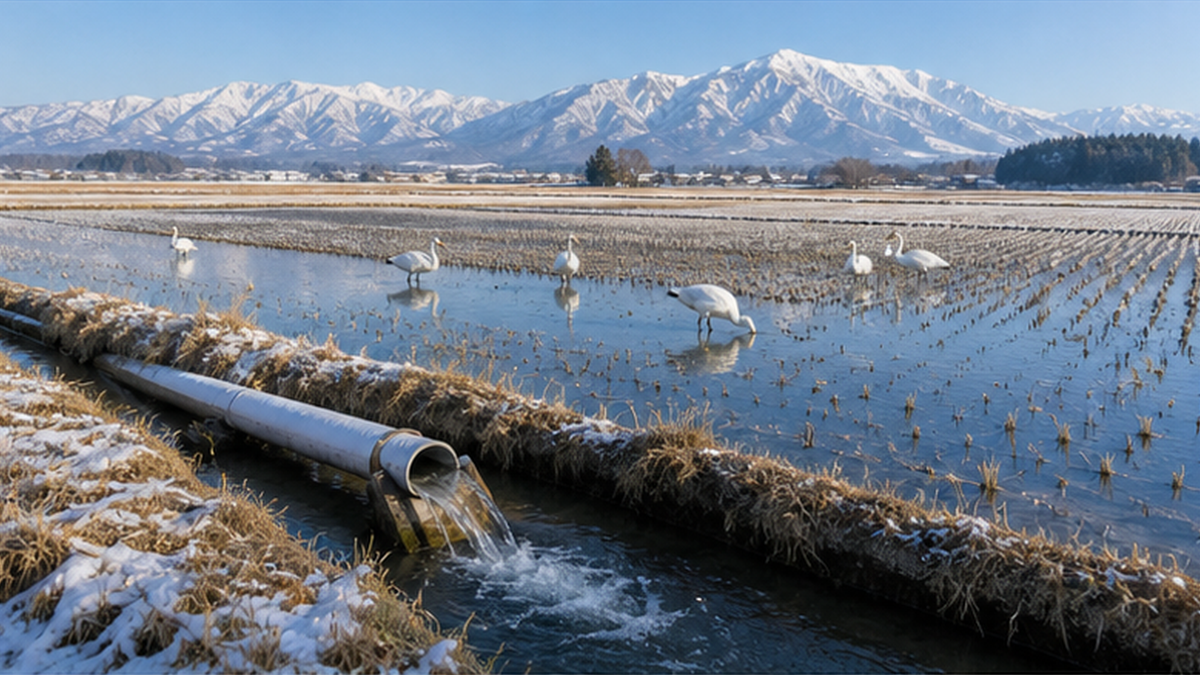
Making it last — support schemes and branding
Wildlife-friendly farming usually means more work on weeding and water management. It may run on enthusiasm for a few years, but reverts once the farmer changes. Not leaving the effort dependent on individual goodwill is the greatest challenge in sustaining paddy biodiversity over the long term.
There are broadly two mechanisms for this. One is public support: Japan has schemes such as direct payments for environmentally friendly agriculture and multifunctionality payments, which support environmentally considerate farming and community-based maintenance of channels and farm roads. Installing paddy fishways, creating refuge ditches and running wildlife surveys are often carried out within this framework of community activity.
The other is valuation through the market. Where branded rice that makes its wildlife credentials explicit — stork-friendly rice, or rice from the village where the ibis lives — sells for more than conventionally grown rice, the extra labour is recovered in the price. That the effort in Toyooka has continued for more than two decades and grown into a recognised producing region is the result of environment and economics meshing. Only when environmental care becomes value rather than a cost borne alone does the area under it expand — a lesson common to all environmentally friendly farming.
| Method | What it involves | Wildlife most likely to recover | Barrier to adoption |
|---|---|---|---|
| Paddy fishway | Install a simple fishway over the drop between drainage channel and field | Loaches, crucian carp, catfish, field gudgeon | Low to medium (installable through community joint work) |
| Winter flooding | Keep water in the field through winter | Overwintering aquatic insects, molluscs, waterbirds | Medium (requires water rights and secured supply) |
| Delayed mid-season drainage | Begin drainage after metamorphosis and emergence | Frogs, dragonflies | Low (only a shift in timing) |
| Refuge ditches (e) | Leave a deeper section in one corner of the field | Anything needing refuge when the field dries | Low to medium |
| Reducing pesticides | Review frequency of application and active ingredients | Aquatic insects and the fish and birds that eat them | Medium to high (balanced against yield and labour) |
| Certification and branding | Reflect wildlife consideration in the price | All of the above (continuity is secured) | High (requires consensus across a producing region) |
The Climate–Biodiversity Trade-Off, and What We Can Do
Finally, a theme currently under the most debate in the field: climate action and biodiversity conservation colliding on the paddy.
Extending drainage and delaying drainage look like opposites
When a paddy stays flooded, the soil turns anaerobic and methane is generated. According to the Ministry of Agriculture, Forestry and Fisheries, methane emissions from paddies account for about 40% of Japan's total methane emissions. This drew attention to mid-season drainage, and in March 2023 "extension of the mid-season drainage period in paddy rice cultivation" (methodology AG-005) was approved under the J-Credit Scheme. Extending mid-season drainage by seven days or more beyond that field's average over the preceding two years or longer is held to cut methane generation by about 30%, and the reduction can be certified and sold as credits. The first project under the methodology was approved in June 2023.
What the biodiversity side has recommended, meanwhile, is delaying the start of mid-season drainage: waiting until tadpoles have come ashore and dragonflies have emerged before draining. Delaying the start and extending the duration are not necessarily the same thing, but a longer period with the field dry is a headwind for aquatic life either way. Citizens' groups and researchers have indeed voiced concern that lengthening drainage in the name of decarbonisation will cost the paddy its wildlife.
How to handle the trade-off
The point is not to cast either side as the villain. Cutting methane has genuine value as climate action, and conserving biodiversity is equally non-negotiable. The key to both lies in designing when and how much to dry the field around the life cycles of its wildlife. Draining outside the peak of emergence and metamorphosis, leaving a deeper refuge ditch in one corner, arranging fields with different flooding periods in a mosaic across a district — such adjustments leave room to retain wildlife without greatly undermining the reduction. Verification is still under way, and the accumulation of local data is what is now needed.
What consumers and citizens can do
The fate of paddy wildlife is not the farmers' problem alone. Wildlife-friendly farming takes more work on weeding and water management, and yields can fall. A structure in which producing regions carry that cost by themselves will not last. Choosing certified rice such as stork-friendly rice or rice from the village where the ibis lives means paying for the wildlife's share of the work. Taking part in a paddy wildlife survey adds to the local data itself.
We cover the broader picture of why Japan's biodiversity is so rich in the biodiversity of Japan's seas, but that richness is not self-contained in the ocean. From mountain to field, field to river, river to sea — it holds only when the whole passage of water is healthy. Whether the chorus in the paddies continues is genuinely tied to whether the richness of the sea continues.
What you can do today
- Record what lives in a nearby paddy through the seasons (calls alone are informative enough)
- Try choosing certified rice that states its wildlife credentials, such as stork-friendly rice or rice from the village where the ibis lives
- Join a local paddy wildlife survey or an environmentally friendly farming event
- Get involved in litter clean-ups along channels and farm ponds (it feeds directly into reducing marine debris downstream)
- Check on a map which river your local paddy water travels down, and which sea it reaches
In summary
- Some 6,305 species are recorded in Japan's paddies and their surroundings, and paddies are classified as man-made wetlands under the Ramsar Convention
- Frogs, loaches, giant water bugs and many other species have built their life cycles around the paddy's rhythm of water
- Paddy area fell from 3.44 million ha in 1969 to 2.30 million ha in 2025, and drying, channel separation and pesticides combined to reduce wildlife
- Paddies and the sea are linked by the water system — as shown by the Lake Shinji study on pesticides affecting estuarine fish
- Management adjustments such as fishways, winter flooding and delayed drainage bring wildlife back comparatively quickly
- The trade-off between methane cuts through extended drainage and biodiversity conservation leaves room for both, depending on the design of water management
References and sources
- Ministry of Agriculture, Forestry and Fisheries – Ecosystem surveys in rural infrastructure improvement (the nationwide paddy wildlife survey, FY2001–2009)
- Lake Biwa Museum, Shiga Prefecture – Complete Species Database of Rice Paddy Life (6,305 species of paddies and their surroundings; published November 2020)
- Ministry of the Environment – Guidance on conserving the giant water bug (May 2023)
- Ministry of the Environment – Japan Red List 2018 supplementary materials (adding the loach as Near Threatened)
- Ministry of Agriculture, Forestry and Fisheries – A Guide to Building Paddy Fishways
- MAFF Chugoku-Shikoku Regional Agricultural Administration Office – Handbook for undertaking paddy fishways (March 2011)
- Ministry of Agriculture, Forestry and Fisheries – Arable land area, 2025 (as of 15 July)
- J-Credit Scheme – Methodology AG-005: extension of the mid-season drainage period in paddy rice cultivation
- Graduate School of Frontier Sciences, the University of Tokyo – Insecticides emerge as a factor in the decline of eel and pond smelt (Science, 2019)
- Toyooka City, Hyogo Prefecture – Stork-friendly farming
* Listed in order of reliability: government and academic institutions > peer-reviewed papers > specialist bodies > trusted media