⚡ The answer in 30 seconds
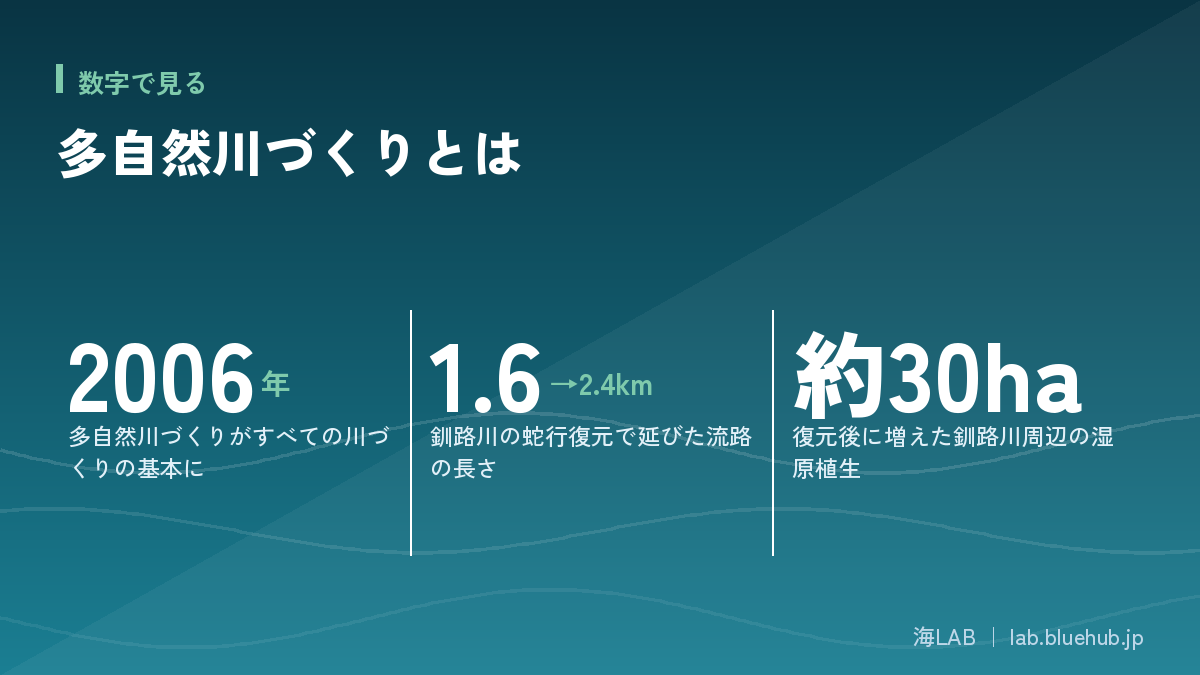
- Nature-oriented river works means river management that conserves and creates habitats and river landscapes with the natural workings of the whole river in view.
- Starting from a 1990 guideline, the 1997 River Act revision made the environment a legal purpose, and in 2006 it became the basis of all river works.
- On the Kushiro River, a straight 1.6 km reach was restored to about 2.4 km of meanders, with recovery of fish, aquatic insects and wetland vegetation reported.
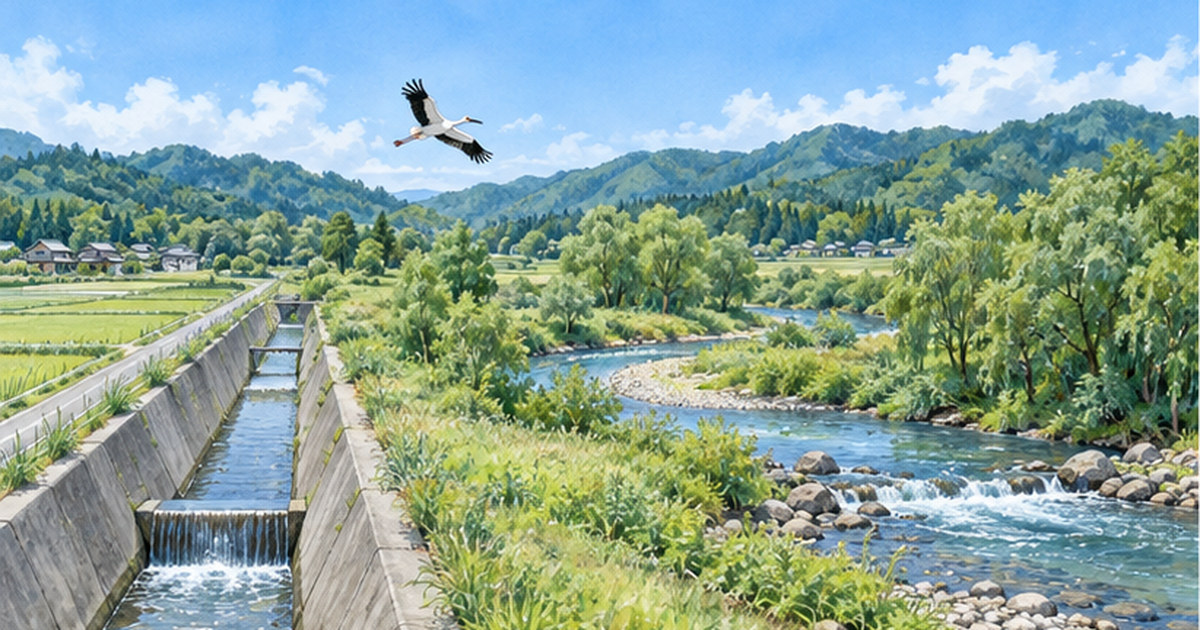
Straight, concrete-lined rivers were built to protect people from floods. But they also took away habitat for river life. How can flood control and the natural environment coexist? Japan's river administration has answered with "nature-oriented river works" (Tashizen Kawazukuri).
This article organizes, from primary sources such as the Ministry of Land, Infrastructure, Transport and Tourism (MLIT), why three-sided concrete lining was questioned, the history from 1990 to 2006 and the 2024 revision, and the cases of meander restoration on the Kushiro River and nature restoration on the Maruyama River.
Rivers are connected to the sea. Changes in river works are linked to estuaries, coastal environments, migratory fish and marine litter.
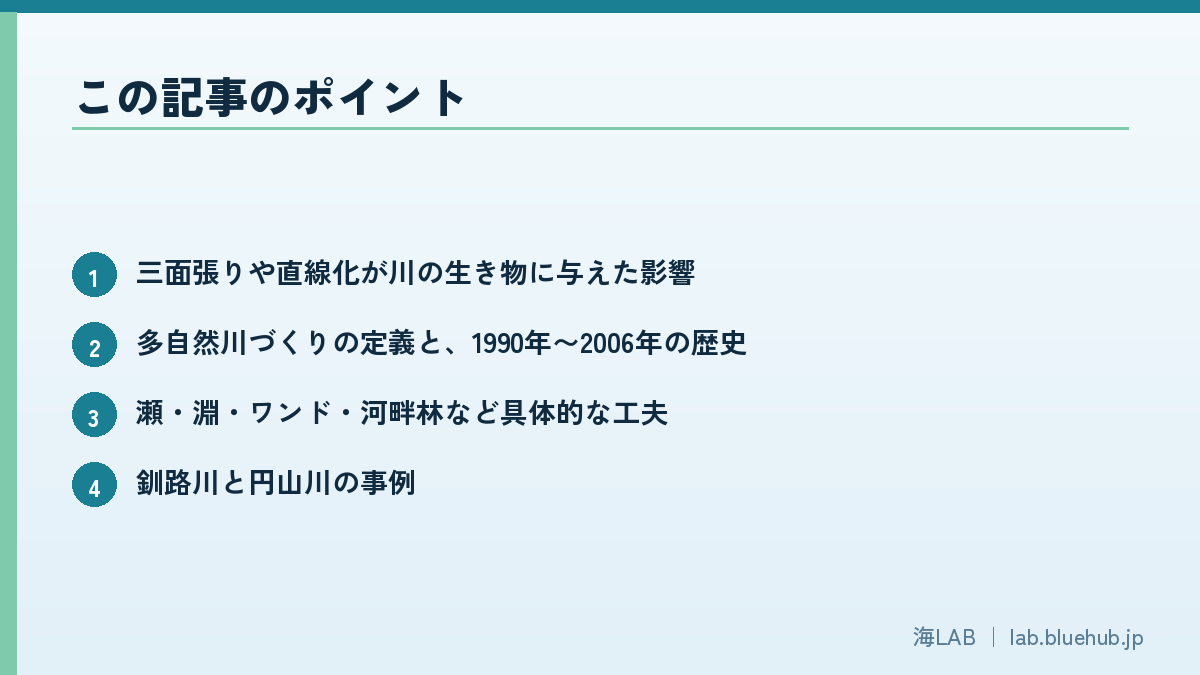
What you will learn
- How concrete lining and straightening affected river life
- The definition of nature-oriented river works and its history from 1990 to 2006
- Concrete measures: riffles, pools, wando, riparian forest
- The Kushiro River and Maruyama River cases
- Why river works connect to the marine environment
- Future challenges and what we can do
Why were straight concrete rivers seen as a problem?
Japan's rivers are known for being steep: the distance from mountains to the sea is short, and water levels rise quickly with rain. To protect low-lying areas where people and assets are concentrated, embankments were built and river courses rerouted repeatedly from the Meiji era onward. Especially during the period of rapid economic growth, three-sided concrete lining of banks and beds, and straightening that removed meanders, spread across the country. From the viewpoint of moving water quickly and safely to the sea, this was a rational choice.
Yet a river is not only a channel for water but also a living space for fish, aquatic insects, birds and plants. In straight concrete channels, variation in flow, bankside plants and underwater refuges tend to disappear. "Nature-oriented river works" grew out of this reflection. This article organizes the shift in Japanese river improvement toward coexistence of flood control and the natural environment, through institutional history, technical points and the Kushiro and Maruyama cases.
What is lost in concrete-lined channels?
In three-sided channels the bed is flat and uniform, so variation in depth and current speed shrinks. Fish use different places: they wait for food in fast water, rest in slow water and flee to deep water. In a uniform channel they cannot do this, and both species richness and numbers tend to fall. With concrete banks, grasses and trees cannot root, and insects falling onto the water and shade are also lost.
- Monotonous flow: uniform depth and speed reduce fish refuges and spawning sites
- Loss of banksides: vegetation and muddy or sandy edges disappear, removing habitat for aquatic insects and amphibians
- Fragmented connectivity: drop structures prevent fish from moving up and down
- Cut-off from groundwater: links between the river and surrounding soil and groundwater weaken
Do flood control and the environment really conflict?
The key point is that this is not about abandoning flood control to bring back nature. Nature-oriented river works keep the basic river function of carrying floodwater safely, and add ingenuity so that the environment for living things is protected as well. Rather than "concrete or nature", the current stance is to choose a design suited to each river and reach.
This chapter's key points
- Three-sided lining and straightening spread for reasons of flood control
- Monotonous channels lose flow variety, banksides and connectivity, making life difficult for river organisms
- Nature-oriented river works aim to combine environmental protection with flood control function
History: from the 1990 guidelines to nationwide rollout in 2006
Nature-oriented river works did not appear suddenly. According to MLIT materials, the origin lies in the 1990 (Heisei 2) implementation guideline for "nature-oriented river works" (Tashizen-gata Kawazukuri) compiled by the then Ministry of Construction. It started as model projects, learning from approaches such as near-natural river engineering in Europe.
1997 River Act revision: "environment" added to the law's purpose
A major turning point was the 1997 (Heisei 9) revision of the River Act. In addition to flood control and water use, "improvement and conservation of the river environment" was placed among the law's purposes; the planning system was split into two stages, the River Improvement Basic Policy and the River Improvement Plan, and procedures to reflect residents' opinions were introduced when drawing up plans. Behind the revision was growing public interest in the relation between river development and the environment, including debate over the Nagara River estuary barrage. After the revision, nature-oriented river works gathered momentum.
Problems emerge: rivers built to a template
As institutions matured and results accumulated, problems also appeared. MLIT's explanations point to river works using uniform standard cross-sections, insufficient consideration of site conditions, and cases where expected effects were not obtained because only some reaches were improved without looking at the river ecosystem as a whole. The word "type" also tended to invite the misunderstanding that fixed methods should simply be applied.
2006 Basic Guideline: dropping "type" and making it the basis of all river works
Reflecting on this, MLIT notified relevant bodies of the "Basic Guideline for Nature-Oriented River Works" in October 2006 (Heisei 18). It is symbolic that "type" was removed from the name. Nature-oriented river works were positioned as the basis of all river works, to be applied at every stage of survey, planning, design, construction and maintenance for all Class A, Class B and quasi-Class rivers, not just for model projects or special reaches. The guideline was revised in June 2024 (Reiwa 6) and continues to be reviewed.
| Year | Event | Meaning |
|---|---|---|
| 1990 (Heisei 2) | Implementation guideline for "nature-oriented river works" | Started as model projects |
| 1997 (Heisei 9) | River Act revision | River environment improvement and conservation added to the purposes |
| 2006 (Heisei 18) | Basic Guideline notified | "Type" dropped; basis of all river works |
| 2024 (Reiwa 6) | Guideline revised | Latest knowledge reflected |
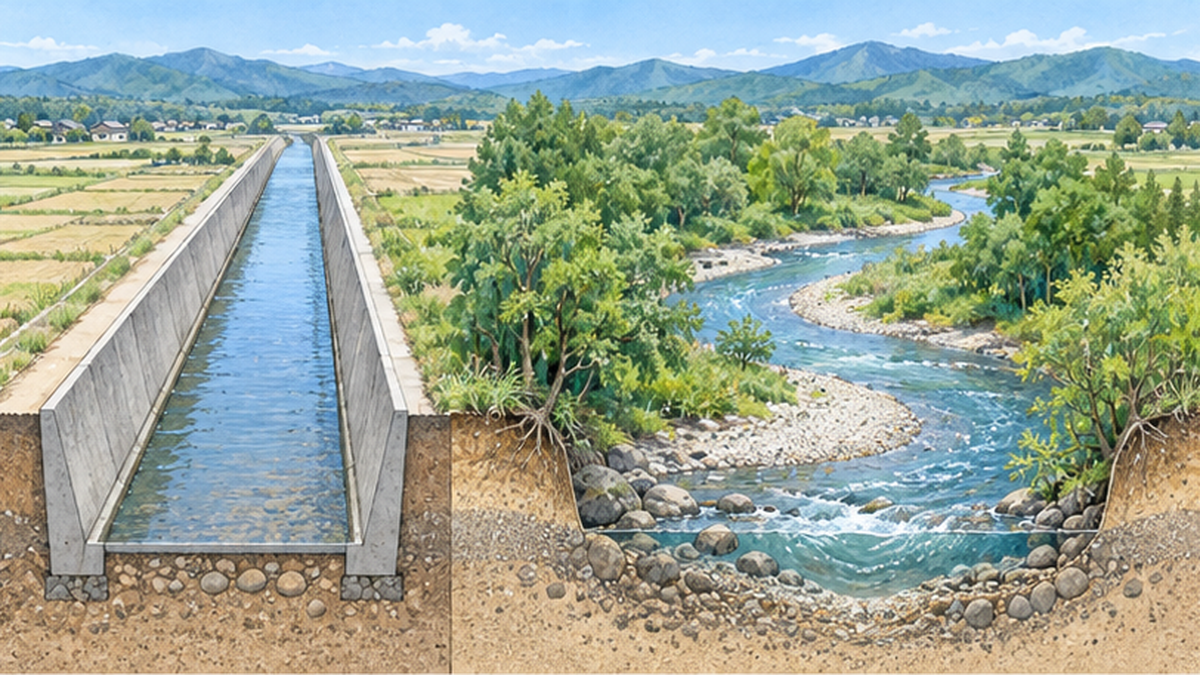
As also discussed in the article on mountain stream ecosystems, river life depends on diversity of flow. Nature-oriented river works try to protect and restore that diversity as far as possible.
The concept: definition and key points
MLIT defines nature-oriented river works as "river management that, with the natural workings of the entire river in view and with consideration for harmony with local life, history and culture, conserves and creates the habitats, growth and breeding environments that rivers originally have, as well as diverse river landscapes." This single sentence contains several important elements.
Looking at "the natural workings of the entire river"
A river is one system connected from upstream to downstream and on to the estuary and sea. Improving only one reach will not bring the expected effect if sediment supply from upstream is cut or a downstream drop blocks fish. River works therefore require a whole-watershed perspective, not a local one. For example, dams and sediment supply are also part of the natural workings connecting rivers and the sea.
"Harmony with local life, history and culture"
Rivers have been tied to local life: festivals, fishing, boat transport, washing places and water play. Considering landscape, access to water and historic revetments is part of nature-oriented river works too. The scope includes restoring the relationship between people and rivers, not only the natural environment.
Conserving the good environment that remains
One of the implementation points shown in MLIT's basic guideline is to conserve as far as possible the good environmental resources that remain, such as riffles and pools, wando and riparian forest. The idea is that not destroying what remains is more efficient, both in cost and ecologically, than rebuilding from scratch.
Riffles, pools and wando
- Riffle: shallow, fast, rippling water; rich in oxygen, used by aquatic insects and for spawning
- Pool: deep, slow water; refuge and resting place for large fish
- Wando: bay-like backwater connected to the main channel; refuge for fry and small fish
Practical measures: meanders, riffles and pools, riparian forest, revetments
The concrete methods of nature-oriented river works differ greatly with river size, topography and surrounding land use. Here we outline typical approaches.
Using meanders and bed relief
In natural rivers, as water flows around bends, the outside is scoured into pools, while sediment accumulates on the inside to form riffles and bars. In straightened rivers this mechanism works poorly. By restoring the original meander where possible, or allowing natural topographic change by giving the river room, habitat for living things is created.
Keeping riparian forest and waterside vegetation
Bankside trees and grasses shade the water and suppress temperature rise, supply food for fish through fallen insects, and protect the bank with their roots. The waterside, the boundary between river and land, is especially important for organisms.
Revetment design: avoiding full concrete
Even where revetments are needed for flood safety, materials with rough surfaces, methods using stone and wood, and structures with voids for plant roots may be chosen. However, such materials do not automatically substitute for nature; design must balance flow velocity, bed conditions and ease of maintenance.
Reconnecting fish passages
When weirs or drop structures divide a river, fish cannot move upstream. Installing fishways and easing steps to secure longitudinal connectivity is also important. For fish that live by moving up and down rivers, like the homing migration of salmon, connectivity is a lifeline.
- Secure topographic diversity such as meanders, riffles and pools, and bars
- Retain bankside environments such as riparian forest and waterside vegetation
- Keep revetments to a minimum and devise materials and structures
- Secure longitudinal connectivity (fishways, removing steps)
- Design after confirming flood safety (flow capacity)
Case 1: Meander restoration of the Kushiro River (Hokkaido)
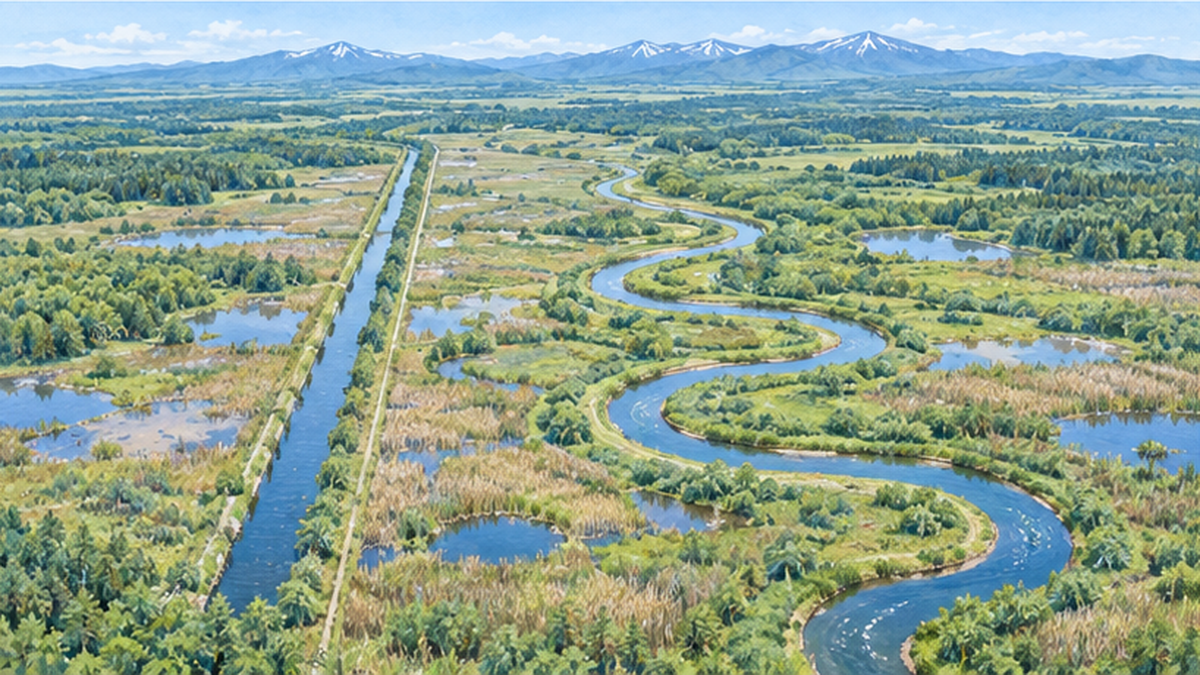
A well-known practical example of nature-oriented river works is the meander restoration of the Kushiro River, which flows through Kushiro Marsh in Hokkaido. In the Kayanuma area, the channel was straightened in the 1970s mainly for surrounding farmland development. As a result, the riffles and pools once seen were lost, and problems such as sediment and nutrients flowing into the marsh during floods came to be pointed out.
Project overview
As part of the Kushiro Wetland Nature Restoration Project, from 2007 to 2011 a straight reach of about 1.6 km, about 32 km upstream from the river mouth, was restored to a meandering channel of about 2.4 km. The project cost is reported as about 900 million yen. It is introduced as the first river meander restoration in Asia.
Changes confirmed after restoration
According to the Japan Science and Technology Agency (JST) Science Portal, researchers' surveys reported that the goals of the meander restoration were largely achieved. Specifically, more fish species were found in the restored reach than in the straight reach and numbers increased; aquatic insect species increased; and more frequent flooding increased wetland vegetation by about 30 hectares. Reducing sediment and nutrient outflow to the downstream marsh and restoring a near-natural river landscape were also among the goals.
Lessons from this case
- Restoring not only the shape but the movement of water and sediment is the key
- Effects are verified by post-project surveys (monitoring)
- For the link with Kushiro Marsh, see also the article on the Kushiro Marsh ecosystem
Case 2: The Maruyama River and the stork reintroduction (Hyogo)
Another representative case is the Maruyama River in Toyooka City, Hyogo Prefecture. The Maruyama River Basin Nature Restoration Project of the Kinki Regional Development Bureau, MLIT, is set against the background that shortcuts and widening from river improvement reduced wetland environments and the varied flows that form riffles and pools, and sets the goal of "restoring an environment where storks and people coexist."
Main menu of the nature restoration project
- Conservation, restoration and creation of distinctive natural environments
- Restoration and creation of wetland environments
- Securing river connectivity
- Conservation, restoration and creation of people's relationship with the river
Relation to the stork reintroduction
The reintroduction of the Oriental stork has been promoted in Toyooka. According to sources such as the Hyogo Prefectural Park of the Oriental White Stork, five birds were released on a trial basis in 2005, and in 2007 they bred in the wild for the first time after release. Wild hatching was the first in Japan in 43 years and fledging the first in 46 years. Wetlands, rice paddies and sandbars along the Maruyama River are important feeding grounds, and farmers, citizens, experts and government have cooperated in creating the environment.
The stork's revival is not the result of river improvement alone but of community-wide efforts including paddy management. Still, the fact that projects restoring the river and surrounding wetlands form part of creating an environment where a large bird can live well illustrates the idea of nature-oriented river works.
Rivers and the sea: nature-oriented works also affect the marine environment
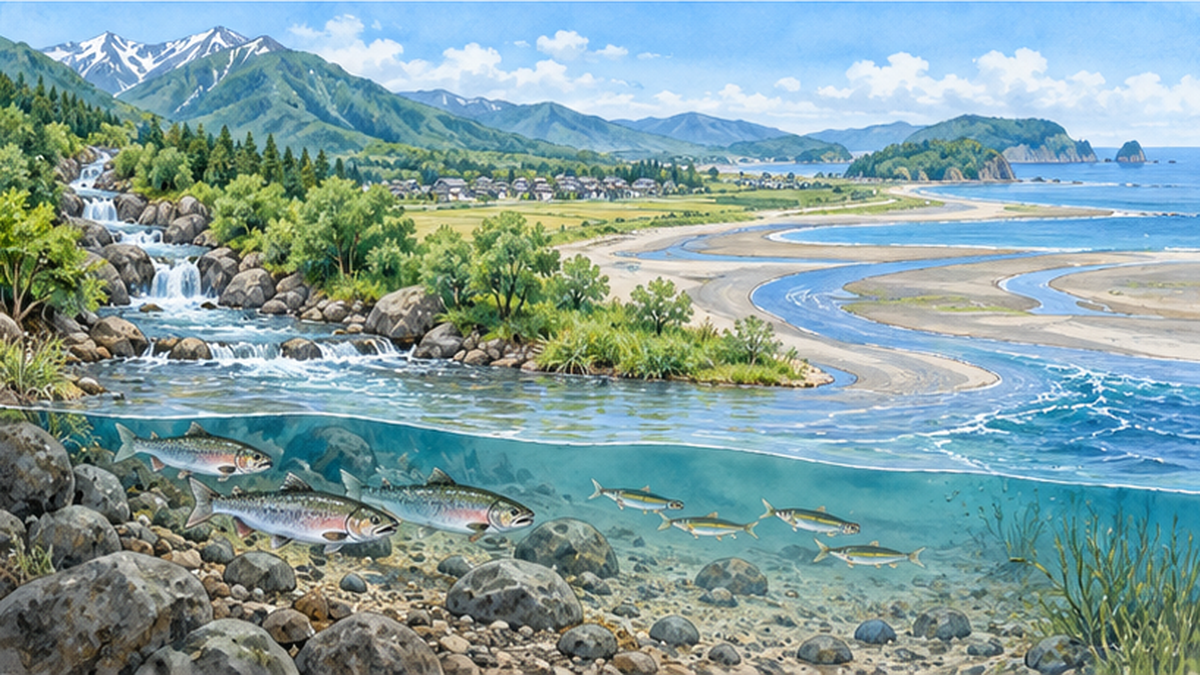
From the perspective of Kaiyo LAB, it is important that river works are deeply connected with the marine environment. Rivers are the "arteries" carrying not only water but sediment, nutrients, organic matter and living things to the sea.
Sediment and nutrient flows
Sediment carried by rivers is also the material for estuarine tidal flats and beaches. Environmental alteration upstream and fixing of channels change the amount and grain size of sediment and affect coastal topography. As in the article on dams and sediment supply to coasts, rivers and the sea must be considered as one. Estuaries, where fresh and salt water mix, are also places where juveniles of many fish grow. Please also read about tidal river environments.
Passage for migratory fish
For fish that travel between river and sea, such as salmon, ayu and eels, river connectivity and the environment near the mouth are their very life history. Removing steps and keeping riffles and pools suited to spawning and growth also relate to fishery resources and marine biodiversity.
Litter carried from rivers to the sea
River works also need measures against litter outflow and accumulation, and cleanup activities, in addition to flow capacity during floods. Since much plastic waste entering the sea is said to pass through rivers, measures against plastic litter from rivers and creating river environments go hand in hand.
Challenges ahead and what we can do
Since the basic policy was presented in 2006, nature-oriented river works have been the basis of all river works. Challenges remain in practice, however. As heavy rain intensifies with climate change, how to reconcile flood safety with environmental consideration continues to be asked.
Challenge 1: Balancing flood control and environment
In recent years the risk of river flooding from heavy rain has been strongly recognized. Where flow capacity and embankment reinforcement are needed, room for environmental consideration may be limited. On site, the balance is sought by devising channel width, cross-section and bed material.
Challenge 2: Maintenance and monitoring
Near-natural rivers change shape with every flood. Vegetation growth and sediment deposition occur, so maintenance takes effort. A system that surveys effects after works and manages adaptively is essential. Cases like the Kushiro River, where results are confirmed by post-project surveys, are a good model.
Challenge 3: Local consensus and involvement
The River Act also provides that river works proceed reflecting residents' opinions. When local people become familiar with rivers and join cleanups and observation, they notice environmental change sooner. Joining citizen science is one form of this.
What we can do
- Observe a nearby river: riffles and pools, bankside plants, fish and birds
- Join river cleanups and wildlife surveys
- Take a look at public comment periods for your municipality's river improvement plan
- Review household drainage and waste disposal to protect river water and environment
Summary
- Three-sided lining and straightening spread for reasons of flood control but harmed the environment of river life
- After the 1990 guideline and the 1997 River Act revision, nature-oriented river works became the basis of all river works in 2006
- Cases such as meander restoration on the Kushiro River and nature restoration on the Maruyama River confirm effects through post-project surveys
- Rivers are one system connected with the sea, and river works also affect the marine environment
References and sources
- MLIT Water and Disaster Management Bureau, "Nature-oriented river works"
- MLIT, "What are nature-oriented river works"
- MLIT, "Technical information: nature-oriented river works"
- National Institute for Environmental Studies, Environmental Outlook, "Nature-oriented river works"
- JST Science Portal, "Meander restoration revived nature on the Kushiro River"
- Kushiro Development and Construction Department, "Restoration to meandering rivers"
- Kinki Regional Development Bureau, Toyooka River and National Highway Office, "Maruyama River Basin Nature Restoration Project"
- Hyogo Prefectural Park of the Oriental White Stork, "How was it revived?"
- MLIT, "Efforts for river environment improvement and conservation (policy review)"
※ Ordered by reliability: government and academic institutions > peer-reviewed papers > specialist organizations > reliable media