⚡ The answer in 30 seconds
- Isoyake has no single cause: urchin and fish grazing, warming and silt overlap differently by region.
- Urchins eat seaweed shoots, then stay thin and unsellable and are left alone, a vicious cycle.
- Fishers' timed, continuous removal has restored seaweed beds in some places.
- Raising removed urchins is promising but mostly still being verified.
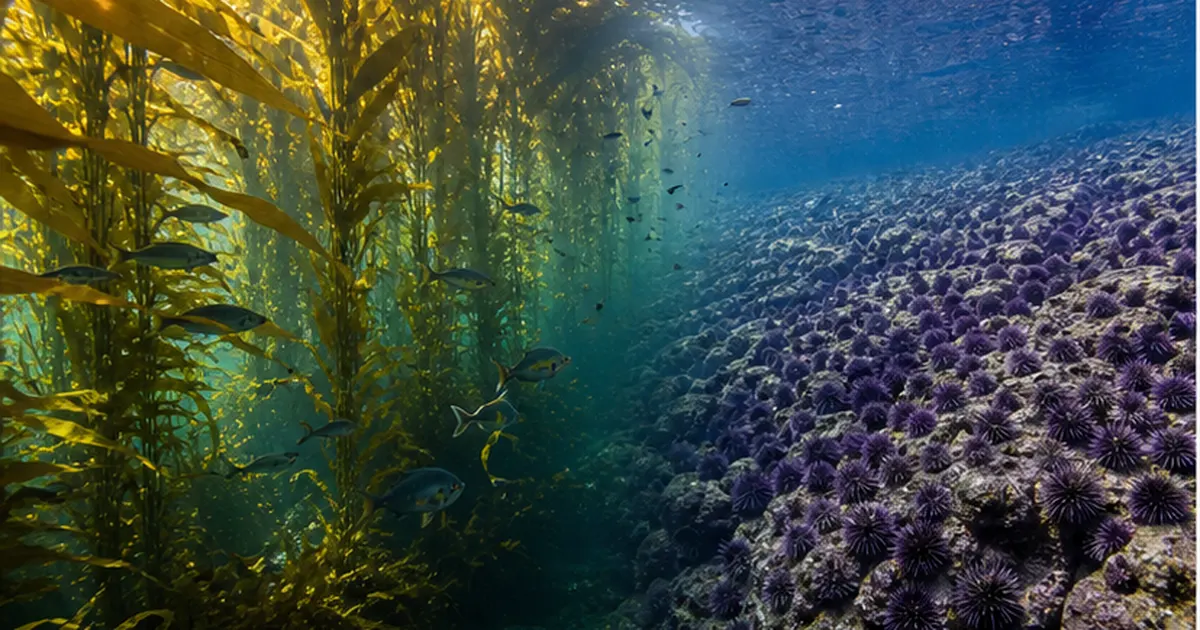
When the sea forest vanishes, the fish go too. "Isoyake" (coastal barrens), in which kelp and wakame disappear from rocky shores and only pale rock remains, quietly threatens Japan's coastal fisheries.
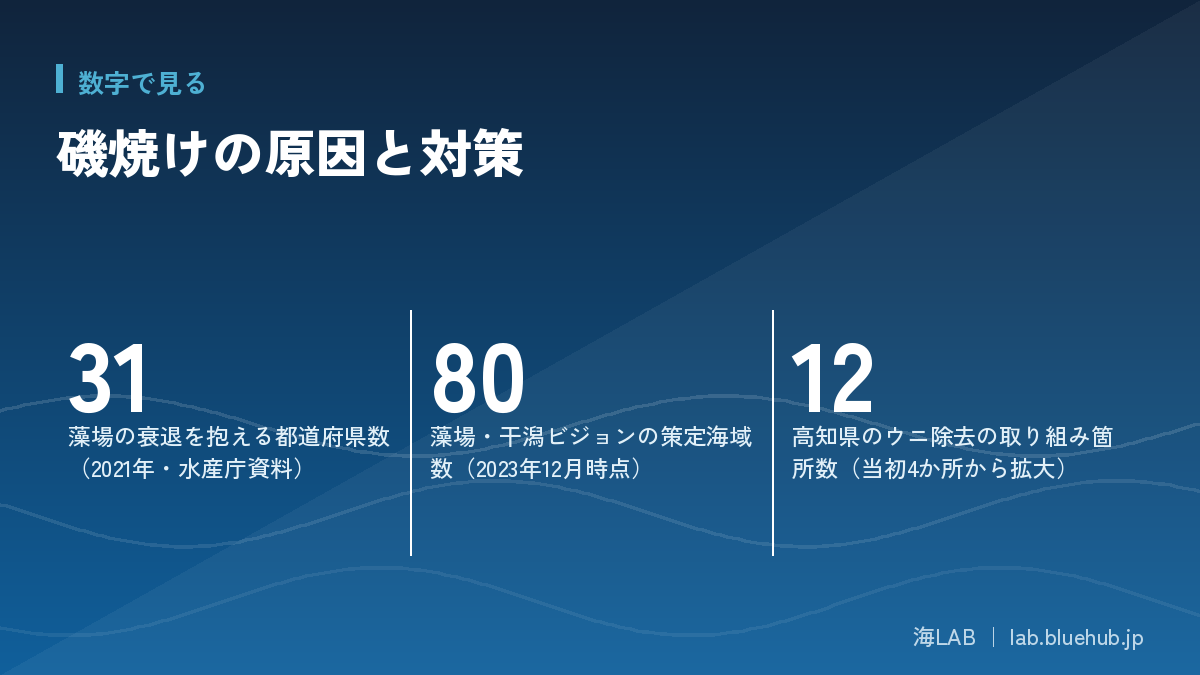
According to Fisheries Agency materials, 31 prefectures had declining seaweed beds as of 2021. Grazing by sea urchins and herbivorous fish is a major cause.
This article organizes how isoyake works, its causes, and the restoration efforts of fishers and researchers across Japan, based on published materials.
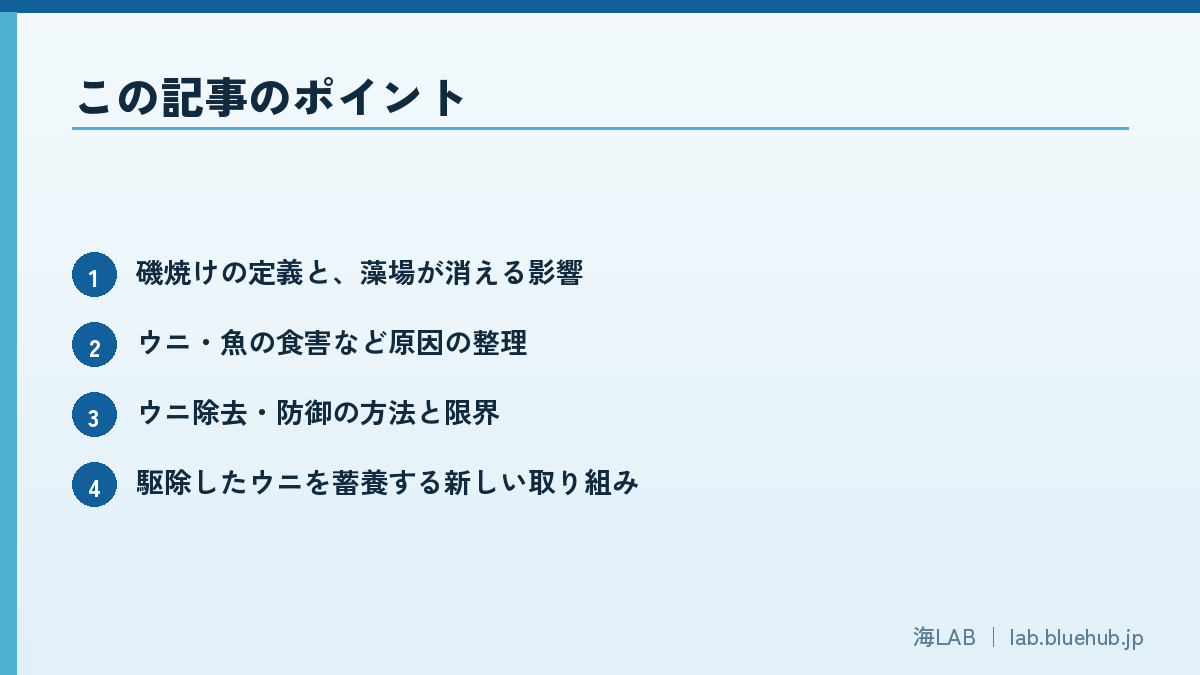
What you will learn
- What isoyake is and what is lost when seaweed beds vanish
- Causes such as grazing by urchins and fish
- Urchin removal and protection methods, and their limits
- New efforts to raise removed urchins (stock enhancement)
- Where national visions and guidelines fit in
What is isoyake? The disappearance of the sea forest
Definition, and how it differs from normal variation
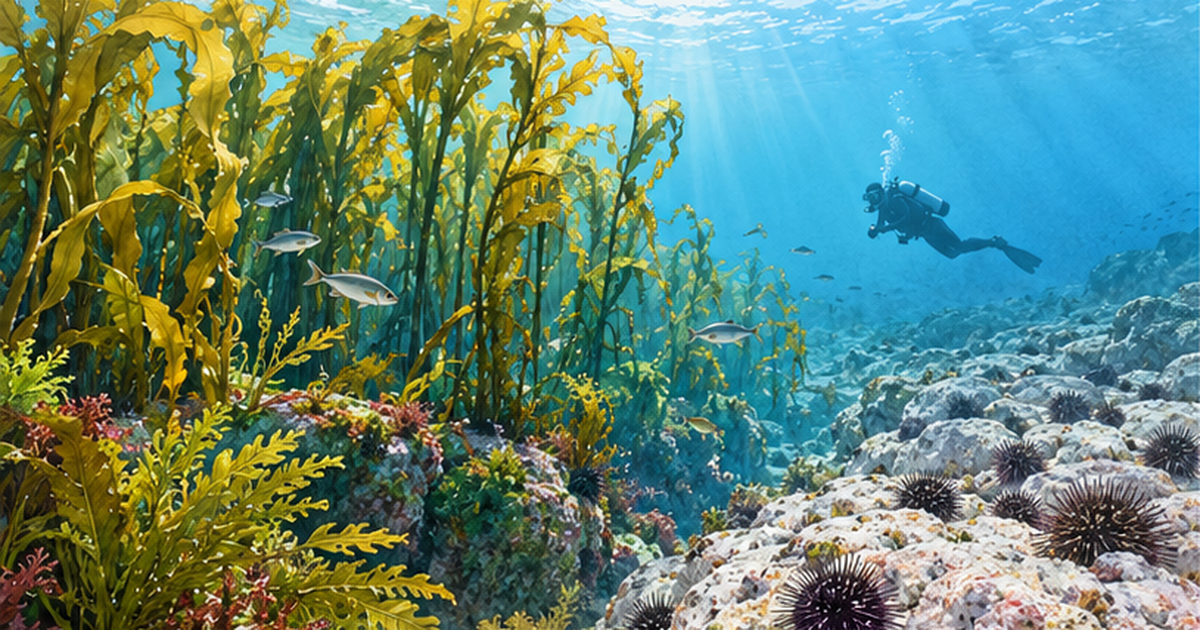
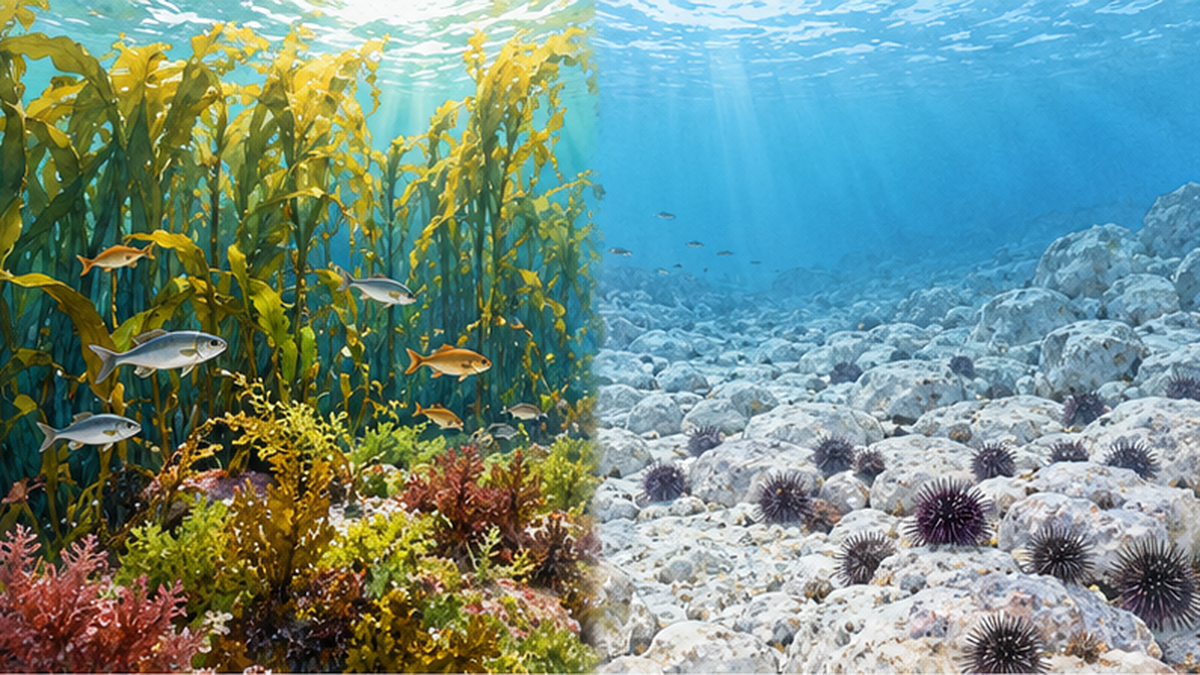
Isoyake is a phenomenon in which "mobaba" (seaweed beds) of large algae such as kelp, wakame and sargassum decline or disappear markedly, beyond seasonal swings and modest year-to-year change. Fisheries Agency materials describe it in this way. Seaweed beds serve as spawning grounds, nurseries and feeding grounds for fish, shellfish and crustaceans, so when they vanish, coastal fishery resources themselves dwindle.
Seaweed naturally changes with the seasons, growing in spring and dying back in summer, so a poor year alone is not isoyake. It is judged to be isoyake when seaweed does not return for years and the rock stays covered with whitish coralline algae.
Seaweed bed decline across Japan
Fisheries Agency materials summarize that 31 prefectures had declining seaweed beds as of 2021. It is reported everywhere, from kelp grounds in Hokkaido to seaweed and seagrass beds in Kyushu and the southwestern islands, so it is not a problem of one sea only.
Why it matters to our lives
- Fishery resources: abalone, turban shell, urchin, spiny lobster and juveniles of many fish depend on seaweed beds
- Water purification: seaweed absorbs nutrients from seawater
- Carbon storage: seaweed beds draw attention as blue carbon (blue carbon explained)
Causes of isoyake: urchins are not the only culprit
Three factors organized by Hokkaido fisheries experiment stations
Materials from Hokkaido fisheries experiment stations organize the factors behind isoyake into three groups. Of these, people can most readily control grazing by urchins and others and a shortage of seaweed seeds (spores).
| Type of factor | Examples |
|---|---|
| Chemical | Changes in water temperature, nutrient shortage |
| Physical | Waves, currents, accumulation of fine silt |
| Biological | Grazing by urchins, herbivorous fish and snails |
How urchin grazing creates a vicious cycle
Urchins do not die quickly when food runs short. They survive in a thin state and promptly eat the tiny seaweed that sprouts. This fixes a vicious cycle: many urchins → seaweed cannot grow → isoyake persists.
Worse, urchins in food-poor areas have almost no meat (gonads) and cannot be sold. With no market value, fishers do not harvest them, and they remain.
Fish grazing west of Kanto and rising water temperature
Urchin grazing is a nationwide problem, while grazing by herbivorous fish such as rabbitfish (aigo) and parrotfish (budai) is described as a problem west of the Kanto region. Tokushima Prefecture materials also suggest that rising coastal temperatures made herbivorous fish and urchins feed more actively and for longer periods.
Key point
- Causes differ by region, and several often overlap
- The starting point is finding out what is eating the seaweed in that particular sea
Identifying grazing in the field
Basics: feeding marks and the animals present
In the field, divers and underwater cameras check feeding marks on seaweed, urchin density and schools of herbivorous fish. Grazing intensifies when young seaweed sprouts, so it is important to match survey and control timing to the seaweed life cycle.
Season is the key
A Nagasaki Prefecture case shows that removing urchins (long-spined urchins) before autumn, when seaweed sprouts, tends to be effective. Reducing urchins beforehand leaves room for new shoots to grow without being eaten.
Why monitoring must continue
A Saga Prefecture manual stresses keeping the density of urchins and snails low and monitoring regularly. Even after recovery, urchins return if many remain nearby, so a system that does not end with a one-off effort is needed.
Urchin control in practice: removal, dispersal and protection
Removal is most reliable but costly
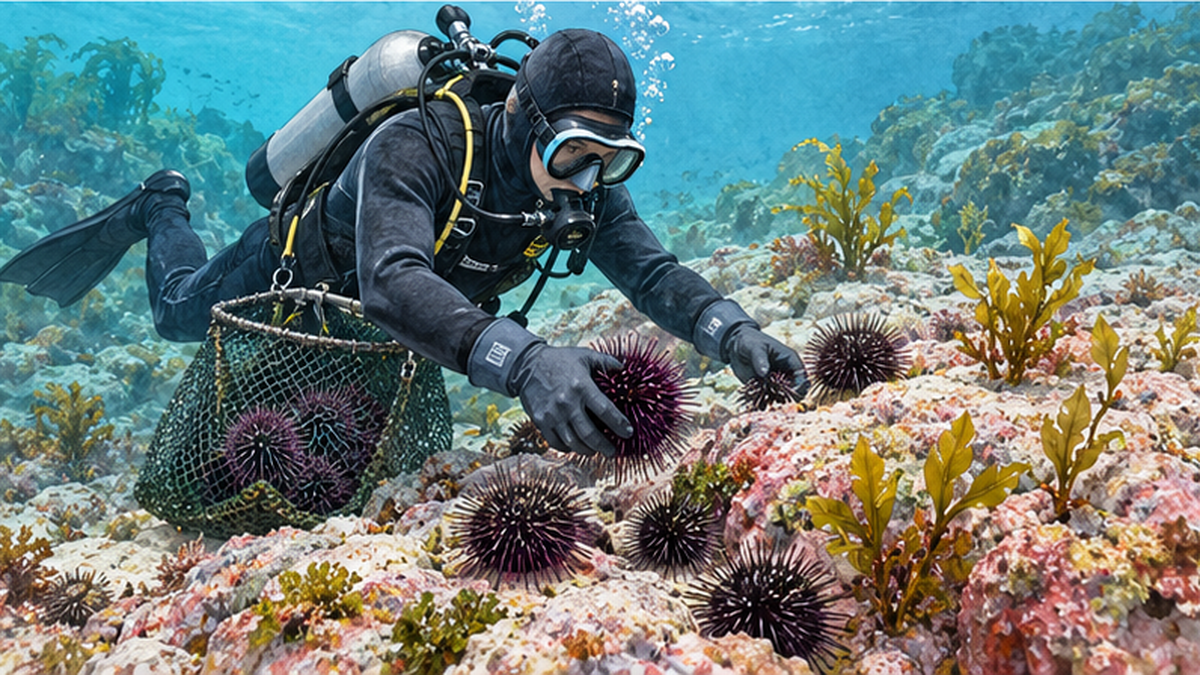
Urchin control is broadly divided into removal/dispersal and protection from urchins, and removal is described as the most reliable. Methods include trap fishing, collection from boats and removal by diving, and efficiency and labor costs are challenges.
- Traps and boat collection: cover a fairly wide area but are weak in deep water and rock crevices
- Diving removal: reliable but needs labor and time
- Urchin fences: enclose seaweed to keep urchins out (installed in Nagasaki Prefecture and elsewhere)
Effects can be temporary
Reports note that effects can be temporary and that continuous removal is needed when many urchins remain around. Clearing only a small plot is not enough, because urchins move back in. The balance of area and continuity matters.
Results from fishers' activities
In the Takahama district of Nagasaki City, young fishers of the youth division led urchin removal from 2010. According to reports, in the spring after removal began, barrens that had been dominated by coralline algae showed small seaweeds as well as large brown algae such as wakame and sargassum.
In Kochi Prefecture too, the effectiveness of urchin-removal plots run by fishers was demonstrated, and sites grew from the original 4 to 12.
How to read these cases
- These are reports limited in place and time, and the same result may not appear in other seas
- Results came from combining fewer urchins with an environment where seaweed can grow
Turning a nuisance urchin into a resource
Raising thin urchins: stock enhancement
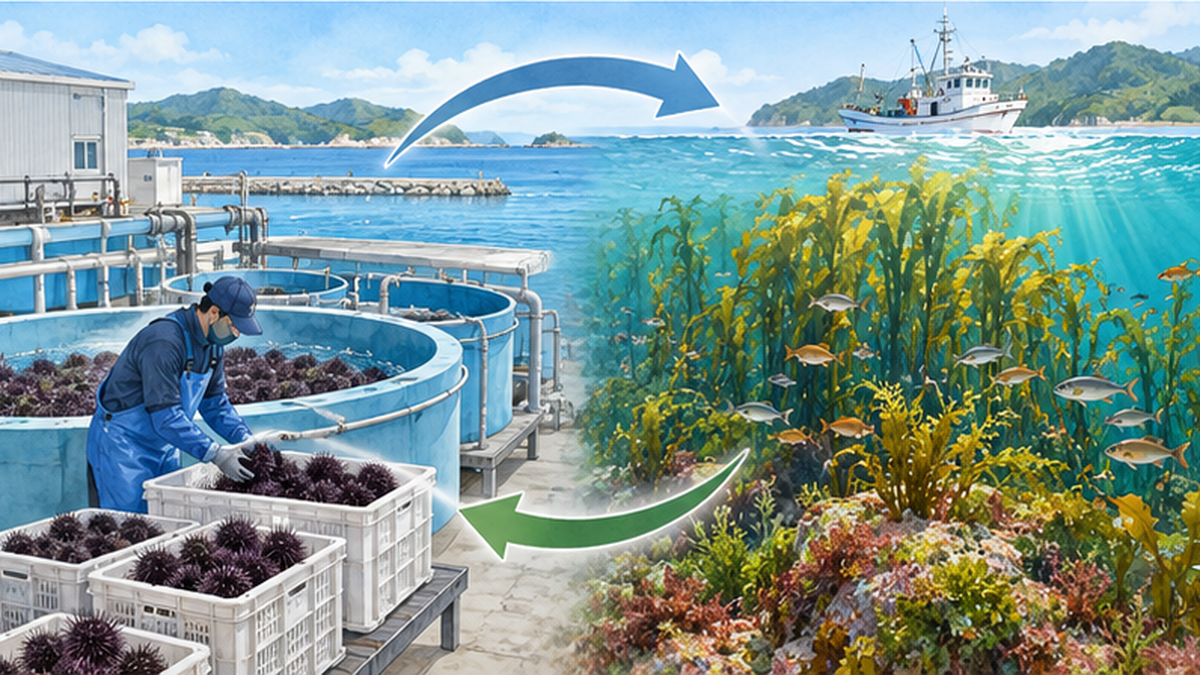
Urchins in isoyake seas have little meat and do not sell. Efforts are under way in various places to raise removed urchins elsewhere with feed, improving their meat before shipping. In Ito City, Shizuoka Prefecture, a seafood company's challenge to turn nuisance urchins into "delicious urchins" was reported by local media.
If removal gains economic value, fishers find it easier to continue. The idea is to reconcile environmental conservation with income.
Moving urchins to seaweed-rich places
The Nagasaki Prefectural Fisheries Experiment Station is examining a model in which poor-quality urchins are moved to places with small seaweed, fed there and harvested in May. It reports that points remain to be clarified, such as the link to removal timing and transplant density.
Munakata City (Fukuoka) pilot project
As a fiscal 2024 pilot, Munakata City (Fukuoka) raised removed urchins on land using discarded food, and set fertilizer nets made from the urchin shells, with akamoku (Sargassum horneri) seedlings attached, at sea. It is reported to have also helped build a cooperative framework among the Munakata fisheries cooperative, Fukuoka Prefecture and a private company.
Caution: effects of raising are still being verified
- Improvement of meat yield and cost viability through raising is mostly at the verification stage in each case
- It cannot be said to be a stable business nationwide
National frameworks and growing support
The Seaweed Bed and Tidal Flat Vision and isoyake guidelines
The Fisheries Agency published the "Seaweed Bed and Tidal Flat Vision" in January 2016, and visions based on it have been drawn up for 80 sea areas nationwide (as of December 2023, when it was revised). It also revised its isoyake countermeasure guidelines as the third edition in March 2021, covering everything from diagnosing causes to carrying out countermeasures.
Sharing cases at the national council
The Fisheries Agency holds a national council on isoyake countermeasures and shares cases from around the country. Materials are published on its website for local fishers and governments to consult.
Links to blue carbon
Restoring seaweed beds also attracts attention from the viewpoint of blue carbon, which takes CO2 into the sea. For how protecting seaweed beds can be recognized, see our explainer on J-Blue Credits.
What we can do: learn, eat, share
Deepen your understanding with related articles
- Isoyake from a global perspective: Why do kelp forests turn into urchin barrens?
- Predators and ecosystem balance: Why are sea otters a keystone species?
- Restoring seaweed beds: Restoring seaweed and seagrass beds, the nurseries of fish
Three everyday actions
- Learn about local sea efforts: check seaweed bed conservation by local fishery cooperatives and governments
- Choose local seafood: know and enjoy seafood supported by seaweed beds
- Look at climate change: rising water temperature is one factor affecting seaweed beds
Isoyake is not a problem of urchins alone, fish alone, or temperature alone. Identifying the cause, and fishers, researchers and governments sustaining effort over time is the shortest path to bringing the sea forest back.
Summary
- Isoyake is the long-term decline or loss of seaweed beds
- Causes such as grazing by urchins and fish, temperature and silt differ by region
- Efforts combining removal, raising and seed supply are advancing in many places
- Many results are reports limited in place and time, so continuous management is needed
References and sources
- Fisheries Agency: National Council on Isoyake Countermeasures materials – Current state of isoyake and seaweed beds, and countermeasure cases
- Fisheries Agency: National Council on Isoyake Countermeasures materials (FY2023) – Cases from around Japan
- Hokkaido Research Organization: Fisheries Experiment Station materials – Organization of isoyake factors
- Tokushima Prefecture materials – Water temperature rise and feeding by herbivorous fish and urchins
- Saga Prefecture seaweed bed conservation manual – Density control of urchins and snails, and monitoring
- Nagasaki Prefecture seaweed bed materials – Cases of urchin removal and urchin fences
- Ministry of the Environment: Satoumi activity cases (FY2024) – Munakata City urchin raising and seaweed bed restoration case
- Shizuoka Shimbun (@S) – Efforts to raise urchins in Ito City
* Listed in order of reliability: government and academic institutions > peer-reviewed papers > specialist organizations > reliable media