⚡ In short
Wakame and kombu farming in Sanriku, devastated by the Great East Japan Earthquake, has clawed back production around the rebuilding of cooperative shared-use facilities. Japan's FY2024 wakame aquaculture harvest was 39,700 t, with Miyagi and Iwate alone accounting for about 75%. We trace where seaweed aquaculture stands today using official data — from poor harvests caused by warm water and the shrinking workforce, to the new value being placed on blue carbon.
The salted wakame and dried kombu on supermarket shelves were almost all grown in someone's sea farm. Most of Japan's wakame is cultivated, and the main production area is Sanriku — the very coast that suffered the greatest damage on 11 March 2011.
The tsunami swept away the aquaculture facilities floating offshore and, at the same time, the processing plants, cold stores and workrooms on land that supported them. And yet Sanriku wakame was back on the market the year after the disaster. It was not because individual fishers rebuilt on their own. It happened because the fisheries cooperative rebuilt the facilities collectively and everyone used them together — a long-standing arrangement in Japanese coastal fisheries.
Now, fifteen years on, seaweed aquaculture has entered a different phase from reconstruction. Years in which high sea temperatures prevent seedlings from growing properly have continued, and people keep leaving the fishing villages. At the same time, seaweed has been reported to the United Nations as "blue carbon" that absorbs CO2, and has begun to be traded as credits. This article traces what Sanriku's seaweed aquaculture lost, what it regained, and where it stands now, using official statistics and primary sources.
What you will learn from this article
- The damage the Great East Japan Earthquake did to Sanriku's seaweed aquaculture, and why landings resumed the following year
- How "shared-use facilities" became decisive in rebuilding wakame and kombu farming
- What production statistics up to FY2024 reveal about how far recovery has come — and where it has stalled
- The three walls that arrived after reconstruction: high water temperatures, poor seedlings and a shrinking workforce
- The scientific basis for valuing seaweed aquaculture as blue carbon, and real examples of J Blue Credit
- Non-food uses of seaweed that are expanding, and why we should not expect too much of them
The sea farm that vanished overnight: what happened to Sanriku's seaweed aquaculture in 2011
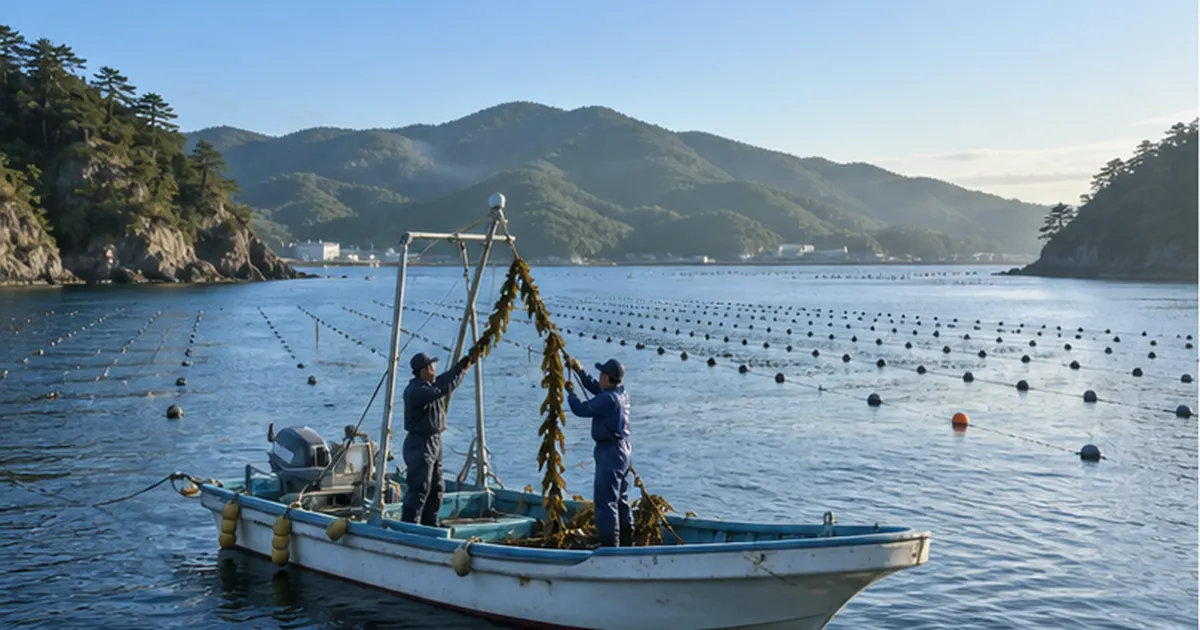
Wakame and kombu farming leaves nothing standing on the sea. When the harvest ends the gear is taken in, and when the season comes it is set out again. That is precisely why, when the tsunami came, the damage appeared not as "broken" but as "gone".
The aquaculture facilities disappeared from the sea surface
Iwate Prefecture was the top wakame-producing prefecture in Japan continuously until 2010. Prefectural documents record that the Great East Japan Earthquake tsunami devastated offshore aquaculture facilities and fishing boats, and that "almost all of the aquaculture base was lost". The ropes strung offshore, the floats, the anchors, and the seaweed growing on them all vanished from the sea at once.
Wakame farming is a one-year cycle: seedlings go out to sea in autumn, grow through winter and are cut in spring. March was the very peak of the cutting season. A whole year of labour, and that year's income, were washed away just before harvest.
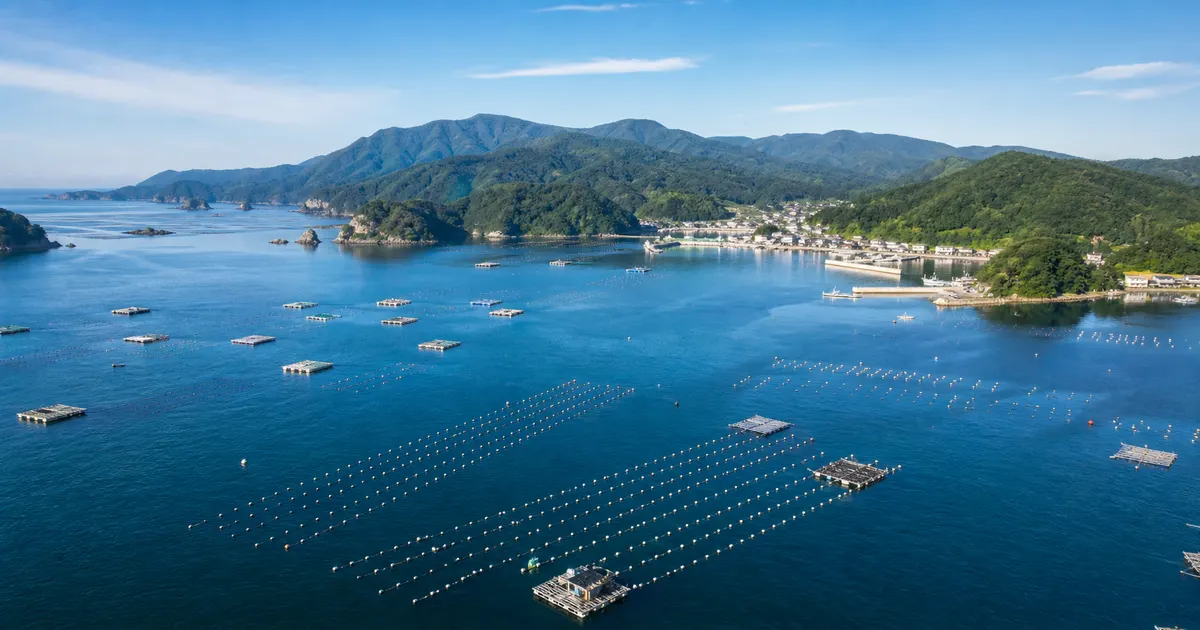
There are reasons why Sanriku became a major wakame region in the first place. The deeply indented bays of a ria coast are calm, so cultivation ropes can be kept in place for months. Cold Oyashio water enters in winter, and river water from the mountains carries nutrients. A sea with low temperature, high nutrients and calm water produces thick, elastic fronds. Wakame farming began in Iwate in 1949 and is now carried out along almost the entire prefectural coastline.
But that same topography worked to raise the water level when the tsunami came. The further into a bay the wave travelled, the more its energy concentrated — so both the farming grounds and the processing plants on the shore were damaged together.
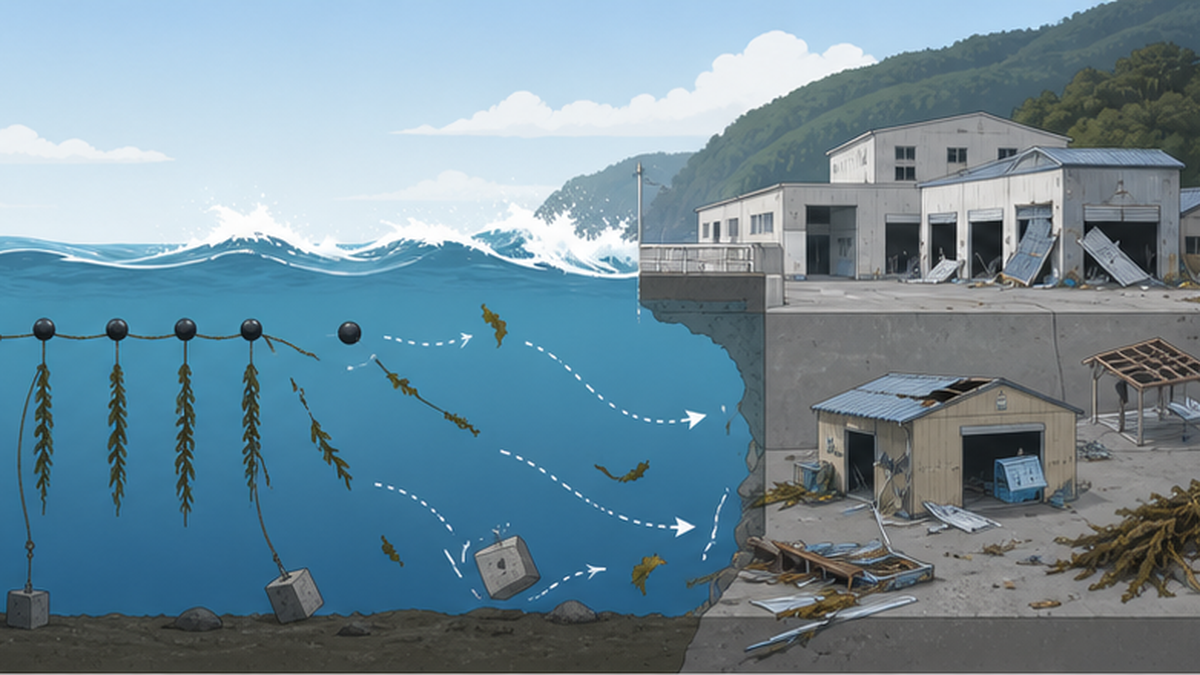
The equipment on land was lost at the same time
It is easy to overlook, but the damage to seaweed farming was not limited to the sea surface. Cut wakame is not a product as it is. It becomes marketable "blanched salted wakame" only after a chain of shore-side steps: blanching in hot water, salting, dewatering, sorting and refrigeration. These facilities stood on low-lying coastal land, exactly where a tsunami strikes hardest.
- Seedling production facilities: land-based tanks where spores are released from mekabu and attached to twine. Without them, next season's seed cannot be made
- Blanching and salting plants: equipment to process freshly cut seaweed quickly. Freshness is everything, so they must be near the farming grounds
- Cold and freezer stores: to hold salted product and adjust shipping timing
- Landing and collection points: hubs where the cooperative buys, sorts, weighs and ships
- Workrooms and fishing huts: shared spaces for repairing ropes and storing gear
And yet landings returned the following year
According to Iwate Prefecture, farmed wakame landings resumed in 2012, the year after the disaster. Being a one-year crop worked in its favour here. If seedlings and facilities can be readied by autumn, there is a harvest the following spring. Compared with scallop or oyster farming, which takes several years to reach harvest, seaweed gets back on its feet quickly.
But the condition "if they can be readied" is a heavy one. Few fishers could buy a full set of facilities again out of their own pocket. What made it possible was the shared-use arrangement examined in the next chapter.
Why seaweed farming could lead the recovery
- A short one-year cycle (seedlings in autumn, cutting in spring)
- No feed required, unlike fish, so growing costs are low
- The inner bays of a ria coast are calm, so farming works once the gear is set
- Existing sales channels (the salted wakame market) survived, so there was somewhere to sell
Why no one can recover alone: shared-use facilities as the foundation
Seaweed farming looks like work at sea, but in fact half of the process happens on land. And the land-side equipment is too large for a single fisher to own. This structure determined how the recovery unfolded.
Half of the process takes place on land
Lining up the steps from sea to table makes it clear where equipment is needed. Work at sea can be done with one's own boat and skill, but the shore-side steps are closer to a capital-intensive industry.
| Season | Step | Location | Equipment needed |
|---|---|---|---|
| Early summer to summer | Collecting mother fronds (mekabu) and making seed twine | On land | Seedling tanks, cooling units |
| Autumn | Putting seedlings out to sea, setting ropes | At sea | Boat, ropes, floats, anchors |
| Winter | Thinning and growth management | At sea | Boat, workroom |
| Early spring | Cutting | At sea | Boat, containers |
| Immediately after cutting | Blanching, salting, dewatering | On land | Blanching tanks, dewatering machines, salting equipment |
| Until shipment | Sorting, storage, shipping | On land | Sorting tables, cold store, landing facility |
The blanching and salting step in particular is a race against time. Cut wakame deteriorates rapidly if left, so it must be processed the same day. Building the plant tens of kilometres away was never a realistic option.
The cooperative model: rebuilding everything at once
In rebuilding its fisheries after the disaster, Iwate Prefecture made two things central: collective procurement of boats and aquaculture facilities by fisheries cooperatives, and restoring and developing shared-use facilities such as collection points and workrooms. Rather than each fisher buying back equipment with their own money, the cooperative acquired it with national and prefectural support, and members used it jointly. In the circumstances of the time, this had decisive advantages.
- Fishers who had lost both collateral and savings could restart without taking on debt
- Concentrating facilities in one place let more people return to production on a small budget
- The cooperative could coordinate who restarted and at what scale, making it easier to reorganise the grounds
- Because the equipment is shared, it stays in the village even when older members retire
An unexpected benefit of shared use
Shared-use facilities existed in Japanese coastal fisheries long before the disaster. But many of the facilities built after it were a step up from the old ones in hygiene management and labour-saving design. If you are building new, the reasoning went, you may as well rethink the workflow and the drainage. That in turn laid the groundwork for the branding and export efforts that followed.
The same pattern appears in the recovery of oyster farming. In both cases, having to rebuild the equipment became an opportunity to rethink how things were done (see The recovery of oyster farming: how Sanriku chose to grow fewer, better oysters).
The structure worth remembering
- Rebuilding seaweed aquaculture only works when both the offshore gear and the shore-side plant are in place
- Land equipment is too heavy a burden for individuals, so cooperative shared use became the practical answer
- Shared use not only sped up recovery but also modernised the facilities as a side effect
Recovery in numbers: how far has wakame come back?
So how far has production recovered? Let us line up the fisheries and aquaculture production statistics of the Ministry of Agriculture, Forestry and Fisheries with the share figures published by Iwate Prefecture.
The national statistics for FY2024
In FY2024, the national wakame aquaculture harvest was 39,700 t, down 9,900 t (20.0%) on the previous year. Working backwards, FY2023 was about 49,600 t. Seaweed aquaculture as a whole came to 274,600 t (down 8.0%), of which nori accounted for 194,100 t (down 3.4%). In other words, by volume Japan's seaweed aquaculture is dominated by nori, and wakame is only about a fifth of that scale.
| Rank | Prefecture | Harvest (FY2024) | National share |
|---|---|---|---|
| 1st | Miyagi | 17,481 t | 44.1% |
| 2nd | Iwate | 12,077 t | 30.5% |
| 3rd | Tokushima | 3,626 t | 9.1% |
| — | National total | 39,700 t | 100% |
Miyagi and Iwate together account for 74.6% — three quarters of national output from just two Sanriku prefectures. Add Tokushima (Naruto) and the figure passes 80%. Japan's wakame farming is a geographically very concentrated industry.
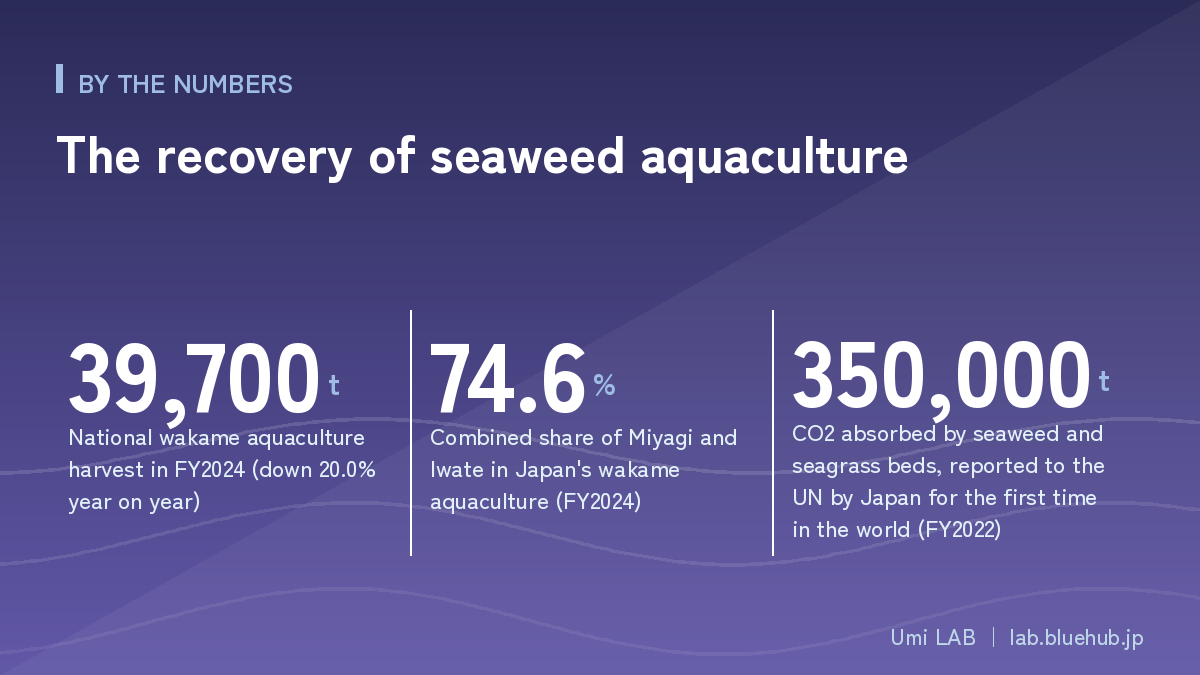
The number-one spot has not returned
The ranking is what stands out. Iwate held first place nationally until 2010, but as of FY2024 it remains second, behind Miyagi. Production restarted quickly, yet the pre-disaster position has not been regained. This is the combined result of the shrinking workforce discussed below and recent changes in the marine environment.
In short, production statistics do not give a simple yes to the question "is the recovery over?". The facilities came back and production resumed. But the scale of the industry did not return in a straight line to its pre-disaster level.
Check the primary sourceWakame (Iwate's local pride) | Iwate PrefectureThe prefecture's official page covering the history of wakame farming in Iwate, recovery from the disaster, and FY2024 production and national share.🔗 pref.iwate.jpKombu is following a different story
Even among seaweeds, kombu's situation differs. About 90% of the kombu eaten in Japan comes from Hokkaido. And in Hokkaido, kombu production in FY2024 was projected to fall below 10,000 tonnes for the first time since records began. The prefectural government set up a "Study Meeting on Measures for Stable Kombu Production" in August 2024 and compiled a set of stabilisation measures in March 2025.
Kombu is farmed in Sanriku too, but not on the scale of wakame. Looking at seaweed aquaculture as a whole, a common axis — change in the marine environment — is beginning to bite across production regions nationwide, quite separately from the axis of disaster recovery.
Where wakame sits within seaweed aquaculture
Breaking down the 274,600 t of seaweed aquaculture, nori accounts for 194,100 t, about 70% of the total. Wakame's 39,700 t is about 14%. On the numbers alone, wakame looks like a supporting player.
From the standpoint of a production region, however, the picture changes. Nori farming is centred on western Japan — the Seto Inland Sea and the Ariake Sea — and is barely practised in Sanriku. In Sanriku, seaweed aquaculture is essentially all wakame, and a good or bad year translates directly into the local economy. Fluctuations that look small in the national statistics hit production regions at a scale that affects daily life.
Summary so far
- FY2024 wakame aquaculture totalled 39,700 t nationally (down 20.0% year on year)
- Miyagi 44.1% + Iwate 30.5% = 74.6%. Production is concentrated in two Sanriku prefectures
- Iwate restarted production quickly but has not regained its pre-disaster number-one position
- Hokkaido kombu was projected to fall below 10,000 tonnes in FY2024 for the first time since records began
The wall that overtook reconstruction: warm water and seedlings
When people in Sanriku talk about wakame these days, water temperature comes up more often than the earthquake. The facilities and the people are there, yet years keep coming in which the seaweed simply does not grow.
Two consecutive poor harvests
The 2024 and 2025 wakame crops were poor in Sanriku two years running. That is why the national FY2024 harvest fell so sharply, by 20.0%. There was no single cause: storm damage to facilities in winter, delayed growth from warm water, and disease and pests all overlapped.
What really matters is the summer water temperature
The key point is that the water temperature during the seedling production period (roughly June to November) affects the following year's output more strongly than the temperature at harvest time. Wakame seedlings are made by attaching zoospores released from mekabu to twine in land-based tanks and raising them into small sprouts before they go out to sea. If the water is too warm during this period, the sprouts fail to develop, or become vulnerable to competing algae and bacteria.
Iwate Prefecture's material explains that in wakame farming, "apart from the stage where spores from mekabu are attached to rope in land-based tanks, every process is managed in the sea". Put the other way round, the only period in which people can control the water temperature is the seedling stage; from there on it is up to the ocean. Once the sea warms, the options are limited.
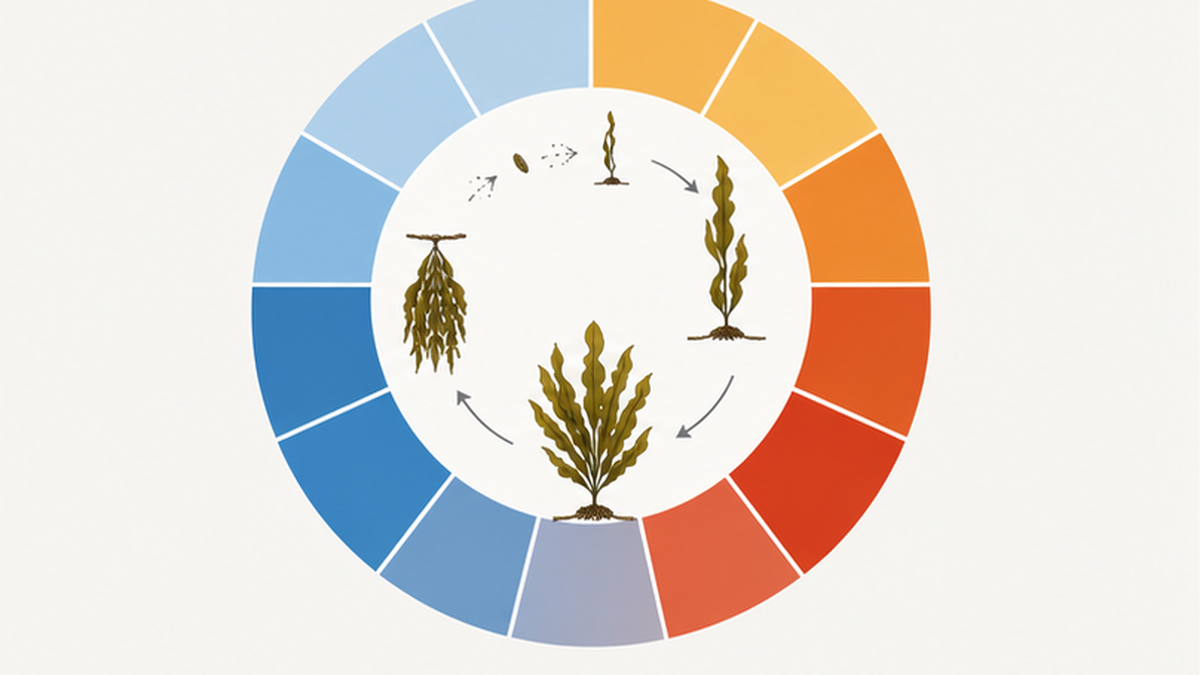
What the 2026 rebound showed
The 2026 season, by contrast, brought good news. According to a report to the Japan Wakame Association's general meeting in June 2026, Sanriku wakame landings reached 22,227 t as of 12 May, up 24% year on year. There was no major outbreak of the disease and pest damage that had been one cause of the 2024 and 2025 shortfalls, and the crop was rated as having "unusually high yield rates and good quality in recent terms".
That figure, however, is a landings-based tally compiled by an industry body, and uses different criteria from the ministry's production statistics (harvest volume). It cannot simply be compared with the 39,700 t cited earlier. Even so, it shows that Sanriku still has ample productive capacity when conditions align.
- In the same 2026 season, Naruto (Tokushima) saw output fall 20–30% as grazing damage, insufficient rainfall in the early growth stage, a declining number of producers and strong-wind damage combined
- Chinese production shrank its farming area by about 30% after the previous year's bumper crop crashed prices
- Mekabu has had poor harvests from 2024 to 2026, leaving a supply gap: domestic demand of 8,000 t against total Sanriku output of around 6,000 t
What it means that good years still happen
When we talk about climate change we tend to picture a steady downward line, but seaweed aquaculture is actually affected in the form of a widening year-to-year swing. There are good years and devastating ones. What hurts is not so much a falling average as the impossibility of predicting income. Decisions about capital investment and about whether a successor takes up the work are hit directly by that uncertainty.
Another factor not to be missed is the condition of the natural seaweed beds surrounding the farming grounds. "Isoyake" — the disappearance of seaweed through warm water and grazing by herbivores — is advancing in many areas regardless of whether farming takes place. As natural beds thin out, securing mother fronds and the productivity of surrounding waters are affected too. Poor farm harvests and isoyake should be seen as phenomena with shared roots (see Why do isoyake and urchin barrens happen? Causes of kelp forest loss and restoration efforts worldwide).
Environmental risks facing seaweed aquaculture
- Poor sprout development from warm water during the seedling period (summer to autumn)
- Loss of farming gear to winter storms and strong winds
- Outbreaks of disease, pests and competing algae (with large year-to-year variation)
- Increasing grazing damage from urchins and fish, sharing a background with isoyake
- Widening swings between good and bad years, making business planning difficult
Who goes out to sea? The state of the workforce
The facilities are back, and in a good year the catch is good. The biggest reason production still falls short of pre-disaster levels is that the number of people going out to sea keeps falling.
Fishery workers down 20% in five years
According to the 2023 Fisheries Census, Japan had 121,389 fishery workers, down 30,312 (20.0%) from five years earlier. Numbers fell in every age bracket, with the largest decline among those aged 65 to 69 — meaning that a wave of retirements from that cohort has worked through. The share of workers aged 65 and over is on an upward trend.
Wakame farming is hard labour: cutting from early morning in a winter sea, then blanching and salting on shore the same day. During February to April, when the work is concentrated, even the whole family is not enough. Ageing operators are the first to become unable to maintain their grounds.
A training scheme as an entrance: the Iwate Fisheries Academy
Iwate Prefecture shifted from waiting for successors to training them. The Iwate Fisheries Academy is a one-year training scheme launched in April 2019 and run by the prefecture's fisheries workforce development foundation. It combines classroom study of fisheries fundamentals with practical training at actual fishing sites, and as of 2026 its eighth cohort of trainees is studying there.
The significance of such a scheme is that it created a route in from outside fishing families. Traditionally, entry into coastal fisheries was almost entirely a matter of succession from parent to child. When training is paired with acceptance by the cooperative, the door opens to young people with no local ties.
See the training scheme in detailIwate Fisheries Academy | Iwate PrefectureOfficial page outlining the prefecture's fisheries workforce training scheme, including course content, recruitment and contact details.🔗 pref.iwate.jpFishing villages raising their own successors
A scheme alone does not make people stay. The regional revitalisation plans drawn up by cooperatives around Ofunato City list measures such as sharing information through social media, instruction by veteran fishers, support for young fishers' groups and the prefectural fisheries masters' association, and hands-on fishing experience programmes at primary and junior high schools. The idea is that the community takes charge of everything from sparking interest before employment to skill-building afterwards.
Young fishers on the ground say they want to raise the next generation while the dependable parent generation is still active. Working for several years as a veteran's right hand while taking over the skills and the grounds functions as a route quite distinct from formal training.
Is seaweed farming a good way in?
From a new-entrant perspective, seaweed farming has advantages. There is no feed cost, the time to harvest is a short one year, and the boat required is relatively small. Where shared-use facilities exist, investment in processing equipment can also be kept down. On the other hand, because income is concentrated in spring, it does not on its own provide a year-round livelihood, and most operators combine it with scallops, oysters, urchins or boat fishing.
Looking at Sanriku's fisheries recovery as a whole, rebuilding that "combination" was the real heart of the matter (see The path of Sanriku's seafood recovery: from restarting wakame, scallop and oyster farming to branding).
Key points on the workforce
- Fishery workers numbered 121,389 in 2023, down 20.0% in five years
- Training schemes such as the Iwate Fisheries Academy created routes in from outside fishing families
- Seaweed farming is light on initial investment and suits new entrants, but does not provide year-round income on its own
- How grounds, facilities and skills are handed to the next generation will determine production volume
Does seaweed absorb CO2? The science of blue carbon
In recent years a new value has been attached to seaweed aquaculture: the idea that "seaweed absorbs CO2". But unless this is understood precisely, it is easily exaggerated.
The question is not absorbing but retaining
Of course seaweed takes up CO2 through photosynthesis. The question is where that carbon goes. If the seaweed dies and decomposes on the spot, the carbon returns to the seawater and the atmosphere almost immediately. Only cases in which the carbon remains cut off from the atmosphere for a long period can be counted as climate mitigation.
In the case of kombu and wakame, fronds break off, ride the currents and are carried into the open ocean. Some of that material sinks to the mesopelagic zone and, while decomposing, stays there for a long time. This is thought to be the main sequestration pathway for seaweed-derived blue carbon. The key point is that the mechanism differs from that of mangroves and seagrass beds, which store carbon in the sediment where they grow.
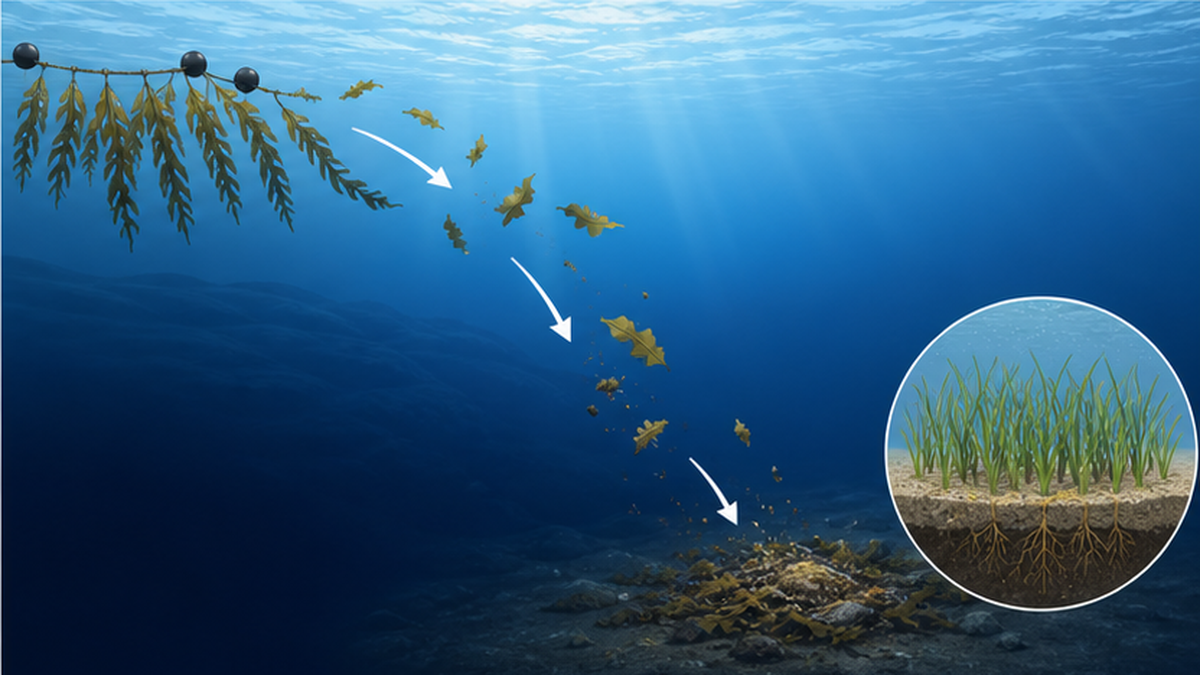
Japan reported it to the UN first in the world
In April 2024, Japan included, for the first time, absorption by seaweed and seagrass beds in its report of greenhouse gas emissions and removals to the United Nations. The figure calculated for FY2022 was about 350,000 tonnes. Japan is the first country in the world to include absorption by seaweed beds in a national report.
This became possible because the calculation methods were put in place. The Ministry of Land, Infrastructure, Transport and Tourism and the Port and Airport Research Institute developed a method for estimating the area of coastal seaweed and seagrass beds, and combining it with absorption coefficients by bed type developed by the Ministry of Agriculture, Forestry and Fisheries made nationwide estimates possible. The Japan Fisheries Research and Education Agency has also published a manual for standing-stock surveys.
What this "world first" means is not that Japan has some special abundance of seaweed. It means that Japan was first to prepare measurement methods robust enough to put seaweed bed absorption into an official national report. Internationally, seagrass beds and mangroves came first, and the treatment of seaweed was not settled even in the IPCC guidelines. Japan's coasts have extensive kombu and Sargassum beds, so whether they can be counted materially affects the absorption estimate — which is why so much effort went into developing the methodology.
Read the press releaseCO2 absorption by marine plants in Japan's coastal waters reported to the United Nations | MLITPress release announcing that about 350,000 tonnes of CO2 absorption by seaweed and seagrass beds was reported to the UN — the first such report on seaweed beds in the world.🔗 mlit.go.jpHow is farmed seaweed treated?
What needs care here is that the beds counted in the national inventory are not the same thing as farmed seaweed. Most farmed wakame is cut and eaten by people, so its carbon is not sequestered; it returns to the atmosphere within months to a few years.
Even so, there is room for farming to be credited with absorption: fronds that break off and drift away during cultivation, seaweed that grows on the structures themselves, and cases where the act of farming maintains or creates seaweed beds. J Blue Credit, discussed below, measures and certifies exactly this portion. The general mechanism of blue carbon is covered in detail in another article (see What is blue carbon? How mangroves and seagrass beds store carbon in the sea, and Japan's efforts).
Points that are easily misunderstood
- "Seaweed absorbs CO2" does not equal "this is climate action". It counts only once carbon is sequestered long term
- The carbon in wakame you eat is not sequestered. Value as food and value as carbon are separate matters
- The main sequestration pathway for seaweed is transport to the mesopelagic zone, a different mechanism from sediment storage in seagrass beds
- The national figure of 350,000 tonnes is a tiny fraction of Japan's total emissions. Seaweed farming alone cannot deliver decarbonisation
A new price tag: J Blue Credit and seaweed aquaculture
Once absorption can be measured, the next thing that happens is marketisation. Japan already has a credit scheme covering coastal blue carbon.
What is J Blue Credit?
J Blue Credit is Japan's first blue carbon credit, certified and issued by the Japan Blue Economy Association (JBE). JBE was established in July 2020 by the National Institute of Maritime, Port and Aviation Technology and others. Its scope covers mangroves, seagrass beds and wetlands and tidal flats, and also extends to seaweed beds and farmed beds.
Methods for calculating seaweed are not included even in the IPCC wetlands guidelines published in 2013. In other words, J Blue Credit is an initiative building methodology ahead of the field, in an area where no international standard yet exists.
Credits from kombu farming: the case of Fukushima Town, Hokkaido
A concrete example of credits certified for seaweed farming is the "Hokkaido Fukushima Town Blue × Deep Blue Project" in Fukushima Town, Hokkaido. With the Fukushima Yoshioka Fisheries Cooperative as the lead applicant and the town as joint applicant, the project covered the creation and conservation of seaweed beds through kombu farming. 369.9 t-CO2 was certified for the five years from 1 October 2018 to 30 September 2023.
| Purchase course | Volume | Price |
|---|---|---|
| Course P | 20.0 t-CO2 | 99,000 yen per unit |
| Course Q | 20.0 t-CO2 | By auction |
| Course R | 89.9 t-CO2 | 55,000 yen per t-CO2 |
Can it become a pillar of income?
The realistic thing to keep in view is scale. The Fukushima Town case is 369.9 t-CO2 over five years. Even if all of it sold at around 50,000 yen a tonne, that would come to just under 20 million yen across five years. This cannot be a pillar supporting a cooperative's business — but the significance lies in the fact that maintaining seaweed beds now has a price attached to it.
What matters more at this stage is that credits build relationships with companies and local governments. Purchasing companies visit the region, handle its products and join hands-on programmes; such secondary connections have been reported in various places as generating value beyond the unit price. The detailed mechanics of the scheme are explained in another article (see What is J Blue Credit? The marine decarbonisation market turning CO2 in seaweed beds and tidal flats into money).
Three points for viewing credits soberly
- Certified volumes are on the order of a few hundred t-CO2. This will not be a main source of fishery income
- Measurement and application require specialist surveys, a heavy burden for a cooperative alone
- The effect of making conservation visible and connecting with outsiders matters more than the money
Beyond food: the uses of seaweed are widening
In thinking about the future of seaweed aquaculture, non-food uses have suddenly become a much more common topic. Here is the global picture and where Japanese research stands.
36.5 million tonnes are farmed worldwide
According to the FAO, global farmed algae production in 2022 was 36.5 million tonnes (wet weight), up 1.4 million tonnes (4.1%) from 35.1 million tonnes in 2020. In value terms this is about 17 billion US dollars. Growth was led by China, followed by Malaysia, the Philippines, Tanzania and Russia, while Indonesia, the Republic of Korea and Japan declined.
In other words, world seaweed aquaculture is expanding while Japan is on the shrinking side. Domestic demand is flat, the workforce is falling and the marine environment is harsh — a triple set of factors overlapping.
Seaweed that reduces cattle burps
The non-food use attracting the most attention in recent years is feed that reduces methane from ruminant livestock. Bromoform, a compound contained in the red alga Asparagopsis taxiformis, is known to suppress the methane-producing microbes in a cow's stomach. In January 2024, Kajima Corporation announced that it had developed a method for stably mass-culturing this alga in land-based tanks.
Challenges remain before practical use, however: securing stable production volumes, developing processing that does not let the volatile active compound escape, and evaluating the effects on livestock of long-term feeding. It is worth keeping a cool head about the fact that an effect at test-tube level will not necessarily reproduce on a farm.
Read the press releaseDevelopment of a mass-culture method for seaweed that suppresses methane in cattle burps | Kajima CorporationPress release (January 2024) on the development of a method for stable mass cultivation of the red alga Asparagopsis in land-based tanks.🔗 kajima.co.jpSeaweed as an agricultural input and material
Another expanding use is as a biostimulant that raises plants' tolerance to environmental stress. Products that apply seaweed extracts to crops to improve resistance to heat and drought are already in practical use. Beyond that, seaweed uses are widening in many directions: biodegradable materials, cosmetic ingredients and functional food ingredients.
What it means for Sanriku
These new uses will not bring immediate benefit to Sanriku producers. Asparagopsis is not a species farmed in Sanriku, and biostimulant raw material is mostly imported seaweed. What matters, nonetheless, is that seaweed as a resource is gaining multiple outlets. A structure dependent solely on the price of edible wakame is fragile in an era of widening swings between good and bad years. Diversifying uses spreads the risk carried by production regions.
New outlets for seaweed
- Global farmed algae production reached 36.5 million tonnes in 2022; Japan is on the declining side
- Methane-reducing feed using Asparagopsis is at the stage of developing mass production technology
- Seaweed-extract biostimulants are already on the market as agricultural inputs
- Diversified uses spread producer risk against swings in edible-seaweed prices
From reconstruction to adaptation: the future of Sanriku seaweed farming
Putting all of this together makes the situation of Sanriku's seaweed aquaculture clear. In terms of facilities, the task of recovering from the disaster is largely complete. What it now faces is a quite different set of challenges.
Three phases overlapping at once
| Phase | Challenge | Main responses |
|---|---|---|
| Recovery (2011 to mid-2010s) | Rebuilding lost offshore facilities and shore-side plants | Collective procurement of shared-use facilities by cooperatives |
| Maintenance (late 2010s onward) | Falling and ageing workforce, handing over the grounds | Training schemes, village-level acceptance, labour saving |
| Adaptation (2020s onward) | Warm water, disease and pests, widening year-to-year swings | Seedling technology, rethinking varieties and seasons, diversifying income |
The awkward part is that these three did not arrive in sequence but are progressing on top of one another. Warm water arrives just after the equipment has been renewed, and if income becomes unstable, successors are harder to attract. Solving one of them does not settle the matter.
Measures that are proving effective on the ground
- Advancing seedling production: strengthening temperature control in land-based tanks to secure healthy seedlings even in warm years
- Rethinking seasons and grounds: delaying the timing of putting seedlings to sea, or shifting to cooler grounds, to match changes in the ocean
- Labour saving and pooling: mechanising cutting and blanching, maintaining and renewing shared-use facilities
- Mixed operations: combining wakame with scallops, oysters and boat fishing to level out annual income
- Adding value: origin labelling, branding and certification to offset falling volume with higher unit prices
- Making seaweed bed work visible: drawing in outside funding and attention through schemes such as J Blue Credit
What those who eat it can do
From a consumer's standpoint, the possibilities are more concrete than one might think. First, check the origin label and choose domestic, Sanriku-grown product. Wakame has a wide price gap against imports, but if production in these regions falls, the practice of seaweed farming on Japan's coasts will itself disappear.
Second, buy with the season in mind. Wakame is harvested in early spring, and fresh wakame appears only then. Treating it as something available once a year makes the rhythm of the producers' work visible. Some items, such as mekabu, are in tight supply, and rising prices are the flip side of a poor harvest.
And third, take an interest in the sea that grows the seaweed itself. The problem of isoyake, in which seaweed beds are lost, and efforts to restore those beds, are continuous with the story of farming (see Restoring seaweed and seagrass beds, the cradle of fish: eelgrass bed creation, isoyake countermeasures and blue carbon value).
Article summary
- Sanriku's seaweed aquaculture could resume production the year after the disaster because the cooperative shared-use facilities provided a foundation
- FY2024 wakame aquaculture totalled 39,700 t nationally. Miyagi and Iwate account for 74.6%, but Iwate has not regained its pre-disaster number-one position
- The main cause of recent poor harvests is warm water during the seedling period (summer to autumn). In 2026 disease and pests were limited and output rebounded 24% year on year
- Fishery workers numbered 121,389 in 2023 (down 20.0% in five years). Training schemes and village-level acceptance are creating new entrances
- 350,000 tonnes of CO2 absorption by seaweed and seagrass beds was reported to the UN in 2024 for the first time in the world, and J Blue Credit has begun to attach a price to seaweed farming
- The challenge has shifted from recovery to sustaining the workforce and adapting to climate change
References and sources
- Ministry of Agriculture, Forestry and Fisheries – FY2024 Fisheries and Aquaculture Production Statistics (marine aquaculture harvest: wakame, kombu and nori)
- Iwate Prefecture – Wakame (Iwate's local pride): the history of wakame farming in Iwate, disaster damage and recovery, FY2024 production and national share
- Ministry of Agriculture, Forestry and Fisheries – Summary of the 2023 Fisheries Census: 121,389 fishery workers, down 20.0% on five years earlier
- Ministry of Land, Infrastructure, Transport and Tourism – Press release: CO2 absorption by marine plants in Japan's coastal waters (about 350,000 tonnes) reported to the United Nations
- Ministry of the Environment – On the calculation method for seaweed and seagrass beds in Japan's inventory (February 2024)
- Japan Fisheries Research and Education Agency – Guidebook for calculating CO2 storage in seagrass and seaweed beds, Practical Volume 1
- Japan Blue Economy Association (JBE) – Official information on J Blue Credit® certification and issuance
- Fukushima Town, Hokkaido – On the certification and issuance of J Blue Credit for kombu farming in Fukushima Town (369.9 t-CO2)
- Hokkaido Government – On measures for stable kombu production (FY2024 output projected to fall below 10,000 tonnes for the first time since records began)
- Iwate Prefecture – Iwate Fisheries Academy (fisheries workforce training launched in April 2019)
- FAO – The State of World Fisheries and Aquaculture 2024 (global farmed algae production of 36.5 million tonnes in 2022)
- Kajima Corporation – Development of a mass-culture method for seaweed that suppresses methane in cattle burps (January 2024)
- Shokuhin Shimbun – Sanriku wakame quality good, Naruto down 20–30%: report to the Japan Wakame Association general meeting (18 June 2026)
* Listed in order of reliability: government and academic institutions > peer-reviewed papers > specialist bodies > trusted media