⚡ In short
A close look at GREEN CHALLENGE 2050, the environmental declaration Seven & i announced in 2019. From plastic bag and packaging reform to PET bottle collection machines that have gathered 770 million bottles, and MSC/ASC certified seafood in Seven Premium products — targets and results reviewed neutrally from primary sources.
It may come as a surprise to hear that the convenience stores and supermarkets you visit almost every day are, in fact, key players shaping the future of the ocean. The Seven & i Group, which operates 7-Eleven and Ito-Yokado, announced its environmental declaration "GREEN CHALLENGE 2050" in 2019, setting numerical targets for 2030 and 2050 across four themes including plastic measures and sustainable procurement.
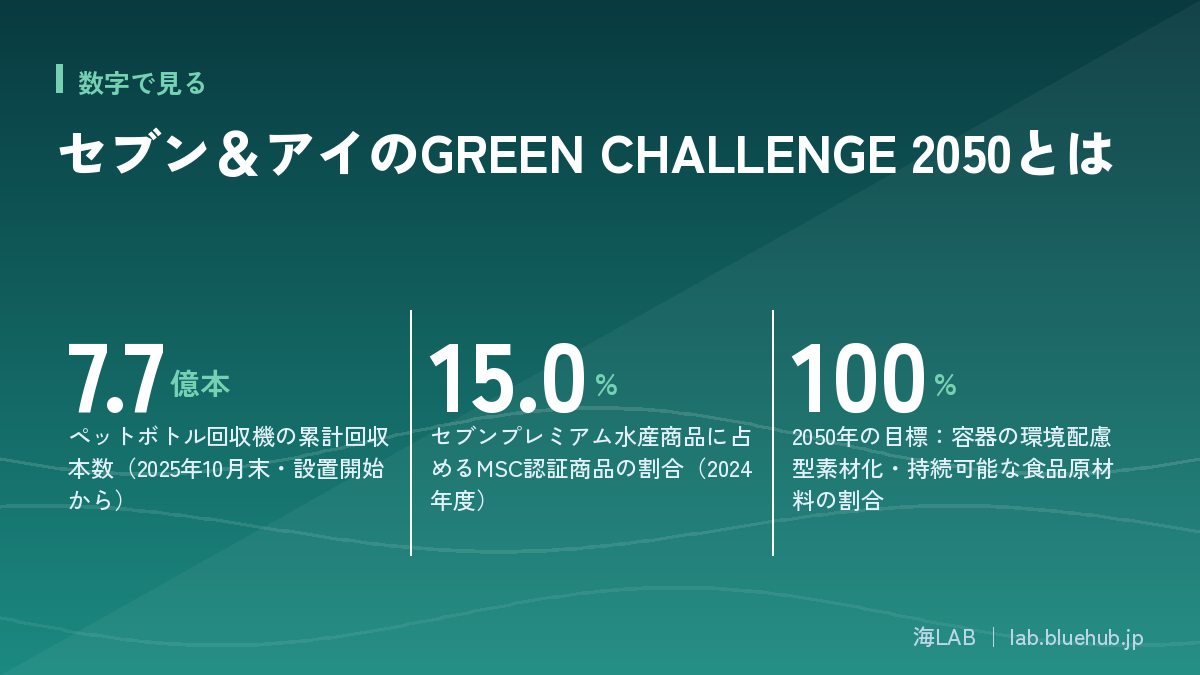
Several years on, PET bottle collection machines now stand at storefronts, and more Seven Premium products carry the MSC "blue fish" ecolabel. Cumulative PET bottle collection surpassed 770 million bottles by the end of October 2025, and the machines have reached all 47 prefectures of Japan. At the same time, the road to the "100%" goals set for 2050 is still only halfway traveled.
This article organizes the contents of GREEN CHALLENGE 2050 based on primary sources (official releases and sustainability reports), focusing on the two themes most deeply connected to the ocean — plastic measures and certified seafood procurement — and reviews results and challenges from a neutral standpoint. We also introduce the small choices each of us can make every time we shop.
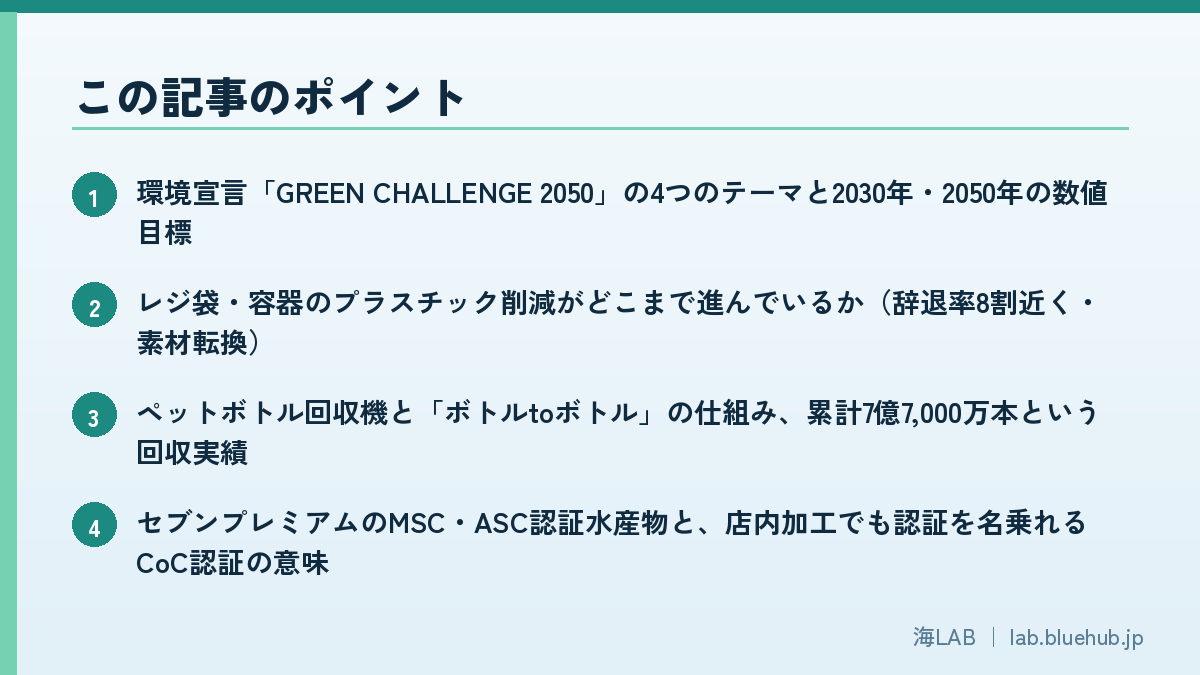
What you will learn in this article
- The four themes of the GREEN CHALLENGE 2050 declaration and its numerical targets for 2030 and 2050
- How far plastic reduction has progressed for shopping bags and packaging (refusal rate near 80%, material conversion)
- How PET bottle collection machines and "bottle-to-bottle" recycling work, and the 770-million-bottle collection record
- Seven Premium's MSC/ASC certified seafood and what CoC certification means for in-store processed fish
- Why the "Ethical Project" against food loss and CO2 reduction are also connected to the ocean
- A neutral perspective for distinguishing achievements from remaining challenges based on primary sources
What is GREEN CHALLENGE 2050 — the environmental declaration of a convenience store group
GREEN CHALLENGE 2050 is the group-wide environmental declaration announced by Seven & i Holdings Co., Ltd. on May 8, 2019. It defines four themes — "CO2 emissions reduction," "plastic measures," "food loss and food recycling," and "sustainable procurement" — and sets numerical targets for 2030 along with a vision for 2050 for each. For a retail group to declare long-term goals with numbers reaching 30 years into the future was a pioneering move in Japan's distribution industry at the time.
The background — a sense of crisis over ocean plastic
Around 2019, when the declaration was announced, international concern over ocean plastic pollution was surging. Regulations on single-use plastics advanced in many countries, and in Japan, charging for plastic shopping bags became mandatory nationwide in July 2020. Convenience stores are a business format with many touchpoints with plastic — lunch containers, PET bottles, and shopping bags. Precisely for that reason, when a group with a store network as large as Seven & i changes its policies, it has the power to change the flow of plastic across society.
Another backdrop was the progress of international frameworks. The SDGs (Sustainable Development Goals) and the Paris Agreement, both adopted in 2015, called on companies to act on long time horizons such as "2030" and "the latter half of this century." The "2050" in the name GREEN CHALLENGE 2050 is a statement of intent to align corporate management with this global timeline. Setting a distant target year alone would be easy, but this declaration is distinctive in that it paired the vision with numerical targets for the midpoint year of 2030. With interim targets in place, progress can be verified through annual reporting, and outsiders can judge whether things are on track or falling behind.
Coverage is group-wide — from convenience stores to supermarkets and restaurants
The declaration covers not only Seven-Eleven Japan but the entire group, including supermarkets such as Ito-Yokado and York-Benimaru and restaurant chains such as Denny's. In recent years the Seven & i Group has been restructuring to concentrate management resources on its convenience store business, but its environmental efforts continue to be disclosed through sustainability reporting. If you want to check the original text of the declaration, the official release below is the place to start.
Why a retailer's declaration matters — store networks as social infrastructure
While a manufacturer's environmental measures change "how things are made," a retailer's measures have the power to change "how things are sold" and "how people live" at the same time. Stores across the country are the final touchpoint where products reach consumers, and they can also serve as the entry point where used containers return to being resources. Change the standards for what goes on the shelves, and suppliers' packaging and ingredients change too; place a collection machine at the storefront, and citizens' behavior changes as well. Retail stands in a position where its influence spreads both upstream and downstream.
Convenience stores in particular are woven into daily routines as "the closest store to home or work." Whether environmental action takes root as an everyday habit rather than a special event depends heavily on what these familiar stores make the norm. Seen as a roadmap for replacing that "norm" by 2050, the overall picture of GREEN CHALLENGE 2050 becomes much easier to grasp.
See the official releaseSeven & i Group's Environmental Declaration "GREEN CHALLENGE 2050"The news release of May 8, 2019. Read the original text of the four themes and the 2030/2050 targets.🔗 7andi.com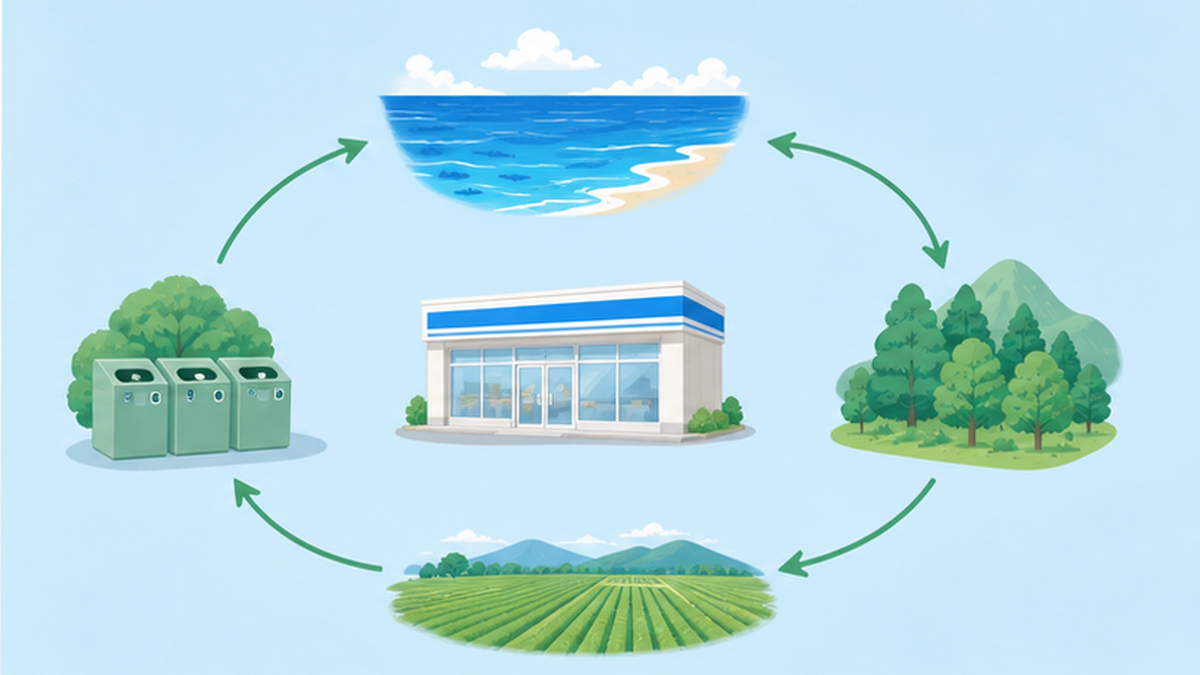
Key points
- GREEN CHALLENGE 2050 is a group environmental declaration announced in May 2019
- A two-tier design: four themes × "2030 targets + a 2050 vision"
- It covers the entire group, including convenience stores, supermarkets, and restaurants
The four themes and their numerical targets
Let us first lay out the four themes and numerical targets that form the backbone of the declaration. The four themes cover store energy (CO2), product containers (plastic), unsold goods (food loss), and the entry point of raw materials (procurement) — in other words, they span the entire life of a product from creation to disposal, from upstream to downstream. The targets in the original release are as follows.
| Theme | 2030 target | Vision for 2050 |
|---|---|---|
| CO2 emissions reduction | Reduce emissions from store operations by 30% (vs. FY2013) *later raised to 50% | Reduce by 80% or more *later raised to net zero |
| Plastic measures | Use 50% eco-friendly materials in original-brand product packaging / zero plastic shopping bags | Use 100% eco-friendly materials |
| Food loss and food recycling | Reduce food waste by 50% per unit of sales (vs. FY2013) / food recycling rate of 70% | 75% reduction / recycling rate of 100% |
| Sustainable procurement | Use 50% sustainably sourced food ingredients in original-brand products | 100% |
What is "intensity per unit"? — how to read the targets
The phrase "per unit of sales" (intensity) in the table may be unfamiliar. It is an indicator of the amount generated per unit of business scale, such as sales revenue. Because total waste tends to grow as stores and sales grow, intensity is used as a yardstick for how efficiently waste was reduced relative to scale. Reduction in total volume and reduction in intensity mean different things, so when reading corporate environmental targets, the trick is to check what the denominator is. Once you develop this reading habit, you will not be swayed by numbers when comparing declarations across companies.
The CO2 target was raised along the way
Worth noting is that the CO2 reduction target was revised upward after the announcement. At the time of the 2019 release it was "30% reduction by 2030 and 80% or more by 2050," but amid the accelerating decarbonization trend it was raised to "50% reduction by 2030 (vs. FY2013) and net zero by 2050." Setting a long-term goal and then raising the bar in response to society's demands — this can be read as a sign that the targets are alive within management rather than mere decoration.
Of the four themes, the ones most deeply connected to the ocean are "plastic measures" and "sustainable procurement." From here, we look at the results centering on these two.
Plastic measures (1) — zero plastic bags and packaging material conversion
The plastic measures rest on two pillars. One is to bring plastic shopping bags to zero by 2030, replacing them with paper and other sustainable natural materials. The other is to switch the packaging of original-brand products, led by Seven Premium, to eco-friendly materials.
Shopping bags — refusal rate has climbed to nearly 80%
Since plastic bags became chargeable in July 2020, bringing your own bag has become part of everyday life. The bag refusal rate across the Seven & i Group reached nearly 80% as of the end of February 2024. Even a choice worth a few yen per bag adds up to an enormous amount of avoided plastic across a network of more than 20,000 stores nationwide. Single-use plastics like shopping bags are among the most likely litter to travel from rivers to the sea (see our article on plastic waste flowing from rivers to the ocean).
What GREEN CHALLENGE 2050 aims for goes beyond raising the refusal rate: it is to bring plastic shopping bags themselves to zero by 2030 and replace them with sustainable natural materials such as paper. Moving from the stage of "charge for bags to reduce them" to "hand out no plastic in the first place" — this deeper goal-setting is a point not to miss when evaluating the declaration.
Packaging conversion — to biomass, recycled materials, and paper
For original-brand packaging, the switch is under way from petroleum-derived plastics to eco-friendly materials such as biomass plastics, recycled materials, and paper. At 7-Eleven, for example, pasta and other noodle containers are being converted to paper and biomass plastics are being adopted, and it is reported that about 40% of the packaging used in original-brand products has been switched to eco-friendly materials. That is within reach of the 50% target for 2030.
- Conversion to paper for salad and pasta containers
- Biomass plastic blends in beverage cups and lunch containers
- Use of recycled PET derived from collected bottles (detailed in the next chapter)
Converting food packaging materials is a far harder job than it looks. Containers must simultaneously keep contents fresh, withstand microwave heating, and survive transport without breaking. Switching to paper or recycled materials requires both designs that preserve these functions and supply chains capable of mass delivery, so items can only be replaced one by one, steadily. The figure of "about 40%" is the current position of that accumulation.
What are eco-friendly materials?
A general term for biomass (plant-derived) plastics, biodegradable plastics, recycled materials, and natural materials such as paper and wood. The aim is to reduce the use of virgin petroleum-derived plastic and lower CO2 from incineration and the burden when materials leak into the ocean.
A caveat on materials — "biodegradable" is not a cure-all
One caution: switching to eco-friendly materials does not make plastic "safe to leak into the ocean." Many biodegradable plastics are designed to break down well under specific conditions such as high-temperature composting facilities, and are known to degrade very slowly in cold seawater (explained in detail in our article on how ocean plastic breaks down). The main significance of material conversion lies in reducing fossil resource use and end-of-life environmental burden — it is no substitute for anti-littering measures. That is exactly why the "collection systems" introduced in the next chapter form the other wheel of the pair.
Plastic measures (2) — PET bottle collection machines and "bottle-to-bottle"
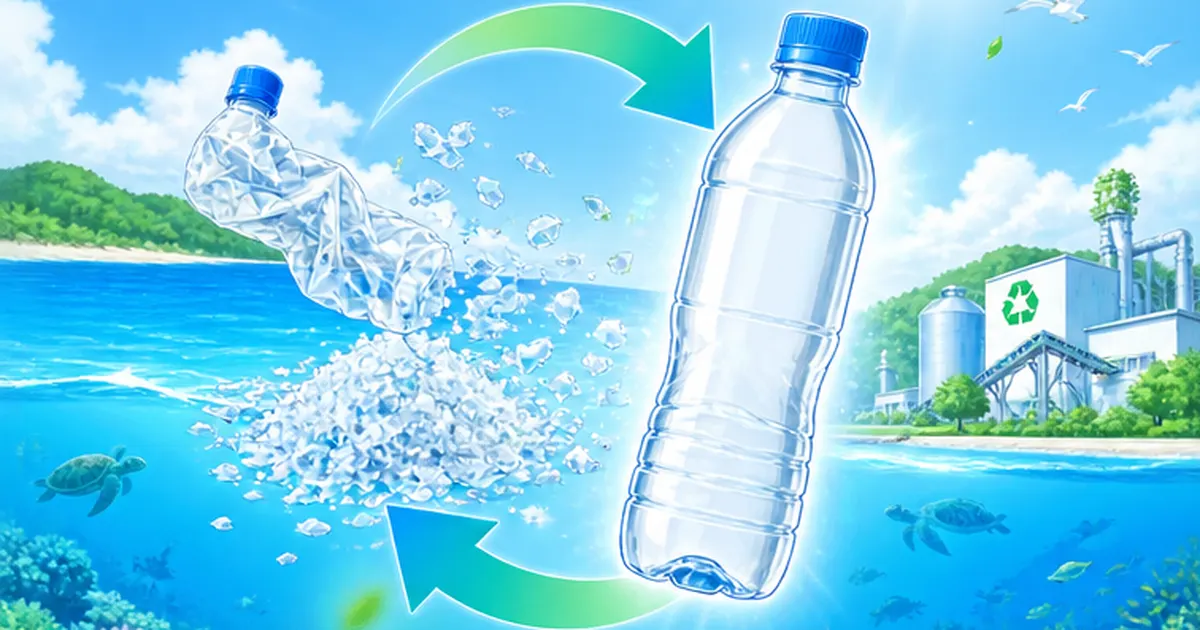
The most familiar mechanism to citizens among the plastic measures of GREEN CHALLENGE 2050 is the storefront PET bottle collection machine. Insert an empty PET bottle into the machine at a 7-Eleven or other store, and it is compressed, collected as a resource, and reborn as a new PET bottle.
Installed in all 47 prefectures, 770 million bottles collected
Installation of the machines began in 2015, and in October 2025 they reached all 47 prefectures. Cumulative collection since launch has surpassed 770 million bottles. According to Seven & i's sustainability reporting, in FY2024 there were 4,763 machines installed and about 14,500 tons were collected in the year. Many installations proceed in partnership with municipalities, with storefronts complementing government resource collection.
| Fiscal year | Volume collected (tons) | Machines installed |
|---|---|---|
| FY2019 | 9,740 | 820 |
| FY2021 | 10,856 | 2,098 |
| FY2023 | 13,100 | 4,187 |
| FY2024 | 14,500 | 4,763 |
Municipal partnerships are part of why the machines have spread. PET bottles are bulky and hard to store at home until collection day, but if they can be dropped off at the store while shopping, more get collected as resources. Municipalities such as Nishinomiya City in Hyogo and Tokushima City in Tokushima actually guide residents to collection machines at 7-Eleven stores as part of their resource circulation programs. Where the government's collection network and the convenience store network overlap, switching from "throwing away" to "returning to resources" becomes much easier.
How to use the machines — remove caps and labels
- Rinse the bottle lightly so no drink remains inside
- Remove the cap and label (sort them via store or municipal separation)
- Insert the bottle uncrushed — the machine compresses it automatically
"Bottle-to-bottle" — collected bottles return to the shelves
The emblematic use of collected PET bottles is bottle-to-bottle (horizontal) recycling: bottles collected at stores are recycled and used again as containers for PET-bottled drinks, adopted for private-brand products such as "Hajime Green Tea with Shizuoka Tea, 600 ml." Unlike "cascade recycling," which turns bottles into clothing or egg cartons, its strength is that bottles can circulate into bottles again and again. For a detailed look at the mechanism, see our article on Coca-Cola's 100% recycled PET bottles.
Simple arithmetic puts 770 million bottles at more than six per person for Japan's population of roughly 124 million. Thinking of it as an accumulation of bottles brought to storefronts one at a time gives a real sense of how large "consumer-participation recycling" has grown. Similar bottle-to-bottle programs are advancing on the beverage makers' side as well — our article on Suntory's horizontal recycling covers the loop from the maker's perspective. Only when retail's "collection network" meshes with makers' "recycling technology" does the PET bottle loop complete a full circle.
See the official sitePET Bottle Collection Machines | Seven-Eleven JapanOfficial page explaining how the storefront machines and the bottle-to-bottle flow work. You can also search for participating stores.🔗 sej.co.jp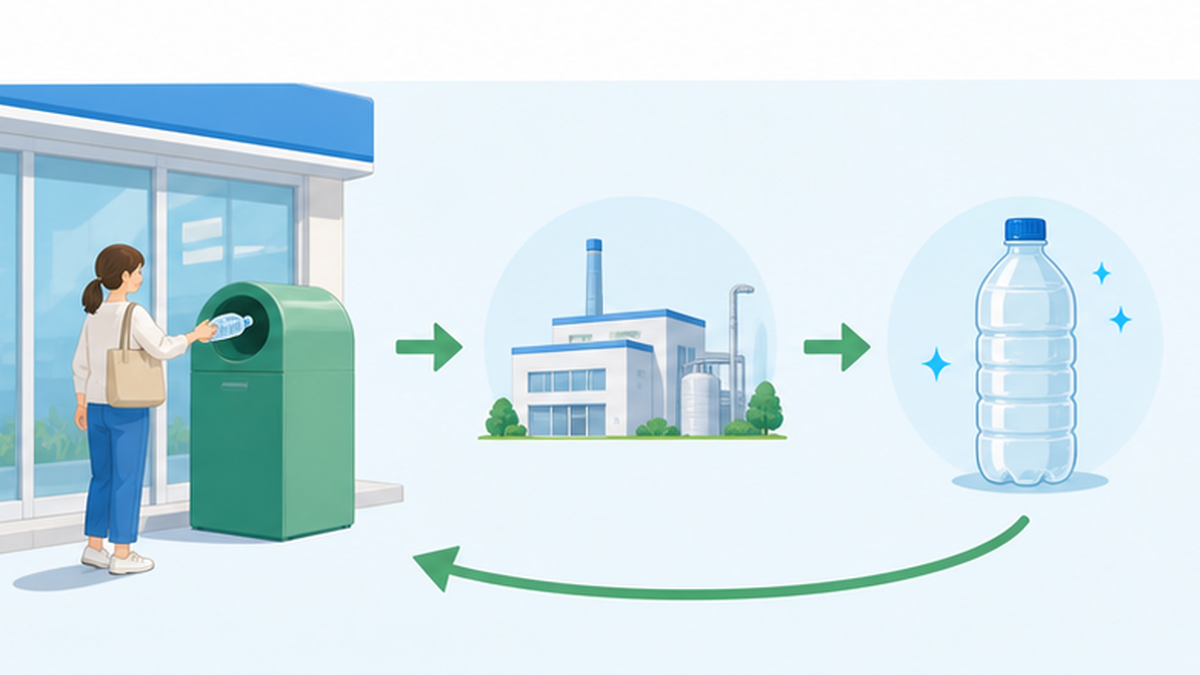
Sustainable procurement — bringing certified seafood to everyday shelves
Of the four themes, the one most directly tied to marine ecosystems is sustainable procurement. The Seven & i Group has set a target of using "sustainably sourced ingredients" for 50% of the food ingredients in original-brand products including Seven Premium by 2030, and 100% by 2050. For seafood, the pillars of that assurance are MSC certification (wild-caught) and ASC certification (farmed).
Why certification is needed — overfished seas and consumers who cannot tell
According to reports by the Food and Agriculture Organization of the United Nations (FAO), more than one third of the world's fish stocks are assessed as fished beyond sustainable levels (the mechanics of overfishing are explained in our article on overfishing and stock collapse). Yet looking at a fillet on the shelf, consumers have no way of telling how the fish was caught. Third-party certification solves this "invisibility." Independent bodies audit that fisheries and farms are sustainable and communicate it to consumers through labels — certification is a translation device that connects the health of the sea to the point of purchase.
When retailers commit seriously to this system, the impact is large: the more shelf space certified products gain, the stronger the economic incentive for fishing and aquaculture operations that "choosing sustainable methods expands your sales channels." The target of "50% by 2030" is the engine for turning this virtuous cycle.
Seven Premium's first MSC-certified product was karashi mentaiko
The first Seven Premium product to carry the MSC "blue fish" ecolabel was karashi mentaiko (spicy cod roe), launched in October 2018. It uses roe of Alaska pollock caught by sustainable fisheries, with the certification mark displayed on the package. Then in October 2022, sales began of ASC-certified (responsibly farmed) "Seven Premium Fresh Raw Atlantic Salmon," and certified seafood has been spreading onto the everyday shelves of convenience stores and supermarkets. How to read the MSC label is covered in detail in our guide to the MSC ecolabel.
CoC certification lets even in-store processed fish carry the label
In October 2022, Seven & i Holdings obtained MSC and ASC CoC certification (Chain of Custody — certification of processing and distribution). This enabled the group's three supermarket companies — Ito-Yokado, York-Benimaru, and York — to label and sell certified seafood processed in-store into fillets and sashimi as certified products. Because certification demands management not only at "the catch" but all the way "to the shelf," obtaining CoC certification signals a retailer's full-scale commitment.
| Fiscal year | Share of MSC-certified items | Share of ASC-certified items |
|---|---|---|
| FY2021 | 8.2% | 3.7% |
| FY2022 | 8.1% | 3.0% |
| FY2023 | 9.2% | 15.7% |
| FY2024 | 15.0% | 5.0% |
Looking at the trend, the share of MSC-certified items among Seven Premium seafood products rose from 8.2% in FY2021 to 15.0% in FY2024. ASC-certified items stood at 5.0% in FY2024 (the figure fluctuates by year). Other retail groups such as Aeon with its "Topvalu" brand are pursuing similar procurement reforms (see our article on Aeon's certified seafood), and an industry-wide race to "make sustainable fish the norm" has begun.
Beyond seafood — procurement reform spreading to produce, soy, and cacao
Sustainable procurement is not limited to seafood. In produce, the group runs the "Vegetables with a Visible Face" and "Fruits with a Visible Face" series whose cultivation records are traceable, and as of FY2024 the group had 77 employees holding instructor qualifications in Good Agricultural Practice (GAP). For soybeans, use of SSAP-certified (U.S. soy sustainability) ingredients began in 2023, and Fairtrade-certified cacao products are also sold. "Whether it is fish, vegetables, or chocolate, the home of every ingredient should be healthy" — that is the goal the "100%" of 2050 stands for.
See the official pageSustainable Procurement of Raw Materials | Seven & i HoldingsPublishes procurement initiatives and results data, including MSC/ASC certification rate trends and "Vegetables with a Visible Face."🔗 7andi.com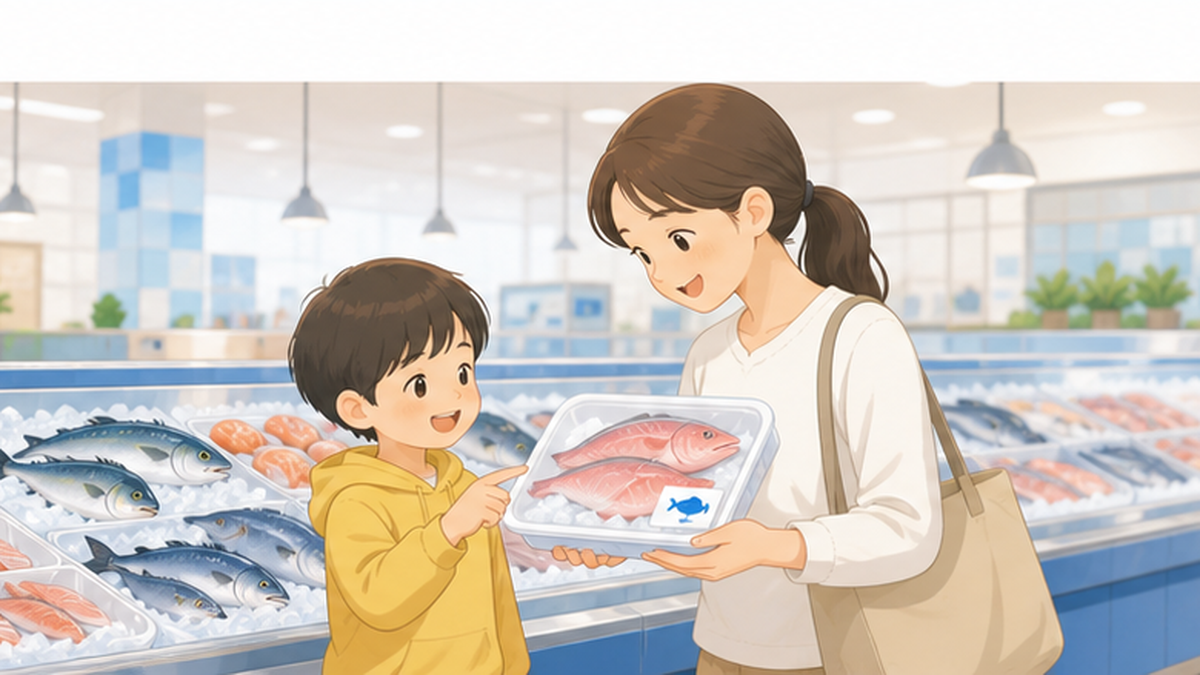
Food loss and CO2 — the remaining two themes also lead to the sea
Less conspicuous than plastic and procurement, the remaining two themes — "food loss and food recycling" and "CO2 emissions reduction" — are also deeply connected to the marine environment.
The Ethical Project — point rewards on items nearing their sales deadline
A flagship food-loss measure is the "Ethical Project" that 7-Eleven has run nationwide since May 2020. Green stickers are placed on rice balls, bento boxes, and other items nearing their sales deadline, and customers who pay with nanaco electronic money receive bonus points worth 5% of the pre-tax price — reducing waste by making it "rewarding to choose earlier" rather than waiting for markdown stickers. It is reported that food loss has been cut by roughly 20% through measures including this project. Reducing loss of fish and seafood is directly tied to making full use of marine resources (see our article on seafood food loss).
Food loss looks like a land problem, but it is not unrelated to the sea. Food that is thrown away uneaten carries with it all the energy and resources spent on fishing, farming, processing, and transport. If fish that were caught go unsold and are discarded, that much more fishing pressure falls on the resource. Reducing food loss is also an "invisible form of fisheries management" that eases the burden on marine resources.
Food recycling — not "zero waste" but "circulation"
No amount of ingenuity can completely eliminate unsold goods and kitchen scraps. That is why the targets include a food recycling rate: 70% by 2030 and 100% by 2050 — meaning that ultimately all food waste generated is to be circulated as feed, fertilizer, energy, and other resources. The design is two-pronged: reduce waste (50% per unit of sales by 2030) and recycle the rest (100% resource recovery) — "reduce first, then circulate what remains."
CO2 reduction — store energy savings and renewable energy
For CO2 reduction, measures under way include LED store lighting, solar panel installation, and adoption of electricity from renewable sources. Rising sea temperatures and ocean acidification are driven primarily by increasing atmospheric CO2, so decarbonizing store operations ultimately helps protect marine ecosystems (the CO2–ocean relationship is explained in our article on ocean acidification and coral reefs). As noted, the target has been raised to "50% reduction by 2030 (vs. FY2013) and net zero by 2050," and the key to achieving it is whether store equipment upgrades and the shift in electricity sourcing can be sustained. Convenience stores run refrigeration and freezers around the clock, making them an energy-intensive business format. The flip side is that the reduction impact when store energy savings and electricity switching advance is just as large.
The four themes are interconnected
- Less food loss → less waste incineration, contributing to CO2 reduction
- Packaging material conversion → works for both plastic measures and CO2 reduction
- CO2 reduction → helps curb sea temperature rise and ocean acidification
A neutral view — what deserves praise and what remains
We have covered the results so far, but corporate SDG case studies should not end as feel-good stories; the challenges must be examined as well. That is because for a corporate environmental declaration, continuing in a verifiable form is far harder than making the declaration itself. Here is what the primary sources show, both credit and challenges.
What deserves praise
- Deadline-bound numerical targets are set for all four themes, with results data disclosed every year
- Standards are updated in line with society's demands, as when the CO2 target was raised after the announcement
- PET bottle collection machines were extended to all 47 prefectures, building collection infrastructure citizens can join
- CoC certification put in place a sales framework for certified seafood extending to in-store processed items
The PET bottle collection machines are significant above all for turning corporate recycling from "something inside factories" into "a system consumers can join every day." Environmental action often happens far from daily life, but put a machine at the storefront and recycling becomes a one-minute act done while shopping. The 770 million figure is the accumulation of those single minutes.
Remaining challenges
- Eco-friendly packaging is reported at about 40%, but walls of material technology and cost remain on the way to 100% by 2050
- The share of ASC-certified items swings widely by year (15.7% in FY2023 → 5.0% in FY2024), making stable procurement a challenge
- Progress on the overall share of "sustainably sourced" food ingredients is still only partially disclosed by item
- Amid group restructuring focused on the convenience store business, how supermarket-side initiatives will be carried on bears watching
The existence of challenges does not itself diminish the declaration's value. If anything, continued disclosure that includes unmet numbers is better evidence of seriousness than reports listing only achieved goals. As a reader, checking three things — "are numbers published?", "did they move from last year?", and "if not, is the reason explained?" — lets you read corporate SDG information with a cool head.
A note on interpretation
The figures in this article are based on official releases, sustainability reports, and news coverage confirmed as of August 2026. Corporate environmental targets and organizational structures are subject to change, so please always check official sources for the latest status.
What we can do — the storefront is a gateway to the ocean
Declarations like GREEN CHALLENGE 2050 only become results when consumers act. If no one feeds bottles into the collection machines, "bottle-to-bottle" does not turn; if no one chooses certified products, their share of the shelves does not grow. Put the other way, convenience stores and supermarkets are the nearest gateway to environmental action for everyone. No special gear or knowledge required — here is what you can start with today's shopping.
- Take empty PET bottles — caps and labels removed — to a storefront collection machine or your municipal collection
- When buying fish, take a moment to look for the MSC or ASC label on the package
- Decline plastic bags and use your own — shrink the "remaining 20%" beyond the 80% refusal rate
- Make positive use of markdowns and point rewards on items nearing their sales deadline to cut food loss
- Visit a company's sustainability page once and see the gap between targets and results with your own eyes
Each of these actions is small, but they resemble votes. When certified products are chosen, their shelf space grows; when collection machines are used, more get installed — because companies invest in what sells and what gets used. Only a few years remain until the 2030 targets of GREEN CHALLENGE 2050. The final push toward those goals may well come from us, the people standing at the register every day.
Actions to start today
Next time you go to a convenience store or supermarket: (1) find where the PET bottle collection machine is, and (2) look for one certification label at the fish counter. With just these two steps, your shopping begins to connect with the ocean.
Summary
- GREEN CHALLENGE 2050 is the environmental declaration Seven & i announced in 2019, with deadline-bound numerical targets across four themes
- PET bottle collection has reached a cumulative 770 million bottles across all 47 prefectures, and the bottle-to-bottle loop is running
- Seven Premium's MSC certification rate has risen to 15.0% (FY2024), and CoC certification covers in-store processed items
- The road to the 2050 goals — 100% eco-friendly packaging and sustainable sourcing — is still only halfway traveled
- Feed the machine, choose the label, decline the bag — consumer action is what turns declarations into results
References
- Seven & i Holdings – News release: "Seven & i Group's Environmental Declaration 'GREEN CHALLENGE 2050'" (May 8, 2019)
- Seven & i Holdings – Sustainability: "Sustainable Procurement of Raw Materials" (MSC/ASC certification rate trends)
- Seven & i Holdings – Sustainability: "Effective Use of Resources" (PET bottle collection volume, bag refusal rate)
- Seven & i Holdings – News release: "Obtained MSC/ASC CoC Certification" (October 27, 2022)
- Seven-Eleven Japan – PET bottle collection machine initiative (how bottle-to-bottle works)
- Seven-Eleven Japan (PR TIMES) – Collection machines installed in all prefectures; cumulative collection tops 770 million bottles (2025)
- Cabinet Secretariat of Japan – Decarbonization hearing material: "Seven & i Group Environmental Declaration GREEN CHALLENGE 2050"
- MSC Japan – Companies expanding MSC-certified seafood
- Ryutsuu News – 7-Eleven converts about 40% of original-brand packaging to eco-friendly materials
* Ordered by reliability: government and academic institutions > peer-reviewed papers > specialist organizations > trusted media